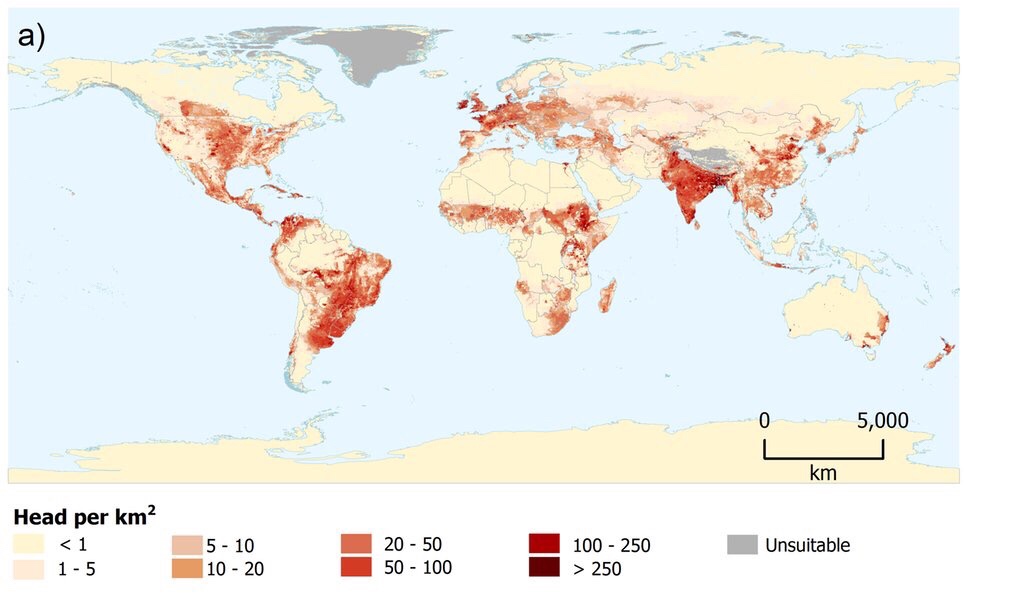
Awesome! This #map shows the population density of the 1.4 billion cows that live on our planet. Source: https://t.co/0n5fek1fA8 pic.twitter.com/tT5psAopuY
— Simon Kuestenmacher (@simongerman600) July 27, 2018
I have been wondering this the past week is that how and why did India become vegetarian. Was it simply a theological quirk or were there some geohistorical reasons for it (the cow was such an economic necessity that it made sense to forgo protein). Was it also an Aryan feature or Dravidian or does that question make no sense?
Another thought that came to mind was that would ancient Indians have been wealthier had they been avid meat-eaters. If there had been lesser resources to go around the population densities would have been lighter perhaps but of course this pales in comparison to bad leadership.
As an aside I definitely concede the fact that more often than not local leadership is almost always better for the population than foreign dynasties. Therefore Hindu dynasties probably were better for India than Muslim ones simply because India was home for the former. The Mughal’s great accomplishments were in art and architecture, which may be very well for posterity but didn’t make them a match for the modern age in contrast to the Safavids who built Iran into a successful nation state.
I would hazard that Ashoka was probably a better Emperor of India than Akbar simply because the former gifted the world India’s most successful export, blue-eyed Buddha (believe it or not the Buddha had blue eyes). We sometimes forget that Buddhism probably ranks as India’s greatest accomplishment in the wider world; it transformed all Eastern religions and became the dominant philosophical paradigm for so much of the ancient world. It’s reflective of Western bias that Indian academics and historians are more concerned with ancient India’s influence on the modern West; the Mitanni were a footnote in history compared to the great accomplishments of Indic civilisation in the East.
However the reason why I think India never really matched China in national identity, sovereignty and political cohesion (even when the Chinese were ruled by foreigners they still managed to maintain their cultural coherence to a very great and recognisable extent) is simply because of caste. The greatest faultline in South Asia, after creed, is caste and that made Indian society vulnerable to foreign despots. The court of Mughal Kings is littered with Brahmins and Rajputs and let’s not forget Urdu was an invention of Khatris and Kayasths. The Brits didn’t only come up with divide and rule; the fissures were inbuilt Into Indian society.. The Sikhs achieved the dominance they did was because they welded a caste-light community to achieve assabiyah, which the different children of Brahma frankly eschewed from time to time. This is something to thank Pakistan and the Muslims; they are such a galvanising force for Hindu society to reconsolidate and shed away such internal divisions..
Interesting Links:
Food Writer Becomes A Butcher To Better Understand The Value Of Meat
Pakistan elects first non-Muslim in modern history to general national assembly seat
Only catastrophe truly reduces inequality, according to a historical survey