Afghanistan’s History
There are several perspectives on Afghanistan’s name. Afghanistan’s name might come from “Upa-Gana-stan”:
- “Upa” with a choti “a” at the end or “उप” means near
- “Gana” or “गण” I believe might be a reference to Shiva’s Ganas (gouls, ghosts, unusual looking beings . . . possibly a reference to non homo sapiens of some kind, some say aliens)
- “Stan”, I don’t know. Is this “Sthaana” or “स्थान”? If so this might mean position or venue or station or field or throne
An extremely wise fellow contributor from Brown Pundit reminded me of two other ancient names used for Afghanistan:
- Panini’s Aṣṭādhyāyī refers to Afghanistan as ash-va-kaa-na (अश्वकान).
- Please note that the Aṣṭādhyāyī is much older than Patanjali who is considered millennia older than Krishna. Traditional scholarship of Aṣṭādhyāyī places it more than 7 thousand BC, which is not to say that the Aṣṭādhyāyī has not in any way been modified since then.
- Pakrit name “a-va-gaa-nna” (अवगान्ना).
The oldest part of the Rig Veda samhita refers to:
The top hyperlinked article also alleges:
- “The Pakthoons are descendants of the Paktha tribe mentioned in Vedic literature.”
- “Archaeological excavations in this region conducted by Sir Estine (an East India Company official) led to the recovery of uncountable shrines and inscriptions. He has authored four books on that topic featuring photos of icons, icons and inscriptions discovered. The photos show a sun temple and a Ganesha statue too. An Islamabad University professor Abdul Rehman has authored two books on those finds recalling the glory and prosperity of those times.”
- “Regimes of two Hindu rulers “Kusham” and “Kidara” lasted for fairly long periods. During their rule a number of Shiva temples were not only in Afghanistan but in other West Asian regions too. Uzbekistan and Takzikistan formed part of the Afghan kingdom in those times. Tashkent has one of those ancient Shiva temples standing even today.”
- “Professor Abdul Rehman states that Bukhara region Was known as “Shah Vihar” in ancient times. It was ruled by an Hindu king. When Arabs invaded that kingdom its queen traveled to Kashmir to seek military help. Arab chronicles mention her as ‘Khatoon’, meaning ’Woman’.”
- “An Ayurvedic practitioner of Varansi (alias Benares) had treated the Khalifa for some ailment afflicting the latter. In those days it was Hindu Ayurvedic practitioners who were eagerly sought by Arab patients. A number of Arabs had translated Sanskrit Ayurvedic texts into Arabic. A list of those translated Sanskrit texts appears in a Volume known as al “Frisht“.”
- “Baku (capital of the Azerbaijan region) known for its underground petroleum yields has still an ancient Hindu temple of the Divine Flame generated by the subterranean petrol and gas). During the Czar regimes in Russia a Punjabi priest officiated at that temple. The walls display some religious stanzas written in Punjabi Gurumakhi script. The market there also had Hindu merchants. Nearby was a locality too of Hindu inhabitants. Baku in Azerbaijani language actually signifies a Goddess. Therefore obviously Baku derives its name from a very ancient Vedic Goddess temple there.”
Afghanistan is also central to the ancient Sharada civilization:
The Sharada civilization [Afghanistan, Northern Pakistan, Kashmir] represents many things. One is the convergence of the six major Shaivite schools (not just Trika) within Uttara Mīmāmsā (Vedanta) and the four major Tibetan schools via the shared 84 Siddhas. Later large streams within Sufism joined this convergence [which might be the topic of a future researched article].
Legend of Rama: Antiquity of the Janmabhumi Debate argues that many places of great significance to the Ramayana and Puranic stories are in Afghanistan:
In the opinion of Wilson the renowned Vedic translator Kandahar is similar to the Rig Vedic word Gandhara. Wilson further observes,:
Ibn Haukil mentions that in his time there were remains of a considerable city more to the west, by the people of which, Zaranj was built. He calls this places Ramshhristan, a curious compound of Indian and Persian appellations.
There were ruins ‘at astonishing number’ in Herat, at Farrah, and Peshawarun–all sites near the province of Dranjiana connected with the Vedic dynasty of the Srinjayas [who were prominent during the 18 day Mahabharata war]. It therefore becomes all the more curious to hear the name of the place called Ramshehristan.
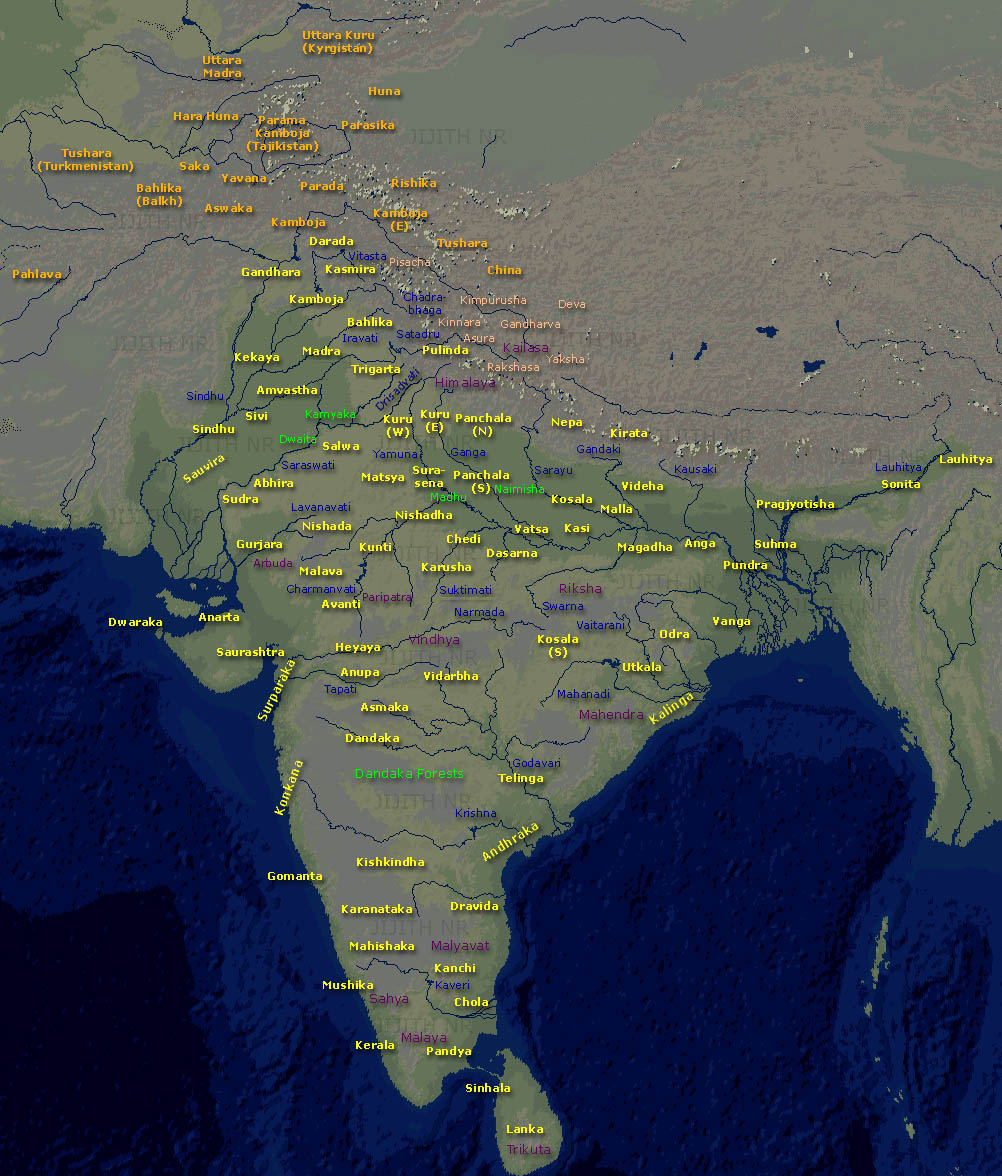
Panini, the eminent grammarian of Sanskrit, lived here in about 350 BC. [for the record I think Panini lived far earlier and before Patanjali] In his composition of the a sutra (4.3.93) on the Sindh and Takshasila class (gana-patha), he includes Sindhu, Varnu, Madhumat, Kamboja, Salwa, Kashmir, Gandhara, Kishkindhya, Urasa, Darada and Gandika. These are geographical names and lie in the trans-Indus regions. The place mentioned by Panini as Kishkindhya is today known as Kalat in Baluchistan. A great linguistic puzzle is that the local people call Brahuis speak in a Dravidian dialect.
Afghanistan was not the name of a country before 1747 AD. The lands lying to the est of the River Indus were called by different times as Kamboja, Bahlika, Madra, Aratta etc. in the north; as Sarayu (Horayu) in the north-west; as Sarasvati (Harahvati) in the south-east; as Gandhara in the center; as Zranjiana in the south-west and as Kishkindhya in the south.
. . .
They were of five streams or Pancajanas. Their leader was Visvamitra, who lived in Satudri-Vipasa valley (RV III.22.1). They fought against the Srinjayas under Vasistha in the famous battle of the ten kings.
Several waves of the new people, the Aryan races–Druhyus, Turvasus and Anus went westwards from these places. These groups are variously known in traditional literature as the Persians (Parsu), Medians (Madras), Parthians (Prithus), Hyksos (Yaksus), Mittanians and Helenes (Alinas) etc. They originally settled at a places known as Shortugai in Badakhshan in North Afghanistan. Old Sumerian texts as also the descriptions in the Baudhayana say that Aratta was Badakhshan, Balkh, or Bactria in Central Asia. From here, they exported lapis lazuli to the Sumer. The Sumerian epic, Enmerker and the Lord of Aratta describes this in detail. The epic, found in the clay tablets of Boghaz Keui is dated c. 1700 BC. In the Mahabharata, Karna derides the Madras and Arattans as being lowly people! [in conversation with Salya during the 17th day of the Kurukshetra war]
. . .
The name Srinjaya is similar to Zaranj and Sarangaei of the Iranians, old Persians and the Greeks. These were the names of the Iranian tribes who lived according to Herodotus in Zranjiana or Dranjiana, an area on the River Sarasvati or Horahvaiti in the Arochosia-Helmand region. Divodasa, greatest among the Rig Vedic kings, was a Srinjaya. He was born here. . . .
Horahvaiti region i.e. the Helmand-Arachosia region of what is today western Afghanistan . . .
Heldebrandt, one of the earliest scholars on the Ramayana in the West, was of the view that Sarasvati was the river Arghandab (Horahvaiti of the Zend Avestaiver, ) in Arachosia of modern Afghanistan (then Iran). Brunhofer, another scholar of the epic, adopted the Iranian link. Zimmer was in favour of placing the Rig Vedic Sarasvati in this area. Recently, Burrow has held that the early Rig Vedic Sarasvati was the River Horaxvaiti of Iran, and the River Sarayu was the Afghan, Horayu. Among the Indian scholars, Jaichandra Vidyalankar, after a detailed rumination, identifies Sarasvati as the Iranian Haraqvati . . .
The Ishvaku, the family Ram belonged to, and the Vasistha family were linked to a very early time of the Rig Veda, originally from the north and north-west region called Harirud of modern Afghanistan, on the bank of the River Horayu, mentioned in the Avesta. Only in the Rig Veda there is the name Sarayu. In the same way, still earlier, the family of Atris hailed from the banks of the River Rasa in the region of South Russia and North Afghanistan today. In a very early hymn in the Rig Veda (53.9), Sage Syavasva Atreya extols in glory a fleeting dolumn of the Maruts moving southward–the horse-borne storm troopers. In the course of their journey, they cross the rivers Rasa (Ranha or Oxus, in modern South Russia), Krumu (Kurran), Sindhu (Indus-between Pakistan and India today) and Sarayu (Horayu or Harirud)
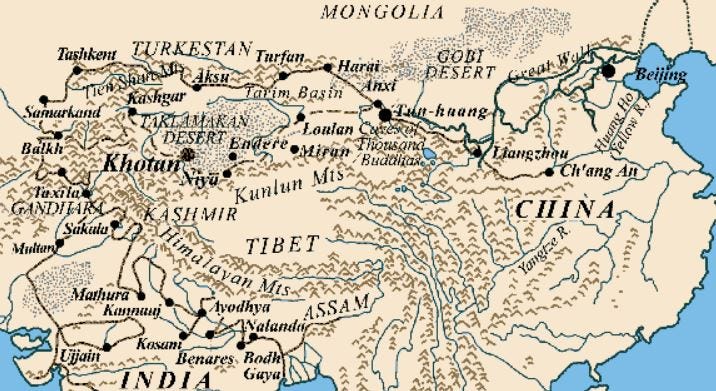
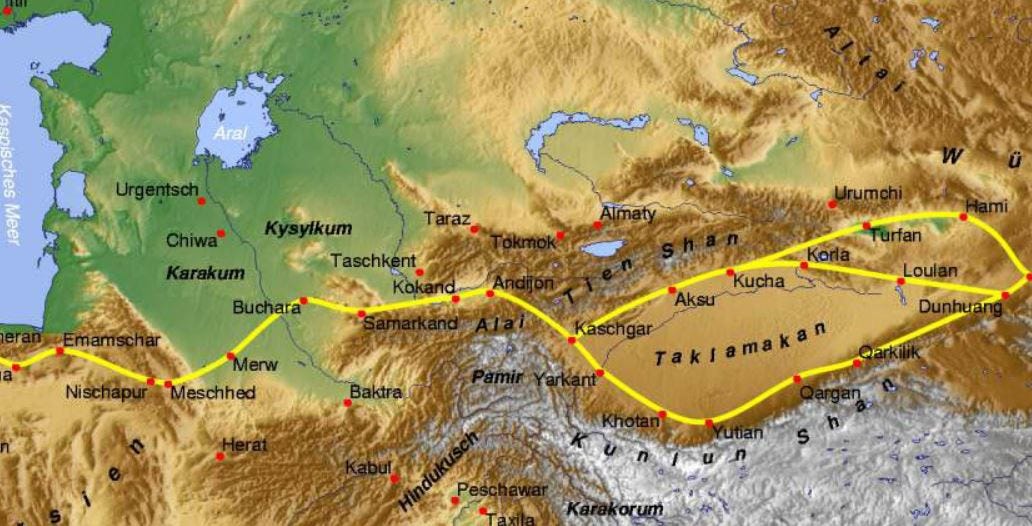
Most people do not know that until about a thousand years ago, the Tarim Basin (northwest of Tibet, which is the part of Xinjiang below the Tian Shin Mountains) was Indic in culture and it was a thriving part of the Sanskritic world; its people spoke the Gāndhārī language which many see as descended from Vedic Sanskrit, and Khotanese Saka, which is also closely related to Sanskrit. Perhaps the region to compare it most is Kashmir, to whose north it lay. There was also much interaction between the two regions with many scholars traveling from Kashmir to Khotan, and silk culture is believed to have passed from Khotan to Kashmir and then into India.
Gāndhārī inscriptions have been found as far east as Luoyang and Anyang in Henan province in Eastern China which attests to the vastness of the influence of Sanskrit. Europeans in recent centuries called the whole region Serindia, indicating the meeting place of China and India.
Khotanese kings were Mahāyāna Buddhist but as we know this sect incorporates Vedic and Tantric systems, with all the devas such as Indra, Śiva, Viṣṇu and Sarasvatī, and just places the Buddha at the head of the system (as in Vidyākara’s Treasury). There was also Krishna worship in Khotan and we find the Rāma story in Khotanese language, of which there is also a Tibetan version.
The above article from Subhash Kak continues:
The traditional date for the of Khotan, on the southern and the more ancient branch of the Silk Road, is the reign of Aśoka Maurya (3rd century BCE). It was ruled by Buddhist kings until it was conquered by the Muslims in 1006. Some of the kings mentioned in the “Prophecy of the Li Country”, composed in 746 CE, dealing with events of the recent past are Vijaya Kīrti, Vijaya Saṅgrāma, Vijaya Dharma, Vijaya Saṃbhava, and Vijaya Vāhana.
Many Khotanese cities had Sanskrit names. For example, Khotan in Sanskrit was Gaustana गौस्तन and the modern city of Kashi (Kashgar) was called Śrīkrīrāti (in Sanskrit Śrī+krī+rāti, श्रीक्रीराति, ‘Glorious Hospitality’). Kashgar itself appears to be the popular name from Sanskrit Kāśa+giri (काशगिरि, bright mountain). The Khotanese called their language hvatanai ह्वतनै which later became hvaṃnai ह्वंनै; this is equivalent to the name deśī that is used for language in India (vatan, from svatana = deśa).
The liturgical texts in the region were written in Buddhist Hybrid Sanskrit, whereas those in the region of Krorän (Chinese Loulan), an important oasis further east of Khotan, used Prakrit in administration. A third language called Tocharian was also used both to translate Buddhist texts and as an administrative language. Many Sanskrit texts of India remember the general region as Tuṣāra or Tukhāra, and it retains currency as a popular proper name.
Another major language was Khotanese Saka, which is sometimes seen as an eastern Iranian language (that is emerging from the region just west of Kashmir). But since the large number of the Śaka who ended up in India as rulers or soldiers have always spoken the more easterly Indo-Aryan languages, I personally believe that the Saka languages were largely Indo-Aryan, although as one traveled further west, the Iranian elements increased.
That Khotanese Saka was principally a Indo-Aryan Prakrit is reinforced by the fact that the texts are in Indian scripts of Brāhmī and Kharoṣṭhī. Many of these documents were collected in archaeological explorations to Chinese Turkestan by Aurel Stein, who is also known for his translation of Kalhaṇa’s Rājataraṅginī. Stein came across tens of thousands of manuscripts from 5th to 11th centuries in various sites including the Caves of the Thousand Buddhas in the Kansu (Gansu) province. One of the principal scholars who edited and translated many of these texts was H.W. Bailey and this literature remains a popular field of study for scholars.
Aurel Stein says in his celebrated Ancient Khotan: “There was little to prepare us for such overwhelming evidence .. on the large place which Indian language and culture must have occupied in the administration and daily life of this region during the early centuries of our era. That Sanskrit Buddhist literature was studied in Khotan down to the end of the eighth century A.D. has been proved beyond all doubt by the texts in Brāhmī script which I excavated.”
The mummies of Tarim Basin
The discovery of the Tarim mummies that go back to 1800 BCE strengthen the view that the region was Sanskritic. The earliest mummies in the Basin are exclusively Caucasoid, and the American Sinologist Victor H. Mair has said: “Because the Tarim Basin Caucasoid corpses are almost certainly the most easterly representatives of the Indo-European family and because they date from a time period that is early enough to have a bearing on the expansion of the Indo-European people from their homeland, it is thought they will play a crucial role in determining just where that might have been.”
Some have suggested Europoid identification to explain the blonds and red-heads among the mummies, but there is no need to travel thousands of miles to Western Europe to explain this; Kashmir, just south of the Basin has plenty of red-heads and blonds.
One of the DNA studies notes that the population had “relatively close relationships with the modern populations of South Central Asia and Indus Valley, as well as with the ancient population of Chawuhu.” This is perfectly reasonable if the original inhabitants of the region were from Indus Valley [code for India] and they left a genetic trace in the region.
My own interpretation is that the Vedas, Purana Itihasas, Ramayana and Mahabharata refer to some places north of Afghanistan in Turan (perhaps Sudakshina‘s army in the Mahabharata came from Turan) and west of Afghanistan in Iran (some believe that Pahlava refers to Arjuna‘s, Abhimanyu‘s, Parakshit‘s and Janamajeya‘s and Ashwamedatta’s ancestral line). Some even claim that the temple of Baalbek in Lebanon
https://www.youtube.com/watch?v=0_p5yU4YGWI
and temple of Delphi in Greece are very closely connected to Arya culture and temples in the east:
Hopefully future articles will be written about Turan, Iran and further west. Again, please read the top hyperlink in full.
Article updated.