Ananda Coomaraswamy: The Arts and Crafts of India and Ceylon (1913)


Coomaraswamy.jpg

“The artist is not a special kind of person; rather each person is a special kind of artist” Ananda  Coomaraswamy, A pioneer historian of Indian Art and foremost interpreter of Indian culture to the West’.

Ananda  Coomaraswamy: The Arts and Crafts of India and Ceylon (1913) not really a review but excerpts from the book. Very readable and not just the art but the religious and philosophical background to art.  This and other books by AC are available free, link at end of the post.

Ananda Kentish Coomaraswamy (1877-1947)
Son of
Sir Muttu Coomaraswamy  the first Ceylon (and  South Asian?)  Knight and Elizabeth Beeby, who was a Lady-in-Waiting to Queen Victoria. First class honours in Geology and Botany (1900) from University of London. The first Director of Mineralogical Surveys, Ceylon (1903). Doctor of Science degree from the University of London in 1906 for identifying and research on the mineral Thorianite.

In 1905 he founded the Ceylon Social Reform Society.  The Society was “formed in order to encourage and initiate reform in social customs amongst the Ceylonese, and to discourage the thoughtless imitation of unsuitable European habits and customs”. He claimed fluency in 36 languages, where his definition of fluency in a language is the ability to read a scholarly article without referring to a dictionary.

AC refused to join the British armed services in World War I and As a result he was exiled from the British Empire and a bounty of 3000
Pounds placed on his head by the British Government and his house was seized. Moved to USA in 1917 together with his extensive art collection, described as ‘among the finest in the Western world’. His entire private art collection was transferred to Boston Museum of Fine Arts,  and worked there as Curator and as Visiting Lecturer at nearby Harvard University for the next thirty years until he retired in 1947.

AC’s first book major book Medieval Sinhalese Art was self published. Using his considerable inherited wealth bought the ailing Essex House Press and a small church called Norman Chapel in Broad Campden in Gloucestershire.  He used part of the premises as his residence and moved the machinery of Essex House Press to the rest of the building.
Hand printing of the book started in September 1907 and was completed in December 1908.  The layout of the book, which is a work of art in its
own right, and the printing of the 425 copies were supervised by him.
(more and much of above from In Appreciation of Ananda Kentish Coomaraswamy)

Excerpts from Ananda  Coomaraswamy: The Arts and Crafts of India and Ceylon (1913)

In the first place, almost all Hindu art (Brahmanical and Mahayana Buddhist) is religious. ” Even a misshapen image of a god,” says Sukracharya {ca. 5th century a.d.) “is to be preferred to an image of a man, howsoever charming.” Not only are images of men condemned, but originality, divergence from type, the expression of personal sentiment, are equally forbidden. “(Animagemade) according to rule (shastra) is beautiful,no other forsooth is beautiful.

” the likeness of the seated yogi is a lamp in a windless place that flickers not”{Bhagavad Glta, vi. 19). It is just this likeness that we must look for in the Buddha image, and this only. For the Buddha statue was not intended to represent a man ; it was to be like the unwavering flame, an image ofwhat all men could become, not the similitude of any apparition (nirmanakaya).

A like impersonality appears in the facial expression of all the finest Indian sculptures. These have sometimes been described as expressionless because they do not reflect the individual peculiarities which make up expression as we commonly conceive it.

This ideal is described in many places, typically, for example, in the Bhagavad Gita xi. 12-19 : ” Hateless toward all born beings, void of the thought of I and My, bearing indifferently pain and pleasure, before whom the world is not dismayed and who is not dismayed before the world; who rejoices not, grieves not,desires not; indifferent in honour and dishonour, heat and cold, joy and pain; free from attachment”—such an one is god-like,from attachment”—such an one is god-like,

BhagavadGita is also the chief gospel of action without attachment: change, says Krishna, is the law of life, therefore act according to duty, not clinging to any object of desire, but like the actor in a play, who knows that his mask {persona) is not himself. For this impassivity is not less characteristic of the faces of the gods in moments of ecstatic passion or destroying fury, than of the face of the stillest Buddha. In each, emotion is interior, and the features show no trace of it: only the movements or the stillness of the limbs express the immediate purpose of the actor.

This amazing serenity (shdnti) in moments of deepest passion is not quite confined to Indian sculpture: something very like it, and more familiar to Western students, is found in the gracious and untroubled Maenad furies of the Greek vases, the irresponsible and sinless madness of the angry Bacchae.

Maenad Satyr-Vase 480bc

There is no more remarkable illustration of the Hindu perception of the relative insignificance of the individual personality, than the fact that we scarcely know the name of a single painter or sculptor of the great periods: while it was a regular custom of authors to ascribe their work to better-known authors, in order to give a greater authority to the ideas they set forth.

This process of intuition, setting aside one’s personal thought in order to see or hear, is the exact reverse of the modern theory which considers a conscious self-expression as the proper aim of art. It is hardly to be wondered at that the hieratic art of the Indians, as of the Egyptians, thus static and impersonal,should remain somewhat unapproachable to a purely secular consciousness.

Much later in origin are the definite Assyrianisms and Persian elements in the Asokan and early Buddhist sculpture, such as the bell-capital and winged lions.

Early Buddhism, as we have seen, is strictly rationalistic, and could no more have inspired a metaphysical art than the debates of a modern ethical society could become poetry. The early Sutras, indeed, expressly condemn the arts, inasmuch as ‘ ‘form, sound, taste, smell, touch, intoxicate beings.” It is thus fairly evident that before Buddhism developed into a popular State religion (under Asoka) there can hardly have existed any “Buddhist art,”

A confusion of two different things is often made in speaking of the subject-matter of art. It is often rightly said, both that the subject-matter is of small importance, and that the subject-matter of great art is always the same. In the first case, it is the immediate or apparent subject-matter—the representative element—that is spoken of; it is here that we feel personal likes and dislikes. To be guided by such likes and dislikes is always right for a practising artist and for all those who do not desire a cosmopolitan experience ; and indeed, to be a connoisseur and perfectly dispassionate critic ofmany arts or religions is rarely compatible with impassioned devotion to a single one.

The paintings of Ajanta, though much damaged, still form the greatest extant monument of ancient painting and the only school except Egyptian in which a dark-skinned race is taken as the normal type.

Ajanta Painting
Ajanta Painting


Painting/fresco,  approx 500 AD Sigiriya, Sri Lanka

When a little later we meet with the excavated chatiya-houses, and, later still, the earliest Hindu temples of the Aryavarta and the Dravidian school, we are again faced with the same problem, of the origin of styles which seem to spring into being fully developed. . It is clear that architecture had not made much progress amongst the Aryans when they first entered  India; on the contrary, all the later styles have been { clearly shown to be developments of aboriginal and non-Aryan structures built of wood(posts and beams, bamboo, thatch), the intermediate stages being worked out in brick. The primitive wooden and brick building survives to thepresent day side by side with the work in stone, a silent witness of historic origins. Some of the details of the early stone architecture point to Assyrian origins, but this connection is, for India, prehistoric. How the use of stone was first suggested is a matter of doubt; none ofthe early forms have a Greek character, but are translations of Indian wooden forms into stone; while stone did not come into use for the structural temples of the Brahmans until so late as the 6th century A. D.

The Ceylon Shilpashastras preserve canons of form and proportion for six different types, called by such names as Bell-shape, Heap of rice, Lotus, and Bubble.

Chaitiya Hall (approx 50 AD), Karli, India

Another most important class of early buildings, and one purely Buddhist, is that of the chaitiya-hall (Buddhist temples).

The prototype perhaps survives in the dairy temple of the Todas. We are well acquainted with the structural peculiarities of the chatiya-halls, from the many examples excavated in solid rock. These have barrel roofs, like the inverted hull of a ship, with every detail of the woodwork accurately copied in stone. The earliest date from the time of Asoka(3rd century B.c.) and are characterised by their single-arched entrance and plain facade.

Toda Hut

Reservoirs:  but it was only notably in Ceylon that there existed conditions favourable to the construction of very large works at a much earlier date. The largest of the embankments of these Ceylon reservoirs measures nine miles in length, and the area of the greatest exceeds 6000 acres (24 sq km). The earliest large tank dates from the 4th century B.C. What is even more remarkable than the amount of labour devoted to these works, is the evidence they afford of early skill in engineering, particularly in the building of sluices: those of the 2nd or 3rd century B.C. forming the type of all later examples in Ceylon, and anticipating some of the most important developments of modern construction. The most striking features of these sluices are the valve pits (rectangular wells placed transversely across the culverts and lined with close-fitting masonry), and the fact that the sectional area of the culverts enlarges towards the outlet, proving that the engineers were aware that retardation of the water by friction increased the pressure, and might have destroyed the whole dam if more space were not provided.but

There is scarcely any Hindu building standing which can be dated earlier than the 6th century a.d. without any trace of historic origins. The explanation of this circumstance is again to be found in the loss of earlier buildings constructed of perishable materials; all the greatarchitectural types must have been worked out in timber and brick before the erection of the stone temples which alone remain. One point of particular interest is the fact that the early temples of the gods, and prototypes of later forms, seem to have been cars, conceived as self-moving and rational beings.

and in another place, the whole city of Ayodahya is compared to a celestial car. The carrying of images in processional cars is still an important featurej of Hindu ritual. The resemblance of the Aryavarta shikhara to the bamboo scaffolding ofa processional car is too striking to be accidental. More than that,’ we actually find stone temples of great size provided with enormous stone wheels (Konarak, Vijayanagar) and the monolithic temples at Mamallapuram (7th century) (fig. 83) are actually called rathas, that is cars, while the term vimana, applied to later Dravidian temples, has originally the same sense, of vehicle or moving palace.

The greatest period of Indian shipbuilding, however, must have been the Imperial age of the Guptas and Harshavardhana, when the Indians possessed great colonies in Pegu, Cambodia, Java, Sumatra, and Borneo, and trading settlements in China, Japan, Arabia, and Persia.

Many notices in the works of European traders and adventurers in the 15th and i6th centuries show that the Indian ships of that day were larger than their own ; Purchas, for example, mentions one met by a Captain Saris in the Red Sea, of 1 200 tons burden, about three times the size of the largest English ships then made (161 1).Many notices in the works of European traders and adventurers in the 151!^ and i6th centuries show that the Indian ships of that day were larger than their own ; Purchas, for example, mentions one met by a Captain Saris in the Red Sea, of 1 200 tons burden, about three times the size of the largest English ships then made (1611).

It is worth while to remark that a good deal of the material used for dagger-handles and similar purposes is not Indian or African ivory, but is known as “fish-tooth,” most of it being really fossil ivory from Siberia. Old examples prove that there used to exist an overland trade in this material. Hippopotamus and walrus ivory may also have found its way to India by land routes.

The great majority of Indians wear cotton garments, and it is from India that all such names as chintz, calico, shawl, and bandana have come into English since the i8th century. Weaving is frequently mentioned in the Vedas. cotton, silk, and woollen stuffs in the epics. Silk was certainly imported from China as early as the 4th century B.C.,

Neither cotton-printing nor dye-painting are Sinhalese crafts. All the finer cloths found in Ceylon appear to be of Indian origin. There is evidence of several settlements of Indian weavers in Ceylon on various occasions.

The Mughal portrait style is scarcely clearly developed before the time of Jahangir (1605 to 1627). At its best it is an art of nobly serious realism and deep insight into~character7 at its worst, it is an art of mere flattery. Two works reproduced here, the Bodleian Dying Man (fig. 169) and the Ajmer portrait of Jadrup Yogi (fig. 170), stand out before all others in their passionate concentration.
(my sbarrkum note; if some one can send link to modern colored images, Jadrup Yogi or Dying Man very welcome)


List of free books by Ananda Coomaraswamy
https://archive.org/search.php?query=Ananda%20Coomaraswamy

Forbidden Fruit: Military and Politics in Pakistan (and beyond)

From Dr Hamid Hussain

While browsing through some old material, found an old piece written in 2003 when General Pervez Mussharraf had just completed the political engineering project. It is lengthy and indulges in some theories but gives some context to what is happening now. While pondering over it, I found words of Amjad Islam Amjad as best description;

Hum loog;

dairoon mein chalte hein

dairoon mein chalnen se

daire to barhtey hein

fasley nahin ghatey

aarzoen chalti hein

jis taraf ko jate hein

manzilein tammana ki

saath saath chalti hein

gard urhti rehti hey

dard barhta rehta hey

rastey nahin ghatey

subhe dam sitaroon ki

tez jhilmilahat ko

roshni ki amad ka

pesh baab kehtey hein

ik kiran jo milti hey

aftab kehte hein

daira badalne ko

inqilab kehtey hein

Enjoy if you have some extra time on hand.

Hamid

Forbidden Fruit – Military & Politics

Hamid Hussain

2003

Introduction

Politics and profession of soldiering has nothing in common. They are totally different but essential elements of any society. Politicians and soldiers have an interesting relationship in all societies. In societies where civilians are in control, military officers act in accepted boundaries though ready to defend their turf against civilian encroachment. In societies where political institutions are weak and there is lack of consensus on legitimate course of succession, soldiers gradually expand their area of influence. They gradually restrict the role of civilians in various areas and sometimes directly take over the state replacing the civilians. This generally accepted model does not mean that military as an institution has no relevance to the important policy decisions. Even in countries where the tradition of civilian supremacy is well established, military has a political role relating to national security, albeit a different one. One commentator has correctly pointed that “the military’s political role is a question not of whether but of how much and what kind”. [1]

This article will evaluate soldier’s attitude towards political activity and how it develops. This will be followed by the details of Pakistani experience of politicization of officer’s corps and how repeated and prolonged military rules have militarized the politics. In the end, the complex relationship between soldiers and politicians will be summarized. Continue reading Forbidden Fruit: Military and Politics in Pakistan (and beyond)

Bhadralok are made not born

Tanushree Dutta is a Bengali Kayastha

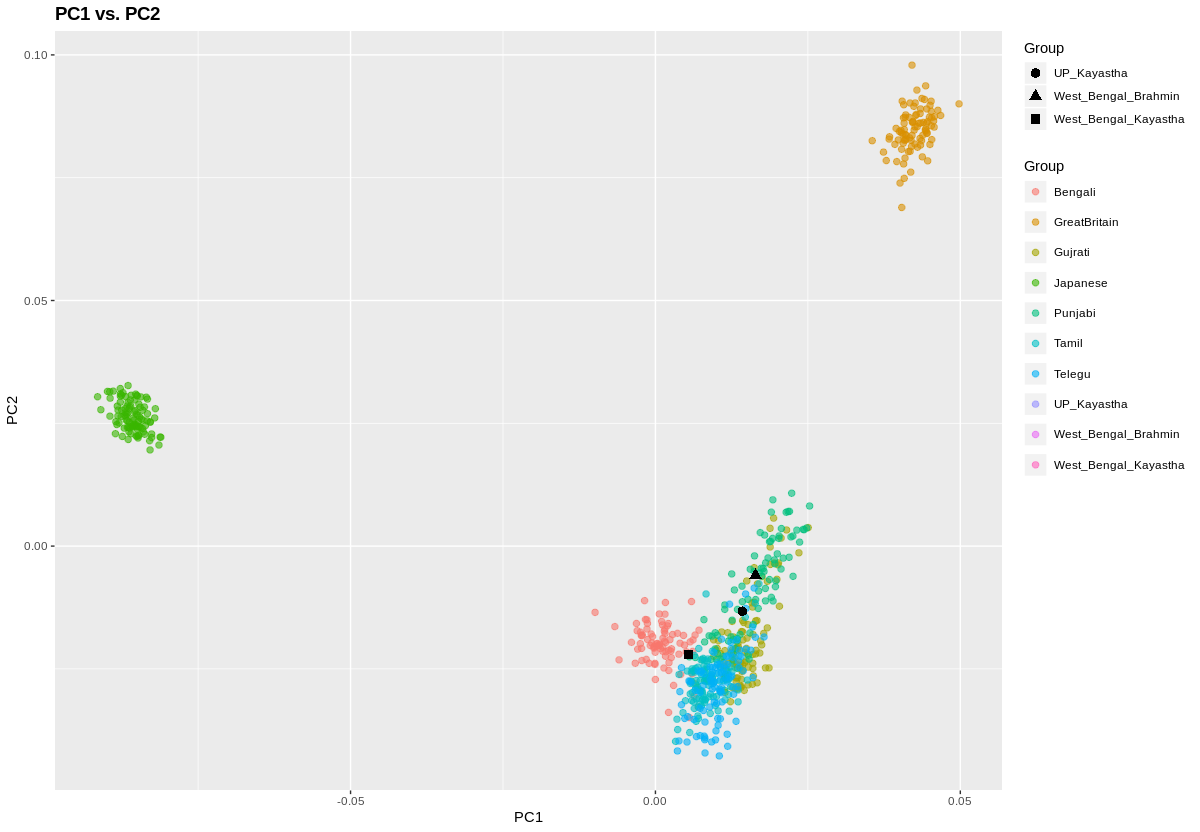
I have two samples of full ancestry from West Bengal. A Kayastha and a Brahmin. You can see where they plot.

Bengali Brahmins are very similar to North Indian Brahmins (often they have some “eastward” shift). In contrast, the Kayastha individual looks like the Bangladeshi samples, except with far less East Asian ancestry.

I do want more samples. Though I’ve gotten a few Bengali Brahmins and they exhibit the sample pattern as above. I am curious about non-Brahmin West Bengalis. But from the above, I think I will conclude that the hypothesis that Kayasthas are a cultivator caste which uplifted themselves occupationally is probably the right one.

Muslims and Urdu in India

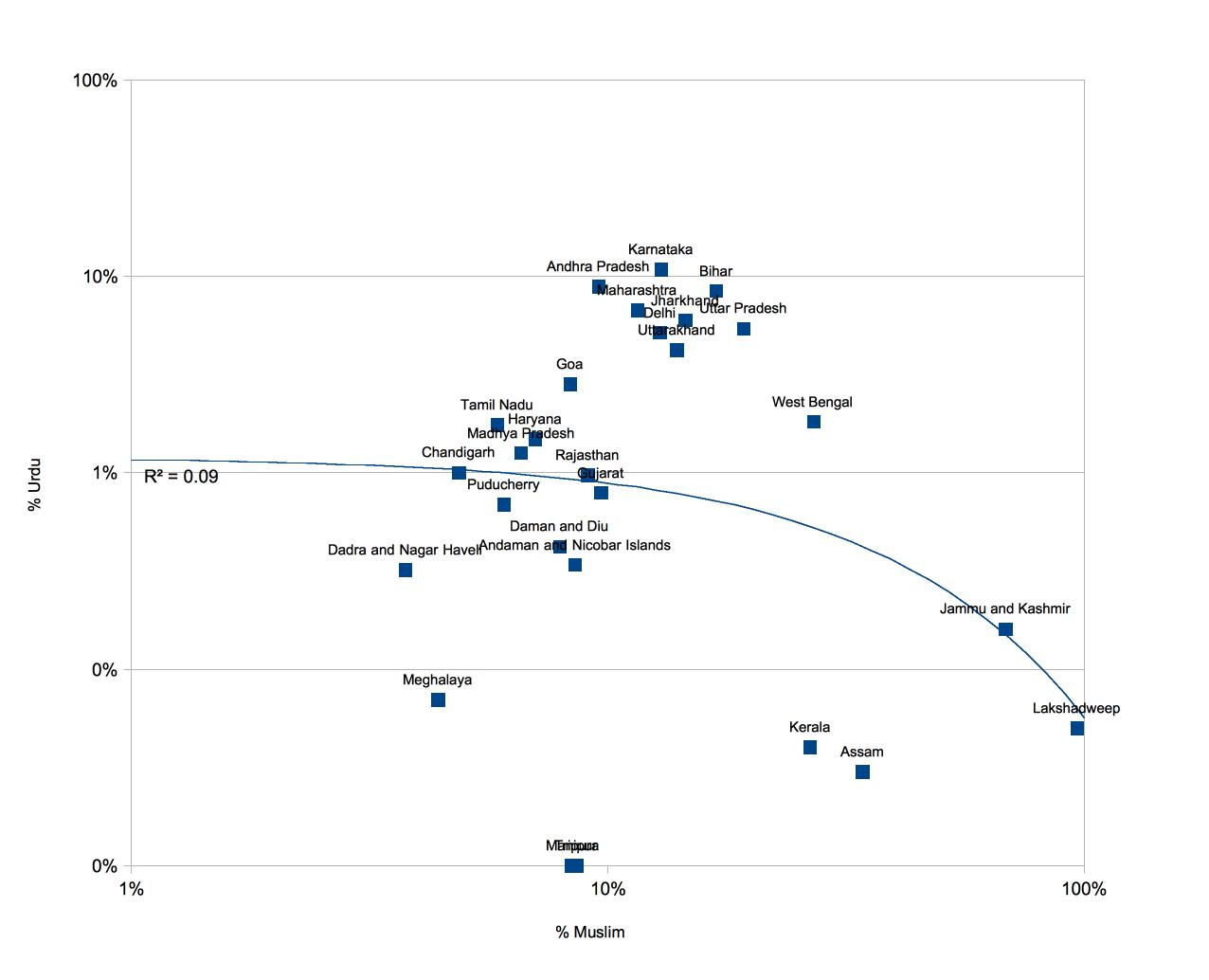
The plot above shows the % Urdu speakers vs. % Muslim in states where Muslims are 4% or more of the population. The data is from Census 2011 (thanks for Vikram of the language data). There are some interesting trends. Assuming that the vast majority of Urdu speakers are Muslim, it seems that in India the core Urdu-identified region is in the Deccan and to the east of its traditional heartland, in Bihar. In South India, 30% of Muslims in Tamil Nadu may be Urdu-speaking. But in Kerala the fraction is almost zero, while in Gujarat and West Bengal less than 10% of the Muslims are Urdu-speaking.

Below the fold is the table.

Continue reading Muslims and Urdu in India

Loki (or Odin) in Asgard

Just a thought re dignity of labor/music.

No question about IQ differences in gender and people. Then there is meritocracy and the sense of entitlement. i.e. We are smart and therefore we should/entitled to multiples of income to the less smart.

Many talk about gender equality in pay. What about less differentiation in pay between the skilled and labor intensive work and so called “high IQ” work.

Post Modernism (a)

This is a follow up to:

A much longer article on post modernism is planned. For now, please see Professor [Dr.] Stephen Hicks’s 153 minute summary of how post modernism emerged from European Enlightenment, Modernism, Kant, Friedrich Wilhelm Nietzche, Marx, the failure of Marx’s economic predictions 1800s to 1950s (about the gradual reduction in the number of middle class, rich people; and the stagnation of proletariat wages), the moral catastrophe created by Nikita Sergeyevich Khrushchev’s 1956 revelation of Stalin’s atrocities communist regime atrocities.

For the record Professor Hick’s acknowledged that his short summary is a very inadequate and incomplete summary of the foundations of post modernism. For example the roles of Jean-Jacques Rousseau, Ferdinand de Saussure and Freud are not mentioned.

I would start watching 1 hour 17 minutes to 22 minutes. In the 1950s four bright very far left academics [Leotard, Foucault, Derrida, Rorty] tried to create a new left [also called post modernism] to revive the globally devastated leftist brand image.

Start watching again 1 hour 42 minutes in as Prof Hicks discusses the internal logical inconsistencies of post modernism. I would slightly modify the good professors’ arguments and summarize these inconsistencies as follows:

  • post modernists say all truth is relative yet imply their cultural ethnocentric view is true
  • all cultures are equally deserving of respect yet Eastern Arya culture and to a lesser degree western culture are especially destructive and bad
  • values are evil yet sexism, different perspectives on LBGTQ and racism are really evil
  • Technology is bad and destructive, yet it is unfair that some have more technology than others
  • Tolerance is good and dominance is bad, yet when in power political correctness (a lack of freedom of art, thought, intuition and feeling) dominates

Foucault is described 2 hours and 1 minutes in as a pro Maoist  socialist. Friedrich Wilhelm Nietzche is described 2 hours 3 minutes in as in some ways the inspiration for post modernism. However if he were alive today he would likely be strongly opposed to post modernism’s celebration of victimization, slave or weakness mentality.

On the whole this is a very informative presentation on post modernism. You can also watch this video by Stephen Hicks (who many consider to be part of the intellectual dark web):

https://www.youtube.com/watch?v=lkfH87CgKOQ

Dalits in Bangladesh

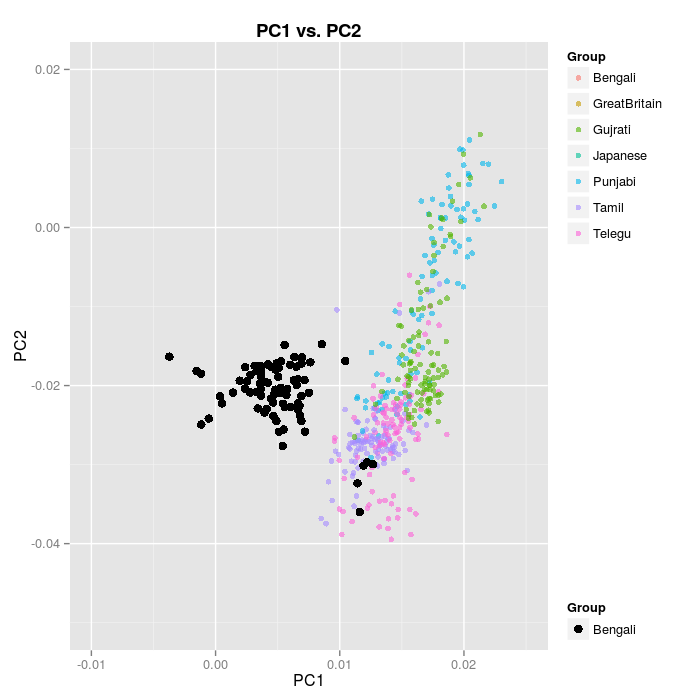
When I looked at the 1000 Genomes data five samples collected in Dhaka, did not align with the others. Most Bengalis are shifted away from other South Asians because of East Asian ancestry. These five individuals, in contrast, clustered with Tamil and Telegu Dalits. Importantly, their identification numbers indicate they were sampled at the same time.

This highlights the fact that a large community of Dalits live in Bangladesh, Dhaka Dalits push for anti-discrimination law:

A considerable number migrated into what is now Bangladesh between 1835 and 1940, during a British-sponsored urbanisation plan. They worked in jobs such as road sweeping, clearing sewage, shoe repair and tea harvesting. This historical legacy of working in low-paying, difficult jobs continues today.

The genetic data suggest to me that they are indeed descendents of migrants.

The decline in South Asian poverty

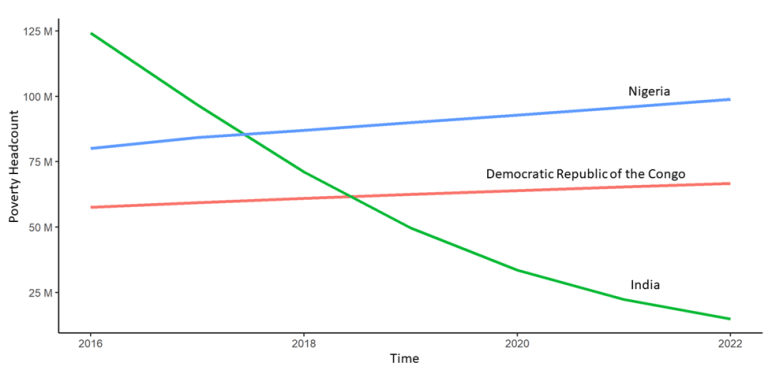
It has long been asserted that South Asia may make average strides economically, but it is still in absolute terms the locus of most of the world’s grinding poverty. This may not be true much longer. In particular, some estimates now suggest that India is no longer the world’s “leader” in extreme poverty in absolute terms. From Brookings, The start of a new poverty narrative:

According to our projections, Nigeria has already overtaken India as the country with the largest number of extreme poor in early 2018, and the Democratic Republic of the Congo could soon take over the number 2 spot (Figure 1 below). At the end of May 2018, our trajectories suggest that Nigeria had about 87 million people in extreme poverty, compared with India’s 73 million. What is more, extreme poverty in Nigeria is growing by six people every minute, while poverty in India continues to fall. In fact, by the end of 2018 in Africa as a whole, there will probably be about 3.2 million more people living in extreme poverty than there are today.

Bangladesh has been making progress as well, from the World Bank:

Bangladesh has made remarkable progress in reducing poverty, supported by sustained economic growth. Based on the international poverty line of $1.90 per person per day, it reduced poverty from 44.2 percent in 1991 to 13.8 percent in 2016/17. In parallel, life expectancy, literacy rates and per capita food production have increased significantly. Progress was underpinned by 6 percent plus growth over the decade and reaching to 7.3 percent in 2016/2017, according to official estimates. Rapid growth enabled Bangladesh to reach the lower middle-income country status in 2015. In 2018, Bangladesh fulfilled all three eligibility criteria for graduation from the UN’s Least Developed Countries (LDC) list for the first time and is on track for graduation in 2024.

Here’s GDP for South Asian countries in 2005 dollars:

I left Bangladesh in 1980. Not too long after I was born. I went back to visit in 1989 and 2004. In relation to 1980, per capita GDP was 1.15x. in 2004 it was 1.6x. In 2016 it was 2.9x. So over the past 14 years there’s been a 2x increase in GDP per capita in Bangladesh! The equivalent figure in the United States is 1.1x.

Why not Persian for the pre-1971 Pakistan ?

Update: I’ve undeleted this since Zach has admitted that he overreacted below. If you want me to trash this post again Vikram just leave a comment below and I’ll do so. -Razib

I understand the nostalgia and desire for an Islamicate language among the Ashraf elite of British North India. After all, Hindus have a similar desire to live in the house of classical Indian languages, and the vast majority of Hindus give their children names from these languages.

But what baffles me is the the Ashraf insistence on Urdu. Choosing Persian as the national language of Muslim South Asia would have had many benefits:

  1. Just like Hindus, whether Kashmiri or Marathi, have a reverence for their classical languages (currently mainly Sanskrit for North Indian Hindutva types, but with a bit of maturity this sentiment also extends to other Indian classical languages), Muslims whether Sindhi or Bengali see Persian and Arabic as their classical language. This would have dramatically reduced the internecine conflicts amongst South Asian Muslims due to language.
  2. Persian as a national language would cement Pakistan’s relation with the Iranic world (and thus the core Muslim world), which is the ancestral land of much of the Muslim Ashrafi in South Asia. South Asian Muslims would come into deeper contact with a sophisticated and highly cultured Muslim population.
  3. Muslims of South Asia would have access to a true, expansive classical literature (including heroic epics, not just romantic poetry) dating back to antiquity, much like Indians have access to classical literatures in Sanskrit, Pali and classical Dravidian. This would diminish the need for extreme religiosity as the glue for holding the Muslim nation together, and produce a far larger, self confident cultural output.

On the other hand, the choice of Urdu created quite a few issues for the preservation and growth of Islamicate culture in South Asia:

  1. At the end of day, Urdu is an Indo-Aryan language with Sanskrit grammar and substantial Sanskrit vocabulary. Even the most Arabo-Persianized version of Urdu (Pakistan’s official Urdu) has at least 40% Sanskrit and Prakrit vocabulary. More so, since Hindus speak Hindi, which has the same grammar, but a steadily increasing Sanskrit vocabulary, it leaves Urdu perpetually vulnerable to an increase of Sanskrit vocabulary.
  2. Some key words in Urdu like aap and sakna have roots in Hindu concepts (aap comes from aatma, the higher self) and sakna derives from Sanskrit shakt, which has a higher meaning in Shakti, the feminine divinity of Hinduism, walla from pal, which means protector.
  3. Muslims in Pakistan and Bangladesh, already have their own languages and literatures, especially the Pashtun, Bengalis and Sindhis. No wonder the imposition has led to substantial conflicts instead of synergy towards the ultimate goal of a sophisticated, modern Muslim culture in South Asia, which is also shared by these populations.

All this leaves me baffled as to why the Muslim Ashrafi were so insistent on Urdu. My best guess is that they mistakenly felt that Urdu was a variant of Arabic and Persian, with no real Sanskrit influence. This is quite possible since the different language families would not have been widely known then, and since Urdu was written in the Arabic script, which is dramatically different from Indian ones.

In any case, the Ashrafi insisted on Urdu. This led to a breakdown of Muslim nationalism when Bangladesh separated. Bangladesh now uses an Indic script, and speaks a language with mainly Sanskrit vocabulary. On the other side of the subcontinent, for the first time in more than two millennia Pashtuns could be under more Indic influence than Iranic (this might change as Iran rises again). Within India, Urdu has declined dramatically, as Muslim families in UP and elsewhere have reconciled themselves to Hindi[1]. Knowing Urdu leaves Pakistani Muslims vulnerable to a substantial amount of Hindu literature and concepts via television shows and Hindi movies.

None of these could have been the goals of the Ashrafi when they demanded a Muslim homeland.

[1] – Urdu is the only scheduled language in India that registered a decrease in the absolute number of speakers between 2001 and 2011. Its proportion of first language speakers has decreased from 5.22% in 1971 to 4.19% in 2011, despite an increase in Muslim population percentage.

Brown Pundits