Is Political Philosophy the key difference between west and the rest even now?


One of the reasons by which west has perhaps emerged successful is through political philosophy, philosophy is a method of discourse that seeks to corner the opponent into providing coherent answers that are not rooted in identity based reasoning. Western world has gone through incredible transformation over last 5 centuries and one of the key component of that transformation has been the political philosophy that emerged in parallel and its place in guiding their worldview.

Which is why one might observe and study the arguments and discourse of people in other countries in public and in parliament . One must check for the proliferation of enlightenment values in these societies . If it is tribal in nature with no understanding or value given to plain reasoning not rooted in identity or no active pressure by various levels of society, from civic rights groups to media to academics to politics & business to this effect, then one might conclude that they deeply value tribal identity as a means to be preserved without it being called into question(free speech), these societies are going to continue to be trapped in the said discourse without any recognition precisely as the political /tribal interests of various participants across different sections of society are rooted in identity .Civic groups, media, academics in those societies for all their pretensions of being liberal or secular are infact engaging in this tribal discourse.  Without enlightenment values, can these societies transform?.  I would have to say no. This brings us to the fact that progress measured merely in terms of benefits or poverty or maternal mortality etc can still accompany  illiberal politics. Any difference measured in these societies will be imagined only through identity and solutions will also be driven with regards to identity.

Philosophy must be therefore made a necessary part of education, specially made for law,media,politics and science .  This is so, because with freedom one can gain further freedom and make social progress on all measures, but society without freedom , even if it advances in some or all other social scores cannot be certain to preserve or gain further freedom .  I see lot of comparison being made between Islamist states or states with Islam given primacy and India or china/communist states and India. This is unfair comparison altogether, making progress while preserving freedom is harder than otherwise.
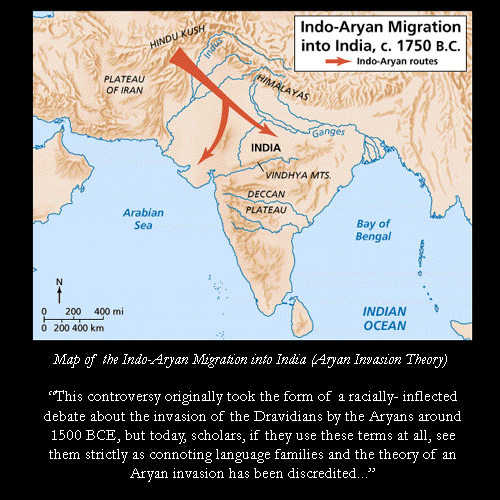
Was there an “Aryan Invasion?”

I’ve been fairly busy recently with work but I read a very good comment right now about semantics.

An Indo-European migration is a very different term to an “Aryan invasion”; the latter seems simply to be a Euro-colonialist divide & rule tactic.

I confess I don’t know much on the matter but I don’t see how the recent genetics somehow justifies anything more than a population movement.

Until there is more evidence of an “Aryan invasion”; I don’t see why such hurtful terms need to be bandied about (it only accentuates unnecessary divisions, which do have modern-Day political consequences).

We should be wary of external narratives foisted on a vulnerable Subcontinent; South Asians have a worrying propensity for ideology that has already cost so much in terms lives, prosperity & prestige..

The quiz show contestant

The above click is “going viral.” One of the things that crosses my mind: would a guy who looks like this ever get a shot in Bollywood, or more generally Indian, film industry as a leading man? Is skin color an issue for men as well as women? The only leading men I know off the top of my head are relatively fair to medium, as opposed to dark (I can think of three or four, hardly any, I don’t follow Indian media).

South Asian genetics, the penultimate chapter

A long post at my other blog, The Maturation Of The South Asian Genetic Landscape, a reflection on the important preprint The Genomic Formation of South and Central Asia. Shorter:

  1. The original inhabitants of the Indian subcontinent who descent from the “out of Africa” migration separated very quickly, ~50,000 years ago, from other eastern populations (East Asians, Andaman Islanders, Papuans, etc.). These are the “Ancient Ancestral South Indians” (AASI).
  2. Agriculturalists from what is today Iran seem to have entered and mixed with the AASI in the Indus Valley earlier than 5,000 years ago, and possibly as early as 9,000 years ago. The only samples they have are from extra-Indian sites, in Central Asia and eastern Iran, as outlier individuals. They call these “Indus_Periphery” (I call then InPe).
  3. The “Ancestral South Indians” (ASI) were created from a mixing of InPe with AASI still extant in much of South Asia ~4,000 years ago.
  4. Between ~4,000 and ~3,200 years ago populations from the steppe arrive, carrying admixture from Iranian farmers, as well as people from the steppe (Andronovo-Sintashta?). They mix with the ASI population, though a few groups, such as the Kalash, mix directly with InPe, and create unmixed “Ancestral North Indian” (ANI).
  5. Subsequent mixing between ASI and ANI populations in various fractions accounts for most of the variation in South Asia.
  6. Some groups are enriched for “steppe” as opposed to the Iranian agriculturalist that first came with InPe. In particular, Brahmins. The hypothesis then is differential ancestry of Indo-Aryan heritage persists to this day.
  7. The Munda of northeast India have a somewhat different origin, mixing Southeast Asian ancestry with ASI and further AASI. The fact that unmixed AASI were present in South Asia indicates that the Munda arrived before the full mixture was complete. Though Austro-Asiatic expansion into northern Vietnam dates to ~4,000 BC, so I think it can’t be that early.

Things I now think are unlikely:

  • Indo-Aryan interpenetration with non-Indo-Aryans in the IVC before 4,000 years ago (I was somewhat agnostic on this). The date for migration now seem very close to the “Classical Model” of arrival around 1500 BC.
  • The AASI is very diverged from the Onge, who form a clade with mainland Southeast Asian Negritos. I now think it is likely that the AASI were primal, and not migrants from Southeast Asia.

It would be nice if the results were published from the Rakhigarhi site, which dates to 4,600 years ago. But it seems less and less necessary. Perhaps at some point we’ll get enough samples from Pakistan to generate a reasonable model….

Neoliberalism

Thomas Friedman is one of the world’s greatest champions of neoliberalism. Neoliberalism works great when most people have high levels of physical health, mental health (called Chitta Shuddhi in Sanskrit) and intelligence (called Buddhi in Sanskrit).  In my opinion human beings can acquire these things through their own effort. [Many neuroscientists disagree with me that “environment” can appreciably increase measured IQ.]

Listening to Thomas Friedman makes clear how much new technologies such as AI benefit those with physical, mental health and intelligence. In my view countries with less post modernist syndrome (which colonizes the mind with inferiority complex, a lack of self confidence, and a lack of freedom of thought, intuition and feeling) especially benefit from globalized neoliberalism and technological innovation. Implicitly this benefits Asians. Very soon China will have more billionaires than America; India too will follow in less than a generation. How will post modernists react?

Continue reading Neoliberalism

Administrative note on this weblog

I don’t know most of the people who contribute to this weblog anymore. So I don’t know how to contact you. Can you please update your profile with an image icon so that it’s easy to see who is who?

Thanks.

The Indian chapter of Who We Are and How We Got Here

Since Who We Are and How We Got Here is out I thought I would spoil the “India chapter” (though you should buy the book!).

– The “Ancestral North Indians” are best modeled as a 50/50 ratio of Yamna-type people from the steppes & “Iranian farmers.” The implication is that the Indo-Aryans mixed with agriculturalists in the BMC on the way into South Asia.

– The “Ancestral South Indians” have about ~25% “Iranian farmer”, along with the indigenous component more like the Andaman Islanders.

Bow before me Dasa!

David Reich clearly believes in a model of the ethnogenesis of South Asian populations detailed in A genetic chronology for the Indian Subcontinent points to heavily sex-biased dispersals. Also, I think I can now say in public when I had lunch with him he indicated that he thinks this is the most likely model. Also, the West Eurasian admixture into South Asian populations is “male-mediated.” R1a1a-z93 for the win!

He also believes there were several admixtures. He notes that his group’s 2013 paper, Genetic Evidence for Recent Population Mixture in India, reported two admixture events in North India, but one in South India. And the North Indian populations had the most recent event. This makes more sense if you consider that much of the admixture probably happened in the Northwest, as a mixed population spread across the subcontinent.

Reich contends that long tracts of ANI ancestry in some North Indians indicate that later people arrived from the first ANI wave. Also, several populations have an atypical Yamna-Iranian ratio in their ANI ancestry, being enriched for Yamna, and not so enriched for Iranian. These are all Brahmin groups.

Finally, he unmasks some of the backstories of difficulties collaborating with researchers in India, who have to be sensitive to cultural and political pressures. 2009’s Reconstructing Indian Population History was hailed in India as refuting the “Aryan invasion theory,” but the evidence was on the contrary, and I said so at the time.

In Who We Are and How We Got Here David Reich makes an explicit analogy between the Indian subcontinent and Europe. Both protrusions from Eurasia are characterized by a synthesis of indigenous hunter-gatherers, intrusive pastoralists from the Eurasian steppe, and migrating West Asian farmers.

Polyandry in Ceylon/Sri Lanka

Polyandry

There is an old  Sinhala saying where four breasts cant get along, four heads can.

Many are under the impression that polyandry was some ancient/mythical social structure ( (e.g. Draupadi in the Mahabaratha).

To the the contrary it was prevalent till modern times  in Sri Lanka/Ceylon, Nepal and certain groups in India.  In Ceylon polyandry was prevalent till the 1950’s in the remote parts of the Kandyan kingdom, e.g. Nuwara-Kalaviya. Apparently there is a rise in fraternal polyandry in the  Malwa region of the Punjab  (see wiki on Polyandry).

The dynamics and customs of polyandry differ among the various cultures. I’ll only write about polyandry in Ceylon/Sri Lanka.

There were two types of unions, Deega amd Binna (those terms are still kind of used or understood). Diga was where the woman went to the man’s house. Binna was weh the man went to the woman’s house.

Deega: Where a woman went man/mens house. When she went to the men/mens house she was entitled to a share of the property that belonged to the house and income thereof. So if a woman had a union with 3 men she was entitled to 1/4th of the property and its income.

Knox, mentions that the dowry was considered the property of the wife and she was free to take it away, should the marriage be a failure. Among the things that were given as a part of the dowry Knox mentions slaves, cattle, tools and money. NOTE: Dowry was movable assets, not land.

Now at some point the woman gets tired of the men, or the men get tired of the woman.  The woman will move back to her house (note I did not say parents house). When she moves back, her house property share has to be given back to her.

Binna:  Thats when a man moves into the woman’s house.  This could be a womans first unions or after she walks away from a Diga union and she is back in her house.  They can get an income from either administering or working the woman’s share of the property.

Binna or Diga, the children remain in the house they were born and will inherit a share with other children also born in the house. The children dont belong to the parents, they belong to the house.
The Sinhalese names are based on the house. e.g. Galaha Lekamge Sunil. Written in English custom it would be Sunil of the Secretary’s house in Galaha (a village). The suffix “ge” pronounced “gay” means house or of.

Some key points that made the system work.
The house was an entity and had property (rice paddy, coconut groves etc). The property was not necessarily adjacent to the house.
Property could not be bought or sold.
Children belong to the house, not to either parent.
Minimum children: Infanticide and abortion were practiced. Infanticide was not gender based, but because the “horroscope” was bad.
Virginity for women and men was a non issue.

Knox (1681) says (1681):

  • “In this country each man, even the greatest, hath but one wife; but a woman often has two husbands. For it is lawful and common with them for two brothers to keep house together with one wife, and the children do acknowledge and call both fathers”.
  • These women are of a very strong and courageous spirit, taking nothing very much to heart, mourning more for fashion than affection, never overwhelmed neither with grief of live. And when their husbands are dead, all their care is where to get others, which they cannot long be without.”
  • Their marriages are but of little force or validity for if they disagree and mislike one another, they part without disgrace…. Both women and men do commonly wed four or five times before they can settle themselves to their contention.”
  • As soon as the child is born, the father or some friend apply themselves to an astrologer to inquire whether the child was born in a prosperous planet and a good hour or in an evil one. If it is found to be in an evil they presently destroy it.”

Links/refs

https://en.wikipedia.org/wiki/Polyandry_in_India

Robert Knox (1681) “An historical relation of the Island Ceylon in the East Indies”.  Complete book is online
http://www.gutenberg.org/etext/14346
Knox was captured by the Kandyan King and was kept for 20 years. Escaped and wrote about life in the Hill Country. Supposed to have inspired Defoes, Robinson Crusoe

Brown Pundits