Clash Of Civilisations – Samuel Huntington

After Ukraine, China asserting itself, Turkey – Rise of Erdogan, Myanmar (Burma) crisis, Even India with rise of Modi . I think this book deserves a revisit. Perhaps all his works deserves a visit.

collection of his quotes .

“This changing international environment brought to the fore the fundamental cultural differences between Asian and American civilizations. At the broadest level the Confucian ethos pervading many Asian societies stressed the values of authority, hierarchy, the subordination of individual rights and interests, the importance of consensus, the avoidance of confrontation, “saving face,” and, in general, the supremacy of the state over society and of society over the individual. In addition, Asians tended to think of the evolution of their societies in terms of centuries and millennia and to give priority to maximizing long-term gains. These attitudes contrasted with the primacy in American beliefs of liberty, equality, democracy, and individualism, and the American propensity to distrust government, oppose authority, promote checks and balances, encourage competition, sanctify human rights, and to forget the past, ignore the future, and focus on maximizing immediate gains. The sources of conflict are in fundamental differences in society and culture.”

“In the post-Cold War world flags count and so do other symbols of cultural identity, including crosses, crescents, and even head coverings, because culture counts, and cultural identity is what is most meaningful to most people.”

“ability of Asian regimes to resist Western human rights pressures was reinforced by several factors. American and European businesses were desperately anxious to expand their trade with and their investment in these rapidly”

“The dangerous clashes of the future are likely to arise from the interaction of Western arrogance, Islamic intolerance, and Sinic assertiveness.”

“The philosophical assumptions, underlying values, social relations, customs, and overall outlooks on life differ significantly among civilizations. The revitalization of religion throughout much of the world is reinforcing these cultural differences. Cultures can change, and the nature of their impact on politics and economics can vary from one period to another. Yet the major differences in political and economic development among civilizations are clearly rooted in their different cultures. East Asian economic success has its source in East Asian culture, as do the difficulties East Asian societies have had in achieving stable democratic political systems. Islamic culture explains in large part the failure of democracy to emerge in much of the Muslim world.”

“The prevalence of anti-patriotic attitudes among liberal intellectuals led some of them to warn their fellow liberals of the consequences of such attitudes for the future not of America but of American liberalism. Most Americans, as the American public philosopher Richard Rorty has written, take pride in their country, but ‘many of the exceptions to this rule are found in colleges and universities, in the academic departments that have become sanctuaries for left-wing political views.’ These leftists have done ‘a great deal of good for . . . women, African-Americans, gay men and lesbians. . . . But there is a problem with this Left: it is unpatriotic. It repudiates the idea of a national identity and the emotion of national pride.’ If the Left is to retain influence, it must recognize that a ‘sense of shared national identity . . . is an absolutely essential component of citizenship.’ Without patriotism, the Left will be unable to achieve its goals for America. Liberals, in short, must use patriotism as a means to achieve liberal goals”

“What, however, makes culture and ideology attractive? They become attractive when they are seen as rooted in material success and influence. Soft power is power only when it rests on a foundation of hard power. Increases in hard economic and military power produce enhanced self-confidence, arrogance, and belief in the superiority of one’s own culture or soft power compared to those of other peoples and greatly increase its attractiveness to other peoples. Decreases in economic and military power lead to self-doubt, crises of identity, and efforts to find in other cultures the keys to economic, military, and political success.”

“The argument now that the spread of pop culture and consumer goods around the world represents the triumph of Western civilization trivializes Western culture. The essence of Western civilization is the Magna Carta, not the Magna Mac. The fact that non-Westerners may bite into the latter has no implications for their accepting the former.”

“There can be no true friends without true enemies. Unless we hate what we are not, we cannot love what we are.”

“reaffirming their Western identity and Westerners accepting their civilization as unique not universal and uniting to renew and preserve it against challenges from non-Western societies.”

“These transnationalists have little need for national loyalty, view national boundaries as obstacles that thankfully are vanishing, and see national governments as residues from the past whose only useful function is to facilitate the elite’s global operations”

“the situation between Ukraine and Russia is ripe for the outbreak of security competition between them. Great powers that share a long and unprotected common border, like that between Russia and Ukraine, often lapse into competition driven by security fears. Russia and Ukraine might overcome this dynamic and learn to live together in harmony, but it would be unusual if they do.”

“One grim Weltanschauung for this new era was well expressed by the Venetian nationalist demagogue in Michael Dibdin’s novel, Dead Lagoon: “There can be no true friends without true enemies. Unless we hate what we are not, we cannot love what we are. These are the old truths we are painfully rediscovering after a century and more of sentimental cant. Those who deny them deny their family, their heritage, their culture, their birthright, their very selves! They will not lightly be forgiven.”

“God and Caesar, church and state, spiritual authority and temporal authority, have been a prevailing dualism in Western culture. Only in Hindu civilization were religion and politics also so distinctly separated. In Islam, God is Caesar; in China and Japan, Caesar is God; in Orthodoxy, God is Caesar’s junior partner.”

“Collective will supplants individual whim”

“People define themselves in terms of ancestry, religion, language, history, values, customs, and institutions. They identify with cultural groups: tribes, ethnic groups, religious communities, nations, and, at the broadest level, civilizations. People use politics not just to advance their interests but also to define their identity. We know who we are only when we know who we are not and often only when we know whom we are against.”

“Hypocrisy, double standards, and “but nots” are the price of universalist pretensions. Democracy is promoted, but not if it brings Islamic fundamentalists to power; nonproliferation is preached for Iran and Iraq, but not for Israel; free trade is the elixir of economic growth, but not for agriculture; human rights are an issue for China, but not with Saudi Arabia; aggression against oil-owning Kuwaitis is massively repulsed, but not against non-oil-owning Bosnians. Double standards in practice are the unavoidable price of universal standards of principle.”

“It is my hypothesis that the fundamental source of conflict in this new world will not be primarily ideological or primarily economic. The great divisions among humankind and the dominating source of conflict will be cultural. Nation-states will remain the most powerful actors in world affairs, but the principal conflicts of global politics will occur between nations and groups of different civilizations. The clash of civilizations will dominate global politics. The fault lines between civilizations will be the battle lines of the future.”

“Becoming a modern society is about industrialization, urbanization, and rising levels of literacy, education, and wealth. The qualities that make a society Western, in contrast, are special: the classical legacy, Christianity, the separation of church and state, the rule of law, civil society.”

“Every civilization sees itself as the center of the world and writes its history as the central drama of human history.”

“In the emerging world of ethnic conflict and civilizational clash, Western belief in the universality of Western culture suffers three problems: it is false; it is immoral; and it is dangerous.”

“Islam’s borders are bloody and so are its innards. The fundamental problem for the West is not Islamic fundamentalism. It is Islam, a different civilisation whose people are convinced of the superiority of their culture and are obsessed with the inferiority of their power.”

“The West won the world not by the superiority of its ideas or values or religion (to which few members of other civilizations were converted) but rather by its superiority in applying organized violence. Westerners often forget this fact; non-Westerners never do.”

“Democracy is premised, in some measure, on majority rule, and democracy is difficult in a situation of concentrated inequalities in which a large, impoverished majority confronts a small, wealthy oligarchy.”
The Third Wave: Democratization in the Late Twentieth Century (1991)

“Cultural America is under siege. And as the Soviet experience illustrates, ideology is a weak glue to hold together people otherwise lacking racial, ethnic, and cultural sources of community.”
Who Are We? The Challenges to America’s National Identity (2004), p. 12

“Many more people in the world are concerned with sports than with human rights.”

“In the emerging era, clashes of civilization are the greatest threat to world peace, and an international order based on civilizations is the surest safeguard against world war.”

“In Eurasia the great historic fault lines between civilizations are once more aflame. This is particularly true along the boundaries of the crescent-shaped Islamic bloc of nations, from the bulge of Africa to central Asia. Violence also occurs between Muslims, on the one hand, and Orthodox Serbs in the Balkans, Jews in Israel, Hindus in India, Buddhists in Burma and Catholics in the Philippines. Islam has bloody borders.”

“Religiosity distinguishes America from most other Western societies. Americans are also overwhelmingly Christian, which distinguishes them from many non-Western peoples. Their religiosity leads Americans to see the world in terms of good and evil to a much greater extent than most other peoples.”
“Dead Souls: The Denationalization of the American Elite,” The National Interest, November, 2002, p. 16

“It is my hypothesis that the fundamental source of conflict in this new world will not be primarily ideological or primarily economic. The great divisions among humankind and the dominating source of conflict will be cultural. Nation-states will remain the most powerful actors in world affairs, but the principal conflicts of global politics will occur between nations and groups of different civilizations. The clash of civilizations will dominate global politics. The fault lines between civilizations will be the battle lines of the future.”

“The balance of power among civilizations is shifting: the West is declining in relative influence; Asian civilizations are expanding their economic,military, and political strength; Islam is exploding demographically with destabilizing consequences for Muslim countries and their neighbors; and non-Western civilizations generally are reaffirming the value of their own cultures.”

“Some Westerners, including President Bill Clinton, have argued that the West does not have problems with Islam but only with violent Islamist extremists.Fourteen hundred years of history demonstrate otherwise. The relations between Islam and Christianity, both Orthodox and Western, have often been stormy. Each has been the other’s Other. Th e twentieth-century conflict between liberal democracy and Marxist-Leninism is only a fleeting and superficial historical phenomenon compared to the continuing and deeply conflictual relation between Islam and Christianity. At times, peaceful coexistence has prevailed; more often the relation has been one of intense rivalry and of varying degrees of hot war. Their “historical dynamics,” John Esposito comments, “. . . often found the two communities in competition, and locked at times in deadly combat, for power, land, and souls.” Across the centuries the fortunes of the two religions have risen and fallen in a sequence o f momentous surges, pauses, and countersurges. ”

“Some Westerners […] have argued that the West does not have problems with Islam but only with violent Islamist extremists. Fourteen hundred years of history demonstrate otherwise.”

https://www.goodreads.com/author/quotes/38041.Samuel_P_Huntington
https://en.wikiquote.org/wiki/Samuel_P._Huntington
Clash of civilizations

Inter Services Public Relations; ISPR (Pakistan)

From Dr Hamid Hussain

Some questions came my way about ISPR and following was the response. Every officer posted to ISPR should read Brig. R Siddiqi’s book. It is out of print but I’ll be happy to lend them my own copy.

Regards,
Hamid

Battle of Narrative – Public Relations of Pakistan Army
Hamid Hussain


“The expansion of its image gradually cuts the military establishment adrift from its professionalism, and it succumbs to a kind of narcissism, loving its media-contrived image too well to brook any rival image”. Brigadier ® A. R. Siddiqi; Former Director General of Inter Services Public Relations (ISPR).

Army is the dominant and most powerful institution of Pakistan. Every conflict between army and civilian institutions results in a competing narrative from each party. Armed forces manage its narrative through Inter Services Public Relations (ISPR). There are few officers from air force and navy but ISPR is mainly manned by army officers. During direct military rule, army chief is also President and information ministry is used for communication. ISPR is the main channel for communication when army is not directly controlling the levers of power. Public opinion in Pakistan is very positive about armed forces and any criticism on professional grounds is usually very limited. Unfortunately, any criticism is viewed by armed forces as challenging its authority and equated with anti-state activity.

ISPR has evolved over seventy years into a huge media machine with a large bureaucracy. It was a small entity headed by a Lieutenant Colonel rank officer and today headed by a Major General rank officer. Previous Director General (DG) ISPR was a Lieutenant General rank officer. It was backwater for officers not destined for further promotion. This changed in the last two decades. The importance of a stint as DGISPR can be gauged from the fact that DGISPRs have been posted to important combat formations. One DGISPR became Chief of General Staff. In the past, a brief statement was given to DGISPR to pass it on to the press. Now, DGISPR sits in important high level meetings and travels with army chief on foreign travels. The horizon has also expanded from brief press statements to frequent press conferences and extensive use of print, electronic, digital and social media as well as big budget productions. Continue reading Inter Services Public Relations; ISPR (Pakistan)

Review: The Hajj, by FE Peters

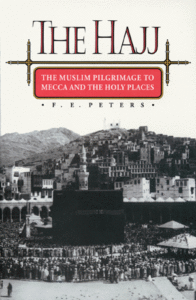
Francis Edward Peters (F.E. Peters) is Professor Emeritus of History, Religion and Middle Eastern and Islamic Studies at New York University (NYU) and he has written a great review of the Haj through the ages, from its pre-Islamic beginnings to the way it was in 1926. He ends the book in 1926, so the current hugely enlarged, incredibly safer, more convenient, and in may ways, totally transformed Haj is not covered in this book.
The most intetesting part of the book for me was the first; the discussion of what pre-Islamic Haj looked like and how its rituals were modified (and combined with another pre-Islamic pilgrimage, the Umrah) to creat the current Islamic Haj. This is also the most frustrating section of the book, but that is not FE Peter’s fault. We just do not have a lot information about what happened before Islam. Pagan Arabia was completely converted to Islam within one generation, and the attitude of the new religion towards the past was generally negative and dismissive. A mostly illiterate culture, it has left us with almost nothing except a few poems (preserved, ironically, because the later interpreters of the Quran felt that their language could help unlock the meaning of words and phrases in the Quran that these later generations had difficulty understanding) and whatever (generally negative and dismissive) references survive in Islamist historiography. Of course, we can learn some things from the Quran itself, but these frequently tend to be in the form of “answers without a question”, which must have been completely transparent to the first generation, but whose meaning required some explanation and interpretation by later generations. Most of this is supplied by the exegetical and historical works written in the next 2-400 years, but it can be impossible to separate fact from posthoc mythmaking. Anyway, this is what we have, and FE Peters makes a heroic effort to sift through it to find what can still be found. Continue reading Review: The Hajj, by FE Peters

Will the last Parsi to die please blow out the sacred fire?

Our ancestors, Persia’s first-born, preserved their ancient faith in the underground warrens of Yazd. Zarthushti houses had to be on a lower level to Muslim homes so that if it rained the water of infidels couldn’t contaminate that of the believers. It is only fair that for the sake of those ancestors who have sacrificed so much that at least some of their descendants should go on to light the sacred fire for the generations to come. 

Twitter is in a huff about Jiyo Parsis’s last-gasp campaign to raise the anemic Parsi birthrate through blunt ads. The liberal opposition are featuring an angsty article denouncing JP as racists:

Imagine a khap panchayat in rural Haryana – a kangaroo court of village elders – launching a slick ad campaign encouraging members of their caste to marry (each other) and rapidly multiply to increase their dwindling numbers.

(Disclaimer: I had my Navjot when I was nine, despite having a Hindu father.) 

Anahita Mukherji is a US-based journalist who has a quarter-Parsi son with a full-Parsi name.

The author’s father is a Bengali Brahmin and she herself married out of the Parsi caste. Anahita’s only sop to her mother’s identity is to give her son a Parsi name.

Now she’s the designated American voice of the (liberal) pushback against those Indian Parsis who understandably want to preserve Zoroaster’s bloodline for posterity. If the Parsi community were to follow Anahita’s personal example; they’d be extinct in a generation.

She has every right to lead her life as she sees fit but it is unacceptable to hector others to follow her PC non-solutions. When it comes to the Parsi community there are simply no lemmings left to fall of the cliff.

Good luck Jiyo Parsi!

Indian History Wars..

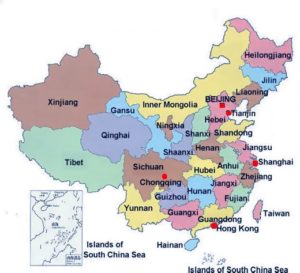
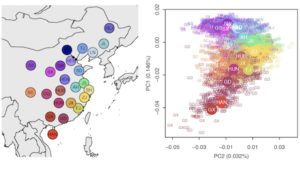
Razib has an excellent post about the genetic history of China up on gnxp.nofe. Worth a read.

Of course, unlike India, China is dominated by one ethnic group with clear genetic and cultural identity and has a long history of political unity (even though interspersed with recurrent civil wars and invasions), so there is relatively little fear of population genetics and its findings.. let the chips fall where they may, we know who is boss.. (I admit that I may not be aware of lower level Chinese debates about ancestry, where some people may indeed get hot and bothered about genetic results, but the point is that it is still not a hot-potato in the way population genetics is in India).

For background on the Indian debates, see Razib’s article here and my own (less genetics, more politics) article here.

By the way, the comments and answers on Razib’s article are very sane and add value. Please do read.

Continue reading Indian History Wars..

Royal Rumble – Dynamics of Saudi Royal Family

From Dr Hamid Hussain

‘In a western democracy, you lose touch with your people, you lose elections; in a monarchy, you lose your head’. Prince Bandar Bin Sultan, Former Saudi ambassador to Washington.

In the last two years, Saudi Arabia has gone through many changes. Absolute monarchies are not easy to decipher. There are many opacities and it is very difficult for any outside observer to have a real sense of events. Two main factors are very limited expression by Saudis in their own country and opaque decision making process in the form of decrees with flavor of palace intrigue. A Saudi will not express his honest view in the presence of another Saudi due to fear factor. In view of these limitations, the perspective of an outsider has severe limitations.

Current system of governance of the country is based on accession to throne of one of the sons of the founder of the country Abdul Aziz bin Abdur Rahman al-Saud (d. 1953). He works with other family members especially senior princes, Council of Ministers (most of whom are also royal family members) and Council of Senior Clerics in running day to day affairs of the country. There is a fair amount of competition among all these groups about various issues and King carefully balances his act to avoid open conflict.

Continue reading Royal Rumble – Dynamics of Saudi Royal Family

The Indo-Aryan question nearing resolution


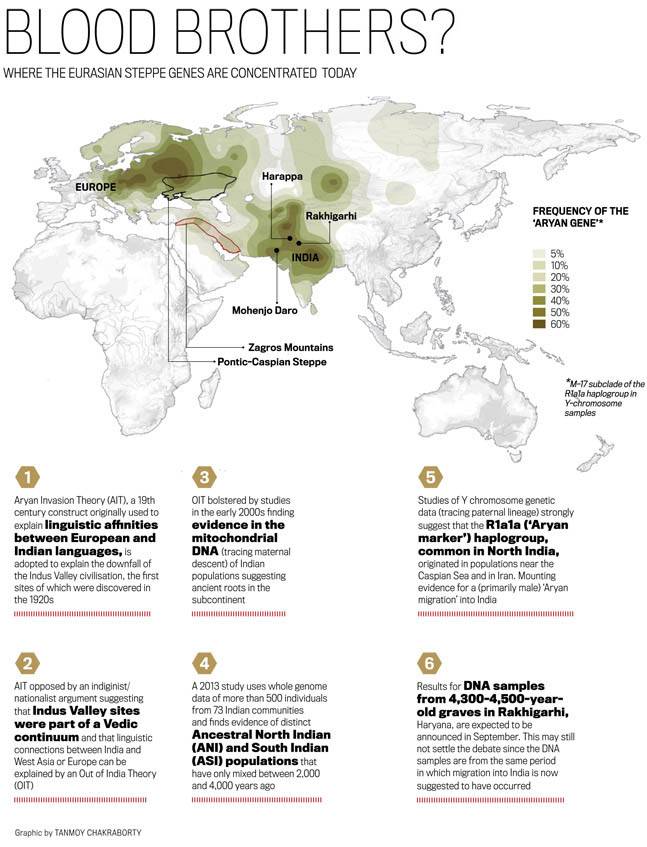
India Today published my review of the current state of the genetics and genomics of the Indian subcontinent, and what it can tell us about the ethnogenesis of South Asians generally. In the piece I tried to be very circumspect and stick to what we know with a high, if not perfect, degree of certainty. Here I will add some comments where I reduce the threshold of certainty somewhat. That is, I’m going to include here my beliefs where I think I’m right, but in some details wouldn’t be surprised if I was wrong.

First, the title is Aryan wars: Controversy over new study claiming they came from the west 4,000 years ago. Writers don’t get to choose titles, and this is not one I would have chosen. But I am not in a position to care or know what draws clicks. Let’s note that this “controversy” is restricted mostly to India. Outside of India it’s not controversial, but a matter of the science, because people don’t have any political or social investment in the topic. It reminds me of debates about genetics and intelligence in the West, where emotions get overwrought and lies fly wildly with abandon.*

Second, there is a reference in the figures to an “Out of India” (OIT)  model. That is, the Aryans migrated out of India, and implicitly the Indo-European languages derive from South Asia. I don’t think this theory has any support at all. That is, I think it is rather clear that proto-Indo-European probably emerged neither in Europe proper, nor in South Asia, but in the Inner Eurasian spaces between. But for an Indian audience ignoring OIT would seem a peculiar lacunae, so there was a reference added to the figure on that account (I pushed back against this, but do not make ultimate decisions on figures).

But I do think it was plausible up until 2009’s Reconstructing Indian History to suggest that most modern South Asian ancestry dates to the Pleistocene. In this framework the Indo-Europeanization of the subcontinent was primarily a cultural one, where small groups of Central Asians imposed their language on the native population. What the genome-wide work has shown is that South Asians are the product of a large-scale mixing process between a population very distant from West Eurasians (“Ancestral South Indians”, ASI) and a population which was indistinguishable from other West Eurasians (“Ancestral North Indians”, ANI).

Since ANI is indistinguishable from West Eurasians I hold it is clearly a West Eurasian population in provenance. Those who reject this position from a scientific perspective believe that there could have been some sort continuous zone of “ANI-like” habitation from northwestern South Asia up into northern Inner Eurasia (and perhaps toward West Asia as well) dating from the late Pleistocene. I do not that believe this is plausible, and I will tell you that prominent researchers who I have brought up this idea to are somewhat incredulous.**

Third, there are major unresolved issues genetically in relation to the dates and the total number of mixing populations. I am quite confident saying around half of the total South Asian genomic ancestry today derives from populations who were living outside of South Asia on the Holocene-Pleistocene boundary 11,700 years ago. Much of that ancestry probably flourished between the Caucasus and Zagros mountains. The remainder somewhere in the vast swath of territory between the Baltic and Siberia (perhaps further south, toward the Pamirs?).

But I am not confident of the relative balances of contribution to the ANI. It does seem that the northern component, which is derived in part from the southern component, is much more prominent in upper castes and northwestern populations. In contrast the southern component is found throughout the subcontinent.

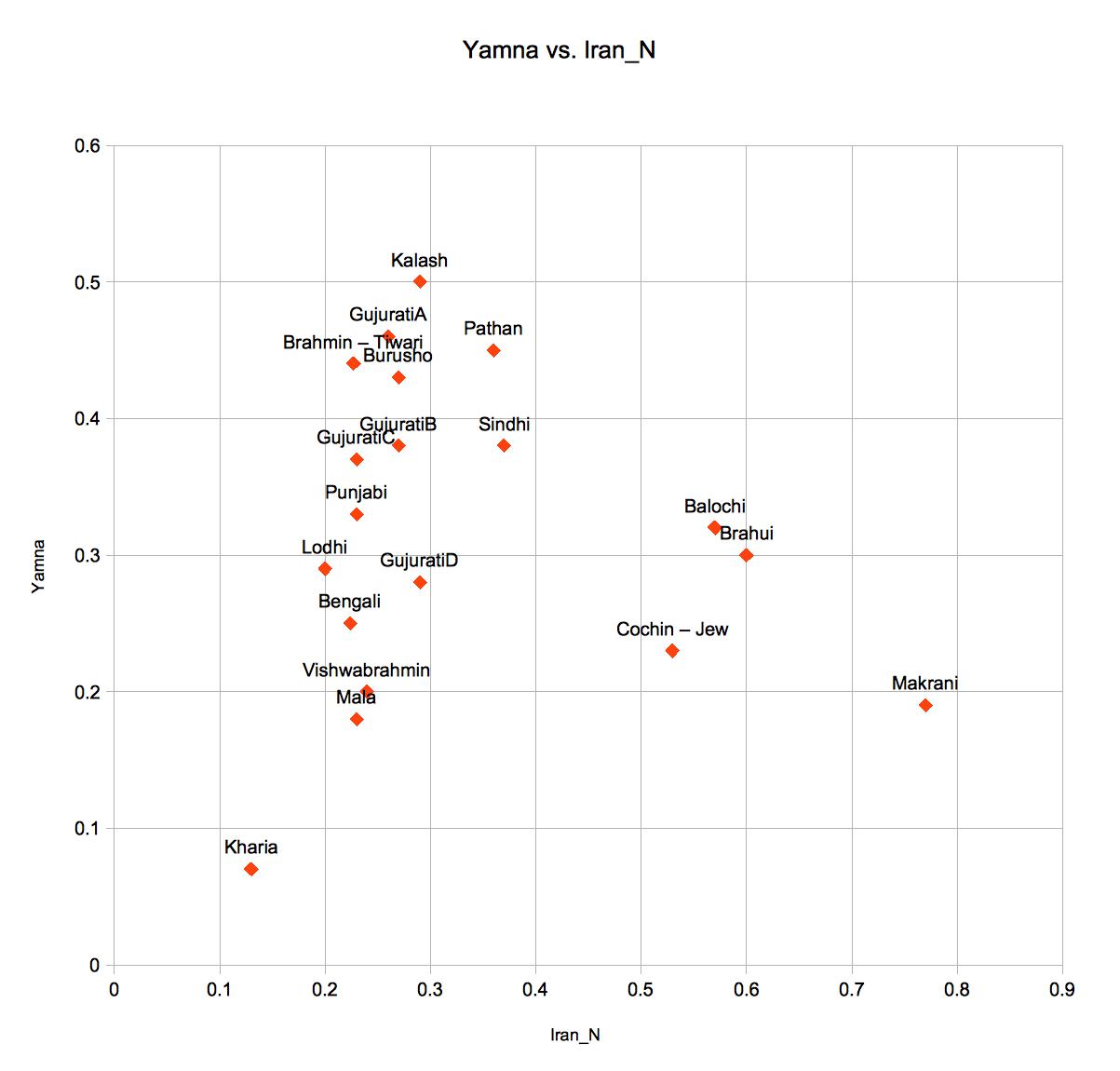
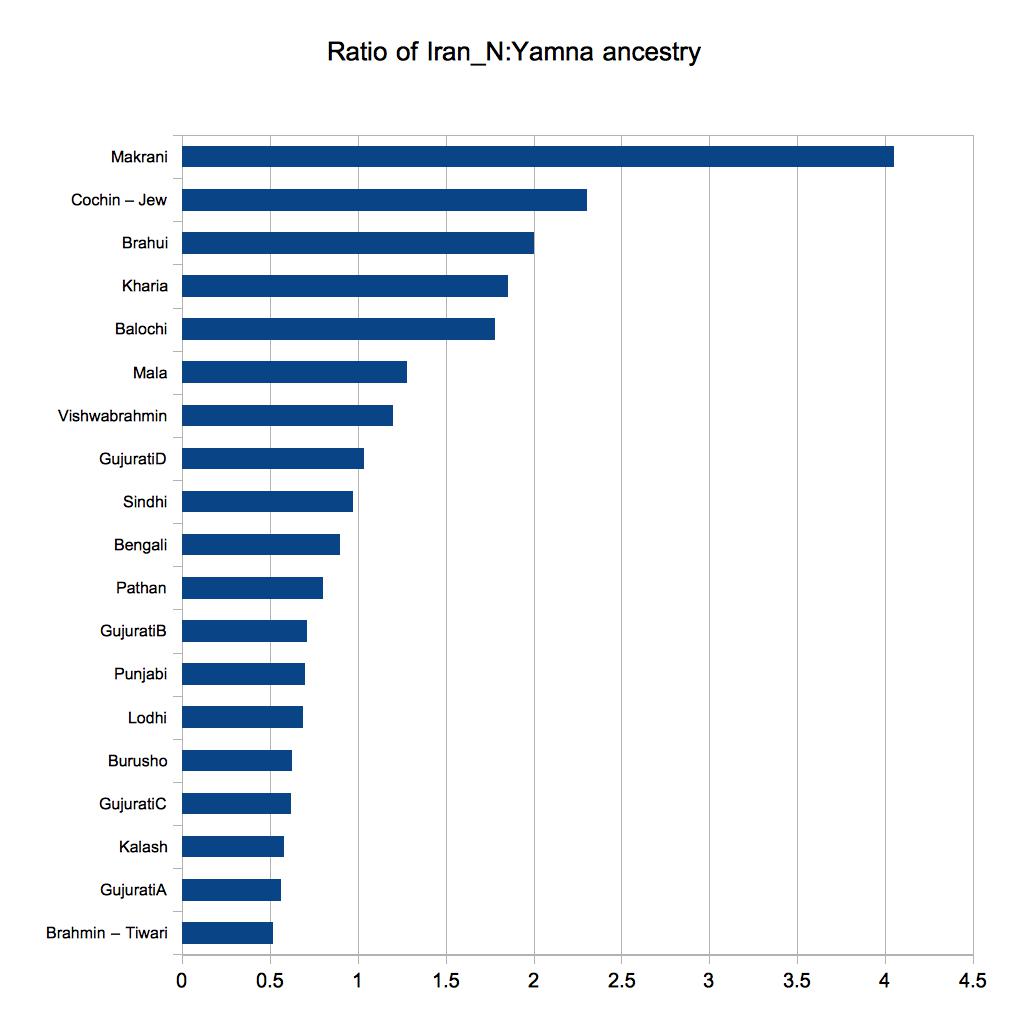
In Genomic insights into the origin of farming in the Near East there is analysis of South Asia in the supplements. The author concludes that ANI can not be modeled as a single population (Zack Ajmal and I were saying this in 2010). The top hits for the sources of ANI tend to be the genomic sample from the Zagros, in western Iran (before subsequent admixture with Levantine farmers), and a population similar to the Yamna culture of the steppe. The issue seems to be that later steppe populations which harbor a fair amount of “Early European Farmer” ancestry (e.g., LBK in Central Europe) due likely to back migration aren’t good model fits.

Below are two plots, one showing a scatter of South Asian groups with their Iran_N (a sample from ~10,000 years ago) vs. Yamna (from ~5,000 years ago), and another with the ratios.


DO NOT TAKE THE PROPORTIONS LITERALLY.  My intuition is that these models are overestimating the proportion of steppe ancestry, but my confidence in my intuition is low.

There are two groups enriched for Iran_N ancestry:

  1. Lower caste groups, especially from South India.
  2. Populations in southern Pakistan.

The reasons differ. If you have done genetic analysis of the Pakistani populations it seems quite obvious that unlike other groups in South Asia Pakistani groups facing the Arabian sea across from Oman have genuine Near Eastern ancestry. This affinity declines as you go north in Pakistan rather rapidly. Notice though one South Indian group: Jews from Cochin. This population clearly has recent Near Eastern ancestry.

The Kharia are an Austro-Asiatic Munda group. For whatever reason Austro-Asiatic groups seem to consistently have very little steppe ancestry. The Mala are Dalits from South India. The further up you go on the modal Iran_N-Yamna cline you see the populations are either upper caste, or, they are from the far northwest of the subcontinent.

The conclusion I derive from this is that first there was an early migration of West Eurasian populations consisting of Iranian farmers. This group mixed with the ASI element. The Indo-Aryans, which probably correlates with the Yamna-like component, arrived later as an overlay (and nearly half of their ancestry was derived from Iranian farmers). Then many South Asian populations have modifications on this base model of compound ANI + ASI; Munda and Bengali have later East Asian ancestry, while populations on the Arabian sea have Near Eastern ancestry.

Fourth, the story in India Today leans heavily on Y chromosome of R1a1a lineage. It is true we are Lords of the Steppe and destined to drive our enemies before us. But, it is not the primary story. And yet Y chromosomal phylogenies are easy for the public to understand. But they only make sense in light of the above framework. R1a1a is found in South Indian tribal populations. It seems likely that Indo-Aryan paternal lineages were highly invasive across the subcontinent, just as they were in Europe. In many cases they likely extended far beyond domains where Indo-European acculturation occurred.

I’m probably wrong on some of the details. But I suspect the final story will not be so different from this.

Finally, I will mention the cultural element here. There is a fair amount of the discussion of the form “so you are saying the ancestors of Indians are Europeans?” or “does this mean Hinduism is not Indian?”

The piece was about genetics and demography, not my opinions about culture. So I will say this:

  1. The “West” as an entity is no older that Classical Greece. 500 BC. My own personal position, strongly held, is that the West should indicate cultures and societies which descend from the European societies which adhered to the Western Church around ~1000 AD (some nations, like Lithuania, became absorbed into this cultural complex hundreds of years later). So Russia is not the West. And Merovingian Francia is not the West.
  2. Indian civilization of what we term the Hindu variety coalesced in the period between between 500 BC and 500 AD, from before the Mauryas, up to the Guptas. Obviously the period before 1000 BC was important in setting the ground-work, but I do not believe it was Indian as we’d understand it in anything but the geographical sense, nor was it Hindu in any way we’d recognize it today (similarly, Shang dynasty China was not China as we’d understand, which came into being after 500 BC).

These positions mean that I think nationalist passions are in the “not even wrong” category. Indian Hindu civilization is indigenous by definition, since it was synthesized in situ on the edge of historical perception and attestation (for the record, I think Adi Shankara was critical in the completion of a crystalized self-conception of Hindu religio-philosophical thought, but its origins predate him). Similarly, Indian civilization was not seeded by white Europeans because white Europeans were only coming into being in Europe when the Indus Valley civilization was collapsing.

That is all (for now).

Addendum: The first tranche of ancient DNA should be out in a few months. Also, there is another paper on Indian genetics in the work from the usual suspects. There won’t be anything totally surprising (or so I’ve been told).

* By lies, I mean the contention that intelligence is an “invalid” instrument in relation to predictiveness, or, if it is valid, it is not genetically heritable. People routinely lie about these facts in discussion or spread lies because there are socially preferred positions which they conform to. Similarly, many questions about Indian history seem to hinge on widely promoted lies.

** This model needs to also confront the massive mixing of the last 4,000 years. If it is true then it is ASI which is mostly likely intrusive, because it is not creditable that these two populations were in nearby proximity for tens of thousands of years without exchanging genes.

Partition stories; a pair of beds in Jehlum

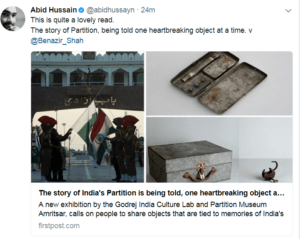
I happened to see a tweet about a museum of objects related to partition

and it reminded me of a story I heard about a particular pair of objects, two old-style massive beds (palang) in a house in Jehlum. Since I doubt that this story has been published anywhere, I thought of putting it down here for posterity:

Continue reading Partition stories; a pair of beds in Jehlum

Objectives Resolution: Logical Culmination or Building Block?

The creation of Pakistan was a culmination of the ‘Indian Muslim National Project’ that was started by Muslim Elites primarily based in UP. It was bound to be a country where religion took center stage in the political arena. Led by a charismatic, populist British lawyer, All India Muslim League was a hotchpotch of landed gentry and titled aristocracy. The Second World War paved the way for an early exit by the British and handed a historic chance to Indian leaders to decide their destiny. It is difficult to predict if a ‘United India’ would have survived for some time in the absence of British interlocutors since fratricide and ethnic cleansing in Potohar had started much before the actual partition. The Muslim Elite (Ashraf) that founded Pakistan decided that the country would be an ideological state, the ideology was chosen to be Islam. Not because the elite overwhelmingly consisted of Islamists (with a few exceptions) but because religion is an easy way to manipulate people. The Khilafat movement had provided a glimpse of what mixing religion and politics could achieve and Muslim Leaguers were well-aware of its power, which is why they used the ‘Islam in Danger’ card during the 1945 election.

Continue reading Objectives Resolution: Logical Culmination or Building Block?

Brown Pundits