Partition stories; a pair of beds in Jehlum

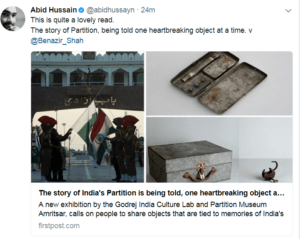
I happened to see a tweet about a museum of objects related to partition

and it reminded me of a story I heard about a particular pair of objects, two old-style massive beds (palang) in a house in Jehlum. Since I doubt that this story has been published anywhere, I thought of putting it down here for posterity:

Continue reading Partition stories; a pair of beds in Jehlum

Objectives Resolution: Logical Culmination or Building Block?

The creation of Pakistan was a culmination of the ‘Indian Muslim National Project’ that was started by Muslim Elites primarily based in UP. It was bound to be a country where religion took center stage in the political arena. Led by a charismatic, populist British lawyer, All India Muslim League was a hotchpotch of landed gentry and titled aristocracy. The Second World War paved the way for an early exit by the British and handed a historic chance to Indian leaders to decide their destiny. It is difficult to predict if a ‘United India’ would have survived for some time in the absence of British interlocutors since fratricide and ethnic cleansing in Potohar had started much before the actual partition. The Muslim Elite (Ashraf) that founded Pakistan decided that the country would be an ideological state, the ideology was chosen to be Islam. Not because the elite overwhelmingly consisted of Islamists (with a few exceptions) but because religion is an easy way to manipulate people. The Khilafat movement had provided a glimpse of what mixing religion and politics could achieve and Muslim Leaguers were well-aware of its power, which is why they used the ‘Islam in Danger’ card during the 1945 election.

Continue reading Objectives Resolution: Logical Culmination or Building Block?

The Man on Mao’s Right..

The Man on Mao’s Right” is the memoir of Ji Chaozhu, a Chinese diplomat who worked as an interpreter for several decades before being promoted to more substantive positions, ending his career as China’s ambassador to Great Britain and a stint as undersecretary general of the UN. His personal story in intertwined with many important events in modern Chinese history, from the Japanese invasion and a peripheral role in the communist’s rise to power (his older brother was a confidant of Zhu Enlai and more or less a Chinese communist agent in the United States), to the Korean war, the early decades of Chinese communism, the Great Leap Forward, the Great Proletarian Cultural Revolution, the fall of the Gang of Four and the rise of post-Maoist China under Deng Xiaoping.

Ji went to school in Manhattan and was a scholarship student at Harvard before most of the family moved back to China to help Chairman Mao build the new China. He is a Chinese patriot and a thoroughgoing Confucian Mandarin at heart, who managed to retain these ideals through decades of purges and ideological twists and turns in China, so he is not inclined to kick up controversy and cross the party’s red lines even in his old age. The memoir seems honest and frank enough when it comes to his personal life, but the politics and political commentary are filtered through a lifetime of extreme care and awareness of what words can mean and what limits are to be kept in mind. He may have exactly these beliefs and attitudes, or he may think these are the beliefs and attitudes he considers safe to share. Either way, opinions that the CCP now considers safe are freely shared, those that could upset the CCP apparently never entered Ji’s head. That’s just how it is in this book.

Continue reading The Man on Mao’s Right..

Right Hand Path Orientalism vs Left Hand Path Orientalism

A few days ago, Razib posted a piece about “Castes of Mind” that discussed Historian Nicholas Dirk’s book that argued that the Indian caste system as it exists may be (mostly) a colonial creation. I have not read Dirk’s book, but it is my impression (from hearing about it) that it is not superficial and has useful information and perspectives in it. Still, what less informed readers take from it, or what residue remains in the Zeitgeist from that book, is a tendency to blame evil British colonialism for whatever is worst about the caste situation in India. In that sense, it has joined the long (and growing) list of “Right Hand Path Orientalism” pieces, written by Western scholars eager to exculpate orientals when it comes to practices that are not in line with current fashions and opinions (as opposed to old fashioned “left hand path Orientalism”, which was much better informed (and far more useful), but frequently racist). Currently the most favored (and sometimes unwilling) recipients of this largess are Muslims, some of whose cultural and religious practices are now considered passe, but since the RightHandPath orientalists do not wish to “blame” Muslims for these views and practices, they prefer to find some way to blame colonialism, capitalism or some other aspect of modernity.  A trivial but truly outstanding example is this astoundingly ignorant and illogical (but extremely well-meaning) piece  about dogs and Islam. 

Continue reading Right Hand Path Orientalism vs Left Hand Path Orientalism

Headwinds Ahead : The Growing Divergence Between Truth and Productivity?

Throughout Human history, Productivity has required an understanding of nature, whether it meant predicting the seasons for agriculture or navigating the seas for trade through astronomy or curing diseases through medicine. European societies gained a huge advantage over other societies by creating incentives for exploration of ideas by institutionalizing patent & copy right laws in the late medieval period and eventually by enshrining the notion of free speech.

Productivity leaped ahead in these societies, which promoted a culture of intellectual exploration of ideas. And never has there been a society where a scientist like Einstein gained a degree of popularity transcending his own time to become the visual cognate to the word “genius”. All this gave a great boost to the social status of many scientists in these societies. And in the 20th century people across the world are now familiar with the name ‘Einstein’. Meanwhile, the establishment of awards to scientists has been an annual affair for over a century by the prestigious Nobel committee. However, the nature of progress itself thus far should not reassure us with regards to the future.

Continue reading Headwinds Ahead : The Growing Divergence Between Truth and Productivity?

Clarifying Two Misconceptions

First up, I want to admit that I been a harsh critic of Pakistan Army’s interference in political matters, their gross inefficiency during all the wars that they fought (and lost), their myopic worldview and land grabbing in the garb of ‘National Security’. However, I believe that two very common misconceptions about our army need to be addressed.

  1. While talking about General Zia, an Islamist dictator who ruled Pakistan for eleven years (1977-88), many people refer to his role in the ‘Black September’ events from 1970. If you try to look this up on the internet, there are conflicting stories about his involvement. What we know for sure is that he was stationed in Jordan as part of a military training mission (Read here) sent by Pakistan in the aftermath of the 1967 Arab-Israel war. The Deputy Chief of Mission (DCM) in Amman at the time was Mr. Tayyab Siddiqui. According to an article he wrote in 2010, (Read here)

“Following the June 1967 military debacle, the Arabs requested Pakistan for military training. Pakistan sent training contingents to Syria, Jordan and Iraq.”

In August-September 1970, the Palestinians, aided by the Syrians, revolted against the Hashemite Kingdom of Jordan. During the battle, the Commanding Officer (CO) of a Jordanian infantry unit deserted. King Hussain asked Brigadier Zia to take charge of that unit temporarily. Zia sought permission from the embassy where Mr. Siddiqui established contact with Secretary Defence, Mr. Ghiasuddin. Ghias’s comments are the most cringe-worthy issue in this whole affair. He cabled Amman that

“We had [performed] Istikhara, Hashmite Kingdom’s star is ascendant. Go ahead. Follow king’s commands.”

In Ambassador Siddiqui’s words:

“That the foreign and defence policy of Pakistan was formulated not on a dispassionate analysis of the situation but on the dubious religious invocation still amazes me”.

Zia took temporary charge of the unit but before any fighting could take place, the Syrians withdrew and the offensive ended. Later on, Zia developed contacts with Palestinian leadership and was not accused of being the ‘Butcher of Palestinians’ by any Palestinian fighter. In fact, Yasser Arafat visited Pakistan three times during Zia’s regime.

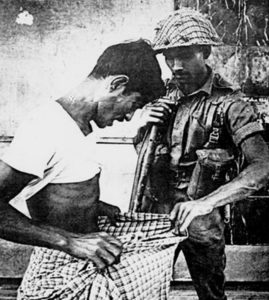
2. You might have seen a picture of a soldier inspecting a Bengali man’s Dhoti, from 1971. That is provided as a proof that Army folks there used to inspect Bengali men’s genitals to decide if they were Muslim or not (based on circumcision status). While the Pakistan Army indulged in some of the worst atrocities against the Bengalis, this picture is not a valid evidence.

This picture was taken by Indian photographer Kishor Parekh. In an interview, his son Swapan Parekh mentioned that it was a photograph of Indian army personnel checking the [Bengali] collaborators for weapons. The caption in Kishor Parekh’s book validates this backstory.

Aryan Migration and its Discontents


How many fires are there, how many suns? How many dawns? How many waters?

I ask this, O fathers, not to challenge. I ask it to know, O poets. (Rig Veda)

The debate about the origins of the “Aryans” and their arrival in India has flared up again, this time triggered by new genetic findings that appear to confirm with a great deal of certainty that large numbers of Indo-Europeans herders migrated into the Indian subcontinent about 4000 or so years ago.  Razib Khan (one of the best informed and unbiased bloggers on this topic) has written in detail about this topic in several posts, the most recent of which is here. I am not going to go into the genetics or the details, I just wanted to recap the story in very simple layperson outline and focus mostly on some of the politics around this topic. My basic argument is that the Hindutvavadi reaction to the political uses of “Aryan Invasion Theory” is relatively justified, but opting to take a stand against population genetics and common sense in the form of a relatively recently concocted (and very unlikely) “Out of India” (OIT) theory is an unfortunate and self-defeating mistake.

The Indo-Europeans who migrated into India were one of several migratory stream that, between 4000-2000 BCE, spread in all directions out of the Pontic Steppe (what is now Eastern Ukraine and Southern Russia, North and North-East of the Black Sea). They were cattle herding, horse breeding steppe dwellers who, like practically all other human populations, were themselves a product of the layers of human settlement and migration that have woven the intricate net of human racial groups since the first emergence of modern humans in Africa. They were also a very successful, capable and warlike people who had developed light, fast, spoke-wheeled chariots (and possibly, the composite bow) that were the wonder weapons of their time.

Continue reading Aryan Migration and its Discontents

The Qatar Crisis

From Dr Hamid Hussain

Qatar’s Dilemma
“Everyone is critical of the flaws of others, but blind to their own.” Arab Proverb

On June 05, 2017, Saudi Arabia, Egypt, Bahrain and United Arab Emirates (UAE) severed diplomatic relations with Qatar and also placed land and air embargo. This move came as a surprise to many as this immediately followed U.S. President Donald Trump’s high profile visit to Saudi Arabia where most heads of Muslim countries gathered. The simmering differences between Qatar and its Arab neighbors reached the boiling point resulting in the June shock therapy.
Qatar is a small country but in the last two decades it has gradually shown its presence on the international diplomatic scene. Qatar began its foreign policy as a broker of negotiations and mediator of conflicts. This combined with softer image of involvement in humanitarian and cultural interactions increased its profile and earned genuine respect. However, in the last few years, it got directly involved in armed conflicts resulting in negative fallout. Continue reading The Qatar Crisis

The pork episode of Master of None

The Aerogram has a piece out, Bacon & (Un)Belief: Religion & American Secularism in Master of None, which reviews The Master of None episode about religion. I kind of agree that it was a little unbelievable in relation to his cousin, and how quickly he became a porkoholic (I don’t think pork is superior to chicken, but that’s a matter of taste).

That being said I think it is important to note a personal aspect of Aziz Ansari’s relationship to religion. Here’s a correction to an article in The New York Times profiling Aziz:

In an earlier version of this article, Michael Schur, the co-creator of “Parks and Recreation,” partly described Mr. Ansari as a Muslim. Mr. Ansari describes himself as an atheist.

Aziz Ansari does not define himself from what I can tell as a bad or liberal Muslim. He says he’s not religious. He happens to be a guy who is an atheist, a very negatively viewed group, who is from a Muslim background, a very negatively viewed group. That is one way we have a lot in common.

Also, I had a bacon experience very similar to Aziz. Though in my case it was at a friend’s house where they were Hindus from West Bengal, and my friend was having bacon. My mom came over and I had a piece of bacon in my mouth. She was a little chagrined. She said I’m not supposed to eat pork products and not to do it again.

In general I still don’t eat much pork and ham. But I really love bacon, and have no problem with pork sausages.

Hasan Minhaj and Aziz Ansari: your race defines you and it doesn’t

Today I watched Homecoming King, a comedy show by Hasan Minhaj. Honestly I wasn’t going to watch it, because Minhaj’s political schtick at The Daily Show was not geared toward someone like me. That is, it’s funny to laugh along with him, but it is much easier if you agree with him politically. To me this is a major contrast with Aziz Ansari, who probably shares most of the politics of Minhaj, but who does not seem to foreground it as much.

Some of this is happenstance. Minhaj blew up on The Daily Show, which focused on politics with a liberal slant. Ansari became more well known through episodic television. That’s going to impact the sort of comedy they put out there.

But after watching Minhaj outside of The Daily Show context, and comparing his routine to Aziz Ansari’s (I’ve also watched much of Master of None), I think it is notable how differently they come off despite the likelihood that on the fundamentals they probably agree about much in American society. In short, Minhaj’s experience and recollection of racism seems much more raw to me than Ansari, who seems to have taken it more in stride.

I was encouraged to watch Homecoming King  in part because Minhaj grew up in Davis, California. I lived there for five years and one of my closest friends during my undergraduate years is a Davis native. In fact I went to her wedding in Davis during Minhaj’s senior year in high school. The centerpiece of Homecoming King happens to be about an event before prom which involved racism of a subtle but hurtful form that traumatized him in a very deep fashion. He’s talked about this incident extensively so you can Google it. But it colors all of Homecoming King.

But there are some differences between Ansari and Minhaj which I think require highlighting. Ansari is 5’6 feet tall, while Minhaj is 6’0 feet tall. Ansari is also darker-skinned, and I think I can say he is less conventionally attractive than Minhaj (readers who are attracted to men can correct me here). Finally, Minhaj grew up in very liberal Davis, California, situated between the Bay Area and Sacramento. Ansari grew up in a small town in South Carolina. I suspect that Ansari probably faced more racism than Mihnaj when he was growing up if I had to bet.

And yet of the two Aziz Ansari seems to be less deeply impacted by the banal ubiquity of white American racism. He acknowledges that it exists, sometimes in a pointed fashion. But he does not seem to let it define him.

In  Homecoming King Minhaj’s trauma from his abortive relationship with a white girlfriend scars him so much that he says he could not date white girls after that. I’m sure Ansari has experienced some level of racism against him on the dating scene. Especially in the South where when he was growing up interracial relationships were probably more taboo than in Davis. It comes up a few times in Master of None, but it’s not defining in any way. He keeps on trying to find someone he can connect with no matter their race, even if “on paper” they should be out of reach for a short dark-skinned guy.

Finally, this is a minor thing, but Ansari is more explicitly disconnected from his Muslim background. He has stated he is an atheist to the media. One episode of Master of None involves him eating pork in front of his parents. Minhaj in contrast seems to own his Muslim identity much more (albeit, of a very liberal cultural variety).

Rather than being exemplars of young brown men in the United States, the subtle differences between Ansari and Minhaj show that there isn’t one way to be brown, and that we aren’t impacted in the same way by how society views us. Like Minhaj I went to high school where I was the only brown kid. Also, like Minhaj I was called Saddam Hussein. Unlike Minhaj my town was overwhelmingly conservative, while his was overwhelmingly liberal. While my town was over 90 percent white (actually more than 95 percent when I went to high school since I’m about 10 years older than Minhaj), his was about 70 percent white. What was the difference between us? A lot of it comes down to personality.

Some liberals of a minority background feel besieged by the white majority. In contrast, many of us who are more conservative accept racism is part of life, but move on, and don’t believe it is as determinative as liberals assert. Much of this comes down to personality differences, rather than race differences. Minhaj and Ansari are both successful politically liberal Indian American comedians from a Muslim background. But how they experienced American society and present themselves still differs because they are still individuals with all the differences that entails.

Brown Pundits