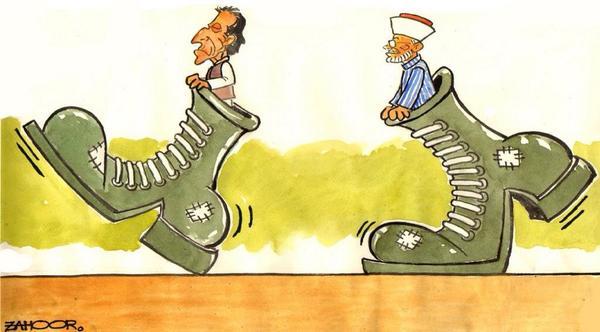
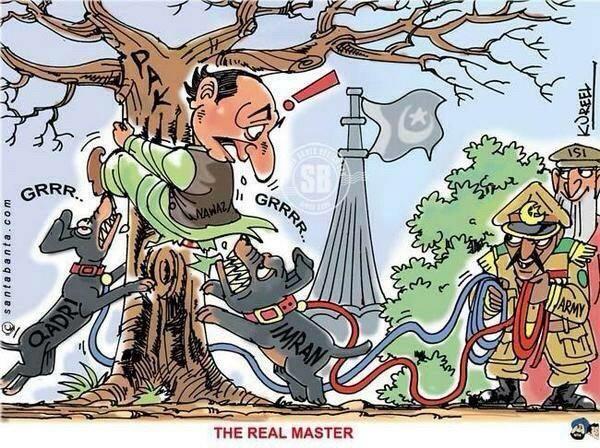
Pakistan following “Bangladesh model”

…..According to the PTI president Hashmi, a script for such a move was laid out
well in advance.
…..”When
Imran laid out the plan, I said to Imran, ‘Khan sahab what are you
doing?…..
He
said, ‘I am telling you there will be elections in September and everything has
been worked out'”……

 ….
What is being proposed is a rule by zero-corrupt technocrats acting in the best interests of the nation (without being harassed by ankle-biting, low-information voters). We wonder why such a common-sense approach has not been acted on before  in Pakistan, and elsewhere, and why there is a lack of durable, successful techno-dictatorships (Chicoms are probably the closest to this ideal).

….

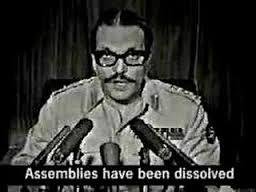
It is notable that Pakistan now (publicly) aspires to follow the example of Bangladesh, when right after Partition-I she imagined herself (with some justification) to be the new Medina in South Asia. 

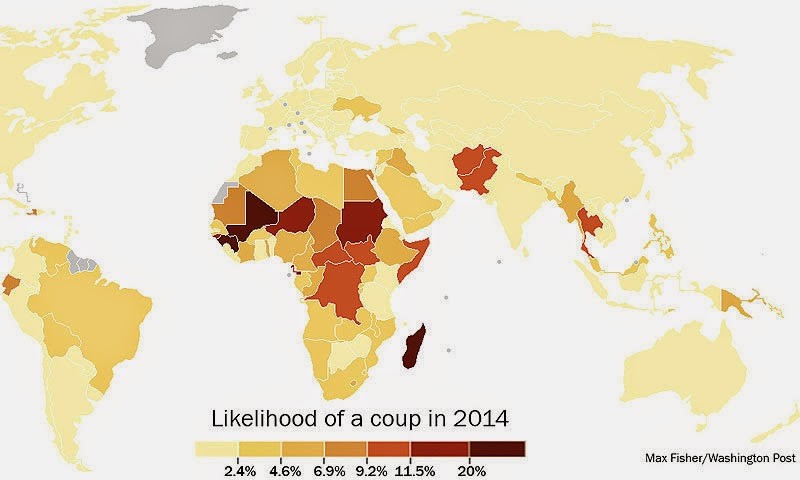
One more point of interest (for parochial Bongs): a look at the map above and we note the likelihood of Bangla herself experiencing a coup in 2014, along with sister nations Nepal, Burma, Pakistan and Afghanistan. It was a hundred years ago when the freedom fighter from Maharashtra, Gopal Krishna Gokhale noted: “what Bengal thinks today, India thinks tomorrow.” This dictum updated for the C21 may read as “what Bangla thinks today, South Asia (sans India) thinks tomorrow.” We speak in jest, of course.
…….
Pakistan
Tehreek-i-Insaf (PTI) President Javed Hashmi’s startling claims of a scripted
political crisis being engineered in Pakistan has led to widespread speculation
among analysts that a version of the ‘Bangladesh Model’ may be in the works.

……
“Imran
had told the PTI core committee it won’t be called a martial law,” Hashmi
alleged at a press conference, hinting at a covert form of takeover by the
military establishment, using PTI Chairman Imran Khan and Chief of the Pakistan
Awami Tehreek Tahir-ul-Qadri as their instruments.


The
‘Bangladesh Model’, a soft coup, is based on the idea that the political system
must be cleansed of corrupt elements for the welfare of the public, which
perhaps has been left incapacitated to elect honest leaders.


The model
works on the premise that the military and judiciary must intervene to help
differentiate the ‘right’ from the ‘wrong’ before it is too late. The model
stipulates that the democracy that follows such a ‘cleansing’ is therefore a
truer form since the people have been rightly ‘guided’ and are now able to make
informed decisions.


Technocrats, current and former officials aligned with the military and
judiciary play a vital role in the implementation of the ‘Bangladesh Model’ of
which the strings are pulled from the background and through an interim
government that remains in power for a lengthy period as happened in Bangladesh in 2007.

….
“If Nawaz
Sharif survives, for the rest of his term, he will be a ceremonial prime
minister—the world will not take him seriously,” said Ayesha Siddiqa, an
Islamabad-based analyst told the Wall Street Journal on Saturday.
“A
soft coup has already taken place. The question is whether it will
harden.”

Reacting to the drama in Islamabad, the International Crisis Group (ICG) had
also warned last week that the possibilities of a coup were very high and that
such a development “would imperil any progress that has been made in
addressing grievous economic, development and security challenges.”


“The
protests rocking Islamabad threaten to upend the constitutional order, set back
rule of law and open the possibility of a soft coup, with the military ruling
through the backdoor,” the ICG said in its statement.


According to the PTI president Hashmi, a script for such a move was laid out
well in advance.

“When
Imran laid out the plan, I said to Imran, ‘Khan sahab what are you
doing?'”

“He
said, ‘I am telling you there will be elections in September and everything has
been worked out.'”

..
In January
this year, the Washington Post cited Pakistan as ‘high risk’ on a list of
countries likely to face coup attempts.

……

Link: dawn.com/javed-hashmis-allegations-what-is-the-bangladesh-model

….

regards

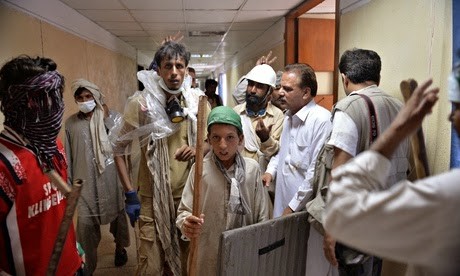
“They have stormed the PTV office”

…..200 supporters of Qadri seized the PTV building……”They
have stormed the PTV office”…news anchor said just before the screen
went blank…..”PTV staff performing their journalistic duties are being
beaten up”…….Khan, who
like Qadri has since 15 August been living on the streets…..frequently
alluded to a “third umpire”….send Sharif home…veiled
reference to the army…..

….

….
This is looking like the beginning of the end. How long is it before Nawaz Sharif departs for Saudi Arabia. This guy is likely to be de-throned for the third time…this has to be a record of some sorts. The closest analogy we can think of is from the fictional depictions of Latin America a few decades back when there would be a musical chair full of supreme rulers which ever way you look.

One thing is for sure, we would not like to tangle with that youngster – the one in the fore-ground with an intense look and a thick stick – down a dark alleyway.

Here is our revenge in a teacup proposal. After the PTI-PAT combo comes to power, can the Sharif brothers return the favor by invading the inner sanctum with their supporters? The country will by then have moved to a permanent chaotic state. The new mind-set is as follows: why bother to co-operate in the national interest, when you can be in opposition and have fun all the time.
…….
Anti-government protesters pushed further into sensitive areas
of the Pakistani capital on Monday, briefly taking over the state
broadcaster and forcing it off air.

……
The police force, under orders
from the beleaguered civilian government, did little to prevent
thousands of supporters of former cricket star Imran Khan
and populist cleric Tahir-ul-Qadri from entering a compound containing
many government ministries in Islamabad and the offices of the Pakistan Television Corporation (PTV).

The
all-powerful army had decreed on Sunday night that the government
should not use force against protesters following clashes on Saturday in
which three people died and hundreds were injured.

The weekend
violence had been triggered when Qadri and Khan ordered their followers,
who had been camped on a road in a high security area of the capital
where government buildings are located, to storm the prime minister’s
residence although ultimately they only succeeded in flooding on to the
lawns of parliament.

On Monday more than 200 supporters of Qadri seized the PTV building, reportedly seizing weapons from security guards. “They
have stormed the PTV office,” a news anchor said just before the screen
went blank. “PTV staff performing their journalistic duties are being
beaten up.”

Army troops also refused to use force and protesters were free to simply mill amid the large troop deployment in the capital. Instead army soldiers asked the crowds to leave restricted areas and not enter government ministry buildings. Eventually, protesters were also persuaded to leave PTV, which then began broadcasting again.


All
sides of the dispute are treating the military with extreme caution and
respect. On Sunday it published a statement saying it was “committed to
playing its part in ensuring security of the state” but wanted the
situation to be “resolved politically without wasting any time and
without recourse to violent means”.

Many protesters say they hope
the army will step in to support their cause by either seizing power or
at least ordering prime minister Nawaz Sharif to step down, just 15
months after he was elected in a huge landslide victory.

Khan, who
like Qadri has since 15 August been living on the streets in a
specially modified sea container, has in his many speeches frequently
alluded to a “third umpire” who will send Sharif home – a thinly veiled
reference to the army.

Although the military has directly ruled
Pakistan for half of its history, and wielded enormous power behind the
scenes even when civilians have nominally been in control, many analysts
doubt the army wants to oust the government.


While senior
generals have repeatedly clashed with Sharif over the past year, an
unconstitutional removal of the government would jeopardise billions of
dollars of much needed US aid.

It is widely suspected however that
the army will attempt to use the crisis to clip the wings of Sharif,
who has defied the top brass by ordering a high treason trial for former
military ruler Pervez Musharraf and by pushing for better diplomatic
and trade relations with India.

But even though the military
appeared to be trying to remain as an independent arbitrator between the
two sides the extraordinary television pictures of troops flooding on
to the streets highlighted the government’s growing vulnerability.

Many
of the soldiers were members of the 111 Brigade, which has been
responsible during past coups for grabbing government buildings – in
particular the offices of PTV. On Monday morning large numbers of troops were seen pouring into the office block in central Islamabad.

The
mornings have generally been quiet during the two-week long crisis that
has gripped Pakistan’s capital with political speeches and rallies
largely being held in the evening. But just before 9am the crowds
began to once again try to remove sea containers placed on roads leading
to the prime minister’s house. Despite the use of teargas and shooting
into the air above the protesters the police were unable to stop the
crowds moving to various areas around Islamabad’s Red Zone.

Khan
said attempts to negotiate had collapsed because the government had
refused to meet his main demand that the prime minister should step
down, even just temporarily whilst a commission of inquiry investigates
last year’s election that Khan claims was rigged to deprive him of
victory. 

While the May 2013 election was not without
irregularities, no independent election monitoring group has supported
Khan’s claims of massive rigging that would have changed the overall
result.

On Monday Khan said he would not call off the protests. “I
call upon my workers to remain peaceful,” Khan said from atop a
shipping container at the main rally site. “Do not carry out any acts of
violence. God has given us victory.”

……

Link: guardian.com/pakistan-protesters-prime-minister-nawaz-sharif-islamabad

…..

regards

This is Rape Culture

The untold story of how a culture of shame perpetuates abuse. I know, I was a victim:

It was with a lump in my throat and tears in my eyes that I read about the horrific cases of abuse and neglect revealed in the Rotherham report this week.
Much of the media coverage has focused on how men of mostly Asian descent preyed on vulnerable young white victims. The details of this abuse are awful. But what has largely been ignored is the report’s finding that sexual abuse has been systemically under-reported among Asian girls due to deeply entrenched cultural taboos – obscuring the reality that there is a similarly rampant problem of minority girls being abused by members of their own community.
I have first-hand knowledge of this problem. I’m coming forward to publicly share my own story in the hope that I can encourage others to do the same and help tear down the wall of silence that perpetuates further abuse.
I grew up in a small community of a few hundred British-Pakistanis in Skipton, less than 60 miles from Rotherham. When I was 10 a neighbour started sexually abusing me. Paralysed by shame, I said nothing.

It was only after a decade away from Skipton that I was finally able to garner the courage to return and testify against my abuser. When I first told my mother about the abuse I’d suffered, she was absolutely devastated. The root of her anger was clear: I was heaping unbound shame on to my family by trying to bring the perpetrator to justice. In trying to stop him from exploiting more children, I was ensuring my parents and my siblings would be ostracised. She begged me not to go to the police station.

I don’t need to get into details with the audience of this weblog to know where this attitude comes from. Readers will be aware that it transcends religion and religiosity, though it is bound within the cultural matrix of which religion is part and parcel. My mother, who condemns Western immorality and libertinism, has expressed sadness that a pedophile who preyed upon girls within her social circle had to flee to Bangladesh, because of the shame it brought upon his family. That’s a culture for you.

Babri Masjid Redux (just say no)

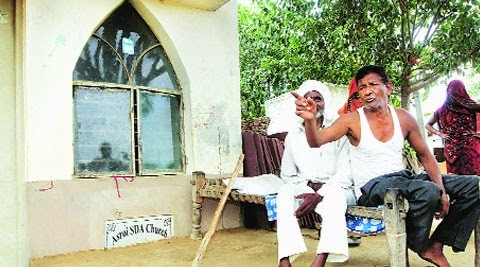
….Ram Pal who raises pigs, said, “We celebrated Holi and Diwali along with Christimas…..people were asking….If you’re a
Christian, how can you be a Dalit?
”…..danger
is that the re-converts will seize the church and put up a temple…..“We will not let another church come
up….there is no Christian left,” said Rajeshwar Singh….

….


Just say NO to any C21 sequel of Babri the horror movie. The powers that be are of the opinion that beating up on minorities will help win elections. This is from the Gujarat playbook but the success there was more out of a sense of Gujarati asmita than Hindu pride. Already there is evidence (recent by-polls in Uttarkhand, Bihar, and Karnataka) that a backlash is taking shape. Finally, people who live by the sword must be prepared to die by the sword as well…a number of ruling party leaders/workers in UP have been murdered in the past few weeks.

As far as the Valmikis (Dalits) are concerned, the important question is how they survive in difficult conditions not their status as Hindus or Christians or Muslims. Religious status is not helpful for improving social status….otherwise there would be no need for separate Dalit Christian burial grounds and Dalit Muslim Mosques.

Religious conversion is a dangerous game and we are ambivalent about the ways to deal with this “problem.” A
true liberal will be for the freedom to convert (and
re-convert). Also if we were truly disadvantaged we would be happy to take money
from all of them buggers and adopt a new religion every week (that will
teach them).

As an aside, we would love to hear Prof. Kancha I-laiah defending pork eating as a millenium old Dalit tradition and his plans to support the cause of the pig-farmers – the Valmiki community – by launching a national pork festival (just like the beef
festivals he supports with so much enthusiasm).
…………
Another contentious issue is foreign money. We do not like Hindu NRIs or Christian Evangelicals or Wahabi Saudis to fund extremists in India and contribute to social disharmony. Religion is one of the most moneyed businesses in India, if people really want to fight conversion battles they can/should fight with local money.

Finally while we are not enamored of constructing yet one more temple or mosque or church, is it OK to insist that these folks first pay up for a 1000 toilets? And while they will be responsible for maintaining the place of worship, they should also take care of maintenance of the toilets. Call it the Temple-Mosque-Church-Toilet scheme (Yojana).
…………..

For 10 years, 29-year-old Ram Pal was a practising Christian, but
three days ago he converted and become a Hindu. The change in faith,
however, has not tangibly altered his life as the struggle to make ends
meet and the worry about the future of his children continue unabated.


….
Despite converting to Christianity in 2001, seven Valmiki families in
Asroi village were not accorded minority status. Instead, the village
register – maintained by the district administration – continued to
identify them as Scheduled Caste. This continued for over a decade, but
Ram Pal said that over the past few years, this ambiguous identity of
being neither a Christian nor a Dalit was becoming increasingly
difficult.


….
Ram Pal, who like others in his community raises pigs, said, “We
still used our SC identity to get our children admission in schools and
avail to various government schemes. We celebrated Holi and Diwali along
with Christimas. But people were asking questions. If you’re a
Christian, how can you be a Dalit?”


Another such Dalit, 44-year-old Ram Chandra, said, “Our children go
to school, on the basis of their SC certificates. But most drop out in
their teens and look for work in Hathras and Aligarh. Now that we’re
Hindu, at least no can doubt that we’re Dalits.”


….
On Wednesday, a church belonging to the 7th Day Adventists that
functioned from a small room in the village was “converted” into a
temple through a “shuddhikaran” (purification) ceremony that saw the
“ghar wapsi” (reconversion) of 72 Dalit Valmikis in the seven families
by various Hindu groups, including the RSS, VHP, Bajrang Dal and Arya
Samaj, said villagers.


….
Ram Pal said that the Dalit community did not want the puja to take
place within the church. “But, they said it was the only way for us to
become Hindus again,” he said.


Meanwhile, Khem Chandra, the Sangh pracharak and pramukh of Dharam
Jagaran Vivad in Aligarh asserted that the conversion was a “conscious
choice made by the Dalit Valimiki community”. However, the news of the
appropriation of the church spread tension in the area.


….
Fearing an outbreak of violence, the district administration locked
the room on Thursday. The Shiva poster, which was put up in the place
where a framed-photograph of Jesus Christ used to hang, has been taken
off  “and kept in a safe place.”
The belongings of the church – a cupboard, Christmas-lights and a single copy of the Bible – has also been kept in a locker.

….
The Christian community has alleged that such conversions were a part
of an RSS conspiracy, aimed at reaping electoral benefit. Seeking
immediate action against the perpetrators, civil rights activist John
Dayal said, “It is the right of an individual to convert to any religion
of his choice. But such mass conversions imply political, social and
physical coercion and the threat of violence.  I condemn the coercion
and conspiracy of the Sangh Parivar which is using it to polarise the
religious environment in the state with an eye on the elections.”


….
Father  Dominic Emmanuel, community leader and the editor of a
Christian magazine in Delhi said, “With the BJP in power, these groups
have become aggressive.”
The village pradhan also pointed out that the BJP, for the first
time, had received an overwhelming majority of the votes in the village.
“Usually, the votes go for RLD. This time the elections was about
Hindus and Muslims and every one voted for Modi. That has been reflected
here,” said Vikas Choudhury, pradhan of Asroi.


….
But, while the RSS and the VHP have been making in-roads into the
village by working with the Dalit-Christian community, villagers said
that it was not simply a matter of faith, but also economics.
 

“Over the years, the activities of the Church here have receded. We
were promised schools, health care and better lives, but nothing came of
it. We haven’t been accorded minority status and soon, we feared, our
Dalit status would also be taken away from us,” said 54-year-old Guji
Lal, who added that Hindu groups in the past months had been
increasingly active in the village, convincing people to ‘reconvert’ to
Hinduism.


…….

When the
demolition of the Babri Masjid was threatened in 1991, Parliament en acted a
law prohibiting the conversion of any place of worship of one religion into
that of another, the only exception being the Babri Masjid itself. Back then,
the Vishwa Hindu Parishad sought to demolish 3,000 mosques, claiming these were
once temples.


This threatened 3,000 more clashes of the Babri Masjid variety,
stoking communal carnage and destroying Indian secularism. The Masjid was
ultimately demolished, but the new law helped prevent the disease spreading to
other places of worship.

The
problem has returned in unexpected fashion in Aligarh. It must be tackled
before it can grow.

In
Aligarh, several dalits were once converted to Christianity by the Seventh Day
Adventists. That organization then built a church for its new converts.
However, 72 of these dalit Christians have been re-converted to Hinduism by the
Dharam Jagran Vibhag (DJV), an RSS branch aiming to stop conversions of Hindus
to other religions, and attempt re-conversion.

The DJV
organized a “shuddhikaran” (cleansing ceremony) to wash away the Christian
“taint” in Aligarh. A Shiv poster was put up in the church, but later removed.
The alarmed Seventh Day Adventists locked up the church.

The danger
is that the DJV and re-converts will seize the church and put up a temple
there. “We have found a place near the chabootra (verandah). That is where we
will set up the temple. I don’t have anything to say for the church. We have
done the shuddhikaran in the building, whether they want to uproot the church
or raze it to the ground is their headache. We will not let another church come
up because there is no Christian left,” said DJV pramukh Rajeshwar Singh, who
came from Uttarakhand for the re-conversion.

Khem
Chandra, a local member of the DJV, added, “We will think about the church
building. It belongs to the missionaries, but the ground on which it stands
belongs to Hindustan. We will not compromise on our dharti (earth). We will
meet the villagers and decide about the temple (coming up).”

Now, our
Constitution and laws clearly permit the conversion and re-conversion of
individuals from and to any religion. The use of financial and other
inducements for conversion is illegal, but voluntary conversion is permitted
freely. The Seventh Day Adventists and the DJV both have a right to convert
people to their respective faiths. 


The RSS claims that foreign Christian money
is being used to “buy” converts to Christianity. This has certainly happened in
some countries, leading to the derisive term “rice Christians”. But the
Christians point out that overseas Hindus pour enormous sums into Indian
religious organizations. Besides, Indian temples and organizations have
humungous wealth. If indeed faith can be bought, Hindu organizations have a
distinct financial advantage in India, and can easily outbid Christian ones.

But this
is just a distraction. Financial inducements for conversions are illegal. Only
voluntary conversions are legal.

What is
clearly illegal, however, is the destruction of a place of worship, or its
conversion into a place of worship for another sect or religion. The 72 dalits
in Aligarh can follow any religion they want, but cannot claim ownership of the
church, which belongs to the Seventh Day Adventists.


The mere fact that the 72
dalits worshipped in that church does not make it their personal property, to
be disposed of as they like. They can build a temple on any other land, close
or far from the church. But they cannot claim, as DJV leader Khem Chandra has
done, that the church building may belong to the Christians, but the ground
underneath belongs to Hindustan.

Hindustan
does not mean the exclusive land of religious Hindus. Historically, Hindustan
simply meant the land of the people of the Indus valley. The Constitution is
very clear that India is a land of multiple religions where persons of all
faiths are equal, and none can be discriminated against.

……

Link (1): stop-new-babri-movement-against-churches

Link (2): indianexpress.com/didnt-get-minority-status-so-embraced-hinduism

…..

regards

The doctor has no heart

….the Indian-American physician….describes how the medical profession has become pitiless, mercenary…..money ripping vocation where doctors treat patients as revenue
generators….keep patients in hospital longer than
necessary….order needless tests….helping predatory pharmaceutical companies sell dangerous
drugs……doctors are
suffering from a “collective malaise” of discontent, insecurity, and
immoderation….. 

….

 …
No no no no, we did not say that….we still hero-worship doctors..for us it is the ultimate noble profession.

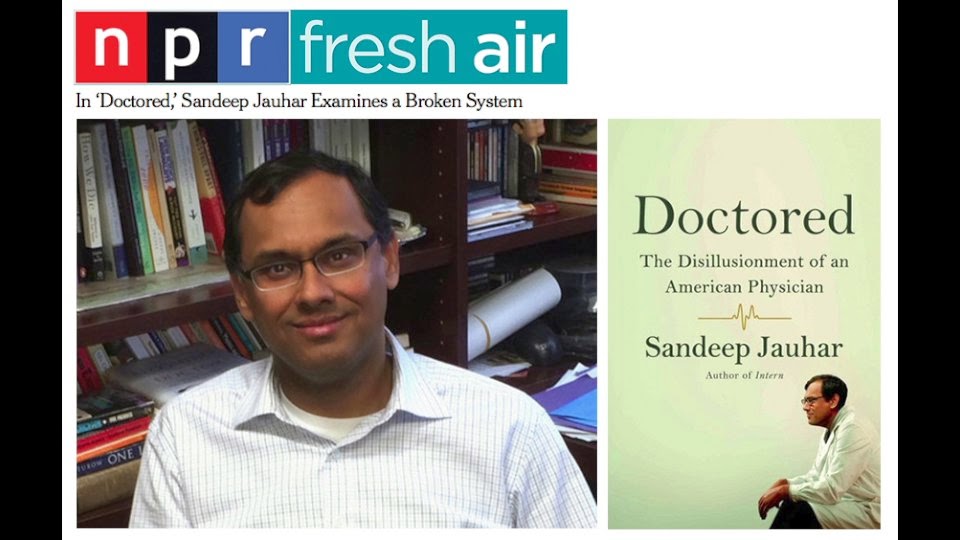
But then according to Dr Sandeep Jauhar,  things are very wrong with the medical community in the USA. He speaks as a person from within the belly of the beast, and he claims to speak on behalf of the many outstanding doctors from the Indian American community (and the medical profession as a whole). Who knows if there is any substance in his (devastating) allegations…common people will tend to think that no smoke can result without fire.
…….

The growing discontent has serious
consequences for patients. One is a looming shortage of doctors,
especially in primary care, which has the lowest reimbursement of all
the medical specialties and probably has the most dissatisfied
practitioners. 
Try getting a timely appointment with your family doctor;
in some parts of the country, it is next to impossible. Aging baby
boomers are starting to require more care just as aging baby boomer
physicians are getting ready to retire. The country is going to need new
doctors, especially geriatricians and other primary care physicians, to
care for these patients. But interest in primary care is at an all-time
low.

Perhaps the most serious downside,
however, is that unhappy doctors make for unhappy patients. Patients
today are increasingly disenchanted with a medical system that is often
indifferent to their needs. 

People used to talk about “my doctor.” Now,
in a given year, Medicare patients see on average two different primary
care physicians and five specialists working in four separate practices.
For many of us, it is rare to find a primary physician who can remember
us from visit to visit, let alone come to know us in depth or with any
meaning or relevancy.

Insensitivity in
patient-doctor interactions has become almost normal. I once took care
of a patient who developed kidney failure after receiving contrast dye
for a CT scan. On rounds, he recalled for me a conversation he’d had
with his nephrologist about whether his kidney function was going to get
better. “The doctor said, ‘What do you mean?’ ” my patient told me. “I
said, ‘Are my kidneys going to come back?’ He said, ‘How long have you
been on dialysis?’ I said, ‘A few days.’ And then he thought for a
moment and said, ‘Nah, I don’t think they’re going to come back.’ ”

My patient broke into sobs. ” ‘Nah, I don’t think they’re going to come back.’ That’s what he said to me. Just like that.”

It
is the Holy Grail for almost every Indian parent: that their son and or
daughter go to medical college, become doctors, and embark on a thriving career
that brings laurels – and sure, some lolly. 
…It’s no different with NRIPIO
parents, in the US, UK, or elsewhere, which is why the nearly 100,000 Indian
American physicians in the US includes some 20,000 who are either born or have
grown up in America and graduated from US medical schools. 
Dr Sandeep Jauhar
has been there, done that – and not liked it one bit. And he’s blown the
whistle on his profession – or ripped it apart with a scalpel. Medicine, as
practiced in the United States, is sick – very, very, sick.

In a devastating – and immensely self critical – book that is making waves in
the US, the Indian-American physician, with specialization in cardiology,
describes how the medical profession has become a pitiless, mercenary medical
profession, money ripping vocation where doctors treat patients as revenue
generators rather than human beings, keep patients in hospital longer than
necessary to bill them more, order needless tests to generate profits, and cozy
up with drug reps helping predatory pharmaceutical companies sell dangerous
drugs. American doctors – and that includes Indian-Americans like himself -are
suffering from a “collective malaise” of discontent, insecurity, and
immoderation.

None of this is a great secret; discerning patients, activists, and even many
physicians themselves have recognized this for a long time in the US. But its
Dr Jauhar’s astonishing candor in `Doctored: The Disillusionment of an American
Physician’ that has shocked the medical fraternity and layman alike, shattering
the image of the doctor as a do-gooder -and for Indians, that of the NRI
physician as the epitome of nobility. 

No one comes out looking good in this
tortured, self-lacerating book: not Jauhar himself, nor his brother (also a
cardiologist), nor physician friends and mentors, and not the American system.
This is the Ferguson moment in medicine – ugly but true.

Asked in an interview
on Thursday if he intended to stay on in the medical profession at all, given
the shock and horror his book is creating (the NYT reviewer said this is the
first book that’s prompted her to write “Yuck!” in the margin), Dr
Jauhar said he owed it to his readers to give them the unvarnished, unfiltered
truth, without being irresponsible. 
“Probably the person who comes in most
for criticism is myself. When you are willing to be self-critical, people will
appreciate it,” he told me gravely, after initial jokes about his taking
potshots at his own family, including his father, subsided. “I am
disillusioned with how medicine is practiced in this country but not
disillusioned with being a physician. “
….
Jauhar’s sulfurous chronicle of the
medical profession in the US begins almost as soon after he graduates from
fellowship and takes a salaried job at a hospital (after 19 years of college
education, including a PhD in physics). 
The hours are brutal, the money is
meager, and before long he becomes part of the venal system, treading dodgy
ethical terrain to keep his body, soul, and family together. He moonlights on
other jobs and shills for pharma companies as he observes compromises,
cronyism, and corruption flow like crud through the system. Doctors, hospital
administrators, the health insurance sector, and pharma industry collude and
conspire in sundry ways to rip-off patients – some who want to live forever
despite being at their careless best.

The dysfunction is not entirely due to doctors. Jauhar describes how external
sources – the government, the insurance industry, and pharma companies – have
all played a role. Doctors, particularly primary care physicians and
internists, who previously spent 20-30 minutes with each patient, now hurry out
after 10 minutes because they now have to see twice the number of patients to
generate the same revenue. 

….
As a result, patients do not get the attention they
deserve and are not diagnosed properly. Meanwhile, some specialist doctors get
to bilk the system (which is why everyone wants to specialize and there are
fewer primary care doctors in the US), prescribing a multitude of tests and
treatment -some to cover for malpractice liability, others to generate more
revenue. Patients who came in complaining of even routine breathlessness are
hustled into taking nuclear stress tests and bumped into cardiac procedures.
That’s because insurance companies don’t pay doctors to spend time with
patients trying to understand their problem. But they pay for CT scans and
stress tests whether they’re needed or not.

Elsewhere, hospital administrators are also constantly putting pressure on
doctors to keep occupancy rates high enough to generate profits (somewhat like
hotels). Jauhar cites the economist Julian Le Grand’s idea of humans as
knights, knaves, or pawns, to describe how the American system promotes knavery
over knighthood. 


But most of all, once you read this tormented, self-lacerating book, it’s hard
to see a doctor with the same respect. Doctors know it too. In a survey cited
by Jauhar, 30 to 40% of US physicians today say they will not choose the same
profession if they had a choice; and even more would not encourage their
children to. The medical profession, it appears, is terminally ill, in the
United States at least.

…..

Link (1): wsj.com/usa-ailing-medical-system-a-doctors-perspective

Link (2): A-heartless-profession

…..

regards

The United Colors of India

…..I am a Hindu, but that is an absurd thing to say….there is
nothing like a Hindu…..I am a Brahmin….that doesn’t describe me either…..I am a Hindu in a broad way….Ganga is sacred, Ramayana and the Mahabharata, Upanishads
have deep spiritual insights….All this I believe…..I believe what my
ancestors believed, that is, there is not one God…. Hinduism is also
difficult because it is based on hierarchies…..

….
We are largely in agreement with UR Ananthamurthy – hero of the left-liberals and a (Brahmin) disciple of (Shudra Socialist) Ram Manohar Lohia – that India should find a common path forward based on harmonizing Gandhian and Ambedkarite principles. Except that the true devil is in the details…Gandhi disliked Western societal mores…Ambedkar was passionate about the American way.

We would like to expand the pantheon by borrowing a liberal lion from the West, such as John Stuart Mill or Thomas Paine. If there is a demand for a C20 inspirational figure then we propose Vaclav Havel…because of his life experiences under a non-liberal regime. Next, a humanist/atheist like Richard Dawkins (or Sam Harris, Christopher Hitchens,…) because we would like India (and Indians) to move away from religion and towards humanism.  

Finally as one of the great Indians (re: Ramchandra Guha, see details below) and as a woman, we would recommend Kamaladevi Chattopadhyay (or Sarojini Naidu), the freedom fighter and social reformer.
………………….
Earlier this year, Udipi Rajago­pa­la­charya Ananthamurthy
(URA), the Jnanpith award-winning Kannada novelist, educationist and
public intellectual, had declared that he would not live in an India run
by Narendra Modi. This had provoked lacerating responses from
right-wing Hindutva supporters. URA breathed his last on August 22,
2014, before the Modi government completed 100 days in office. ….

Chandan Gowda
of the Azim Premji University had interviewed the litterateur for an
eight-part Doordarshan series, telecast in June and July. It is possibly
URA’s last major interview. Excerpts:


….
What parts of the Gandhian legacy are important for you?

His suspicion of the modern world system is one. The modern world
system will destroy the earth, will destroy the sky, will destroy the
balance bet­ween nature and man because it is very greedy. Gandhi’s
rejection was sometimes extreme. But extremes can open the gate of
heaven, that’s what they have said. 


So Gandhi exaggerated at times, but
in the main you know that. He used trains all the time. But he said we
could live without trains. He rightly feared centralisation. Gandhi was
also friendly towards nature. There are many valuable Gandhian ideas.
The whole idea that small is beautiful comes from Gandhi. So he wanted
such ideas to govern the whole country. He didn’t like big buildings.


….
How do you view Nehru’s legacy?

I can still say primary education should  be nationalised and that
the healthcare system should also be nationalised. Where do I get these
ideas from? I get them from Nehru and, later, Indira Gandhi. We get
something very wholesome from the Nehruvian tradition.


….
What has Ambedkar meant for India’s politics in the 20th century?

I think nobody can help the Dalits reg­ain their self-respect as much
as Ambedkar can. Gandhi makes them regain their self-respect, but when
they regain it, you know, they will be softer than what they are. But
with Ambedkar, they can be themselves and still get self-respect. 

..
Ambedkar was a socialist and had a legal mind. His becoming a Buddhist
is very important for me. It’s not merely a political act. It’s a deep
act of self-purification. So Gandhi and Ambedkar began with two
different directions but they meet at one point, wanting spiritually
enhanced visions.


….
Lohia has meant a lot for you as a writer and thinker. How do you evaluate Lohia’s criticism of tradition?
I learnt a great deal from Lohia—to become what I have always called a
critical insider. Lohia was a very great critical insider. He absorbed a
lot from India’s spiritual traditions. He has written a great book, Interval During Politics, which has essays on Valmiki, on Vyasa, on Rama, Krishna, Shiva. They are great. 


Another great essay called Lessons in Yoga
shows he was deeply rooted in tradition. He knew his Shankaracharya
too. But he was very critical of the Brahminical element, which becomes
more and more important as Indian civilisation evolves. He was also
critical of the Shudras behaving in Brahmin ways. His opposition to
English as a language of knowledge was important to me.


….
Lohia was able to produce more pol­itical leaders than Nehru did.
Nehru inherited his friends from his party, but Lohia created a new
leadership. You find it in Uttar Pradesh and Bihar. Mulayam Singh Yadav
and Laloo Prasad Yadav, for example, are products of Lohia’s movement.
And Karnataka too has seen many fine socialist leaders. Unfortunately,
the socialist leadership became populist in some places. Lohia himself
was critical of these trends. He wanted some anarchy so that India kept
thinking of alternatives.


…..
How have you understood your relation with the Hindu dharma?

I am a Hindu, but that is an absurd thing to say. I mean, there is
nothing like a Hindu. I should say I am a Brahmin, to be very exact. But
that doesn’t describe me either, because I have given up the
ritualistic part of the Brahmin religion. 


I am a Hindu in a broad way,
in the sense that all of us believe that the Ganga is sacred, that the
Ramayana and the Mahabharata, our two great epics, and the Upanishads
have deep spiritual insights. All this I believe. I believe what my
ancestors believed, that is, there is not one God but we can imagine
several gods and describe them in different ways…. Hinduism is also
difficult because it is based on hierarchies.


….
Has anything about Indian politics struck you as mysterious?

The fact that if you are an ascetic and if you have given up
everything, you can go beyond language, religion, caste, and appeal to
the whole country. You know when Gandhi emerged, it was a mysterious
thing, because he was neither a Bengali nor a Maharashtrian. All great
leaders until then had come from eit­her Bengal or Maharashtra.


….
How do you understand the need for swaraj in thought in India today?

I an not too passionately involved in what they call the desi,
because you will not find the pure desi when you search for it. It is
based on Sanskrit; it is mixed with Persian; it’s linked with different
rulers at different times.  There is nothing pure even in our folklore.
Therefore, I am more a follo­wer of Pampa (the 10th century Kan­­­nada
Jain poet), who wanted to combine the desi with the marga.


All my writing is a combination of the desi and the marga. I have
perhaps more marga in me than desi. But there is something like swaraj
in ideas. I have a feeling that we have become second-rate imitators of
the West. There was absolutely no original thought in India, except for
Gandhi, over the last two centuries. He was the only original thinker
and he had the courage to imag­ine a world without railways, without
technology, without whatever Britain brought to India. He could conceive
of a world without these and hence some kind of swadeshi chintana was
possible for him, that we can survive without the aid of the West. That
we can be intellectual without depending heavily on western thinkers.


….
What are the challenges facing someone who chooses to write about India in English?

Anyone who writes in English should be deeply knowledgeable about at
least one Indian language. I say this for all journalists too. You
cannot be an English journalist in Karnataka unless you know Kannada.
Similarly, for anthropological, sociological and other kinds of
writing.  I think it is very necessary to know how people think, how
people feel. You should be able to grasp that. And an ins­tinctive grasp
becomes possible if you know the language of the people.


….
Does it matter very much to you that people like you?

I enjoy being liked. Though I am ill, I forget I am ill because of
the affection and warmth I get from people who read me, who remember
what I write, who write me letters. I like it very much.


….
Could you tell us how you would like to be rem­embered?

As a Kannada writer. For having made a contribution to Kannada
through my works…that there are many younger writers who will get
something from me, because I have brought whatever I could from my own
past, from my Brahminical past, from the European world, from my various
experiences, and from my probing of my own self into the Kannada
language. It might be a threatened language in the modern world, but I
have worked against the threat and that is an achievement. I would like
to be remembered as a teacher, as a writer.

…………..

Consider, in this regard, the current invisibility from
the national discourse of Kamaladevi Chattopadhyaya. Married to a man
chosen by her family, she was widowed early, and then married a
left-wing actor from another part of India. She joined the freedom
movement, persuading Gandhi to allow women to court arrest during the
Salt March and after.

After coming out of jail,
Kamaladevi became active in trade union work, and travelled to the
United States, where she explained the relevance of civil disobedience
to black activists (her turn in the South is compellingly described in
Nico Slate’s recent book Colored Cosmopolitanism). 

After
Independence and Partition, Kamaladevi supervised the resettlement of
refugees; still later, she set up an all-India network of artisanal
cooperatives, and established a national crafts museum as well as a
national academy for music and dance. 

Tragically, because her work
cannot be seen through an exclusively political lens, and because her
versatility cannot be captured by a sect or special interest, Kamaladevi
is a forgotten figure today. Yet, from this historian’s point of view,
she has strong claims to being regarded as the greatest Indian woman of
modern times.

……

Link(1): http://www.outlookindia.com/printarticle.aspx?291808

Link (2): hindu.com/indians-great-greater-greatest

……

regards

Love Jihad: problem resolved

recent case of Tara
Shadeo…deceived by Ranjit Kumar Kohli
into marriage….real name Raqibul Hasan
Khan….
.suggestion for the Muslim community….advocate a court marriage
in the case of mixed couples….if a girl from another community is to enter a Muslim
home….genuine effort to have a more enlightened
approach….

….

…….
We are in complete agreement with Saba Naqvi Bhaumik (a Shia Muslim married to a Bengali Hindu) that civil marriages will go a long way to help resolve the love-jihad problem….but why not suggest civil marriage for every one? Especially as she (correctly) notes that personal marriage laws “diminish women.”

………..

……..
As SNB explains there are enough morons (to borrow the language of Ram Gopal Varma) like Raqibul Hasan Khan to bring to life (and keep alive) the “love jehad” theory. Fact remains that Muslim boys/girls will be falling in love with Hindu girls/boys. We imagine that the social barriers today are a bit more tightly drawn around muslim girls, hence the Muslim boy-Hindu girl match is more likely…hence all the poisonous confusion.
…………..
This is how a muslim women rights body views the problem with the personal law as applied to marriages:
….
Among other things, the draft law contemplates a complete ban on
the oral, unilateral and triple divorce (talaq)
and seeks, instead, use
of ‘talaak-e-ahsan’ method where at least four attempts at
reconciliation are made before the divorce is granted. 

….
The draft law stipulates that a Muslim marriage should be solemnised
only when the bride is at least 18 years old and the groom 21.
Further,
there should be “an unambiguous consent” by both, and neither of them
should have a living spouse. Polygamous marriage should be strictly prohibited and marriages
should be compulsorily registered, payment of maintenance to the wife
and children must be made mandatory
during the marriage, or in the event
of separation and divorce, it says. 

A minimum ‘mehr’ should be paid to the bride before the marriage
and the amount should not be less than the groom’s annual income, the
draft law says.
The BMMA will launch a nation-wide campaign for creating
awareness about the need to codify the Muslim Personal Law and make the
government act towards it, Soman said. 

………. 


The way we see it is the conversion “problem” is essentially an issue of purity. For example in a Brahmin household, a Muslim daughter-in-law may not be permitted to participate in puja ceremonies. Likewise a Hindu daughter-in-law will create a problem for Muslim households. However that is essentially a problem for the pandits and the maulavis to resolve. Simply issue fatwas that all temples (mosques) is open to people of all faiths, creeds and castes.

As we march to the future we have the following three choices: (1) we harmonize in a manner that is considered to be fair by all communities, or (2) we fight and break up (partition) or (3) we fight and the minority groups get assimilated (by the majority). Option II was the easiest one and we have seen two partitions over six decades (both disasters at an epic level). 

Option III is an even more ugly one (and right now we have something like that taking shape in Pakistan where Hindu girls are abducted in plain view) and the Sangh Parivar will be very happy to work towards this goal. Here we should also mention that the separate but equal approach favored by the left-liberals and secularists did not work in the USA and will not work in India. It is also a repulsive notion. 

That leaves us with only Option I as the reasonable way forward.

As we imagine, conservative muslims dislike civil registration of marriage because it is not the way of the Sharia and more importantly, this is a backdoor way to assimilation (with Hindus). The actuality will be that inter-faith couples will further the cause of communal harmony. We are a great believer in inter-caste marriages as well and for the same reasons. The idea of India is an important one to support (and to strengthen) and we cannot let the extremists win. 

…….
If there is a historical profile to be used, it would be upper-caste
men and/or Muslims who controlled lands and would just pick up and
devour women from the lower castes or social strata. It is very likely
that following some cross-rel­igious marriages, the woman is pressurised
to convert. 

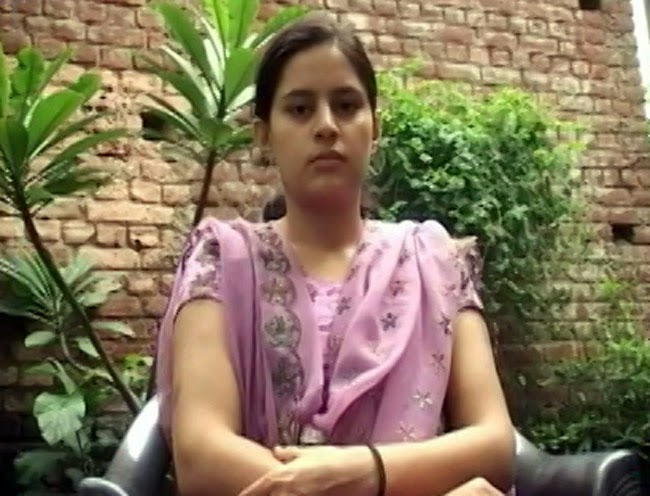
The recent case in Ranchi of national-level shooter Tara
Shadeo, who has alleged that she was deceived by one Ranjit Kumar Kohli
into marriage, only to discover that his real name was Raqibul Hasan
Khan, is a sad individual tale with its own particular details. No
responsible organisation in multi-religious India would see it as
conclusive evidence of a trend involving over 144 million Indians.


….
More than an insult to men from a particular denomination, the notion
of love jehad is at its core an insult to all women, who are seen as
nothing more than chattel, led astray sometimes by wicked men with
impure thoughts.
But they can apparently be made to see the righteous
path with the help of the VHP/RSS that has launched a “brotherhood”
campaign in western UP where Hindu girls will tie rakhis on Muslim men.
In the land of khap panchayats, brother and sister will presumably live
in innocent harmony till the families decide it is time for wedlock and
child-rearing to keep the caste and community lineage going.


….
Empirical socio-economic data should be collected from areas where
love jehad is supposed to have happened and where it has now allegedly
spread to. That would be Kerala, the Mangalore coast of Karnataka and
now western UP.
One can hazard an intelligent guess that in all these
regions the Muslim community would be large in numbers, of which there
would be a prosperous strata. They would have come up economically and
it is also very likely that the more visible signs of this prosperity
would be an increase in the numbers of minarets of madrassas and
mosques.


….
Still, people do live in the same towns and the chemistry of love and
attraction cannot be circumscribed. Girls of one religion will continue
to fall in love with boys from another and vice versa. 

But because the
situation in UP is poised so delicately and the potential for trouble so
great, here’s a suggestion for the Muslim community: clerics, prominent
citizens and elders of the community should advocate a court marriage
in the case of mixed couples. As it is, Muslim personal laws diminish
women’s rights. If a girl from another community is to enter a Muslim
home, a genuine effort should be made to have a more enlightened
approach. 

In the small towns of UP, the community should organise,
reflect and come up with a rational strategy. Clerics too must show that
they can speak for something beyond defending regressive personal laws
and feeding off the fears of a community.

…….

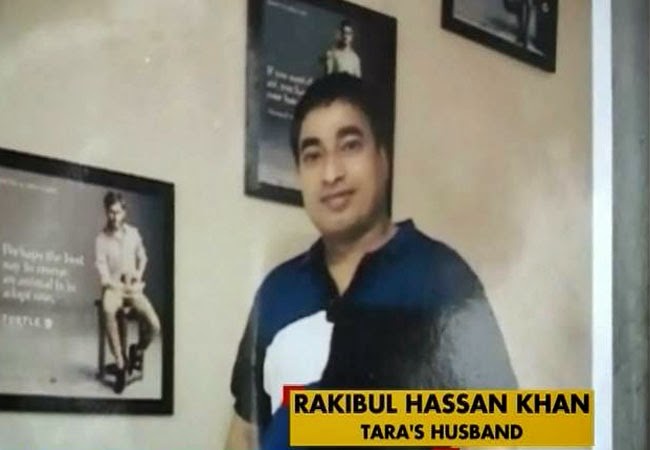
The husband of national champion shooter Tara Shahdeo was arrested in
a joint operation by Jharkhand and Delhi Police on Tuesday night,
sources said. Ranjeet Singh Kohli alias Rakibul Hassan Khan, 30, was arrested from a place near the Delhi-Ghaziabad border.

Last
week, national rifle shooting gold medallist, Tara Sahdeo, had alleged
that she was tortured to change her religion to Islam by a Muslim man
who claimed he was a Hindu and married her. In her police
complaint, Sahdeo claimed she got married in June this year to a person
named Ranjit Kohli. She said the marriage was solemnised as per Hindu
rituals.

However, during the Islamic
holy month of Ramadan, when people invited her husband for Iftar, she
came to know that her husband’s name was Rakibul Hassan. She allegedly
found the name on the invitation cards to the Iftar.

She also alleged that Hassan and 20 other people forced her to change her religion. When she refused, she was allegedly beaten up. Sahdeo
also alleged that she was threatened with dire consequences if she told
anyone about the conversion. She alleges that she was kept under close
vigil but when Hassan went to New Delhi on  August 19, she sent a
message to her family members and was rescued.

…..

Link (1): http://www.outlookindia.com/printarticle.aspx?291813

Link (2): muslim-womens-organisation-seeks-changes-in-personal-law

Link (3): love-jihad-tara-shahdeo-rakibul-hasan-khan-ranjeet-singh-kohli

“Its a jungle out there”

…..“You can’t see anything here at D-Chowk. The tear-gas is
overwhelming……I have my shirt tied around my face, as do most of the
other people who are still here…..This is madness, it’s a jungle out
here”…..a Dawn reporter on Constitution Avenue described the melee that took place on Saturday night…..

….
Its actually a war out there. People are drowning in tear gas, women are fainting. The Prime Minister has abandoned his palace (residence). Every one is issuing threats, deadlines and what not.

So this is what happens when the civilians try to go up against the khakis – their nose gets really really rubbed into the ground. Lost of pawns (people) get shoved around. The polio vaccination drive in Sindh comes to a full stop. The economy goes into a tailspin. The rupee tumbles against the dollar. The international agencies and the diaspora (and even the neighbors) pray that ultimately there will be stability.


The army will stop the tear gas, the drownings, the killings. Nawaz Sharif will fly out to Saudi Arabia. Zardari will go to prison. The army will chase out the darkness and bring the sunshine back to Pakistan. Long live the Army.
…………

“You can’t see anything here at D-Chowk. The tear-gas is
overwhelming. I have my shirt tied around my face, as do most of the
other people who are still here. This is madness, it’s a jungle out
here.”

This was how a Dawn reporter on Constitution Avenue described the melee that took place on Saturday night.

The
capital city’s high security area, the Red Zone, resembled a
battlefield as marchers from the Pakistan Tehreek-i-Insaf and the
Pakistan Awami Tehreek, en route to their new destination – the Prime
Minister’s House – clashed with security personnel.

Just after
10pm, when both Tahirul Qadri and Imran Khan gave their supporters their
marching orders, advancing demonstrators heading towards The
Presidency, Cabinet Division and Pakistan Secretariat were met with
rubber bullets and tear-gas from the heavy police contingents deployed
in the area.

Protesters, mostly men, armed with sticks advanced
onward towards the PM’s House, which is located behind the Presidency
and the Secretariat. Initially, police and security personnel deployed
on Constitution Avenue moved back and allowed them through. However,
when charged activists tried to storm official buildings, they were met
with force.

According to DawnNews, at least one person was killed
– a woman from the PAT camp – and well over a 150 people injured. Then,
just before midnight, the protesters began to push back and hit out at
the law enforcement personnel with anything they could lay their hands
on – batons, sticks and stones, marbles and slingshots.

To counter
the debilitating effect of tear gas, several piles of trash were set
alight by the protesters. Others had salt and wet towels handy, to keep
from succumbing to the crippling gas.

On the streets of the
capital, there was an eerie calm. Many chose to remain indoors for fear
of getting caught up in the clashes. Ambulance sirens could be heard
wailing throughout the night as the injured were ferried from the melee
to Polyclinic, Pims and other hospitals across the city.

After
a whole day of anticipation, just after 9:30pm, both Tahirul Qadri and
Imran Khan gave their supporters orders to march towards PM’s House.
Both were clear that their followers should remain peaceful and were at
pains to stress that women and children should stay behind.

Imran
Khan promised marchers that he would lead them from the front. But as
the procession began to move, his container got left behind.

Military
and rangers deployed inside the perimeter of the Cabinet Block and
parliament building looked on as cranes lifted containers blocking the
path towards PM’s House.

Both sides were raising slogans
proclaiming unity between the marching parties. Some charged individuals
ran towards the Presidency. That is when police began firing tear gas
and rubber bullets, stopping most people in their tracks.

Dense
clouds of tear gas forced many-a PTI supporter to abandon D-Chowk and
their attempt to march towards PM House. At midnight, the area which had
hitherto been occupied by demonstrators from PAT and PTI looked more
like the rubble of a warzone. Many women were reported to have fainted,
and over 80 people were rushed to Polyclinic, which reported around
midnight that it was full to capacity. At the time of going to print,
Pims reported at least 50 injured were being treated there.

…….

Link: islamabad-protests-all-hell-breaks-loose

….

regards

Mission 5000

Everything in life needs a mission (and a vision) statement, even a humble blog like BP.

When the old brownpundits “crashed and burned” we were very sad that such a wonderful meeting place of ideas is lost forever. We must thank the proprietors for bringing BP back into our lives.

At that time the thought occurred that something must be done – an initial spark – that leads to a solid foundation from which further progress (incremental) is possible.

This is how Mission 1000 came into being. The question was: can we ramp up fast enough, can we put up stuff which is interesting to a broad spectrum of readers? The focus would (naturally) be on browns and their (global) affairs.

So here we are, 200+ days young, 1000 posts on the score-board and 200,000+ page views. Mission 1000 is well done (if we say so ourselves).


However things can always be improved and that will depend on the bloggers that will (hopefully) take BP forward (perhaps in new directions). We need more readers who are open-minded and who have some time to spare to come forward and contribute. We cant speak for the bosses but they have been at least very kind to us and allowed us to have our say. That is greatly appreciated.

Many of our readers have come forward with helpful suggestions (which will be taken up as much as possible) and more are welcome. We would like to get to 5000 posts and 1,000,000 page views in 3-5 years. It will take some effort and a lot of sacrifice, but we think this is a fair target to dream about. And at some point all you can do is to dream sweet dreams.

warm regards

Saving the Incompetent Sharif Brothers and this Rapacious Unfair System

Embedded image permalink

We know from history that the skill, wisdom and effort (and oodles of luck) needed to build and sustain a working democratic system (whatever you may think of the pros and cons of such a system is a separate and interesting discussion) in one of the ex-colonial countries is orders of magnitude greater than the skill needed to just run a functional government for a few years. Saddam, Gaddafi, Ayub Khan, they all ran functional regimes and even made their Universities conduct their examinations on time. But none had a system with adequate checks and balances or the mechanism to transfer power smoothly from one elite clique to another without having to shoot the other clique first.
It may be possible to repair the effects of poor governance by this or that democratic regime in a few years, but if the system as a whole is undermined and devalued, then it may never get working again, or may take decades to repair. Political authority (like money) is a shared (useful) illusion. Puncture the illusion and what is left is naked force (or, if enough of asabiya exists, a monarchy; whether called a monarchy or under some other name).

Given our history, it is a significant achievement that all parties participated in a reasonably (by our standards) fair election under reasonably (by our standards) neutral caretaker administrations and an actual transfer of power took place peacefully. All that progress can be (and is) being undermined by this sustained campaign against democracy and civilian politics (with TUQ playing a conscious and Imran Khan a characteristically semi-conscious role in the undermining). That the Sharifs are not the best rulers is hardly debatable, but that the system should be wound up on that account is a disastrous step beyond the punishment of the Sharifs for any specific crime or misdemeanor. They must be removed from within the system or else they must be tolerated for their term. There is no third choice.
We know very well from our history that the next step in the paknationalist (aka PMA) framework is a “technocratic government of all talents” and we also know that in short order that will prove worse than the poor Sharifs and will lack even the rickety checks and balances that limit the damage done by the Sharifs or any other democratically elected crook. Beyond that, we also know that the institutional biases of the Pakistani army in particular are utterly opposed to the rights of smaller nationalities and are determined to pursue suicidal and extremely disruptive policies with respect to relations with our neighbors and with the wider world. The Sharif brothers dalliances with ASWJ notwithstanding, it is the army that is most responsible for creating and sustaining various sectarian and islamofascist tendencies in the body politic. For all these (and other) reasons, this latest farcical soft coup is very bad news.
Finally, it is good to keep in mind that it is not all fun and games…there really IS a bottom. One fine day the whole shithouse could go up in flames (as East Pakistan did in 1971); and what follows could then cause significant discomfort even to those whose low opinion of the Sharifs or of bourgeois politics or of the current politicians, makes them look kindly upon any disruption to the system…
I would add that I have come around to agreeing with those who think that NONE of the major VISIBLE players really had a detailed plan or a script that has been faithfully followed during this farce. But that does not mean that there is no one with a coherent agenda. There are people with coherent agendas and they make hay while the sun shines on Imran Khan’s empty chairs. Just as the ASWJ terrorists are pursuing their agenda, the “Paknationalists” in the intelligence agencies are pursuing theirs. Sharifs (including Raheel Shareef) may have no plan and may be blundering in the dark, but some people have plans and most of them are dangerous…

Embedded image permalink

Brown Pundits