Pope applies universal salve to Middle East

Spengler writes
“Urs von Balthasar insisted that the Church must “contrast Christian universality of redemption to Jewish salvation-particularism”. For most of its long history, the Church taught that it was Israel and that Gentiles were saved by adoption into Israel; not until the 1980s did John Paul II declare that the living, breathing descendants of Abraham still were “Israel” in a theological sense. John Paul II’s declaration (restated by his successor, Benedict XVI, as well as Francis I) that the Old Covenant never was revoked was a revolution in the Church’s relationship with the Jews. Nonetheless, the new universalism


also raises the prospect a new form of anti-Judaism. It abhors the notion that God has a particular love for any section of mankind. 

Pope Francis’ impatience with Jewish particularism roils below an amicable surface. When Prime Minister Binyamin Netanyahu mentioned during his public meeting with Francis that Jesus spoke Hebrew, the pope corrected, “Aramaic!” Netanyahu patiently observed that Jesus spoke both languages. Israelis, for example the distinguished Jerusalem Post columnist Caroline Glick, read this (I believe correctly) as an effort to attenuate Jesus’ Jewish identity, that is, his association with the particularity of Israel. It is not that Francis does not want to love the Jews: he wants to love everyone in exactly the same way.”

Basically if we don’t believe that God loves the Jews above all else, we are anti-Judaism (and by extension anti-Semitic)?

Are currency movements and capital outflows the relevant lever for China problems?

I think all emerging markets are going to be hit by the tightening trend that’s especially developed in the Anglo-Saxon economies (Oz, UK & US).
After all cable at 1.70 is at multi-year highs and currency strength is going to favor GBP & USD especially as there is pressure on higher yields (and restructuring of shorter term interest rates) in US treasuries.
The asynchronous nature of the economy where the flow of capital is beginning to redirect away from emerging markets (and even Japan, the EU & Switzerland) back to the days of the infamous carry trade is invariably going to hurt growing (but inefficient) markets like India, China & Africa.
Risk-return metrics are the basis for good investment and why accept moderately higher yields at substantially higher risk levels.

– See more at: http://marginalrevolution.com/marginalrevolution/2014/06/are-currency-movements-and-capital-outflows-the-relevant-lever-for-china-problems.html#comment-158239633

Comments I’ve left around the web

I feel blogging is re-consolidating into professional writing while the social media is taking back the amateur blogger. In social media one has the benefit of vociferous and instant reactions.

So for now I’ll post my various comments that I leave on the web and linkback.

Heart for Hvovi (in 13 min 22 sec)

“As
soon as the heart was brought, the transplant began. By 10.15pm, the
heart was beating in the patient’s chest,” said Dr Suresh Rao, chief
anesthetist at Fortis Malar.

May many a million “green corridors” bloom. Best wishes (truly a second born) to Hvovi Minocherchomji (an interesting name – Naga? – if anything).

 
It is un-imaginable that people (and society in general) are silly enough to fight between themselves instead of co-operating. The silliest fights are on the basis of ideology, as if a Hindu heart beats differently from a Muslim one. If any policy question needs resolving, just apply the rule: how does it affect women (positively, adversely)? In general, the people in power need to remove bottlenecks that tend to throttle the lives of the aam aurat and lend a helping hand (and a useful heart) whenever required.

……….

Five
people with heart failure were waiting for a second shot at life and one
got lucky on Monday.
Early Monday morning changed Mumbaikar Hvovi
Minocherchomji’s life when doctors told her that she would get a new
heart.    The 21-year-old BCom student was suffering from swelling of the
heart (dilated cardiomyopathy) for four years and had decided to go to
the US for a transplant. But doctors advised her against it as the
waiting period for a heart there was two years
and she had just three
months before things might turn worse.


 Two
weeks ago Minocherchomji was admitted at Fortis Malar Hospitals in Adyar
and was enrolled in the state organ transplant registry. Good news came
at 7am. “There were five patients waiting for a heart and we chose
Hvovi as her condition was worsening by the moment. The donor’s blood
group and body weight also matched only with hers,” s
aid Dr Suresh Rao,
chief anaesthetist at Fortis Malar.


The
ambulance carrying the heart, harvested from a 27-year-old man who died
in a traffic accident and preserved in a special container at 4 degrees
Celsius,
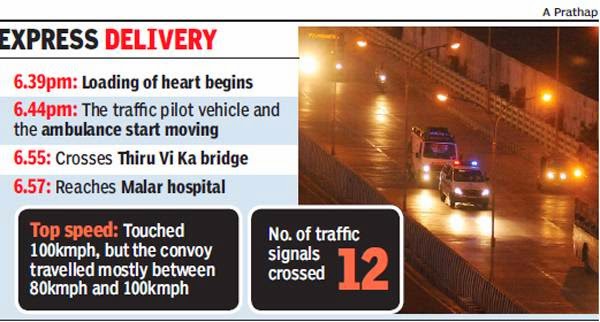
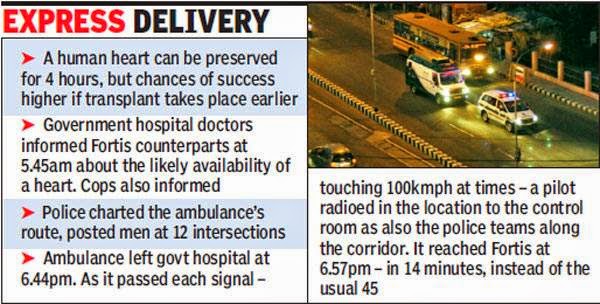
started from Government hospital at 6.44pm and reached Fortis
Malar 13 minutes and 22 seconds later, at 6.57pm. Normally, a vehicle
takes 45 minutes to cover the stretch at peak hour.

At the
private hospital, the parents of Hvovi Minocherchomji’s, a 21-year-old
BCom student from Mumbai, received the heart – the mother in tears, the
father with a prayer on his lips.

Malar surgeons immediately got to the job of transplanting the organ on
the recipient who was kept ready. Through the day, the teams of doctors
at the two hospitals had been keeping each other informed about the
condition of the donor and the recipient. The liver and kidneys went to
other hospitals.

Malar got a call as early as 5.45am on Monday
that a brain-dead patient may be taken off the ventilator in a few hours
and that a heart, a liver and kidneys would be available for donation.
The Mumbai woman turned out to be luckier than five others awaiting a
heart transplant, as the donor’s blood group and body weight matched
only with hers among the other patients.

Almost simultaneously,
Karunasagar, the additional commissioner of police (traffic) was
informed about the need to transport the organ. By afternoon, the
traffic police were ready to create the green corridor, most of it along
the Beach Road and Santhome High Road, two of the busiest stretches in
the evening.

……..

Link: http://timesofindia.indiatimes.com/india/No-lal-batti-Chennai-halts-traffic-to-save-life/articleshow/36676797.cms

……

regards

Fight Taliban Arundhati Roy style

If
you look at Afghanistan, Waziristan, you know, the northeast states of
India and this whole mineral belt that goes from West Bengal through
Jharkhand through Orissa to Chhattisgarh, what’s called the Red Corridor
in India, you know, it’s interesting that the entire thing is a tribal
uprising. In Afghanistan, obviously, it’s taken the form of a radical
Islamist uprising. And here, it’s a radical left uprising. But the
attack is the same. It’s a corporate attack, you know, on these people.
The resistance has taken different forms. – See more at:
http://www.blackstarnews.com/others/extras/interview-arundhati-roy.html#sthash.x2qXMXnZ.dpuf

If
you look at Afghanistan, Waziristan, you know, the northeast states of
India and this whole mineral belt that goes from West Bengal through
Jharkhand through Orissa to Chhattisgarh, what’s called the Red Corridor
in India, you know, it’s interesting that the entire thing is a tribal
uprising. In Afghanistan, obviously, it’s taken the form of a radical
Islamist uprising. And here, it’s a radical left uprising. But the
attack is the same. It’s a corporate attack, you know, on these people.
The resistance has taken different forms. – See more at:
http://www.blackstarnews.com/others/extras/interview-arundhati-roy.html#sthash.x2qXMXnZ.dp
 Comrade Roy taking a break from people’s revolution, at her home in Delhi’s most posh neighborhood (High Security Diplomatic enclave in Chanakyapuri)
“When you say things like, ‘We have to wipe out the
Taliban,’ what does that mean? The Taliban is not a fixed number of people. The
Taliban is an ideology that has sprung out of a history that, you know, America
created anyway…

If you look at Afghanistan, Waziristan, you know,
the northeast states of India and this whole mineral belt that goes from West
Bengal through Jharkhand through Orissa to Chhattisgarh, what’s called the Red
Corridor in India, you know, it’s interesting that the entire thing is a tribal
uprising. In Afghanistan, obviously, it’s taken the form of a radical Islamist
uprising. And here, it’s a radical left uprising. But the attack is the same.
It’s a corporate attack, you know, on these people. The resistance has taken
different forms…
We know from the history of the war on terror that
a military strategy is only making matters worse all over the world. The war on
terror has made the world a more dangerous place. In India, they have been
fighting insurgencies military since 1947 and it has become a more dangerous
place…


In
other words, for any Taliban atrocities, pass the buck on US but
if the local State itself tries to forcibly wrest control from the crazies supposedly created by US, it will be doing a grave injustice- as then these US created crazies (somehow) convert into tribal rebels fighting against Corporate attack. In effect, whatever the course of action you pick- just make sure to blame US, Local state and Corporates for screwing up what otherwise would have been a stateless utopia. War on terror has worked nowhere, goes on Roy. To back her claim, Roy says Indian State’s fight against insurgencies has made India more dangerous (offcourse the official data that says otherwise, is State propaganda and any anectodal evidence that backs the same is no more than middle class delusion). 

PS: Having said that, I do enjoy
Ms Roy’s loquacious diatribes on India’s Hindutva crowd (though she seems OK with some of the  Sharia enthusiasts of Kashmir valley and even trieS to justify 26/11 Mumbai attack)- not as a source of serious analysis but because she tests the boundaries of
freedom of expression in India and at times, just for the heck of it (a welcome break from
right wing nutjobs of India).

Operation in North Waziristan: the end of the beginning?

1. If the aggressive PR operation launched in connection with the latest Waziristan operation is to be believed, the army has finally realized that the bad Taliban are simply intolerable and must be eliminated. They have been beheading soldiers and playing football with their heads for ages, so this realization is not exactly a stroke of genius. But as they say, better late than never.
A few hardcore skeptics continue to doubt that this operation signals any significant change in the age-old policy of playing whack-a-mole with (some) bad jihadis while keeping the good jihadi operation going, but most liberals on my time line seem to find it revolutionary. Who is right?
I am hedging my bets: I support the operation because some particularly nasty people may indeed be eliminated (or at least forced underground), but…I remain doubtful about a serious change of heart about the use of terrorists to kill Afghans or Indians. And barring such a change of heart, new layers of terrorism and violence will arise (and will have to be operated against in turn). I also dont think it will be as clean as is being shown on TV. Innocents will die and unfortunately, may die in rather large numbers.

2. There is no attempt to undermine or discredit the various Taliban front organizations and fellow travelers (JUI-S, Jamat e Islami, right wing of the PTI, etc). There is also no sign of any decisive action against the Lashkar e Jhangvi (the anti-Shia killing machine). And of course, the good Taliban and good Jihadists continue to be on our good side, planning attacks on Afghanistan and rallies in Kashmir..

3. ALL of the above will have to be tackled if Pakistan is to reverse course. That change of course therefore remains a very big IF.

4. We know from history that a small numbers of determined terrorists can maintain a terror campaign for years. So even if this operation represents a genuine change of course, it will not lead to peace in the short term. At best, it may be the “end of the beginning”.

PS: Imran Khan and the PTI have decided to support the operation. This either means its so damn serious that even IK has been scared into changing his mind…. OR that there is less here than meets the eye….Take your pick. I am an optimist, but when IK steps forward to support an operation, one must pause and at least briefly reconsider any optimism one may have felt.
On the other hand, the nephew of the chief justice (employee of a “sensitive agency”) has been kidnapped in Multan. That may indicate that the Islamists find this operation serious even if some observers do not.

Of course, there is always the “long term optimists” view: that this operation (warts and all) should be seen as yet another small step in the continuing march of Pakistan back towards the modern world. In this supposedly optimistic view, the deficiencies and doubts could all be true, but its all part of a greater process. GHQ (and PTI) may not intend to see this operation lead to future operations against good jihadists and shia-killers, but just like they (slowly) moved from garlanding Nek Mohammed to trying to kill his successors, they will also move (after many delays and unnecessary casualties) to target those who are currently their friends or are not yet a priority. .
What do you think?

Zarb-e-Azb: More the things change…

Insanity, Einstein said, is doing the same thing over and over again and expecting different results. 

Without a comprehensive deradicalisation strategy, dumping of good/bad Taliban dichotomy and a relook at relations with neighbors; it is difficult to understand what this very limited (to bad Taliban based in North Waziristan), much delayed  and crude (How many countries regularly deploy fighter jets to bomb insurgent hideouts in their own territory?) military operation will achieve apart from further alienation of local civilians from State, more reprisal killings of Shias, and violent attacks in  Pakistan’s cities.

Freedom fighters

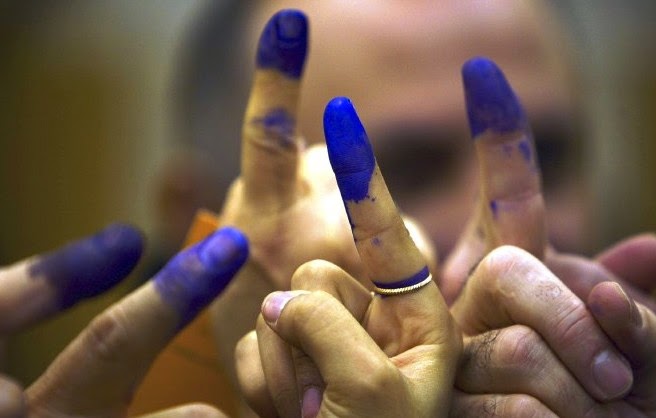
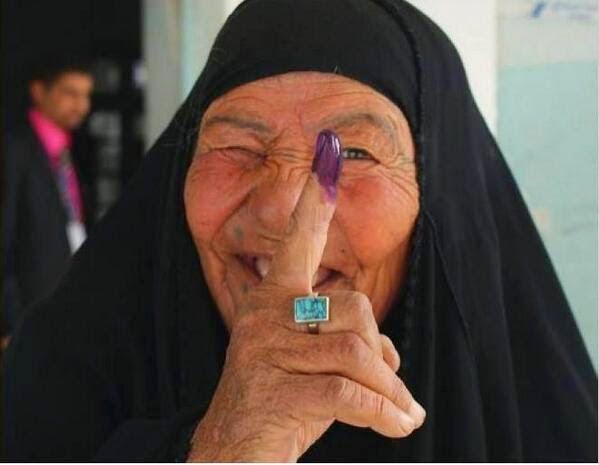
Eleven voters in Herat had their fingers—which were dipped in ink to
register their ballot—cut off by insurgents 

This is what the Pankajists must have in mind when they speak eloquently about the (spiritual) nature of the (spiritual) descendants of Sayyid Jamal-ad-din al-Afghani. As expected, these Gandhians with guns are full of contempt towards silly things that are dear to the bourgeois, such as showing the world your purple voting finger. Cutting off the fingers help prove that noble savages are exactly as advertised. If there is any (little bit of) fault to be dished out it must be laid at the feet of the evil westerners who were irresponsible enough to breed such genetically modified organisms in the first place…

 ….
Officials
said more than 50 people were killed in separate Taliban strikes on
Saturday, when more than 7 million voters cast their ballot in the
contest between former foreign minister Abdullah Abdullah and ex-World
Bank economist Ashraf Ghani.


The deaths included five election
workers killed when their bus was hit by a roadside bomb in Samangan
province, and five members of one family who died when a Taliban rocket
hit a house near a polling station.

Eleven voters in the
western province of Herat had their fingers—which were dipped in ink to
register their ballot—cut off by insurgents.

The UN described
the mutilations as “abhorrent”. More than 70 militants were also killed
in fighting during the day, according to the interior ministry.

The White House praised voters’ courage and called the elections “a
significant step forward on Afghanistan’s democratic path”, after the
turnout topped 50 percent.
. ……..
Link: http://timesofindia.indiatimes.com/world/south-asia/Taliban-target-voters-in-Afghanistan-kill-50-mutilate-11/articleshow/36614278.cms
……
regards

“See you in New York”

“He said, ‘I’ll see you guys in New York,’” recalls Army Col. Kenneth King, then the commanding officer of Camp Bucca

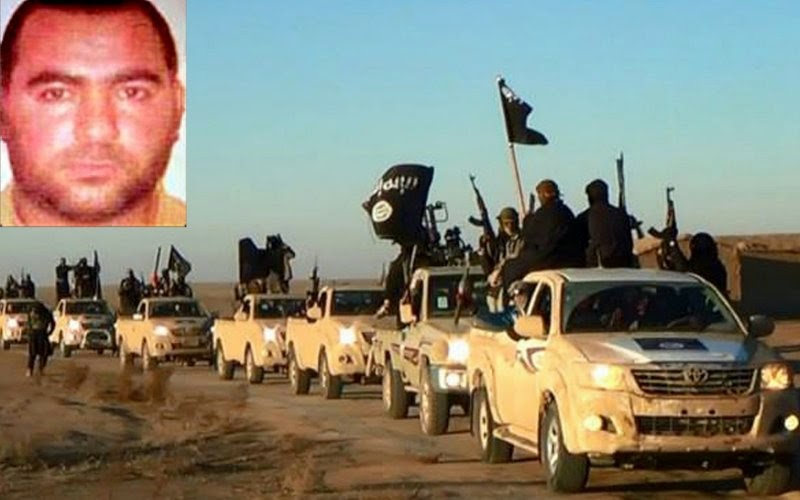
The lead fellow seems quite charming and his boys are a bunch of alpha males with really sexy black gear, still, why do we suspect that most americans will not be very happy when (not if) Abu Bakr al-Baghdadi makes good on his promise?

….
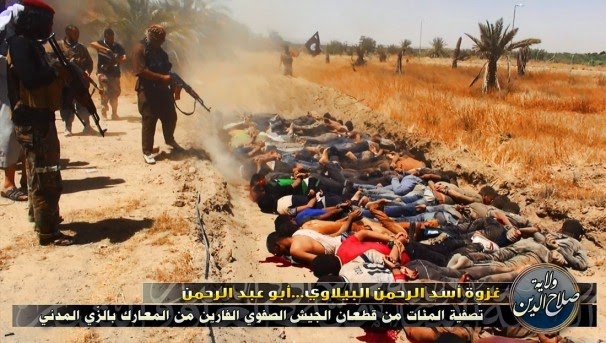
Militants
from the Islamic State in Iraq and Syria boasted on Twitter that they
had executed 1,700 Iraqi government soldiers
, posting gruesome photos to
support their claim.

The
latest attack, if proved, would also raise the spectre of the war in
Iraq turning genocidal,
particularly because the insurgents boasted that
their victims were all Shias. 

……

The Islamist extremist some are now calling the most dangerous man in
the world had a few parting words to his captors as he was released from
the biggest U.S.  detention camp in Iraq in 2009.   

“He said, ‘I’ll see you guys in New York,’” recalls Army Col. Kenneth King, then the commanding officer of Camp Bucca. King
didn’t take these words from Abu Bakr al-Baghdadi as a threat. 

Al-Baghdadi knew that many of his captors were from New York, reservists
with the 306 Military Police Battalion, a unit based on Long Island
that includes numerous numerous members of the NYPD and the FDNY. The
camp itself was named after FDNY Fire Marshal Ronald Bucca, who was
killed at the World Trade Center in the Sept. 11, 2001, attacks.

King
figured that al-Baghdadi was just saying that he had known all along
that it was all essentially a joke, that he had only to wait and he
would be freed to go back to what he had been doing.

“Like, ‘This is no big thing, I’ll see you on the block,’” King says.

King had not imagined that in less that five years he would be seeing news reports that al-Baghdadi was the leader of ISIS, the ultra-extremist army that was sweeping through Iraq toward Baghdad.
“I’m
not surprised that it was someone who spent time in Bucca but I’m a
little surprised it was him,” King says. “He was a bad dude, but he
wasn’t the worst of the worst.”

King allows that along with being surprised he was frustrated on a very personal level.
“We spent how many missions and how many soldiers were put at risk when we caught this guy and we just released him,” King says.
During
the four years that al-Baghdadi was in custody, there had been no way
for the Americans to predict what a danger he would become. Al-Baghdadi
hadn’t even been assigned to Compound 14, which was reserved for the
most virulently extremist Sunnis.

“The worst of the worst were kept in one area,” King says. “I don’t recall him being in that group.”

The guards would seek
to disrupt the courts along with and any nascent organizations and
hierarchies by moving inmates to different compounds, though keeping the
Sunnis and the Shiites separate.

“The Bloods with the Bloods and the Crips with the Crips, that kind of thing,” King says.
The
guards would then move the prisoners again and again. That would also
keep the prisoners from spotting any possible weaknesses in security.

“The
detainees have nothing but time,” King says. “They’re looking at
patterns, they’re looking at routines, they’re looking for
opportunities.”

As al-Baghdadi and the 26,000 other prisoners were
learning the need for patience in studying the enemy, the guards would
be constantly searching for homemade weapons fashioned from what the
prisoners dug up, the camp having been built on a former junkyard.

“People think of a detainee operation, they think it’s a sleepy Hogan’s Heroes-type camp,” the other officer says. “And it’s nothing of the sort.”

Meanwhile, al-Baghdadi’s four years at Camp Bucca would have been a perpetual lesson in the importance of avoiding notice.
“A
lot of times, the really bad guys tended to operate behind the scenes
because they wanted to be invisible,”  the other officer says.

King had every
reason to think he had seen the last of al-Baghdadi in the late summer
of 2009, when this seemingly unremarkable prisoner departed with a group
of others on one of the C-17 cargo-plane flights that ferried them to a
smaller facility near Baghdad. Camp Bucca closed not along afterward.

Al-Baghdadi
clearly remembered some of the lessons of his time there. He has made
no videos, unlike Osama bin Laden and many of the other extremist
leaders. The news reports might not have had a photo of him at all were
it not for the one taken by the Americans when he was first captured in
2005.

That is the face that King was so surprised to see this week as the man who had become the absolute worst of the worst,
so bad that even al Qaeda had disowned him. The whole world was stunned
as al-Baghdadi now told his enemies “I’ll see you in Baghdad.”

…….

Link: http://www.thedailybeast.com/articles/2014/06/14/isis-leader-see-you-in-new-york.html

……

regards

India or Pakistan?

It is probably fair to say that India is now all but in name a Hindu democracy ruled by the Hindu Brother-hood which permits non-Hindus to reside with some constitutional protections related to a) specific listing as minorities -muslims, christians, buddhists, sikhs, parsis and jains, b) minority specific civil laws, and c) minority specific institutions with special privileges (for example reservations for minorities but none for OBC/Dalits).

Policy-wise the present govt (unlike a hypothetical UPA-III regime) is likely to put a stop to any affirmative action program targeting minorities (specifically muslims). There will be also stiff barriers put in place to restrict (or even re-capture) conversion from Hinduism (specifically evangelicals). In some way this path is indicated by the recent Intelligence Bureau (IB) advisory against foreign-funded NGOs such as Greenpeace.

While there are vast differences in societies and societal attitudes, all of the above is in line with ethnic-pure enclaves (and initiatives) that are popping up everywhere in the non-Western world. Han-first China, Rohingya-free Burma, Egypt without Copts,…etc. etc. Pakistan is a long declared Islamic Republic (and now a de-facto nation for Hanafi-Sunnis) and Israel calls itself as (and would like to be recognized as) a Jewish democracy.

Given the way the future is shaping up, it will be interesting to speculate on the nature of relationships that will materialize in the long-term between the West led by the USA and Hindu India and Islamic Pakistan (and also Jewish Israel).

Here it may be relevant to mention that Christian influence is rising in the once considered secular West. Prime Minister David Cameron has been crystal clear in his thinking: “UK is a Christian country” and even more significantly “we should not be afraid of saying so. While it may not be remarkable that a Tory public-school educated man is mouthing such a statement, it is astonishing to know that a militant atheist like Richard Dawkins, has described himself as a “cultural Christian” who liked “singing carols along with everybody else”.

While opinions will naturally differ on this we feel that America will be having the most intense interaction with Pakistan and the generous aid regime will continue even past 2014 (Pakistan is already the largest beneficiary of UK aid, all aid to India will stop by 2015). There are two primary reasons: USA wishes to have an influence on the Muslim world (geo-strategic importance, oil etc) and USA is worried about Pak nukes falling into terrorist hands.

With respect to Israel the facts on the ground are that American Jews vote are increasingly put-off by Israel’s apartheid like policies in the West Bank. While America will continue to protect Israel with vetoes, it may be the case that Washington will become detached from Tel Aviv (John Kerry actually used the apartheid word recently) and there will be growing pressure to reduce aid to Israel, even as the Boycott, Divestments and Sanctions (BDS) movement gathers steam (primarily propelled by as Islam-Left alliance).

With respect to India it is likely that both nations will place the relationship on the back burner. Americans (and non-Hindu expats) will be displeased by evidence of explicit Hindutva policies going forward, in the long run there may even be a BDS movement specific to India (related to Kashmir). The 50% (non-Gujarati) Hindu population in the US is growing but the next generations will grow up increasingly secular and sensitive to charges of persecution against muslims and christians (just as in the case of Israel). There will be most likely a strong evangelical voice (allied with Republicans) also as part of the anti-India lobby. Only  the Gujarati lobby will be standing against this formidable alliance and they will have not much to offer to America politically and precious little more economically.

In contrast, India under Modi will find it much easier to interact with China and Japan (who are not so attentive to human rights issues and who do not have muslim/christian pressure groups asking inconvenient questions). This is in line with the look-East policy declared by the UPA regime. In Afghanistan India may actually ally with a group comprising of northern (Uzbek) establishments and Iran against the wishes of USA. Thus at the establishment level between India and US, it will be a case of “Micro Expectations.”

In summary, as far as Washington and the West is concerned, the following prioritization is probable: Israel > Pakistan >> India (past, now, near-future), and Pakistan > Israel >> India (distant future). Never forget, Nixon all but declared war on India (in support of Pakistan) when he ordered the seventh fleet to move into Bay of Bengal. Declarations of friendship are not worth the (toilet) paper they are written on, it is the permanent interests that matter. India must know this fact and act accordingly.
……………………………..
regards

Brown Pundits