
We are fighting against a deadly ideology, but do we have any ideology to counter it (and vaccinate against it), or are we only offering shallow multi-culturalism to people not attuned to western sensibilities and encouraging third-world ghettos in the first-world?
….
“He told us we should never drive close to the cows,” Wadai
explained. “He said that the spirit of Boko Haram can enter the cows. So
we should always wait for the cow to cross the road.” He laughed. I was
puzzled. Wadai continued. “It’s a common belief here. They believe that
Boko Haram sends its spirit inside the cows.”
….
If this war has to be won we have to first face up to both liberal and conservative bigotry in the West. The liberals would prefer to let the tribals stay true to their tribal ways (and there is no one to fight when girls are stoned to death by their own family bang in front of a court-room in broad daylight), while the conservatives will be content with breaking a country with bombs but not putting in the effort to build it up again.
The lib-con consensus right now is that it is best if the nut-jobs are whacked off at a certain (less than ideal) rate using drones based on humint (spies on the ground). And if somehow refugees escaping death and devastation manage to cross the many miles of sea to reach the safe havens (Italy, Australia, ….) they will be thrown into open air prisons indefinitely. This lib-con consensus needs to be changed. It will be quite an impossible task since the voters are demanding to know: what is in it for us?
The best solution seems to be to empower local communities and give them the tools to fight back- create as many Kurdistan like safe havens as we can. We must not retreat and we must not abandon people to the forces of darkness.
…….
On Monday morning, May 12, I sat in the backseat of a Toyota Corolla,
headed to Chibok. With a satin abaya draping my body in a sheath of
black, and my hair curled underneath a black chiffon hijab, my careful
effort to blend into northeastern Nigeria’s conservative, predominately
Muslim society appeared to be working. The soldiers who peered into the
backseat gave me casual glances, waving us past checkpoint after
checkpoint.
“This is the heartland of Boko Haram,” said the governor of Borno
State when I visited him in the state capital of Maiduguri along the
way. A month earlier, militants from the radical Islamist group had
seized a secondary school in Chibok and kidnapped almost 300 female
students. The town had quickly become an emblem of a region in crisis,
where insurgents attack churches and mosques and kill children in their
sleep while shouting “Allahu akbar.”
…
When I set out for Chibok—a three-day journey from the Nigerian
capital of Abuja—I’d encountered children selling peanuts and sachets of
water along the road. Those who had nothing to sell simply held out
their palms. “Allah ya kiyaye, Allah ya kiyaye,” they’d said,
muttering prayers in the Hausa language for Allah to grant us a safe
journey. I’d been warned about the dangers of the trip: Boko Haram hide
in the bushes along the road to Chibok, waiting for lonely cars to pass
by. They cross the street to get from one end of the surrounding fields
to the other, and they shoot at cars as they go, before disappearing
into the Sambisa Forest.
“From this point of the journey, everything from here is Sambisa,”
explained one of my companions, Daniel Wadai, a lawyer and Chibok native
I’d met in Abuja at one of the daily #BringBackOurGirls rallies. From
the passenger’s seat, he gestured to the left, just above our driver’s
head. I turned to look and saw small bushes stuck in the sand and a few
scattered trees. I had expected to see a dense grove of trees.
“This is not a forest,” I said. “No. It’s not the forest that the media is painting it to be,” Wadai replied.
Dogonyaro, acacia, and baobab trees flashed by in a blur, as the
Sahelian landscape grew drier and flatter. Yellow flowers broke the
monotony of the green and brown landscape. And then, suddenly, we were
surrounded by cows making their way across the road. One of them stopped
by my window. I looked into its big, moist eyes, admiring its shiny,
reddish brown coat. Our driver continued on undaunted, carefully weaving
the car through the horde. A battered blue station wagon drove up
alongside us, and its driver said something to us in Hausa before
speeding away.
…
“He told us we should never drive close to the cows,” Wadai
explained. “He said that the spirit of Boko Haram can enter the cows. So
we should always wait for the cow to cross the road.” He laughed. I was
puzzled. Wadai continued. “It’s a common belief here. They believe that
Boko Haram sends its spirit inside the cows.”
…
For people here grappling with a palpable fear of fighters with no
clear agenda and no set targets on their path of destruction, Boko Haram
had taken on supernatural qualities. The group had completely wiped out
villages like Bulabulin. There, weeds grew freely in farm plots.
Cooking pots lay overturned in the dirt. On our way to Chibok, I counted
three telecom masts, but I couldn’t pick up a network signal on my
phone. Boko Haram had destroyed the area’s infrastructure, too.
We soon reached the town of Damboa, where a battalion headquarters
stood next to the abandoned construction site of a housing development.
Damboa had once been a hotspot for Boko Haram recruitment, explained a
stringer for an international news agency who was traveling with us,
and whom I’ll call “Dayo.” Now, many of the boys there, having renounced
their membership in the militant group, were trying to rid the town of
Boko Haram.
Monday is market day in Damboa, and the town was bustling. Vegetable
sellers congregated along the roadside. A butcher sliced meat on a
wooden plank as women waited for his cuts. Lean dogs scurried about. Men
stood languidly in line in the heat, as civilian fighters inspected the
men’s fingers for trigger marks—signs of heavy gun usage that could out
them as Boko Haram members.
…
We left Damboa, turning onto a pothole-ridden dirt path known as
Chibok road. Here, I came closer to Sambisa than I had ever been before.
Now there were no checkpoints in sight. We had clearly embarked on the
most dangerous leg of the journey. And then our car came to a halt.
We arrived in Chibok covered head to toe in sand from one of the
village’s fierce sandstorms. Amid the dust, a sign for the
government-run secondary school marked the site of Boko Haram mass
kidnapping. A guard let us through the school’s gate without much fuss,
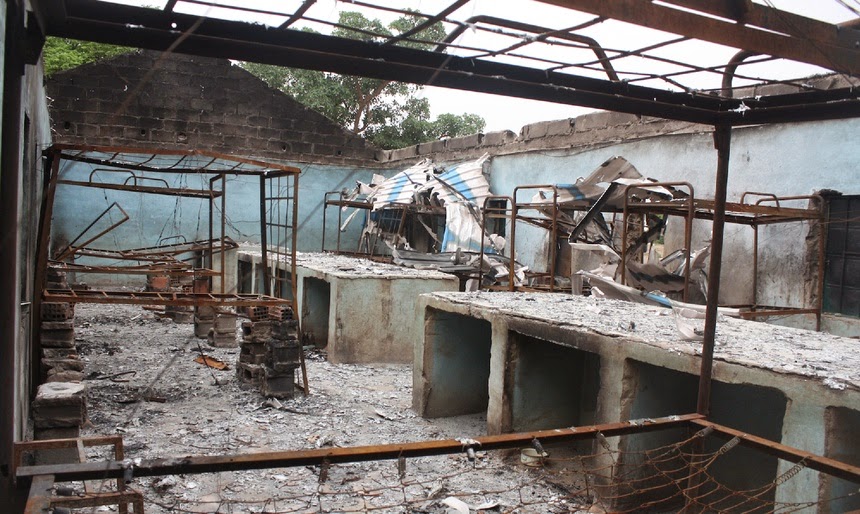
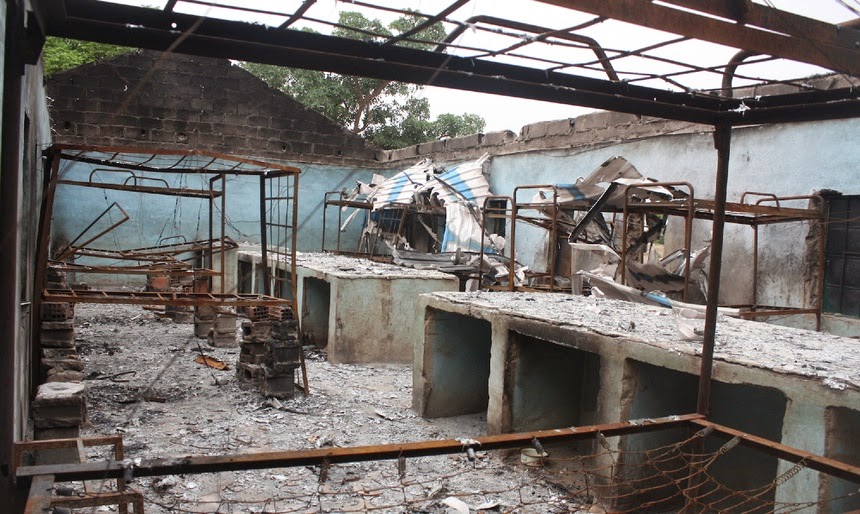
and we made our way across the rubble through a series of burned-out
classrooms.
Nearby, three people were sitting under a mango tree
surrounded by charred debris: the school’s principal, Asabe Kwambura,
and two administrators, who were waiting for a government delegation to
arrive and investigate the incident.
Kwambura greeted me, lifting her purple veil and wiping tears from her
eyes. She projected confidence, though I sensed it was withering. “They
are our girls,” she told me. I asked if the Nigerian military had been
protecting the school on the night of the attack. Kwambura said no—the
school had its own watchmen, and one had been guarding the main gate
while the other was posted at the girls’ residence. I was stunned. A
government school in a state under emergency rule had been left with no
government-authorized security. Young girls had been sleeping in their
rooms without any solid assurance of safety.
Two matrons led us to the girls’ residence, where I saw bare bed
frames and shards of glass on the floor. Standing in the bedrooms, I
imagined the girls’ screams as they were snatched away. I pictured them
disappearing with their kidnappers into the night.
In Chibok, I found a close-knit community in mourning—families
gathering together at dawn and then heading to a dozen or so churches
and a handful of mosques scattered around the village to pray for the
girls to return.
At night, Esther Yakubu—a mother of five, including
15-year-old Dorcas Yakubu, who was among the kidnapped students—crouches
on her knees and clutches her Bible.
“God is not dead. He is alive,”
she told me, and then prayed: “God bring her back.”
…
Esther misses her daughter’s presence. “I like her by my side
always,” she said. “Anytime I think about her, I bust out crying. That’s
all I do everyday.” Sitting with her husband in the family’s cozy
living room, as daylight beamed through two narrow windows, Esther told
me that she and Dorcas spoke either in person or on the phone every day,
and that Dorcas had been planning to take a course on how to sew
garments.
Ten-year-old Marvelous was sitting on the floor as we spoke. I
asked him about Dorcas, and he mumbled, “I am still crying and
praying.”
…
Outside, on the patio, I met Dorcas’s younger sister, Happy, who was
carrying pails of fresh rainwater. Happy was angry. “I want to leave
[Nigeria] because they are not taking care of us,” she told me.
Residents here cannot feel the impact of the federal government’s
estimated $5 billion defense budget.
On my way to the home of Lawan Zanna—whose daughter, 18-year-old Aisha,
had been kidnapped by Boko Haram—I met a gang of giggling girls jumping
in shapes they had drawn in the sand. It looked like a game of
hopscotch. Wadai told me it was called elgalagala. The girls jumped and twirled and laughed with glee. I stopped to take pictures and they posed like fashion models.
At Zanna’s home, I sat cross-legged on a red straw mat on the patio
as he told me how he and the other parents had marched through Sambisa
in a fruitless search for their daughters. Hawa, 19, showed me the
bedroom she shared with Aisha. A large bed took up more than half of the
room; plastic suitcases and laundry baskets were piled along the walls.
…
In a low voice, Hawa described Aisha. “My junior sister has respect,” she said. “She is a very quiet girl.”
..
Back on the patio, Zanna, was on his knees, praying to Allah. I said my goodbyes, and left the family to mourn.
…
My last stop that day was at Lydia Pogu’s family compound. Lydia had
managed to run away from her abductors after the attack in April.
Sitting with Dayo and me on a wooden bench, she described how Boko Haram
fighters had stormed the school asking for food and dragging the girls
onto trucks. With a friend, Lydia had jumped out of her truck and landed
on her stomach, before fleeing the scene. She told me she never wants
to go to school again. She wants to farm the land instead.
By this point, our driver had
returned from the mechanic’s shop in Damboa, and he drove us to Wadai’s
family home in Chibok, where we’d be spending the night. I sunk onto a
couch, weighed down by sadness. I thought about the principal and her
gutted school; about Lydia and her harrowing escape; about Happy’s
bitterness, Marvelous’s hope, and Esther’s continuous tears.
…
The next morning, we left Chibok, but not before stopping at the home
of the oldest man in the village, Bitrus Dawa Kulaha Abugar Woshanta
Umar Ibn Elkanemi, or Bitrus Dawa for short. He tells everyone he was
born in 1910.
We spoke about the first time he saw white
people—Christian missionaries—in Chibok, in 1923; about the 1967-1970
Nigerian civil war, when he was working as a teacher; about how corrupt,
unethical Nigerian leaders had degraded the country. Raindrops
interrupted our conversation.
…
A soldier asked us where we were going, and where we were coming from.
“Maiduguri, Chibok.”
“Chibok! You people passed the night in Chibok?” He shook his head,
incredulous. “Someone like you is not supposed to pass there.”
“Why not?” said Wadai. “It’s my village. ……
……
Link: http://www.theatlantic.com/features/archive/2014/05/in-the-land-of-nigeria-s-kidnapped-girls/371357/
….
regards
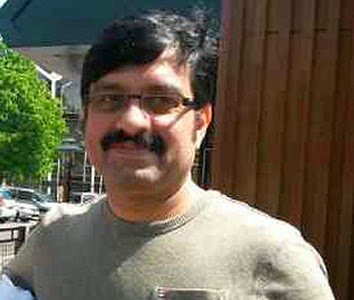
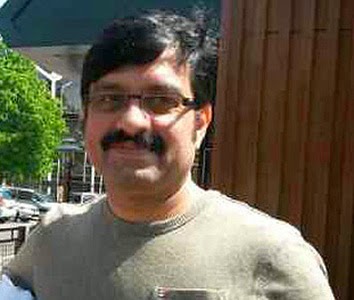


grieving heart that one of our Pakistani community member, a friend of
mine, an intelligent person, a friendly guy and a poet with a very soft
and romantic heart, Dr. Mehdi Ali Qamar has been assassinated in
Pakistan a couple of days ago.
Dr. Mehdi was on a visit to Pakistan
with his wife and kids and had gone to graveyard of his ancestors to say
prayers for them when two persons on a motorcycle opened fire on him.
Dr. Mehdi died in front of his family.
This will be a very shocking news to the Pakistani community of Ohio,
he was well known to a lot of us. Our prayers are with the family and
hope the assassins of Dr. Mehdi will be captured and brought to justice
swiftly.
President CAPA
………
Link (1): http://www.dawn.com/news/1108902/murder-in-rabwah
Link(2): http://capaohio.wordpress.com/2013/08/18/capa-ohio-arranged-a-community-picnic-to-celebrate-pakistans-66th-birthday/
…….
regards