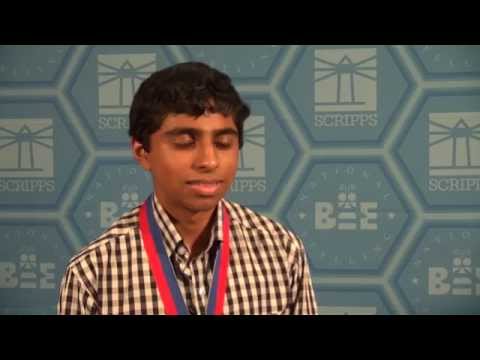
Congratulations (Sriram, Ansun, Gokul, Ashwin)
Indian-Americans Sriram Hathwar of New York and Ansun Sujoe (top) of Texas
shared the title after a riveting final-round duel in which they nearly
exhausted the 25 designated championship words. After they spelled a
dozen words correctly in a row, they both were named champions.
The past eight winners and 13 of the past 17 have been of Indian
descent, a run that began in 1999 after Nupur Lala’s victory, which was
later featured in the documentary “Spellbound.”
Earlier,
14-year-old Sriram opened the door to an upset by 13-year-old Ansun
after he misspelled “corpsbruder,” a close comrade. But Ansun was unable
to take the title because he got “antegropelos,” which means waterproof
leggings, wrong.
Sriram entered the final round as the
favorite after finishing in third place last year. Ansun just missed the
semifinals last year.
They become the fourth co-champions in the bee’s 89-year history and the first since 1962.
“The competition was against the dictionary, not against each other,”
Sriram said after both were showered with confetti onstage. “I’m happy
to share this trophy with him.”
Sriram backed up his status as
the favorite by rarely looking flustered on stage, nodding confidently
as he outlasted 10 other spellers to set up the one-on-one duel with
Ansun. The younger boy was more nervous and demonstrative, no more so
than on the word that gave him a share of the title: “feuilleton” the
features section of a European newspaper or magazine.
“Ah,
whatever!” Ansun said before beginning to spell the word as the stage
lights turned red, signaling that he had 30 seconds left.
Although they hoisted a single trophy together onstage, each will get
one to take home, and each gets the champion’s haul of more than $33,000
in cash and prizes.
Gokul Venkatachalam of Missouri finished third, and Ashwin Veeramani of Ohio, was fourth.
The Hin-Jew conspiracy begins to take shape
To update the Two Nation Theory: their maximum villain-enemies are our maximum hero-friends and vice versa.
……
To his Israeli partners, Modiâs profile
as an opponent of Muslim extremismâa perceived common enemy,
particularly in the wake of the 2008 terrorist attacks in Mumbaiâonly
made him more appealing.
Surveys
by the Israeli Foreign Ministry have found that Indian support for
Israel is higher than in any other country polled, beating out even the
United States. âRural Indians see Israel as an agricultural superpower,â
said Shimon Mercer-Wood, Southeast Asia desk officer at the Israeli
Foreign Ministry. âUrban India sees Israel as a leader of innovation and
entrepreneurship.â
……….
It is actually high time that Israel and India take the partnership to the next level in the civilian domain (military links are already strong).
Technology wise India needs Israel..desperately. But (as we imagine) a country with one billion friends is what Israel needs India far more, in particular in the coming days as the Boycotts, Divestment and Sanctions campaign picks up steam in the West.
In the near future, it may well be that the European doors will close. Anti-semitism is right now rampant and deadly across the continent and is likely to accelerate as the Left-Islam alliance grows in strength. In the mean-time India under the Hindu Brotherhood will be shining brightly (welcome sign: swastika?)
At the same time we wish Palestine and Kashmir to remain peaceful (it will never be resolved because their sacred ground is ours as well).
It is beyond pathetic (but understandable) that people cannot see beyond their artificial communities…..all of them .
……..
Israelis who have met Narendra Modi, Indiaâs newly elected prime
minister-designate, gush about him and what he means for Israel. At a
recent event at the Institute for National Security Studies, in Tel
Aviv, he was described in glowing terms: âoutgoingâ; âassertiveâ;
âextremely, extremely cleverâ; and âvery tachles, very direct,
very Israeli.â
Among the calls Modi received congratulating him on his
win last week was one from Israeli Prime Minister Benjamin Netanyahu,
who told
his cabinet at their weekly meeting that Modi had replied by expressing
the desire to âdeepen and develop economic ties with the state of
Israel.â
….When Modi, the head of the Hindu nationalist BJP party, is sworn in
as prime minister on Monday, he will become the only Indian premier to
have ever visited the Jewish state. He has close relationships with
Israeli business leaders, and his landslide victory has left many
anticipating the possibility of a great leap forward in Indian-Israeli
relationsâand with it, a billion new customers and allies.
Israelâs relationship with India has long been a quiet affair, with a
lot going on behind the scenes, but not much happening in public.
Though India voted to recognize Israel in 1950, successive governments
in the 1960s, 1970s, and 1980s avoided public ties with Jerusalem,
partly to appease Indiaâs large Muslim minority and partly out of a
desire to avoid alienating Arab allies. India didnât establish official
relations with Israel until 1992, making it the last non-Arab,
non-Muslim country in the world to do so.
Despite this, commercial ties, technology sharing, space exploration,
and military cooperation between the two countries have all grown
vigorously in recent years. Bilateral trade has shot up from less than
$200 million in 1992 to almost $4.4 billion in 2013 (not including
weapons sales, which account for billions more). The growth in bilateral
trade has been driven largely by precious stones and by defense
spending. The exception is in Gujarat, the state where Narendra Modi has
served as chief minister for the past 13 years.
In Gujarat, Israeli industry was not only welcomed by Modi but actively pursued. Huge tenders for a semiconductor plant , a new port , and a desalination plant
were awarded to Israeli bidders. Israeli agriculture, pharmaceutical,
alternative energy, and information technology companies have flourished
there. This isnât incidental: Modiâs campaign was based on replicating
his economic success in Gujarat on a national scale, and much of that
success was tied up with Israel.
In Gujarat, Modi emphasized privatization and small government. He
opened financial and technological parks, brought in foreign investment,
and cracked down on corruption. Under his administration, the stateâs
economy expanded by more than 10 percent annually. In 2010, in Modiâs third term in office, Forbes named Gujaratâs largest city, Ahmedabad, as the third-fastest growing city in the world.
Modiâs career was nearly derailed in 2002 when riots broke out in
Ahmedabad; an estimated 1,000 Muslims were killed by Hindu radicals
during the violence. Modiâs government was accused of not doing enough
to stop the massacre, and while Modi was cleared of any wrongdoing by
the Indian Supreme Courtâs Special Investigation Team in 2009, he was banned
from visiting the United States over his role in the violenceâa
circumstance that drove Modi to develop relationships with other foreign
partners, particularly Israel and Japan, instead.
In 2006, Modi accepted an invitation to visit Israel for an
agricultural technology conference. The five-day trip sparked an ongoing
relationship; Modi began encouraging partnerships with Israeli
ministries and advised his constituents to study Israeli agricultural
and water-management systems.
To his Israeli partners, Modiâs profile
as an opponent of Muslim extremismâa perceived common enemy,
particularly in the wake of the 2008 terrorist attacks in Mumbaiâonly
made him more appealing.
Modiâs BJP has often been supportive of Israel. Though diplomatic
relations between New Delhi and Jerusalem were first officially
established under the dominant Congress Party in 1992, it was during the
last BJP coalition government, between 1999 and 2004, that the
relationship blossomed. Indiaâs Foreign Minister Jaswant Singh, of the
BJP Party, visited Israel in 2000, and in 2003 Ariel Sharon became the
first Israeli leader to visit India.
According to a report in the International Business Times,
Modi has suggested that he may make the first official state visit by a
sitting prime minister to Israel during his term of office. His timing
is impeccable: The Indian public seems especially well primed for a
closer alliance with Israel as well.
Surveys
by the Israeli Foreign Ministry have found that Indian support for
Israel is higher than in any other country polled, beating out even the
United States. âRural Indians see Israel as an agricultural superpower,â
said Shimon Mercer-Wood, Southeast Asia desk officer at the Israeli
Foreign Ministry. âUrban India sees Israel as a leader of innovation and
entrepreneurship.â
…
In the last few months a string of cooperative anti-terror agreements
was signed between the two countries; negotiations over a Free Trade
Agreement are ongoing. One of the largest Indian business delegations
ever to visit Israel will be attending the MIXiii conference in Tel Aviv this month. But Modiâs victory has the potential to send these efforts into overdrive.
….
âModi likes Israeli Chutzpah,â said a senior member of the AgileTree
investment company who has dealt personally with him in Gujarat for
years and asked to remain anonymous because of continuing business
operations with both major parties. âIf only a fraction of what happened
in Gujarat will happen in India as a whole, the state of Israel will be
one of the biggest beneficiaries.â
……
Link: http://www.tabletmag.com/jewish-news-and-politics/173767/modi-israels-new-best-friend
….
regards
29 May 1953 (on top of the world)
I
banged out a brief message on my typewriter for a Sherpa to take down to
the Indian radio station first thing next morning. SNOWCON DITION BAD . . .
ABANDONED ADVANCE BASE . . . AWAITING IMPROVEMENT. It meant, as the
Indian radiomen would not know, …that Everest had been
climbed on May 29 by Hillary and Ten-zing.
There is one parochial
grievance (a familiar one). The Western (UK) Press really needs to make
more of a decent effort to give credit to the “”natives” and not grasp
it all for Queen and Country. How many people know that it was
Rakhaldas Bandopadhyay who discovered Mohen-jo-Daro and also Jagadish
Chandra Bose who invented the radio (not Marconi- it took IEEE-
Institution of Electrical and Electronics Engineers – about 100 years to
correct the record)? Similarly it was Radhanath Sikdar, (described in Wiki as an Indian mathematician and surveyor from Bengal), was the first to identify Everest as the world’s highest peak in 1852 (Sir George Everest was the Surveyor General of India, who preceded Andrew Waugh- the man who officially made the announcement).
Finally, in March 1856 he announced his
findings in a letter to his deputy in Calcutta.
Kangchenjunga was declared to be 28,156 ft (8,582 m), while Peak XV was
given the height of 29,002 ft (8,840 m). Waugh concluded that Peak XV
was “most probably the highest in the world”.
Peak XV (measured in feet) was calculated to be exactly 29,000 ft
(8,839.2 m) high, but was publicly declared to be 29,002 ft (8,839.8 m)
in order to avoid the impression that an exact height of 29,000 feet
(8,839.2 m) was nothing more than a rounded estimate. Waugh is therefore wittily credited with being “the first person to put two feet on top of Mount Everest”.
A few more micro-details. Sir Edmund Hilary (20 July 1919 â 11 January 2008) is obviously the inspiration for Captain Keith Mallory, the hero of the Guns of Navarone authored by Alistair MacLean. His mate Tenzing Norgay (late May 1914 â 9 May 1986), was born Namgyal Wangdi, in Tengboche, Khumbu in the foot-hills of Everest. He was a Nepalese Buddhist [ref. Wiki]
…….
Not
many modern adventures, at least of the physical, peaceable kind, ever
achieve the status of allegory. One was, of course, that
ultimate feat of exploration, that giant step for all mankind, the
arrival of Apollo 11 upon the moon. The other was the first ascent of Mount Everest.
It was allegorical in many senses.
The mountain stood on one of the earthâs frontiers, where the Himalayan
range separates the Tibetan plateau from the vast Indian plains below.
The adventure was symbolically a last earthly adventure, before
humanityâs explorers went off into space. The expedition that first
climbed Everest was British, and a final flourish of the British Empire,
which had for so long been the worldâs paramount power. And as it
happened, the news of its success reached London, the capital of that
empire, on the very morning a new British queen, Elizabeth II, was being
crowned in Westminster Abbey. Almost everything meant more than it had a
right to mean, on Everest in 1953.
It did not always seem so at the
time. When those two men came down from the mountaintop, all one of them
said was: âWell, weâve knocked the bastard off.â
The mountain was bang on the line
between Tibet and Nepal, two of the worldâs most shuttered states, but
during the 19th century the British, then the rulers of India, had
regarded them as more or less buffer states of their own empire, and had
seldom encouraged exploration.
….
Everest had first been identified and
measured from a distance, when a surveyor working far away in Dehra Dun,
in the Indian foothills, had realized it to be the highest of all
mountains, and in 1856 it had been named after Sir George Everest,
former surveyor general of British India. It was known to be holy to the
people living around it, it looked celestial from afar, and so it became
an object of tantalizing mystery, an ultimate geographical presence.
Nobody tried to climb itâcertainly
not the Sherpa people who lived at its footâuntil 1921, when a first
British expedition was allowed to have a go. Between the two world wars
five other British attempts were made. All went to Everest via Tibet,
attacking the northern side of the mountain, but after World War II,
Tibet was closed to foreigners, and for the first time climbers
approached the mountain from the south, in Nepal. By then the British
Raj had abdicated, and in 1952 a Swiss expedition was the first to make a
full-scale attempt from the Nepali side. It failed (but only just). So
there arose, in the following year, a last chance for the British, as
their empire lost its vigor, its power and its purpose, to be the first
on top.
The empire was fading not in
despair, but in regret and impoverishment. The British no longer wished
to rule the world, but they were understandably sad to see their
national glory diminished. They hoped that by one means or another their
influence among the nations might surviveâby the âspecial relationshipâ
with the United States, by the genial but somewhat flaccid device of
the Commonwealth, or simply by means of the prestige they had
accumulated in war as in peace during their generations of supremacy.
revived fortunes upon his daughter, the future Queen Elizabeth II, who
would accede to the throne in June of the following year. All was not
lost! It might be the start, trumpeted the tabloids, of a New
Elizabethan Age to restore the dashing splendors of Drake, Raleigh and
the legendary British sea dogs.
With this fancy at least in the
backs of their minds, the elders of the Royal Geographical Society (RGS)
in London, who had organized all the previous British expeditions to
Everest, made their plans for a final grand-slam assault upon the
mountain. The British had long thought that if it was not exactly their
right to be the first on the top of the world, it was in a way their
duty. Everest wasnât in the British Empire, but it had been within a
British sphere of influence, as the imperialists liked to say, and so
they considered it a quasi-imperial peak. As early as 1905, Lord Curzon,
the inimitably imperial viceroy of India, had declared it âa reproachâ
that the British had made no attempt to reach that summit of summits;
nearly half a century later the British public at large would have been
ashamed if some damned foreigners had beaten them to it.
So it was an emblematically powerful
expedition that the RGS sponsored this time. It had a strong military
elementâmost of its climbers had served in the armed forces. Most had
been to one of the well-known English private schools; several were at
Oxford or Cambridge. Two were citizens of that most loyally British of
the British dominions, New Zealand. One was from Nepal, and therefore
seemed a sort of honorary Briton.
Himalayan experience, and professionally they included a doctor, a
physicist, a physiologist, a photographer, a beekeeper, an oil company
executive, a brain surgeon, an agricultural statistician and a
schoolmaster-poetâa poetic presence was essential to the traditional
ethos of British mountain climbing. Astalwart and practiced company of
Sherpa mountain porters, many of them veterans of previous British
climbing parties, was recruited in Nepal. The expedition was, in short,
an imperial paradigm in itself, and to complete it a reporter from the
LondonTimes, in those days almost the official organ of
Britishness in its loftiest measures, was invited to join the expedition
and chronicle its progress.
The leader of this neo-imperial
enterprise was Col. John Hunt, Kingâs Royal Rifle Corps, a distinguished
mountaineer, one of Montgomeryâs staff officers in World War II, and an
old India hand. The reporter from The Times was me.
Three men, in the end, came to
dominate the exploit. Hunt himself was the very incarnation of a leader,
wiry, grizzled, often wry and utterly dedicated. Whatever he was asked
to do, it seemed to me, he would do it with earnest and unquenchable
zeal, and more than anyone else he saw this particular task as something
much grander than a sporting event. As something of a visionary, even a
mystic, he saw it as expressing a yearning for higher values, nobler
summits altogether. He might have agreed with an earlier patron of
Everest expeditions, Francis Younghusband of the RGS, who considered
them pilgrimagesââtowards utter holiness, towards the most complete
truth.â Certainly when Hunt came to write a book about the adventure, he
declined to talk about a conquest of the mountain, and simply called it
The Ascent of Everest.
The second of the triumvirate was
Tenzing Norgay, the charismatic leader of the Sherpas with the
expedition, and a famously formidable climberâhe had climbed high on the
northern flank of Everest in 1938, on the southern flank in 1952, and
knew the mountain as well as anyone. Tenzing could not at that time read
or write, but his personality was wonderfully polished. As elegant of
manner as of bearing, there was something princely to him. He had never
set foot in Europe or America then, but in London later that year I was
not at all surprised to hear a worldly man-about-town, eyeing Tenzing
across a banquet table, say how good it was to see that âMr. Tenzing
knew a decent claret when he had one.â When the time came for Hunt to
select the final assault parties, the pairs of climbers who would make
or break the expedition, he chose Sherpa Tenzing for one of them partly,
I am sure, for postimperial political reasons, but chiefly because he
was, as anyone could see, the right man for the job.
His companion to the summit was one
of the New Zealanders, emphasizing that this was a British expedition in
the most pragmatic senseâfor in those days New Zealanders, like
Australians and even most Canadians, thought themselves as British as
the islanders themselves. Edmund Hillary the beekeeper was a big, burly,
merry, down-to-earth fellow who had learned to climb in his own New
Zealand Alps but had climbed in Europe and in the Himalayas too. He was
an obvious winnerânot reserved and analytical like Hunt, not
aristocratically balanced like Tenzing, but your proper good-humored,
impeturbable colonial boy. There was nobody, I used to think, that I
would rather have on my side in the battle of life, let alone on a climb
up a mountain.
The expedition went like clockwork.
It was rather like a military campaign. Hunt took few chances in his
organization, and tested everything first. Heâd brought two kinds of
oxygen equipment to the mountain, for instance, and climbers tried them
both. Camps established on the mountain flanks enabled men to haul
equipment up in stages, and when they were sick or overtired during
those three months on the mountain, they went down to the valleys to
rest. Two pairs of climbers made final assaults. The first team, Thomas
Bourdillon and Charles Evans, turned back 285 feet from the top. It was
late in the day, and the exhausted climbers saw the final approach as
too risky. Nobody was killed or injured on the 1953 British Everest
Expedition.
Everest was not the most difficult
mountain in the world. Many were technically harder to climb. Once more
it was a matter of allegory that made its ascent so wonderful an event.
It was as though down all the years some ectoplasmic barrier had
surrounded its peak, and piercing it had released an indefinable glory.
It was Ed Hillary the New Zealander who said theyâd knocked the bastard
off, but he meant it in no irreverent senseâmore in affectionate
respect. For myself, cogitating these mysteries in the course of the
expedition, and gazing at the spiraling plume of snow that habitually
blew like a talisman from Everestâs summit, agnostic though I was I did
begin to fancy some supernatural presence up there. It was not the most
beautiful of mountainsâseveral of its neighbors were shapelierâbut
whether in the fact or simply in the mind, it did seem obscurely nobler
than any of them.
Everest 1953, I fear, did much to
corrupt all this. Nationalists squabbled with a vengeance for the honors
of success on the mountain, and Tenzing in particular was the subject
of their rivalries. He was Asian, was he not, so what right had the
imperialists to call it a British expedition? Why was it always Hillary
and Tenzing, never Tenzing and Hillary? Which of them got to the top
first, anyway? All this came as a shock to the climbers, and even more
to me. When it came to such matters I was the most amateurish of them
all, and it had never occurred to me to ask whether Hillary the
Antipodean or Tenzing the Asian had been the first to step upon that
summit.
I was not, however, an amateur at my
trade. Just as the physiologist had been busy all those months
recording peopleâs metabolisms, and the poet had been writing lyrics,
and the cameraman had been taking pictures, so I had been active sending
dispatches home to The Times. They went via a cable station in
Kathmandu, the capital of Nepal. There was no road to Kathmandu from the
mountain. We had no long-distance radio transmitters, and certainly no
satellite telephones, so they went by the hands of Sherpa
runnersâperhaps the very last time news dispatches were transmitted by
runner.
It was 180 miles from the mountain
to the capital, and the faster my men ran it, the more I paid them. The
journey was very hard. The best of them did it in five daysâ36 miles a
day in the heat of summer, including the crossing of three mountain
ranges more than 9,000 feet high. They very nearly broke the bank.
I kept a steady stream of dispatches
going, and I was not at all surprised to find that they were often
intercepted by rival papers and news organizations. I did not much care,
because they generally dealt more in description or surmise than in
hard fact, and were couched anyway in a fancy prose that no tabloid
would touch; but I did worry about the security of the final,
all-important message, the one that would report (or so we hoped) that
the mountain had actually been climbed. This I would most decidedly
prefer to get home without interference.
Fortunately, I had discovered that
some 30 miles from our base camp, at the foot of the mountain, the
Indian Army, keeping a watch on traffic out of Tibet, had established a
radio post in touch with Kathmandu. I arranged with its soldiers that
they would, if the need arose, send for me a brief message reporting
some important stage in the adventure. I resolved to keep this resource
in reserve for my final message. I could not, however, afford to let the
Indians know what such a message containedâit would be a secret hard to
keep, and they were only humanâso I planned to present it to them in a
simple code that appeared not to be in code at all. A key to this
deceitful cipher I had sent home to The Times.
The time to use it came at the end
of May, and with it my own chance to contribute to the meanings of
Everest, 1953. On May 30 I had climbed up to Camp 4, at 22,000 feet in
the snow-ravine of the Western Cwm, a valley at the head of a glacier
that spills out of the mountain in a horrible morass of iceblocks and
crevasses called the Khumbu Icefall. Most of the expedition was
assembled there, and we were awaiting the return of Hillary and Tenzing
from their assault upon the summit. Nobody knew whether they had made it
or not.
As we waited chatting in the snowy
sunshine outside the tents, conversation turned to the forthcoming
coronation of the young queen, to happen on June 2âthree daysâ time; and
when Hillary and Tenzing strode down the Cwm, and gave us the thrilling
news of their success, I realized that my own moment of allegory had
arrived. If I could rush down the mountain that same afternoon, and get a
message to the Indian radio station, good God, with any luck my news
might get to London in time to coincide with that grand moment of
national hope, the coronationâthe image of the dying empire, as it were,
merging romantically into the image of a New Elizabethan Age!
And so it happened. I did rush down
the mountain to base camp, at 18,000 feet, where my Sherpa runners were
waiting. I was tired already, having climbed up to the Cwm only that
morning, but Mike Westmacott (the agricultural statistician) volunteered
to come with me, and down we went into the gathering duskâthrough that
ghastly icefall, with me slithering about all over the place, losing my
ice ax, slipping out of my crampons, repeatedly falling over and banging
my big toe so hard on an immovable ice block that from that day to this
its toenail has come off every five years.
It was perfectly dark when we
reached our tents, but before we collapsed into our sleeping bags I
banged out a brief message on my typewriter for a Sherpa to take down to
the Indian radio station first thing next morning. It was in my
skulldug code, and this is what it said: SNOWCON DITION BAD . . .
ABANDONED ADVANCE BASE . . . AWAITING IMPROVEMENT.
It meant, as the
Indian radiomen would not know, nor anyone else who might intercept the
message on its tortuous way back to London, that Everest had been
climbed on May 29 by Hillary and Ten-zing. I read it over a dozen times,
to save myself from humiliation, and decided in view of the
circumstances to add a final two words that were not in code: ALLWELL, I
wrote, and went to bed.
It went off at the crack of dawn,
and when my runner was disappearing down the glacier with it I packed up
my things, assembled my little team of Sherpas and left the mountain
myself. I had no idea if the Indians had got my message, had accepted it
at face value and sent it off to Kathmandu. There was nothing I could
do, except to hasten back to Kathmandu myself before any rivals learned
of the expeditionâs success and beat me with my own story.
But two nights later I slept beside a
river somewhere in the foothills, and in the morning I switched on my
radio receiver to hear the news from the BBC in London. It was the very
day of the coronation, but the bulletin began with the news that Everest
had been climbed. The queen had been told on the eve of her crowning.
The crowds waiting in the streets for her procession to pass had cheered
and clapped to hear it. And the news had been sent, said that
delightful man on the radio, in an exclusive dispatch to The Times of London.
ascentâs big anniversary? Not at the queenâs London gala. Hint: For
decades he has aided the Sherpas.
they have it just right. Yes, he has had lucrative endorsement gigs
with Sears, Rolex and now Toyota (and has led expeditions to the South
Pole and the source of the Ganges).
mostly devoted himself to the Sherpas, a Tibetan word for the roughly
120,000 indigenous people of mountainous eastern Nepal and Sikkim,
India, since he and Tenzing Norgay, the most famous Sherpa of all,
summated Mount Everest 50 years ago. âIâve reveled in great adventures,â
Sir Edmund, 83, says from his home in Auckland, New Zealand, âbut the
projects with my friends in the Himalayas have been the most worthwhile,
the ones Iâll always remember.â
Hillary and the Himalayan Trust,
which he founded in 1961, have helped the Sherpas build 26 schools, two
hospitals, a dozen clinics, as well as water systems and bridges. He
also helped Nepal establish SagarmathaNational Park to protect the very
wilderness that his ascent has turned into the ultimate trekking and
climbing destination, attracting 30,000 people a year.
His love of the area is tinged with
sadness. In 1975, Hillaryâs wife and youngest daughter were killed in a
plane crash while flying to one of the hospitals. âThe only way I could
really have any ease of mind,â he now recalls, âwas to go ahead with the
projects that Iâd been doing with them.â (A grown son and daughter
survive; he remarried in 1989.)
Historyâs most acclaimed living
mountaineer grew up in rural New Zealand too âweedy,â he says, for
sports. But heavy labor in the family beekeeping business after high
school bulked him up for his new passionâclimbing. Impressive ascents in
New Zealand and the Himalayas earned him a spot on the 1953 Everest
expedition. Hillary was knighted in 1953, and he graces New Zealandâs $5
note and the stamps of several nations. Yet he works hard to debunk his
heroic image. âIâm just an average bloke,â he says, albeit with âa lot
of determination.â
Itâs of a piece with Hillaryâs
modesty that he would rather talk about his partner Tenzing, a former
yak herder who died 17 years ago. âAt first he could not read or write,
but he dictated several books and became a world ambassador for his
people.â What Hillary admires about the Sherpas, he adds, is their
âhardiness, cheerfulness and freedom from our civilized curse of
self-pity.â
To hear him tell it, climbers are
ruining Everest. Since 1953, 10,000 have attempted ascents: nearly 2,000
have succeeded and nearly 200 have died. Hillary concedes that Nepal, a
very poor country, benefits from the permit feesâ$70,000 per
expeditionâthat climbers pay the government. Still, he has lobbied
officials to limit the traffic. âThere are far too many expeditions,â he
says. âThe mountain is covered with 60 to 70 aluminum ladders,
thousands of feet of fixed rope and footprints virtually all the way
up.â
Hillary plans to celebrate the
golden anniversary of the first ascent in Kathmandu, he says, with âthe
most warmhearted people I know.â
…….
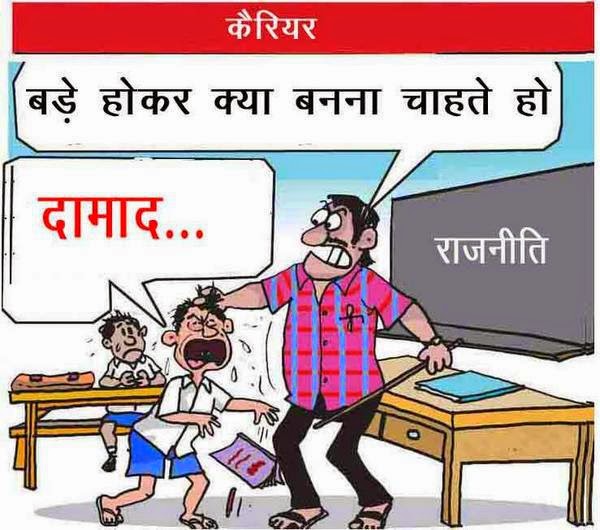
The banana republic strikes back
RV is famous for having said that he was a mango man in a banana
republic. Now that he is truly an Aam Admi, he should be also thoroughly
investigated for his sources of wealth. Let the witch hunt begin (we use the word advisedly). (For those who are not familiar with Hindi, we observe an teacher who is fed up with a troublesome student. Asked about his ambition in life, the student replies: I want to be a son-in-law)
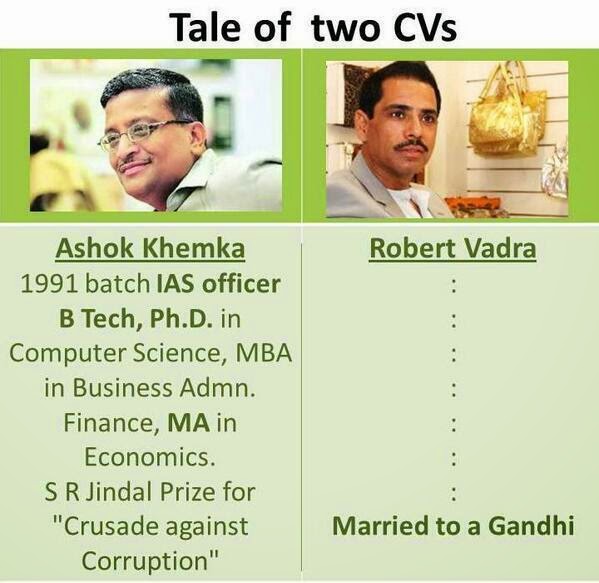
Also there is a lot of push-back from Congress and elsewhere about the (educational) qualifications of the cabinet ministers. Here is one comparison the sycophant army may want to think about (Ashok Khemka has been the main man behind the effort to unearth corruption linked to Robert Vadra and his associates, he has been harshly treated just for doing his job):
……
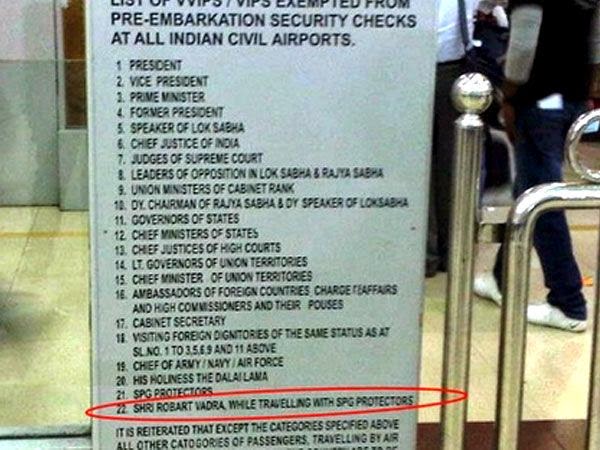
With the Gandhi family out of power, son-in-law Robert Vadra may lose his exalted exempt-from-frisking-at-airports status.
After taking over as aviation minister of Friday, Ashok Gajapathi Raju
Pusapati said that “security should be meaningful not ornamental” in
reference to Vadra who is the only individual named in the list of
dignitaries exempt from security checks at airports. All others on that
list are high constitutional positions with Vadra being the only
individual.
“It is for the home ministry to see the threat
perception of individuals. But generally, by and large, Indians should
go through security checks,” Raju said.
The Bureau of Civil
Aviation Security has 30 positions on the exempt list which begins with
the President of India and goes upto special protection group
protectees. The only individual listed in that list (on number 31) is
Robert Vadra, Sonia Gandhi’s son-in-law.
Last week, the Air
Passengers’ Association of India had written to aviation secretary Ashok
Lavasa why was Vadra getting this special privilege that is reserved
for Constitutional authorities only. The list of exempt people is
displayed prominently at all airports and the inclusion of Vadra’s name
in it led to many people writing to the Association, asking it to take
up the matter with the government.
regards
Left must exit, stage left (says “real India”)
One may say that this is the key difference between India and Pakistan, where the Leftists could not get a strong enough foot-hold (there was a stronger faction in the East – Bangladesh – which faced the fury of the Army in 1971).
Strangely enough the Left also stopped the Far Left in its tracks. In the 1960-1970s when Bengal was being torn apart by violence, the Left fought off the Naxalites in collaboration with the infamous Siddhartha Shankar Ray of the Congress. (Ray would be later deputed to troubled Punjab and he teamed up with KPS Singh Gill to stop the Khalistani movement in its tracks).
Even more strange was the action of the CPI (Communist Party of India, not to be confused with its evil twin, the CPIM) during the dark days of the Emergency. The Communists aligned with Mrs Gandhi, supposedly with the backing of Moscow.
Hartosh Singh Bal (in a write-up before the election results was announced) looks at the reason(s) why the Left has essentially faded from the Indian scene, when it was dominant even a decade ago (and occupied the principal king-maker role in the area of coalitions, even to the extent of co-supporting govts with the aid of the BJP).
………………….
Left, but by the time of her 6 March interview with Arnab Goswami on Times Now,
the third front that the Left parties had been working assiduously to cobble
together since June 2013 had already displayed enough evidence of falling apart
without any help from her.
While the seat-sharing agreement with Jayalalithaaâs
All India Anna Dravida Munnetra Kazhagam had come apart at the last minute, Naveen
Patnaikâs Biju Janata Dal in Orissa had paid no heed to the possibility of an
alliance, and Nitish Kumarâs Janata Dal (United) in Bihar had agreed to a
tie-up only with the Communist Party of India, snubbing the principal Left
party, the Communist Party of India (Marxist).
CPI(M), the CPI, the All India Forward Bloc and the Revolutionary Socialist
Partyâto partner with these regional leaders was made even more humiliating by
the fact that many of them had supported the BJP in the past.
Jayalalithaa, in
particular, shares a strong rapport with the partyâs prime ministerial
candidate, Narendra Modi. Given that the regional parties could end up
supporting the BJP again after the election, the Left was in effect willing to
run the risk that its votes could eventually shore up Modi.
climbdown, most regional figures had come to the conclusion that, for the
present, what mattered was maximising their share of seats in parliament, and
that there was no need to oblige the Left, which is no longer in a position to
exert the kind of influence it once did in any alliance that involved the
Congress.
Under these circumstances, soon after Mamata chose to tell Goswami
that she was willing to support Jayalalithaa as prime minister, Jayalalithaa
reciprocated with a phone call, opening up the possibility that if the
post-election scenario permits, a fourth front without the Left may have more
chances of taking shape than the third front being shaped by the Left.
getsâworse, even, than 2009, when the third front it had espoused alongside
Mayawati had been marginalised. In contrast, in 2004, the Left parties had
stitched together a series of tactical alliances that not only ensured the unexpected
defeat of the Vajpayee-led NDA, but also made them key players in the
subsequent UPA-I government.
While a Marxist would undoubtedly claim that the
contrasting scenarios were but the product of a difference in material
conditions (if Mamata Banerjee can be so termed) it is difficult to avoid
examining the role of the respective individuals guiding the Left under these
different circumstancesâHarkishan Singh Surjeet and Prakash Karat.
together a workable alliance owed much to Surjeet, the then general secretary
of the CPI(M). One of the few communist leaders of significance from north of
the Vindhyas, Surjeet also had a personal rapport with almost every important
political leader outside the Hindu Right. The two failures, however, took place
under the guidance of Prakash Karat, a Marxist theoretician with little
experience of electoral politics, who does not even enjoy the goodwill of all
his colleagues within the CPI(M) politburo.
shortly after his death in 2008, his protégé Sitaram Yechury, who has always
harboured ambitions of becoming the partyâs general secretary, chose to end a
piece, titled with some deliberation as âComrade Surjeetâthe True Marxist,â
thus:
At
the Deoli concentration camp in the 1930s, Surjeet was there along with other
legendary Communist figures like B.T. Ranadive, Dr G. Adhikari and P.C. Joshi.
To keep themselves amused, they would take bets with each other. Surjeet
boasted that he could consume a ser of gheeâa thought, which the others baulked
atâthe ghee was somehow smuggled in and Surjeet consumed it in one go, only to
have the other three stay awake sitting by his side the whole night fearing
that he would now meet his end.
Surjeet
woke up in the morning, and with his lota went into the khet (field) and
returned to tell his comrades, that âurban Communists will have to work very
hard to understand real Indiaââa lesson that remains relevant even today.
seem, words are weighed with great care within the CPI(M). Yechury may have
included himself among the urban communists, but it was not lost on anyone
within the party who the actual target of this veiled barb was.
successor has considerable merit. The handover of power in the CPI(M) from
Surjeet to Karat in 2005 was not just a transfer of power across generations,
but also across attitudes. Karat enjoyed the support of the vast mass of the
cadre in the CPI(M), a party that has always emphasised adherence to Marxist
doctrine. But as subsequent events have shown, this doctrinaire approach is out
of step with the requirements of electoral politics, which had shaped Surjeetâs
vision.
the party in directions not amenable to its own cadre because he was among the
nine ânavratanasâ of the CPI(M), who formed the partyâs politburo after
a split from the CPI in 1964. His entry into active politics dated back to
1930, when he joined Bhagat Singhâs Naujawan Bharat Sabhaâwhich even then
required that its members not have anything to do with communal bodies, or
parties which disseminated communal ideasâand took part in the independence
movement. He subsequently fought and won two elections for the Punjab Assembly.
the formation of coalitions and alliances, Surjeet had the stature of an elder
statesman both within the party and outside it. His worldview had been shaped
by the partition of Punjab, and he abhorred communal politicsâwhether of a
minority, such as the kind preached by the radical Sikh leader Bhindranwale, or
of a majority, as espoused by the BJP. In national politics, as far as he was
concerned, keeping the BJP out of power was the Leftâs main objective.
theoretician, a student of the Marxist academic Victor Kiernan in Edinburgh. He
returned to India in 1970 to join the party, where he became closely associated
with another ânavaratna,â the then general secretary of the party P
Sundaraiyya, who resigned from his post in 1975 because of the CPI(M)âs
ârevisionistâ tendencies. Sundaraiyya was forced to go underground after the
CPI(M) split from the CPI in 1964, and then again in 1975 after the imposition
of the Emergency.
Delhi unit in the early 1970s, Karat participated in student politics while
studying at Jawaharlal Nehru University, before being elected to the CPI(M)âs
Central Committee in 1985, and then to its politburo in 1992. These roles
confined him to working within the party, and he was mostly uninvolved with the
larger politics of the country till he took over from Surjeet in 2005.
inherited Sundaraiyyaâs view that the party needed to maintain an equidistance
from the BJP and the Congress. This view had led him, in 1996, into marshalling
the partyâs young guard to block Jyoti Basuâs ascension to prime ministership
when a coalition government came to power with outside support from the
Congress. First HD Deve Gowda and then IK Gujral took over as prime minister
for brief periods, before the BJP came to power in 1997.
UPA-I that allows us to see what was lost in 1995 from the Leftâs point of
view. In 2004, with Surjeet still in charge, while the CPI(M) and, to a lesser
extent, the CPI were considerably strengthened by strong showings in their home
turfs of West Bengal and Kerala, they also made a number of tactical alliances
with regional parties such as the DMK in Tamil Nadu, which added to their tally
of seats. The influence of the resulting Left Front on the UPA government was
visible in a number of ways, including the passing of the legislation that
resulted in the NREGA.
heed to the practical necessities of politics after he took over as general
secretary of the CPI(M) in 2005. By the time the Leftâs alliance with the
Congress broke down in 2008, over the IndoâAmerican nuclear deal, personal
relations between Karat and the UPA leadership had deteriorated to the extent
that their only communication was taking place through newspaper interviewsâa
situation that would have been inconceivable when Surjeet was in charge.
Equally inconceivable would have been the fact that the Left was eventually
marginalised because Mulayam Singh Yadav came to the rescue of UPA-I, something
he would have never done if Surjeet was in command, given their personal
relationship.
the alliance as a setback. For the 2009 elections the Left managed to stitch
together another alliance, which included Mayawati. This alliance seemed
certain of being an influential factor in any government that would be formed,
but the Left had not taken into account Mamata Banerjeeâs Trinamool Congress.
Her party won 19 seats and, in alliance with the Congress, was able to oust the
CPI(M) from West Bengal in the ensuing assembly polls in 2011.
leave Karat with no say in UPA-II, it also saddled him with fresh problems
within the party. Faced with economic challenges within the state, the Bengal
unit of the CPI(M), under Buddhadeb Bhattacharjee, had in the mid 2000s already
adopted an industrial policy that was far more pro-market than had ever been
envisaged before by the party.
which hail largely from Kerala, blamed those policies for the defeat, the
Bengal unit took the line that the doctrinaire stand over the nuclear deal had
pushed the Congress into an alliance with Mamata, which eventually led to the
Leftâs defeat in the state. Unlike Surjeet, Karat was seen as an interested
party in this war, given his support within the Kerala unit. As a result of
this internal strife, the CPI(M) increasingly resembles two regional parties
with very different economic visions, held together by a central authority that
is getting weaker.
electoral tally of the Left parties, which together won 24 seats in 2009, the
CPI(M) and the CPI had sought state-specific alliances with several regional
parties. All of these alliances have come undone. In Tamil Nadu the Left asked
the AIADMK for two seats each for the CPI(M) and the CPI, a comedown from the
three each offered to them by the DMK in 2004. But given that there was little
the Left was bringing to the table, Jayalalithaa, much like Naveen Patnaik in
Orissa and Nitish Kumar in Bihar, seems to have calculated that the best
strategy for each party in the forthcoming elections is to fight for seats
independently and await the poll results, which could throw up any number of
possibilities.
on its own, the Left faces another unexpected challenge. In past elections, it
regularly picked up a number of isolated seats outside Kerala and West Bengal
through the very sort of tactical alliances that have now fallen through. In
these other states, the rise of the AAP provides an alternative choice for many
voters who desire a liberal, left-of-centre option. Unclear though the AAPâs
stance is on so many issues of concern to such voters, the party at least
brings with it new hope and the prospect of change.
the CPI(M) expect that a debacle in the forthcoming polls, which seems
increasingly likely now, will pave the way for the party to elect a new general
secretary at its next congress, due in 2015. But the end of Karatâs term does
not mean his hold over the party will come to an endâin all likelihood his
successor will be someone who meets with his approval.
weakened, the conditions that brought Karat to the fore still exist, given that
the Kerala unit still wields more support within the organisation than the West
Bengal unit. In some ways the very strength of doctrine that keeps the
organisation together is largely responsible for its decreasing electoral
relevance. As a result, if the party chooses another urban, doctrinaire leader
in the mould of Karat to be its next general secretary, as seems likely, there
will be no one happier than the BJP, which would then have truly put the ghost
of comrade Surjeetâand others like him who understood the âreal Indiaââbehind
it.
âAaj jaane ki zid na karoâ
Farida
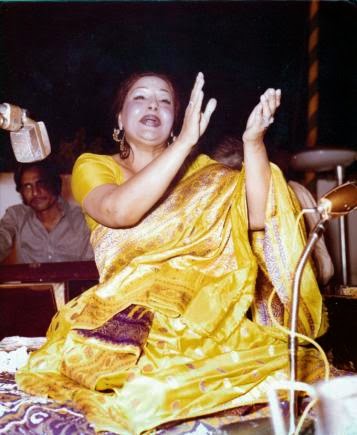
Khanum is one of the last of the Ghazal greats. She grew up in
Kolkata and has great fondness for the city. The denizens of this city
are known for their musical taste, and they have (naturally) great love for Farida. A
beautiful love story that is reaching its end as the giants exit the stage one by one.
Literary Meet. I met BanerjeeââMalaââat last yearâs KaLaM, and told her I was
making a documentary film about Farida Khanum.
Our conversation took place one
night in a car; we were weaving past rotten old buildings somewhere near the
Victoria Memorial and I was telling Mala about Khanumâs Calcutta connection.
Her older sister, Mukhtar Begum, was a Punjabi gaanewali who had come to
the city in the 1920s to work for a Parsi-owned theatrical company. Within a
few years she had become a star of the Calcutta stageâshe was advertised on
flyers as the âBulbul-e-Punjabâ (the Punjabi bulbul)-âand had moved into
a house on Rippon Street.
Khanum herself was born, sometime in the 1930s,
somewhere in these now-decrepit parts.
bring Khanum to next yearâs festival. She also asked, in a sort of polite
murmur, âSheâs still singing and all?â
âOf course!â I said, mainly to serve
my own interests: I had been looking for a reasonâa ruse, reallyâto bring
Khanum to Calcutta and film her in the locations where she had passed her
childhood.
âTheek hai,â Mala said. âLet
me work on this.â
IT WAS A DIM JANUARY AFTERNOON IN
LAHORE, there was a power outage on Zahoor
Elahi Road, and Farida Khanum had finally woken up….I had come to prepare Khanum for a
concert she was to give in a weekâs time in Calcutta, and was trying to engage
her, in this fragile early phase of her day, with innocuous-sounding questions:
which ghazals was she planning on singing there, and in what order?
âDo-tin cheezaan Agha Sahab diyanâ
(Two-three items of Agha Sahibâs), she said in Punjabi, her voice cracking. She
was referring to the pre-Independence poet and playwright Agha Hashar Kashmiri.
âDaagh vi gaana jayâ (You
must sing Daagh too), I said. âOthay sab Daagh de deewane neâ (Everyone
there is crazy about Daagh)âDaagh Dehlvi, the nineteenth-century poet.
me in appalled agreement, as if I had recognised an old vice of Calcuttaâs citizens.
âTe do-tin cheezaan Faiz
Sahabdiyan vi gaadenaâ (And you can also sing two-three pieces from Faiz
Ahmad Faiz).
âBuss,â she said, meaning it
not as a termination (in the sense of âThatâs enoughâ) but as a melancholy
deferral, something between âAlasâ and âWeâll have to wait and see.â
I knew she was nervous about the
tripâthe distance, the many flights, the high standards of Bengalisâand to
distract her I removed the lid of my harmonium and held down the Sa, Ga and Pa
of Bhairavi. I was chhero-ing the thumri âBaju band khul khul jaye.â
âFarida ji, ai kistaran ai?â
(How does it go, Farida ji?) I asked, all goading and familiar.
aalaap.
âAaaaaaâŠâ Her mouth was a
cave, her palm was held out like a mendicantâs.
pumped the bellows.
Her singing filled up the room: she
climbed atop the chords, spread out on them, did somersaults.
âWah wah, Farida ji! Mein
kehnavaan kamal ho jayega! Calcutta valey deewane ho jaangeyâ (Bravo, Farida
ji! It will be extraordinary! The people of Calcutta will go crazy), I said.
away and making a sideways moue that managed to convey deliberation,
disinterest and derision all at once.
debility of the last three years, which has been accompanied by hospital
visits, physiotherapy and rounds of medication. (Khanum herself had described
it to me in terms of demonic sensations: her foot going numb, a tube entering
her throat, being forced to swallow strange pills and feeling a subsequent
whirling in her head.)
But worse, I had sensed, was the gloom accompanying this
illnessâan awareness of the bodyâs vulnerability that led constantly to thoughts
of mortality, wistful ones not unlike those expressed in Khanumâs most famous
song, âAaj jaane ki zid na karoâ:
Waqt
ki qaid mein zindagi hai magar
Chand ghariyan yehi hein jo azaad hain
timeâs cage is life, but
Some moments now are free)
The song is set in Aiman Kalyan, also
called Yaman Kalyan, the evening raag prescribed for creating a mood of
romance.
Her âAaj jaane ki zid na karoâ is delivered in this
semi-free vein: her wilful, uneven pacing of the lyrics creates the illusion of
a chase, a constant fleeing of the words from the entrapments of beat. (This
technique, which has the mark of her teacherâthe erratic and perennially
intoxicated Ustad Ashiq Ali Khanâbears its sweetest fruit in Khanumâs ghazals,
where strategic lags and compressions in the singing can enhance the pleasures
of a deferred rhyme.)
But what after these outlines have
been described? How to account for the slightly torn texture, the husky tone,
the maddening rass of the voice? And what to do about Khanumâs
devastating deployment of the word âhayeâ in the phrase âhaye marr
jayeingeyâ? I once heard the Bollywood playback singer Rekha Bhardwaj say,
âYeh gaana hai hee âhayeâ peyâ (This song is all about the âhayeâ).
I think she is right, in that Khanumâs transformation of that wordâfrom a jerky
exclamation in the original to a dizzying upward glide, a veritable swoon, in
her own versionâhas made of it a mini-mauzu, or thematic locus, of the
lyric.
truncation in Khanumâs musical trajectory: she has said many times that
Partition, which resulted in the loss of her Amritsar home, signaled the end
of her training and forced her to make compromisesâpersonal as well as musical.
For a few years, while living in the alien city of Rawalpindi, Khanum travelled
regularly to Lahore to sing for radio and act in films. But she failed to make
an impact. Soon she was consumed by marriage, and gave up singing at the
insistence of the industrialist who offered her the securities of a âsettled
life.â Later, when she returned to music, she took up not khayal or thumri but
the accessible and mercifully âsemi-classicalâ Urdu ghazal.
IN OCTOBER, three months before the concert in Calcutta, Farida Khanum
moved an audience in Lahore to tears.
This happened at the Khayal
Literature Festival. I was interviewing Khanum, in a session called âThe Love
Song of Pakistan,â about her life in music. Adding star power to our panel was
the ghazal singer Ghulam Ali. I had spotted Aliâurbane in black kurta and
rimless glassesâin the audience at the start of the show and asked him to join
us with a spontaneous announcement.
âFarida ji,â I said, switching on
the shruti box I had placed before her. âCould you please, for just a little
bit, sing for us the bandish in Aiman that you learned as a child? Just
a little sample, please.â
This part was rehearsed. I had
suggested to Khanum earlier in the week that she present on stage a âthreadâ of
Aiman: she could start with a classical piece, then proceed to ghazals and
geetsâincluding the crowd-pleasing âAaj jaane ki zid na karoââall in her
favorite raag. This would give our session a musical coherence, I had said, and
make it easy to follow.
âAchcha?â she had replied. âSirf
Aiman karna ai?â (Really? You want to dwell only on Aiman?) She pressed her
lips together, in her inscrutable way. Then, with a mildly warning look, she
said, âTheekai. Ay achcha sochya ai.â (Okay. This sounds like a good
plan.)
Now, onstage, she ceded to my
request for the bandish with an indulging smile. What happened next surpassed
everyoneâs expectations. Khanumâs voice, in contrast to her ailing frame, was
robust, full-throated, steady, flexible. Everything she sang glowed with
energy: she unfolded an aalaap, a bandish in teentaal, Faizâs ghazal âShaam-e-firaaq
ab na poochch,â Sufi Tabassumâs ghazal âWoh mujhse huway humkalamâ
and her signature âAaj jaane ki zid na karo.â
She was bringing out the
raag in different forms, showing its familiar movements, making it reveal its
secrets. But she was also compressing a century of cultural evolution:
interspersing the singing with anecdotes about her childhood in Calcutta, the riaz
with her ustad in Amritsar, her post-Partition collaborations with poets
and music directors at Lahoreâs radio station, and the fortuitous way in which
she had come to sing âAaj jaane ki zid na karoâ (someone had asked her
to sing it at a mehfil). For the lay Lahore audience, the overall experienceâone
of observing a constant or eternal thing (the raag) endure in ephemeral or
perishable formsâwas eye-opening, cathartic and extra-musical.
In the case of a singer like Farida
Khanum, her role as a transmitter of djinns is magnified by social and
historical contexts. When she sings âAaj jaane ki zid na karo,â she is
passing on the cumulus of centuriesâthe laws of Aiman, according to one legend,
were fixed by Amir Khusro in the thirteenth centuryâin an accessible,
contemporary form. And the process is made poignant and ironic by our
ignorance: how many of the amateurs who upload videos of themselves singing âAaj
jaane ki zid na karoâ on YouTube and Facebook know what they are really
channelling?
hurdle appeared. I had gone to the GD Birla Mandir, the venue of the show, for
a sound check. There I was told, an hour before the concert, that Khanum would
have to go down several flights of stairs in order to reach the auditorium.
âWhat are we going to do?â I asked
one of the organisers, a woman in a sari who looked back at me
uncomprehendingly.
Then she said, âWait.â
Approximately twenty minutes later,
a little before 7 pm, a white car carrying Khanum pulled up to the GD Birla
Mandir. The legendary singer emerged in a pink-and-gold sari, and was led by
helpers and admirers into the foyer. Then the Mandirâs doors closed, and the
foyer emptied.
Khanum, who had only just sat down in a chair, spent the next
few minutes in a state of airborne transport, gripping the chairâs arms and
muttering the lordâs name under her breath, until she found herself seated in
her usual, regal way on a stage decorated with flowers. âYa Ali Madadâ
(Help me, Ali), she said, invoking the prophetâs heir and fourth caliph of
Islam, before the curtain went up.
âEk muddat ho gayi haiâ (It
has been an age), Khanum said, shivering a little but looking serene before her
Calcutta audience, which was comprised of young and old alike. âInnhon ne
kaha aap chalein, buss thhora sa safar haiâ (They said I should
go, the journey is not long).
She stuck to the rules: she sang two
ghazals from Daagh, two from Faiz, the thumri in Bhairavi and âAaj jaane ki
zid na karo.â I had the privilege of sitting next to her on the stage and
holding open the book that contained the words to the songs. I marvelled at her
composureâand, yes, at the soundness of her trainingâwhen I saw how she
conducted the audience, the accompanying musicians and the sound technicians
behind the curtain with just her hand-movements and facial expressions. And I
sawâa novice observing a master, a mortal observing a living legendâhow she
managed her voice: the expansions in the middle octave, the careful narrowing
at the higher notes, the strategic truncation of words and notes when she was
running out of breath. Occasionally, when I feared she was going to skip a
beat, I found myself clenching the book in my hands and glancing at the
audience for signs of a crisis.
But there were none, because even
the odd anti-climax, when it did occur, was a pleasure.
Link: – http://www.caravanmagazine.in/print/4357
…….
regards
Najma Heptullah- Parsis need help (not Muslims)
Najma Heptullah is no Uncle Tom. However we get the feeling that her priorities (as stated) are quite misplaced. The only way to help Parsis (while respecting the stricter than Brahmin blood-line rules) is to clone more Parsis. Then again, with her medical/biology background she may be able to achieve just that. Bravo!!!
If you have six children it is always important to see what you can
do for the weakest of them. So far as my ministry is concerned, of the
six minority communities the weakest is clearly the Parsis.
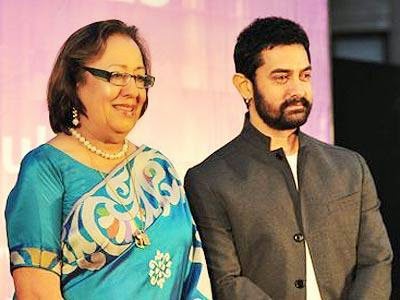
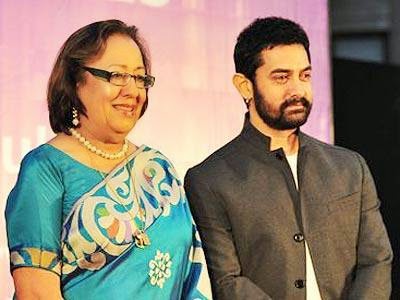
Dr Heptullah hails from a distinguished family (grand-niece of Maulana Abul Kalam Azad, cousin of Amir Khan). Heptullah has a Master’s degree in Zoology and a doctoral degree in
cardiac anatomy from the University of Colorado at Denver, in the USA. She has also been the Deputy Chairperson of Rajya Sabha (upper house, Indian Parliament) for 16 years and she is now the Minister of Minority Affairs and the sole muslim member in the Modi cabinet.
What is clear from her comments is that while muslims may not be unfairly targeted by this govt, they will remain invisible, as far as handouts are concerned.
The top demands from the community have been reservations in education and in jobs. These will not be implemented. To be fair, Congress has highlighted these demands many times (during elections), but has never made good on the promises. Also, efforts to introduce reservations for muslims at the state level (except in Tamil Nadu) have been stymied by the Courts.
The problem of reservations is a complex one. A reservation program for minorities will actually work out as a lose-lose proposition for muslims. The advanced minority communities (Christians, Jains, Sikhs) are likely to take disproportionate advantage of this provision. OTOH such a program would be vilified as a policy to appease the muslim vote-bank.
What is more promising (and legal) is a cut-out from the existing OBC reservation quota (4.5% was the Congress plank). Also, Dalit muslims (and Christians) can be made eligible for reservation benefits (this was first only for Hindus, later extended to Buddhists and Sikhs). However, to the extent the reservation pie is fixed, any quota for muslims will be fiercely opposed by the current Hindu beneficiaries.
Unfortunately, for the muslims, it looks like there are going to be only two viable coalitions going forward: (1) OBC + Forward caste team (and in select areas dalits as well) led by the BJP, and the (2) Dalit + Forward caste team led by Mayawati/BSP (which managed to secure the third highest vote percentage this elections (20%) but not a single seat). Neither group requires muslims, and will actually suffer if they are seen to be fishing for muslim votes (it will anger core supporters).
Due to H/M polarization, muslims at present have really no alternative but to vote for the Congress (A, B, C teams). There is also polarization within muslims, the BJP can expect to win the Shia and Bohra vote (these communities are relatively advanced and would not be seeking reservation benefits anyway). Since the “secular” parties do not have to earn the muslim votes, they will promise a lot and forget quickly (which is the case for the last 65 years). If anything, the track record of non-BJP governments in preventing riots is worse than that of the BJP governments.
Finally, as has happened already in Axom and in Kerala (and Hyderabad), there are viable right-wing muslim parties which have the advantage (from a muslim standpoint) of being for, of and by muslims (conservatives). These parties may grow in strength in other parts of India as well (next stop West Bengal, Bihar and Uttar Pradesh). If that happens, the secular parties will be wiped out (in a first past the post system) and BJP will win the mantle of the “natural ruling party” of India.
There are secular solutions to the above problems and a party like the Aam Admi Party should be able to champion such solutions and even win a mandate based on such a charter. A huge, diverse country like India is best represented by some modified form of proportional representation. Also the concept of reservations can be revisited and the targeting of communities can be in terms of economic backwardness.
Dalits and Muslims (the two most disadvantaged groups) are likely to benefit strongly from such arrangement(s). This is then the “social justice” gap that Indian democracy requires fixing (as fast as possible). It is important for the sake of the country that a left-secular organization like the AAP switches off the dramabazi and focuses on building bridges with the voters (which has been badly bruised by the 49-day tenure in Delhi).
It is surprising that Arundhati Roy (who was voted as the leading thinker in the world) has not proposed such (and other) practical measures which will move both secularism and democracy forward. But then as Omar says, it is not clear that the Pankajists will be happy if this actually happened by some miracle. They have found out that throwing stones from the outside is a hugely profitable business, thus it is unlikely that any help will be forthcoming from them any time soon.
………
Minority Affairs Minister Najma Heptullah has said Muslims are too large
in number to call themselves a minority and that it is the Parsis who
need special attention, for they are a âminuscule minorityâ.
Referring to the issue of Muslim reservation in jobs, she said âthere
is no provision in the Constitution for religion-based reservationâ.
The matter is in the Supreme Court.
…
âIf you have six children it is always important to see what you can
do for the weakest of them. So far as my ministry is concerned, of the
six minority communities the weakest is clearly the Parsis. They are a
minuscule minority that is so â Muslims too many to be called minority,
itâs Parsis who need special attentionâ precariously placed that one
needs to take care of their survival. Muslims really are too large in
number to be called a minority community,â the minister told The Indian
Express.
…
She said the very concept of minority and majority is relative and
when talking about minorities it is imperative to understand that it is a
term that encompasses many parameters, including language, apart from
religion. Neither is there a âone-size-fits-allâ formula for the welfare
of minorities.
…
The Ministry of Minority Affairs was set up in 2006 in the wake of
the appointment of the Sachar Committee by the then prime minister
Manmohan Singh to look into social, educational and economic conditions
of Muslims in India. Though it caters to all six minority communities â
the latest addition being Jains â Muslims have, since its inception,
been a special focus area for the ministry.
…
Heptullah is yet to get a full lowdown on the ministryâs programmes
and schemes, but one scheme that she is not inclined towards is the
Prime Ministerâs 15-point programme for minority concentration areas.
âIt was started by Indira Gandhi in 1980 and in these 34 years all that
has happened is that successive prime ministers have merely âinheritedâ
it without any real thrust on implementation. I will have to discuss
with Narendra Modiji whether he really wants to inherit it. It is
striking that it has remained at 15 points all this while without one
addition or deletion which should have happened if there was application
of mind,â she said.
…
Heptullah made no bones about her aversion to the idea of reservation,
maintaining that it cannot be a solution for anything. âI am not in
favour of reservation. I have come this far without reservation. What is
important is positive action to provide level playing field. Once we do
that politically, socially and educationally they will be able to
compete with the rest.â
………………..
Link: http://indianexpress.com/article/india/politics/muslims-too-many-to-be-called-minority-its-parsis-who-need-special-attention/99/
…..
regards
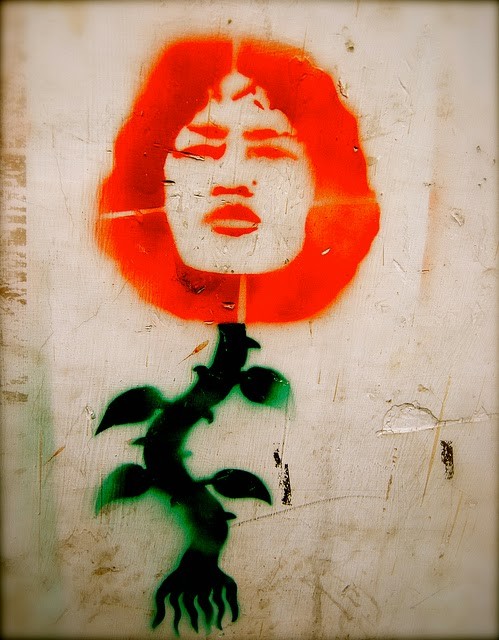
Irom Chanu Sharmila- (Hindu) Terrorist?
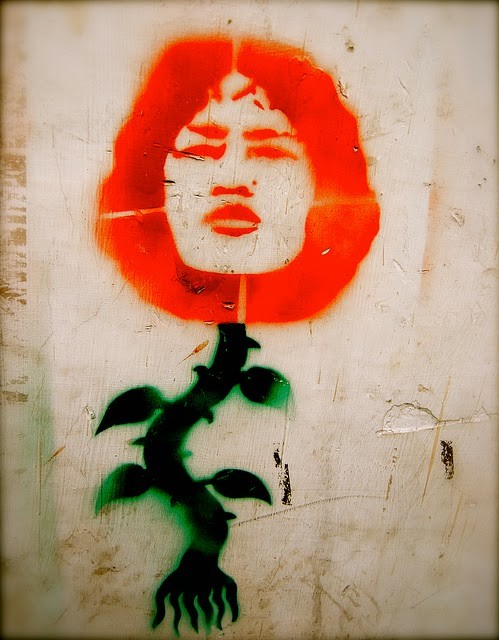
She is Gandhian no. 1 of the nation, the captain of a single-woman non-cooperation movement, without any support from any big name or big money.
I never voted as I had lost faith in democracy, but
the rise of the new anti-corruption party, Aam Aadmi Party, changed my
thinking.
She has now expressed interest in meeting with PM Modi. She is very hopeful that her single point request: repealing the Armed Forces Special Powers Act will be granted (we are not hopeful at all, in simple terms the Army has a veto and will exercise it).
Najma Heptullah, the minorities minister and grand niece of freedom fighter Abdul Kalam Azad, has created a firestorm by saying that muslims in India are too large a population to be considered a minority (unlike Parsis). As long as we are in blunt talking mode, we should also acknowledge that Hindus are not one unified block either (unlike what the Hindutva movement would have us believe).
Not only do we have Hindu minorities who face discrimination from the Hindu majority (Bihari migrants in Maharashtra, for example) but some Hindu groups are actually in a state of opposition to actions of the Indian state. Most of these groups are in the North-East and the most prominent amongst them is the United Liberation Front of Axom (ULFA).
……..
An Indian activist who has been on hunger strike for over 13
years said on Wednesday she was pinning her hopes of finally leading a
normal life on new Prime Minister Narendra Modi.
Irom
Sharmila, 42, who is force-fed by a drip through her nose, said she
wanted to meet Modi in hopes of ending the militaryâs alleged human
rights abuses in her northeastern home state of Manipur.
Escorted
by more than a dozen police officers, Sharmila appeared in a court in
New Delhi in connection with long-running charges against her of
attempting to commit suicide, a crime in India.
Sharmila told a
judge that she wanted a âsettled life as others doâ but would not break
her fast until a controversial law that covers large parts of restive
northeastern India and Kashmir was repealed
…….
[Ref. Wiki]
November 2000, in Malom, a town in the Imphal Valley of Manipur, ten civilians were
shot and killed while waiting at a bus stop. The incident, known as the
“Malom Massacre,” was allegedly committed by the Assam
Rifles, one of the Indian
Paramilitary forces operating in the state. The victims included Leisangbam
Ibetombi, a 62-year old woman, and 18-year old Sinam Chandramani, a 1988
National Child Bravery Award winner.
who was 28 at the time, began to fast in protest of the killings, taking
neither food nor water. As her brother Irom Singhajit Singh
recalled, “It was a Thursday. Sharmila used to fast on Thursdays since she
was a child. That day she was fasting too. She has just continued with her
fast”
days after she began her strike, she was arrested by the police and charged
with an “attempt to commit suicide”, which is unlawful under the Indian Penal Code (IPC), and was later
transferred to judicial custody. Her health deteriorated rapidly, and nasogastric intubation
was forced on her in order to keep her alive while under arrest.
Sharmila has been regularly released and re-arrested every year since her
hunger strike began under IPC section 309. The law declares
that a person who “attempts to commit suicide … shall be punished with
simple imprisonment for a term which may extend to one year [or with fine, or
with both].”
primary demand to the Indian government is the complete repeal of the AFSPA which has been blamed for violence in
Manipur and other parts of northeast India.
Sharmila had become an “icon of public resistance.” Following her procedural release on 2
October 2006 Irom Sharmila Chanu
went to Raj Ghat, New Delhi, which she said was “to
pay floral tribute to my idol, Mahatma Gandhi.”
October, she was re-arrested by the Delhi police for attempting suicide and was
taken to the All
India Institute of Medical Sciences, where she wrote letters to the
Prime Minister, the President, and the Home Minister. At this time, she met and won the
support of Nobel-laureate Shirin Ebadi, the
Nobel Laureate and human rights activist, who promised to take up Sharmila’s
cause at the United
Nations Human Rights Council.
she invited anti-corruption activist Anna Hazare to visit Manipur, and Hazare sent two representatives to
meet with her.
eleventh year of her fast, Sharmila again called on Prime Minister Manmohan Singh to repeal the law.
October 2013 Amnesty India issued a press release recognising Irom Sharmila as
a “‘Prisoner of Conscience’, who is being held solely for a peaceful
expression of her beliefs.”
also offered to contest Lok Sabha polls by Aam Aadmi Party leader Prashant Bhushan from Inner
Manipur under his party’s banner through Just Peace Foundation (JPF), a
solidarity group supporting Sharmila’s struggle.
rejected Aam Aadmi Party’s offer to contest the Lok Sabha polls and said that
“Though I support AAP, I rejected the offer as I’m just a protester not a
politician.” She also showed her moral support to the party and said
“If I am allowed to vote, I will cast my vote in favour of the AAP which I
am confident will restore the rule of democracy.”
offers on contesting Lok Sabha polls ,a JPF trustee said that “Politics is
not a cup of her (Sharmila) tea and she even called politicians ‘shameless
people’ for failing to scrap AFSPA despite their countless promises.”
she showed willingness to cast her vote and submitted an application
expressing her desire and she mentioned that “I never voted as I had lost
faith in democracy, but the rise of the new anti-corruption party, Aam Aadmi
Party, changed my thinking.” But she was not allowed to cast her vote as
per the law. An Election Commission official explained the reason stating that
under Section 62 (5) of the Representation of the People Act, 1951, a person
confined in jail cannot vote.
……
Link: http://www.dawn.com/news/1109200/13-year-long-hunger-striker-pins-hopes-on-modi
…….
regards
Apprehensively Optimistic
are simply too high for partisanship, and there are certain things that only someone
like Narendra Modi can do on the Indian side â just as only Nixon could go to
China and only Begin make peace with Egypt. I hope Mr. Modi has the wisdom to see this and the courage
to act. On the Pakistani side, Nawaz Sharif is probably better placed to act
towards rapprochement than the previous government of the Pakistan Peoples’ Party, but I’m not sure he has
enough freedom to act. Recent weeks have demonstrated that the strings of power
in Pakistan are still pulled by invisible actors who are ruthless, rigid and unburdened by conscience. However, there is a little
room for hope. Though the Nawaz government was not able to stand up fully to
the assault from the Deep State in the matter of Geo TV, it did not completely buckle
under either. Its surrogates pushed back forcefully â if only verbally â and a
degree of moral support for Geo was orchestrated from the chattering classes.
The clash is far from settled, but if the Nihari Caucus emerges from this with
some sort of settlement (the technical term in Pakistan is âmuk-mukaâ), they
may find the guts to move on the infinitely more important issue of rationalizing
relations with India.
whether the Modi government will have the fortitude to remain rational in the
face of provocations that will surely come their way from both the Pakistani
Deep State and their own right-wing. Only a strong government can resist the temptation to lash out, but
this is the strongest government India has had in decades. I, for one, actually
hope that, during their meeting, the two prime ministers hatched some secret
plots and set some hidden agendas, for in this age of screaming TV pundits, the
surest indication of serious ideas is that they cannot be revealed in public.
A friend asked me how I felt about the outcome of
the Indian elections. My answer was “apprehensively optimistic”.
That’s where we are today. May the apprehensions diminish and the optimism
grow!