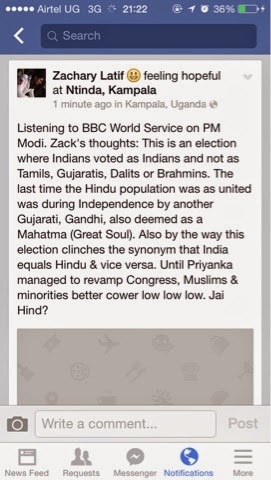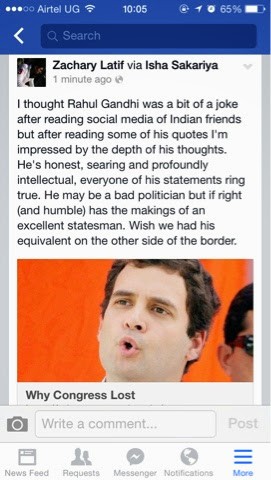

Smart guy Rahul Gandhi he just needs to Indianise more and learn humility in the years out of power.
It used to be that Kerala used to top the suicide charts but now the greatest cause of alarm is Tamil Nadu (and specifically Chennai). There are individual heroes like Lakshmi Vijayakumar and Justice Karnan who are trying to help. But much more is needed to be done, so please help out if you can.
For all the people who are on the edge (or if you are one who knows of such a person), we urge you to listen to the voice of the many failures like Justice Karnan who have now tasted success.
And yes, heartiest congratulations to Ayush. We have never before come across a person with a 99% score, and we are impressed. Keep it up.
………..
Little
did Ayush Banerjee expect that Saturday would be a red-letter day in
his life. The national Indian School Certificate Examinations (ISCE)
topper, said he was completely surprised on hearing the news.
The Loyola School, Jamshedpur, student, who scored 99.25%, said that
though he was expecting a good result, he never expected that he would
rank first in the country. “Although I was expecting to get a good rank,
topping the country is a big surprise for me,” he said.
Son of
Pradeep Kumar Banerjee, chief researcher at Tata Steel’s R&D
department, Ayush said: “Three hours of studying everyday was sufficient
for me.”
………….
A
day after Class 12 results were announced and two ‘failed’ students
committed suicide, with eight others having reportedly attempted
suicide, a sitting judge of the Madras high court has issued an appeal
saying he himself failed in five examinations but became a judge because
he never gave up.
Citing his own failures, not one or two
examination but in five, Justice Karnan issued a public appeal on
Saturday saying: “My appeal to all broken hearted and ‘unsuccessful’
students of Plus Two and SSLC students this year, and for all time to
come, is not to resort to the extreme measure of taking one’s god-given
life. Please trust me and believe that I, once a humble student and of
mediocre means, went through a difficult academic journey at a remote
village in Tamil Nadu. I failed in VI standard, VIII standard, PUC,
BSc., & BL examinations.
……..
Lakshmi Vijayakumar of the suicide prevention NGO Sneha
examines why India’s southern states register more suicides than the
northern states, in a conversation with Shobha Warrier.
The latest report of the
National Crime Records Bureau states that 135,445 people committed
suicide in the country last year. Tamil Nadu tops the list with 16,927
suicides, followed by Maharashtra (16,112), West Bengal and Andhra
Pradesh.
….
Dr Lakshmi Vijayakumar, consultant psychiatrist and
founder of Sneha, an NGO that works in suicide prevention, analyses the
situation, in a conversation with Shobha Warrier.
….
According to the NCRB report, Tamil Nadu tops the list of states that registered the maximum number of suicides…
The NCRB has been coming out with such crime reports for the last
20-30 years. For 20 years, Kerala used to be the state that registered
the maximum number of suicides followed by Karnataka, Tamil Nadu and
Andhra Pradesh.
If you take states and Union Territories together,
Pondicherry is the Union Territory that has the largest number of
suicides in the entire country.
The general pattern is that the southern states register more suicides than the northern states.
…
Is it because suicides are reported more in southern states?
Initially we also thought it was because of the better reporting
system. But recently Vikram Patel and I published a paper called Data from the Million deaths in Lancet,
which is a stratified sampling of a million homes in the country for
various causes of death and not necessarily suicide. When we analysed
the suicide part of it, we found that southern states had more suicides
than northern states.
…..
The national suicide rate is 11.2 per 100,000 but all the southern
states have more than 16. The suicide rate in the central states is
between 10 and 15. Northern states like Uttar Pradesh, Bihar and
Rajasthan register less than five per 100,000.
This pattern has been persisting for the last 20-25 years. We know
there is an under-reporting of suicides by 25 per cent but the pattern
has been the same.
….
What could be the reason? Why do so many southern states have more suicides than northern states?
There are more suicides in southern states because of three reasons.
One, southern states are more literate than the northern states. With
education comes higher level of expectations and that gives rise to
disappointments. In our national representative study, we tried to
analyse the data and found that education is directly proportionate to
suicide which is contrary to what we think. It may be because with
education, expectations also rise.
The second reason is cultural. If you look at the personalities, you
will see that northerners are a little more aggressive because they had
fought many wars with the Afghans, Mughals, the British, etc. while the
southerners never had to face any wars. If you look at the expressions
also, the northerners are more expressive of their emotions than
southerners.
So, people of south India have a tendency to internalise their
feelings. When there is so much of anger and frustration inside, instead
of directing it outside, you direct it inside.
These are the theoretical explanations of why suicides are high in southern states.
….
While Tamil Nadu and Kerala, the two states that are supposed
to be more advanced in all sectors, top the list, Bihar has the lowest
number of suicides.
That is the pattern we see all over. If you take the states of the
United States also, the states with higher GDP register more suicides
than the states with lower GDP. The reason is, the more you develop, the
more the expectations and more the disappointments.
In the US, the educated white male has a higher risk of committing
suicide than an unemployed black. When you blame yourself for your
failures, the suicide rates go up.
….
The NCRB report says that in Tamil Nadu the number of
suicides has gone up by six per cent last year. Kerala used to top the
list till recently. How has the number come down there and gone up in
Tamil Nadu?
Kerala used to have 28-29 suicides per 100,000 and used to top the
list, but in the last four to five years, the rate has been coming down
gradually. This is due to more awareness about taking treatment for
depression. The government also has come out with a mental health plan.
Also, rapid changes are not happening in the state these days.
….
Among the Indian cities, Chennai records the maximum number of suicides. Why is it so?
It has always been either Bengaluru or Chennai when you look at the
metros. Kolkata has the lowest with four or five in 100,000, whereas in
Chennai it is 24.9. Last year, it was almost 29. For six years,
Bengaluru had the highest number and in 2008 or 2009, Chennai became
number one. So, what we had witnessed in Bengaluru, we are now seeing in
Chennai.
Like Bengaluru, Chennai is settling down now.
In the case of suicides due to exam failures, it has come down in
Chennai compared to the rest of the state. That is because of the
intervention and awareness of schools, parents and NGOs.
….
How alarming is the situation in Tamil Nadu?
It is alarming. I would say the government should take active steps
in spreading awareness like the Kerala government did. Also, the health
sector, the social sector, and the education sector should be involved
in the plan.
I have given a policy recommendation to the Government of India and
also done a report for the World Health Organisation on public health
action to prevent suicides. We need to have an advocacy council which
will coordinate with all the sectors.
….
The report says more men commit suicide than women. Why is it so?
Not only in India but it is a global pattern. Globally we find that
more men commit suicide than women, but more women attempt suicide.
This is because men use more violent means to commit suicide. In the
western world, it is 3:1, which means for every three men, one woman
commits suicide. In India, it is 1.8:1. More women in India try to
commit suicide because the most common method is the use of pesticides,
which is more lethal than medicines like sleeping pills.
…….
Is there any particular age at which people are more prone to suicide?
If you look at women, we see that the maximum number of suicides
happen between the ages of 15 and 29. Till 29, the number is almost the
same for both men and women. After 30, three times more men commit
suicide than women. That could be due to a lot of sociological reasons.
Till 30, Indian women are not empowered fully and children act as a huge
protective factor.
…
The report also says more divorced women commit suicide than married ones.
Globally, divorced and widowed women have a higher rate because of
loneliness. Chances are less for a divorced woman with a child.
….
You run Sneha to help people overcome suicidal tendencies. Has the number of calls to Sneha increased?
Yes, the number of calls has increased. We have 30-35 people calling
us everyday saying they are depressed and suicidal. People also email
and even Skype from all over the world — like from Malaysia, Saudi
Arabia, the US.
I can say we are able to help 80 to 90 per cent of the time.
…….
Link: http://www.rediff.com/news/interview/why-tamil-nadu-tops-the-country-in-suicides/20131025.htm
……
regards
Kerala as an unit is 100% literate and social indicators come up to (East) European levels, the only out-standing boy in the class being the muslim belt of Malappuram (aka mini Pakistan). There is an enduring bond with the Gulf countries (where perhaps as many as 25% Malayalis are employed), and strong gusts of Wahabi winds are frequently blowing across the state. The Christians with their booming rubber plantations and all pervasive network of educational institutions play a dominant role as well. The Hindus are rumored to be actually a minority of the population and this trend will accelerate as the muslin population grows (but not the Christians).
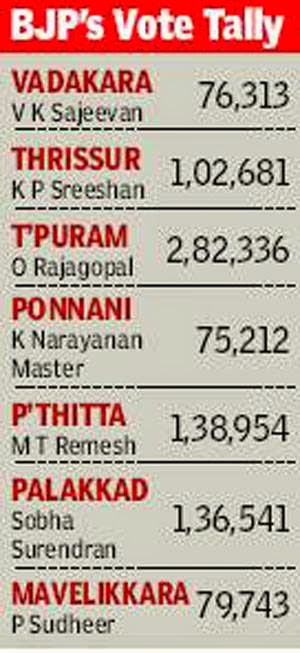
The results have been eminently predictable. While a Tsu-Namo reached out to
all corners of the country, with the BJP tally greater than or equal to that of the DMK (Tamil Nadu), Left Front (Bengal), and Congress (Axom, Kashmir),
Kerala stands out loud and proud as the anti-India, the place where Hindus have
lost their consciousness and are unable to mobilize even under the most
favorable conditions. Indeed, in the Hindu stronghold of Thiruvananthapuram, the BJP lost against a man who stands publicly accused by his wife of being involved in malpractice before she died an untimely (and convenient) death at the hands of an (unknown) assassin.
The only flicker of hope (for the Hindus) lies in the fact that the Left Front (and its Ezhava shudra voting base) is slowly (but surely) disintegrating. The Revolutionary Socialist Party (RSP) has left the Left and joined hands with the Congress. Even more significant (in our opinion) is the fact that a communist star defected and joined the BJP (but still lost by 3 Lakh votes). Girija Kumari is 1965 born (Roy is 1961 born).
It is an unique aspect of Hindu mythology (which makes liberals like Amardeep Singh rather uncomfortable) that a woman’s place is at the head of the army (which destroys the invincible demon or the ashura). In the coming days we fully expect Girija and Arundhati to engage in full-scale war in order to establish a Varanasi or a Jerusalem by the Arabian sea, the Gandhian guns of Ayemenem booming mightily against the feeble Trishuls of the RSS. Let the battles begin in full earnest.
..
The
BJP has increased its vote share in Kerala by nearly 4% this Lok Sabha
polls, up from 6.4% in 2009 to 10.3%. During the 2009 elections, the
party contested from 19 constituencies and managed to secure 10,11,563
votes. This time around, however, BJP fielded candidates in 20
constituencies and managed to garner 18,56,750 votes in Kerala.
With an increase of 8,45,187 votes, there were some constituencies
where BJP’s candidates performed better than expected, especially (as
expected) in Thiruvananthapuram where the BJP candidate, O Rajagopal,
lost by small margin of 15,470 votes to Congress candidate Shashi
Tharoor.
In Kasaragod, where Modi campaigned for BJP candidate K
Surendran, there was a marked increase by 47,344 votes. In 2009,
Surendran managed to get only 1,25,482 votes, while this time it went up
to 1,72,826 votes. Repeat candidate A N Radhakrishnan from Ernakualm
constituency managed 46,035 more votes than in 2009.
In
Attingal, S Girija Kumari, who defected from the CPM and was one of the
two women candidates fielded by the BJP, performed considerably well and
managed to capture 90,528 votes but lost to CPM’s A Sampath by 3,01,950
votes. Girija Kumari’s performance was much better than their 2009
nominee Thottakkad Sasi, who managed to secure only 47,620 votes.
In Kozhikode, C K Padmanabhan received 1,15,760 votes, a small increase
from what the current BJP state president V Muraleedharan managed back
in 2009 (89,718). Overall, the BJP managed to get at least 20,000 more
votes than 2009 in constituencies such as Kannur, Vadakara, Malappuram,
Ponnani, Alathur, Thrissur, Chalakudy, Idukki, Mavelikara, Kannur,
Kollam and above 50,000 votes compared to 2009 Lok Sabha elections in
Palakkad and Pathanamthitta.
…………………
regards
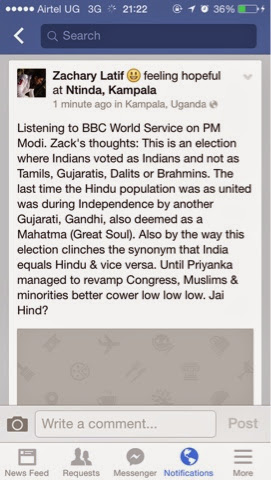
(1.) Chetan Bhagat is going for the kill; separate laws for Kashmir & Muslim is the basis of Indian secularism. Will the permanent rightward shift in India (in identity) mean that this majority will hold? Not necessarily but to look at Israel while the Knesset is full of coalition it’s definitely Likud taking the lead (though Israel interestingly enough doesn’t do dynastic politics – yet).
Pankaj should from time to time, press the pause button on the let me explain brown bastards to white liberals dosh, and try his hand at a Mirch Masala kind of social drama, where the rapacious goonda (Hindu) has his eyes set on a beautiful young damsel in distress. The lady is saved by a valiant yet infirm chowkidar (Muslim) who himself dies in the battle. Now that was not so hard, was it?
OTOH Chetan is one of those brash Punjabi boys that we all love to hate and he is not very modest about his precious word-power either. Earlier he was found out giving advice to (Indian) muslims as to how they should be conducting their lives. Now inevitably, as we reach the high noon of Hindu power (last time Hindus had this much power was way back in 1192 AD when the Gujjar Rajput Chauhan dynasty ruled Delhi) he lists out a bunch of dos and donts for the Hindus (dont kick muslims when they are down).
It will be an unusual government, one of the rare times in our
contemporary history that a party will be in power despite a public,
near boycott by the Muslim community. In any case, a low percentage of
Muslim population voted for BJP historically. With Modi, they have gone
public with their disdain.
The same applies here. What do BJP and the Indian majority do with
this new Hindu power? Do we use it to settle scores with Muslims? Do we
use it to establish a majoritarian, intolerant state where minorities
are ‘put in their place’? Do we impose ourselves and say things like,
‘India is the land of Hindus’? Do we make laws more in line with Hindu
religion?
Frankly, we may have the power to do some of these things now. It may
even appeal to sections of the population. How-ever, be warned. This
would be an awful and terrible use of this power. In the long term, such
a thought process will only turn us into a conservative, regressive,
unsafe and poor country where nobody would want to come for business.
Our neighbors like Pakistan and Bangladesh are prime examples of
majoritarian states that have messed it up. Make no mistake, if this
rise of Hindu power is not channelled properly, we risk turning into one
of our neighbours. Anybody want that?
So how should this Hindu power be used? Here are five areas towards
which the new government and Hindu citizens’ efforts should be focused.
First, get India its rightful place in the world. India has to be
shoulder to shoulder with the world’s economic powers. We need to be a
high growth economy, with a stable business environment. The only risk a
businessman, Indian or foreign, should take is a business risk.
Political, regulatory or government uncertainty risk has to be
minimal. There have to be fair, pro-business policies, with no ‘gotcha’
regulations like GAAR or retrospective taxes. Experts are available to
tell us how to grow the eco-nomy; the will is missing. Let’s generate
that will. Remember, little money means little res-pect in this world
for a country, religion or community.
Second, go after corruption. It bothers Indians and needs to be
fixed. However, at present it also churns the wheels of our economic
system. Draconian measures or finger pointing will solve nothing. It
might bring the country to a halt. You don’t solve a blood contamination
disease by cutting off the arteries of the heart. You make the blood
pure again one pill, one small transfusion at a time.
You don’t want all IAS officers or cops to stop working. You don’t
want them to be corrupt either. Hence incentive structures, laws,
mindsets and empowerment all need to be looked at. Indians don’t want
corruption solved next week. They just want a leader with genuine intent
to solve it. You have your time, but fix it.
Third, win over the Muslims. Even though Muslims may not have voted
for BJP, it has to win them over and Hindus have to open their arms to
them. This can only happen with love and understanding on both sides,
but the onus is on us. BJP must care better than any imam ever did for
Muslims.
Of course, this doesn’t mean appeasement. It does mean making Muslims
feel secure.
It also means never encourage, but rather come down
heavily on violent and fundamentalist acts or those that curb another’s
personal liberty, irrespective of religion.
Fourth, redefine secular – one of the most abused words in Indian
politics today. No-body can define it clearly. The simplest description
is letting all religions coexist. But coexist how? Like oil and water?
Or like milk and sugar? We have to strive for the latter. We have to
blend in as Indians. Oil-and-water secular is not secular at all. It’s
just vote-bank politics.
Fifth, fix laws that keep us separate – no modern, liberal democracy
has separate personal laws based on religion. These laws keep us
separate in the ‘oil and water’ secular mode. Remove them. Same for
Article 370 in Kashmir. It’s one country, one system. Apply for
citizenship elsewhere if you don’t like the rules.
We are at an unprecedented crossroads in Indian history. On one side,
we have a chance to be one of the best in the world. On the other, we
could mess it up with brazen abuse of power. I am an optimist. I’d like
to think we shall all choose the former, and make India the great nation
it deserves to be.
……
regards
All over our neighborhood celebratory bombs (fire-crackers) are exploding like mad.
Well……not really, BPeeps are just too smart to believe that but we had to try, right?
Sadly for us, the fun moments passed by too quickly, the White House must have been checking with legal all day and the lawyers just called back. Hooray!!!
11:24 PM White House says US President Barack Obama would be reaching out to Narendra Modi
………
Reaching out to Narendra Modi after his landslide electoral win, the
Obama Administration tonight said the prime minister-elect is welcome to
visit the US, which has denied him visa since 2005 in the wake the
Gujarat riots.
Hours after the results of the elections were out, the White House
exuded confidence that the India-US relationship under a Modi Government
would make further progress.
“We congratulate Narendra Modi and the BJP on winning a majority of
seats in this historic election. Once the government is formed, we look
forward to working closely with the prime minister and the Cabinet to
advance our strong bilateral relationship based on shared democratic
values,” White House Press Secretary Jay Carney told reporters at his
daily news conference.
Meanwhile, President Barack Obama tonight congratulated Narendra Modi
for his emphatic electoral victory during a telephone call in which
they discussed Indo-US strategic partnership and the global economic
situation.
Obama told Modi that the largest democracy in the world had given a
decisive mandate. The US leader also expressed the hope that under
Modi’s leadership, India would play a significant role on the global
stage. “The prime minister of India will be welcomed to the US,” he said.
In 2005, the US State Department had revoked a visa that Modi had for
travelling to the US on the ground of alleged human rights violations
after the 2002 Gujarat riots.
The US has repeatedly said there is no change in its long-standing visa
policy relating to Modi but he is free to apply for a visa and await a
review like any other applicant.
However, in a sudden u-turn in February, the US signalled the end of its
boycott of Modi when its ambassador to India Nancy Powell met him in
Ahmedabad.
“The President will be reaching out to Modi. And as I noted, we
congratulate him and the BJP on winning a majority of seats in these
historic elections,” Carney said as he described Indo-US relationship as
“important”.
He said Obama looks forward to building on the progress the two
countries made during the outgoing UPA government led by Prime Minister
Manmohan Singh.
“We congratulate India and the people of India on a historic national
election which saw more voters cast their ballots freely and fairly than
in any election in human history,” Carney said in response to a
question.
“We would also like to thank Prime Minister Singh for the role he played
in transforming our strategic partnership during his 10 years in
office,” he said.
Carney refrained from answering questions on Modi’s visa ban by the previous Bush Administration.
“I would refer you to State Department for general answers to questions
about the issuance of visas. I can tell you that the prime minister of
India will be welcomed to the US. And I would also note that US
officials, including (US) Ambassador (to India, Nancy) Powell, have met
with Modi. So he is certainly not unknown to us,” Carney said.
“I think the future is bright. We have long said that we look forward to
working with whomever the Indian people choose in these elections,” the
White House Press Secretary said when asked about the future of India
US relationship.
The US-India partnership enjoys broad support across party lines in both
of our countries, he said, adding that “I am confident that we will
continue our successful and productive partnership with the new Indian
government.”
Responding to questions, Carney said that the visa issues would not affect the bilateral relationship.
“We await the formation of a government and we absolutely look forward
to continuing all the progress that we have made in our bilateral
relationship and fully expect to be able to do so,” he said.
“The Prime Minister of India will receive a visa to travel to the United
States. We look forward to working with the new government and the new
Prime Minister. I don’t anticipate any problem in that regard,” Carney
said when asked about the visa issue.
“What we do anticipate is moving forward with the new government in
strengthening a relationship that has already been strengthened
significantly over the past years with Prime Minister Singh at the helm
in India,” he added.
……
regards
India extends 3200 km on the North-South axis and on the East-West axis. While in school we had to memorize the extreme-points trivia (lattitude, longitude,…). There was really never any use for this till now (and you heard it first here on BP).
BJP swept Gujarat (26 seats) and the Kachch (earlier Kutch) Lok Sabha seat which is the westernmost one.
BJP captured entire Himachal Pradesh (4 seats) in the far North and also emerged victorious in 3/6 seats in Kashmir, including the epic battle of Ladakh which was declared only at 11pm.BJP candidate Thupstan Chhewang won the Ladakh Lok Sabha seat in Jammu and Kashmir by a slender margin of 36 votes. He defeated Tsering Samphel of the Congress, and two independents – Syed Mohd Kazim and Ghulam Raza.
.
BJP captured Kanniyakumari (Tamil Nadu) on the south-end of mainland and Andaman and Nicobar islands in the extreme South.
In the North-East, BJP partner NPF won the sole Nagaland seat, while another partner NPP won in Meghalaya. BJP won 7/14 seats in Axom and 1/2 seats in Arunachal Pradesh.
regards
However there is always this guilty pleasure just a mm below our grief, first the dynasty goes out of the window, next USA is caught with its diplomatic pants down and now, Pankaj Mishra comes in with his machine gun and starts blasting away all neo-Hindus to kingdom come (so, when did the word neo- become a gaali?). Too much pleasure, really.
But to give the master his due, this article is huge and long and really tedious….someone please read it in full in order to get the fullest pleasure. One of things to do (while watching the paint on your fingers dry) is to make out a list of likes and dislikes of St Pankaj.
Likes: Ambedkar, Arundhati Roy, Vikram Seth, Amartya Sen, Jean Dreze, DR Nagaraj, Anand Patwardhan, Rahul Roy, Rakesh Sharma, Sanjay Kak
Neutral (good/bad mixed): Nehru, Gandhi, Indira, Rajiv
Dislikes: Vivekananda, Ratan Tata, Mukesh Ambani, Jagdish Bhagwati, Gurcharan Das, Rajat Gupta, Ayn Rand, Arvind Panagariya, Chetan Bhagat, George Bush, Vlad Putin, Thaksin Shinawatra (why is that? TS is a true champion of the poor)
……………….
In A Suitable Boy, Vikram Seth writes with affection of a placid India’s
first general election in 1951, and the egalitarian spirit it
momentarily bestowed on an electorate deeply riven by class and caste:
“the great washed and unwashed public, sceptical and gullible”, but all
“endowed with universal adult suffrage”. India’s 16th general election this month,
held against a background of economic jolts and titanic corruption
scandals, and tainted by the nastiest campaign yet, announces a new
turbulent phase for the country – arguably, the most sinister since its
independence from British rule in 1947.
Back then, it would have been
inconceivable that a figure such as Narendra Modi, the Hindu nationalist chief minister of Gujarat accused, along with his closest aides, of complicity in crimes ranging from an anti-Muslim pogrom in his state in 2002 to extrajudicial killings, and barred from entering the US, may occupy India’s highest political office.
Modi
is a lifelong member of the Rashtriya Swayamsevak Sangh (RSS), a
paramilitary Hindu nationalist organisation inspired by the fascist
movements of Europe, whose founder’s belief that Nazi Germany had
manifested “race pride at its highest” by purging the Jews is by no means unexceptional
among the votaries of Hindutva, or “Hinduness”. In 1948, a former
member of the RSS murdered Gandhi for being too soft on Muslims. The
outfit, traditionally dominated by upper-caste Hindus, has led many
vicious assaults on minorities. A notorious executioner of dozens of Muslims in Gujarat in 2002 crowed
that he had slashed open with his sword the womb of a heavily pregnant
woman and extracted her foetus. Modi himself described the relief camps
housing tens of thousands of displaced Muslims as “child-breeding
centres”.
Boasting of his 56-inch chest, Modi has replaced Mahatma Gandhi, the icon of non-violence, with Vivekananda,
the 19th-century Hindu revivalist who was obsessed with making Indians a
“manly” nation. Vivekananda’s garlanded statue or portrait is as
ubiquitous in Modi’s public appearances as his dandyish pastel
waistcoats. But Modi is never less convincing than when he presents
himself as a humble tea-vendor, the son-of-the-soil challenger to the
Congress’s haughty dynasts. His record as chief minister is
predominantly distinguished by the transfer – through privatisation or
outright gifts – of national resources to the country’s biggest
corporations. His closest allies – India’s biggest businessmen – have
accordingly enlisted their mainstream media outlets into the cult of
Modi as decisive administrator; dissenting journalists have been removed or silenced.
Absurdly uneven and jobless economic growth has led to what Amartya Sen and Jean Dreze call “islands of California in a sea of sub-Saharan Africa”.
The failure to generate stable employment – 1m new jobs are required
every month – for an increasingly urban and atomised population, or to
allay the severe inequalities of opportunity as well as income, created,
well before the recent economic setbacks, a large simmering reservoir
of rage and frustration.
Such
extensive moral squalor may bewilder those who expected India to
conform, however gradually and imperfectly, to a western ideal of
liberal democracy and capitalism. But those scandalised by the lure of
an indigenised fascism in the country billed as the “world’s largest
democracy” should know: this was not the work of a day, or of a few
“extremists”. It has been in the making for years. “Democracy in India,” BR Ambedkar,
the main framer of India’s constitution, warned in the 1950s, “is only a
top dressing on an Indian soil, which is essentially undemocratic.”
Ambedkar saw democracy in India as a promise of justice and dignity to
the country’s despised and impoverished millions, which could only be
realised through intense political struggle. For more than two decades
that possibility has faced a pincer movement: a form of global
capitalism that can only enrich a small minority and a xenophobic
nationalism that handily identifies fresh scapegoats for large-scale
socio-economic failure and frustration.
In many ways, Modi and his
rabble – tycoons, neo-Hindu techies, and outright fanatics – are
perfect mascots for the changes that have transformed India since the
early 1990s: the liberalisation of the country’s economy, and the
destruction by Modi’s compatriots of the 16th-century Babri mosque in
Ayodhya. Long before the killings in Gujarat, Indian security forces
enjoyed what amounted to a licence to kill, torture and rape in the
border regions of Kashmir and the north-east; a similar infrastructure
of repression was installed in central India after forest-dwelling
tribal peoples revolted against the nexus of mining corporations and the
state. The government’s plan to spy
on internet and phone connections makes the NSA’s surveillance look
highly responsible. Muslims have been imprisoned for years without trial
on the flimsiest suspicion of “terrorism”; one of them, a Kashmiri, who
had only circumstantial evidence against him, was rushed to the gallows
last year, denied even the customary last meeting with his kin, in
order to satisfy, as the supreme court put it, “the collective conscience of the people”.
India’s first prime
minister, Jawaharlal Nehru, appears in the novel as an effective one-man
buffer against Hindu chauvinism. “The thought of India as a Hindu
state, with its minorities treated as second-class citizens, sickened
him.” In Nehru’s own vision, grand projects such as big dams and
factories would bring India’s superstitious masses out of their
benighted rural habitats and propel them into first-world affluence and
rationality.
The Harrow- and Cambridge-educated Indian leader had
inherited from British colonials at least part of their civilising
mission, turning it into a national project to catch up with the
industrialised west. “I was eager and anxious,” Nehru wrote of India,
“to change her outlook and appearance and give her the garb of
modernity.” Even the “uninteresting” peasant, whose “limited outlook”
induced in him a “feeling of overwhelming pity and a sense of
ever-impending tragedy” was to be present at what he called India’s
“tryst with destiny”.
But then the Nehruvian assumption that economic growth
plotted and supervised by a wise technocracy would also bring about
social change was also profoundly undemocratic and self-serving. Seth’s
novel, along with much anglophone literature, seems, in retrospect, to
have uncritically reproduced the establishment ideology of
English-speaking and overwhelmingly upper-caste Hindus who gained most
from state-planned economic growth: the Indian middle class employed in
the public sector, civil servants, scientists and monopolist
industrialists. This ruling class’s rhetoric of socialism disguised its
nearly complete monopoly of power.
As DR Nagaraj, one of postcolonial
India’s finest minds, pointed out, “the institutions of capitalism,
science and technology were taken over by the upper castes”. Even today,
businessmen, bureaucrats, scientists, writers in English, academics,
thinktankers, newspaper editors, columnists and TV anchors are
disproportionately drawn from among the Hindu upper-castes. And, as Sen
has often lamented, their “breathtakingly conservative” outlook is to be
blamed for the meagre investment in health and education – essential
requirements for an equitable society as well as sustained economic
growth – that put India behind even disaster-prone China in human
development indexes, and now makes it trail Bangladesh.
Dynastic politics
froze the Congress party into a network of patronage, delaying the
empowerment of the underprivileged Indians who routinely gave it
landslide victories. Nehru may have thought of political power as a
function of moral responsibility. But his insecure daughter, Indira
Gandhi, consumed by Nixon-calibre paranoia, turned politics into a game
of self-aggrandisement, arresting opposition leaders and suspending
fundamental rights in 1975 during a nationwide “state of emergency”. She
supported Sikh fundamentalists in Punjab (who eventually turned against
her) and rigged elections in Muslim-majority Kashmir. In the 1980s, the
Congress party, facing a fragmenting voter base, cynically resorted to
stoking Hindu nationalism. After Indira Gandhi’s assassination by her
bodyguards in 1984, Congress politicians led lynch mobs against Sikhs,
killing more than 3,000 civilians. Three months later, her son Rajiv
Gandhi won elections with a landslide. Then, in another eerie
prefiguring of Modi’s methods, Gandhi, a former pilot obsessed with
computers, tried to combine technocratic rule with soft Hindutva.
The
Bharatiya Janata party (BJP), a political offshoot of the RSS that
Nehru had successfully banished into the political wilderness, turned
out to be much better at this kind of thing. In 1990, its leader LK
Advani rode a “chariot” (actually a rigged-up Toyota flatbed truck)
across India in a Hindu supremacist campaign against the mosque in
Ayodhya. The wildfire of anti-Muslim violence across the country reaped
immediate electoral dividends. (In old photos, Modi appears atop the
chariot as Advani’s hawk-eyed understudy). Another BJP chieftain
ventured to hoist the Indian tricolour in insurgent Kashmir. (Again, the
bearded man photographed helping his doddery senior taunt curfew-bound
Kashmiris turns out to be the young Modi.) Following a few more
massacres, the BJP was in power in 1998, conducting nuclear tests and
fast-tracking the programme of economic liberalisation started by the
Congress after a severe financial crisis in 1991.
The Hindu
nationalists had a ready consumer base for their blend of chauvinism and
marketisation. With India’s politics and economy reaching an impasse,
which forced many of their relatives to emigrate to the US, and the
Congress facing decline, many powerful Indians were seeking fresh
political representatives and a new self-legitimising ideology in the
late 1980s and 90s. This quest was fulfilled by, first, both the
post-cold war dogma of free markets and then an openly rightwing
political party that was prepared to go further than the Congress in
developing close relations with the US (and Israel, which, once shunned,
is now India’s second-biggest arms supplier after Russia). You can only
marvel today at the swiftness with which the old illusions of an
over-regulated economy were replaced by the fantasies of an unregulated
one.
A transnational elite of rightwing Indians based in the US helped circulate an impression of an irresistibly “emerging giant” – the title of a book by Arvind Panagariya,
a New-York-based economist and another aspiring adviser to Modi. Very
quickly, the delusional notion that India was, as Foreign Affairs
proclaimed on its cover in 2006, a “roaring capitalist success-story”
assumed an extraordinary persuasive power. In India itself, a handful of
corporate acquisitions – such as Tata’s of Jaguar and Corus – stoked
exorbitant fantasies of an imminent “Global Indian Takeover” (the title
of a regular feature once in India’s leading business daily, the
Economic Times).
A wave of political disaffection
has also deposited democratic social movements and dedicated
individuals across the country. Groups both within and outside the
government, such as those that successfully lobbied for the
groundbreaking Right to Information Act, are outlining the possibilities
of what John Keane calls “monitory democracy”. India’s many activist
networks – for the rights of women, Dalits, peasants and indigenous
communities – or issue-based campaigns, such as those against big dams
and nuclear power plants, steer clear of timeworn ideas of national
security, economic development, technocratic management, whether
articulated by the Nehruvians or the neo-Hindus. In a major environment
referendum last year, residents of small tribal hamlets in a remote part
of eastern India voted to reject bauxite mining in their habitats.
Growing demands across India for autonomy and bottom-up governance
confirm that Modi is merely offering old – and soured – lassi in new
bottles with his version of top-down modernisation.
Modi, however,
has opportunely timed his attempt to occupy the commanding heights of
the Indian state vacated by the Congress. The structural problems of
India’s globalised economy have dramatically slowed its growth since
2011, terminating the euphoria over the Global Indian Takeover.
Corruption scandals involving the sale of billions of dollars’ worth of
national resources such as mines, forests, land, water and telecom
spectrums have revealed that crony capitalism and rent-seeking were the
real engines of India’s economy.
His ostensibly
gratuitous assault on Muslims – already India’s most depressed and
demoralised minority – was another example of what the social
anthropologist Arjun Appadurai calls
“a vast worldwide Malthusian correction, which works through the idioms
of minoritisation and ethnicisation but is functionally geared to
preparing the world for the winners of globalisation, minus the
inconvenient noise of its losers”. Certainly, the new horizons of desire
and fear opened up by global capitalism do not favour democracy or
human rights. Other strongmen who supervised the bloody purges of
economically enervated and unproductive people were also ruthless
majoritarians, consecrated by big election victories. The
crony-capitalist regimes of Thaksin Shinawatra in Thailand and Vladimir
Putin in Russia were inaugurated by ferocious offensives against ethnic
minorities. The electorally bountiful pogrom in Gujarat in 2002, too,
now seems an early initiation ritual for Modi’s India.
The
difficulty of assessing his personal culpability in the killings and
rapes of 2002 is the same difficulty that Musil identifies with
Moosbrugger in his novel: how to measure the crimes, however immense, of
individuals against a universal breakdown of values and the
normalisation of violence and injustice. “If mankind could dream
collectively,” Musil writes, “it would dream Moosbrugger.”
There is
little cause yet for such despair in India, where the aggrieved fantasy
of authoritarianism will have to reckon with the gathering energies
below; the great potential of the country’s underprivileged and
voiceless peoples still lies untapped. But for now some Indians have
dreamed collectively, and they have dreamed a man accused of mass
murder.
……….
Link: http://www.theguardian.com/books/2014/may/16/what-next-india-pankaj-mishra
……….
regards