Thatcher or Hitler?

America is seriously angry and bitter about Indian elections. David Cameron and Mahinda Rajapaksa are the only leaders who have so far welcomed the BJP victory. There is still no tweet from Washington.

Americans were hoping (just like us) that BJP/NDA will fall short of
absolute majority and that the secular front can pull together a wobbly
coalition. The margin of victory has probably left them stunned.

Also things are expected to get worse if/when Hilary Clinton is installed in the palace by the Potomac in 2016? She was the inspiration behind a “get Modi” campaign which did not pan out (see below) and now she will have an angry and bitter partner in Asia to thank for.

One thing is for sure: Modi will never get his US visa. We presume that the moment such a visa is issued there will be a thousand cases brought on behalf of Gujarat victims and for the visa being issued in violation of US law. 

So how do we expect Modi’s relations to develop (or not) with the USA? A few commentators have taken a close look and make some very interesting points. Kevin Lees brings up the Western perspective when he talks about Thatcher and Hitler. David Danelo is more respectful towards Indian/Hindu civilization and talks about the avatars of Shiva: benefactor or destroyer.
………………………….
Continuing
to maintain silence on granting a visa to BJP leader Narendra Modi, US
has said the heads of state and government are eligible for A1 visas and
no individual automatically qualifies for an American visa.


“Heads of state and heads of government are eligible for A1 visa
classification under the INA (Immigration and Nationality Act). No
individual automatically qualifies for a US visa,” state department
spokeswoman Jen Psaki told reporters.

“US law exempts foreign
government officials, including heads of state and heads of government
from certain potential inadmissibility grounds,” Psaki said when asked
about the possibility of issuing visa to Modi, whose party-led NDA is
projected by exit polls to form the next government in India.
…………………….

While the Obama Administration continues its heralded pivot toward
Asia, it’s finding that Asia itself is pivoting in new and unpredictable
ways.


But from the U.S. perspective, Modi’s rise could be the most
challenging of all. Even though the bilateral relationship is now at its
lowest point since Obama took office, its current state could feel warm
and fuzzy compared to what lies ahead.
Among the priorities of the
Obama administration in its final two-and-a-half years, the challenge of
restoring strong ties with India should lie at the top of the Asia
agenda. No amount of pivoting will matter much if U.S. ties to the
world’s largest democracy—and, despite its current stumbles, one of the
world’s largest emerging economies—lie in tatters in January 2017.


The most beguiling aspect of Modi’s likely victory is that no one
knows exactly how Modi will approach U.S. relations. U.S. diplomacy is
at least partially to blame for that.


But the main concern isn’t that Modi might be denied entry to the
United States as the duly elected prime minister of a country of 1.27
billion people, or even that Modi might hold a grudge against the United
States and its European allies for shunning him throughout the 2000s.
Rather, it’s that Modi will favor relations with other nations rather
than focus on India’s relationship with the United States.
 

While Western
governments largely turned their backs to him, Modi spent the next
thirteen years inviting Chinese, Japanese, and Middle Eastern investors
and officials to his state, developing relationships that would
influence his foreign policy as India’s next prime minister.
Nancy
Powell, the outgoing U.S. ambassador to India, got around to meeting
Modi for the first time only in February, and BJP officials grumble that
she has much warmer ties with the leaders of the ruling Indian National
Congress. Accordingly, the greatest peril isn’t necessarily that
U.S.-Indian relations will become hostile so much as that Modi will
simply ignore the United States and look to Japan, China and the Middle
East.


Moreover, a BJP-led government would hold an incredibly different
cultural orientation than the outgoing Congress-led government. In an insightful piece for The Financial Times
last month, Indian-British economist Deepak Lal wondered whether Modi
would be a ‘Thatcher’ or a ‘Hitler’; he argued that, unlike the
Nehru-Gandhi family and other English-speaking, Western-educated,
secular elites within Congress, Modi believes in ‘modernization without
Westernization’. Lal ultimately concluded that Modi would be a
‘Thatcher,’ not a ‘Hitler’.


Many influential Americans have held the role in the past, including
industrial economist John Kenneth Galbraith in the 1960s, public
intellectual and eventual New York senator Daniel Patrick Moynihan in
the 1970s, and former Ohio governor Richard Celeste in the 1990s.
Powell’s successor should be someone of equally prominent caliber—it
wouldn’t hurt if the Obama administration appointed a high-profile
Indian-American businessman or even a prominent conservative whose views
might align more closely with Modi’s.


……………………


May
12 was Election Day in Varanasi, India, the holy, mystical city on the
Ganges River where pilgrims come for bathing and blessing—awaiting the
monsoon that will mercifully end May’s dry, dusty heat. Lord Shiva
claimed Varanasi as his home in Hindu tradition, and Gautama Buddha
preached his first sermon after enlightenment just north of the city.
Also called Banaras and Kashi, Varanasi has been continuously inhabited
for 4,000 years.
“Banaras is older than history, older than tradition,
older even than legend,” said Mark Twain, also noting the city, which he
visited in 1896, looked twice as old as all of them put together.


Varanasi’s appearance may have not changed
much since Twain’s visit, but the city’s political significance has—at
least for the 16th Lok Sabha, India’s five-year parliamentary
elections. For six weeks, and over nine Election Days, Indian news
media outlets have broadcast live from one polling station after
another. Narendra Modi, the Hindu nationalist and Gujarati economic
miracle worker from the Bharatiya Janata Party (BJP), must win a seat as
a member of parliament to be appointed India’s Prime Minister. Although
he is running in Vadodara from his home state of Gujarat, Modi is also
contesting Varanasi as a demonstration of his patriotism and religious
devotion. “Ma Ganga has called me,” said Modi, referring to the sacred
river where pilgrims bathe and reverently offer the dead, cremated
faithful.


There is no comparable American analogy to
this fusion of religion, history, and politics. Imagine a U.S.
presidential candidate centering their campaign fortunes in a city that
was America’s version of Jamestown, Virginia; Vatican City; and Sumeria
combined.
Although other candidates oppose Modi in Varanasi—notably
Arvind Kejriwal, whose upstart Aam Adami Party’s anti-corruption message
resonates with many in India—exit polls indicate the BJP will lead
India’s next government and, on May 16, send Modi to New Delhi as Prime
Minister.


What will a Modi victory mean for relations
between the world’s two largest democracies? Modi has an antagonistic
streak, and past calls have arisen from The Economist to Salman
Rushdie for his censure. In 2005, the United States denied Modi a
diplomatic visa for perceived (though unproven) involvement in Gujarat’s
2002 anti-Muslim riots when he was the state’s chief minister. Former
Secretary of State Hillary Clinton embarked on a “get Modi” policy while
in office, funding European NGOs on a quest to find mass graves—which
never turned up. Although President Obama appears to have quietly
reversed the isolation, Modi cannot easily forget being singled out as a
Clinton enemy. With Modi as India’s leader, a future Hillary Clinton
presidency would present a worst-case scenario for U.S.-India relations.


To his current and future human rights
critics, Modi can point to the increased Muslim vote for BJP in 2014, up
6% from 2009 according to exit polls. Additionally, in April 2014,
senior Pakistani diplomats expressed preference for Modi for Prime
Minister, saying he “could provide the strong leadership necessary for
peace talks.” Although no one suggests Modi sees all religions the
same—in a Reuters article last year, Modi was quoted comparing a
Gujarati Muslim killed in 2002 to a puppy being struck by a car—the
votes speak for themselves.  
To Muslims in both India and Pakistan, Modi
may represent the devil they know; a leader whose economic success and
reputation for leadership provides stability and confidence. More
importantly, given Modi’s Indian nationalism, these voting patterns
suggest India’s Muslims who supported the BJP see themselves as Indians
first and Muslims second.


The powerful Indian nationalist sentiment
Modi has tapped into draws upon allegiances and ties some Americans
might find troubling. At a May 8 BJP rally in Varanasi, Modi honored a
115 year old Indian colonel who served under Subhash Chandra Bose in the
Indian National Army (INA). Known to most Indians as Netaji, Bose was
recognized by the Axis Powers during World War II as India’s rightful
government,
whose support he sought against the British to help India
achieve independence. INA soldiers fought alongside the Japanese against
the British in the Burma campaign, were defeated, and 300 officers were
tried for treason. In August 1945, Netaji (Bose) died in a plane crash
in Japanese-occupied Taiwan.


Outside of India, the INA’s legacy has been
mostly forgotten. But within the country—and especially among India’s
rising business titans—Netaji is revered. “I believe India would have
been a powerful exporter much before China if only Netaji had a front
seat in our policy making along with (Jawaharlal) Nehru,” said Infosys
Technologies founder Narayana Murthy at Netaji’s 114th birthday celebration. “Netaji was one of the most courageous leaders in India.”


It is the name absent from that list which
speaks loudest. Mahatma Gandhi, whom many Americans see as India’s most
important founding father, does not command the same respect throughout
his country.
Although Gandhi’s 1948 assassination inspired national
mourning, it was sponsored by the Hindu Mahasabha, the spiritual and
political forerunner to the BJP. The conspirators saw killing Gandhi as a
necessary evil, believing his policies would destroy India. In the
Hindu nationalist view, although Gandhi led a powerful nonviolent
resistance movement, he was responsible for giving away Pakistan,

setting India on a ruinous economic course, and promoting the country’s
cultural division into 22 official languages.


No one really knows how Modi will affect
India’s international relations, but his hardline conservatism and long
memory suggest he will be friendly towards countries who have
steadfastly supported India’s independence.
Ties to Russia have endured
since the Cold War, when India embraced the Soviet Union after the
United States supported Pakistan. In 2007, Japanese Prime Minister
Shinzo Abe visited Netaji’s memorial in Kolkata, a gesture Modi is
unlikely to forget.
Relations with China could benefit from India’s
economic rise, should India grow as a consumer market, or become
strained through geopolitical competition, if skirmishes occurred over
the Arunachal Pradesh or Aksai Chin border disputes.


In the Mahabharata, the epic Hindu
scriptures, Lord Shiva is depicted as a multi-formed enigma, embodying
both honor and brilliance as well as invincibility and terror.
Modi
supporters treat the 2002 violence—in which they tacitly acknowledge his
responsibility—with an Indian equivalent of a Gallic shrug: it was
unfortunate, they say, but sometimes good people are forced to do bad
things. His opponents respond, correctly, that Modi’s victory repudiates
Gandhi’s vision of religious unity, and is thus an Indian tragedy.
Shiva has many forms in the Hindu tradition, but the two most dominant
are as either a benefactor or a destroyer.


One of every five people—22% of the world’s
population—lives in either India or the United States. By 2025,
according to current projections, India will overtake China as the
world’s most populous country. “They are much the most interesting
people in the world—and the nearest to being incomprehensible,” Mark
Twain concluded about Indians. “Their character and their history, their
customs and their religion, confront you with riddles at every
turn—riddles which are a trifle more perplexing after they are explained
than they were before.”
If Ma Ganga could speak, she could not have
better explained the man poised to lead her dynamic and paradoxical
nation. Only time—or, perhaps, the sacred river—can tell which of Lord
Shiva’s many incarnations the devout Hindu leader will become.

 ………
Link(1): http://nationalinterest.org/feature/modi-win-loss-us-indian-ties-10475?page=show

Link(2): http://www.the-american-interest.com/articles/2014/05/15/what-does-a-modi-win-mean/
…….

regards
..
The Tyajya-Putra (son sacrifice) backlash

This is simply amazing. DMK is wiped out from Tamil Nadu!!!

It appears that kicking out a son from the family home (even if he is not very dutiful) does not elicit good feelings from the Indian voter. Cheating the taxpayers is also a problem but more of a diffuse one (all politicians are thieves etc.).

As an outsider we are simply delighted that the DMK dacoits have all been dust under the feet of her highness. You do the crime, you pay the time.

Now there is nothing else to do but worship at the feet of the ever-green Amma Mahadevi (if you are foolish enough to express the slightest dissidence the crawling beasties at the Madras Crocodile Bank will make short work of you).

………………….
After steering single-handedly her party to a splendid victory in Lok
Sabha polls, Tamil Nadu Chief Minister J Jayalalithaa today admitted
there was no situation that facilitates AIADMK’s participation in the
central government.
An elated Jayalalithaa said AIADMK has emerged as the third largest
party in Lok Sabha and would “function as a responsible political
party.”

Meeting reporters as her party candidates established comfortable leads
in more than 37 of the 39 constituencies, indicating a clean sweep,
Jayalalithaa described the performance as “historic, unparallelled and
unprecedented.”


Commenting on the BJP’s impressive show in the polls, Jayalalithaa said,
“I wish the new government well. I wish the new Prime Minister well.
And I hope that the new government that will be formed at the Centre
will be friendly towards Tamil Nadu.”

She also thanked the people of Tamil Nadu for the massive mandate for AIADMK and also her party cadres for their hardwork.

……..

VERDICT
2014
NDA

333 (+192)
2009
2014
BJP
116
284
Shiv Sena
11
19
TDP
6
13
LJP
0
5
S.A.D
4
4
RLSP
0
3
SWP
1
2
Apna Dal
0
2
NPF
1
1
AINRC
0
1
NPP
0
1
UPA

59 (-175)
2009
2014
INC
206
46
NCP
9
5
RJD
4
4
IUML
2
2
JMM
2
1
KECM
1
OTHERS

150 (-18)
2009
2014
AIADMK
9
38


TMC
19
34
BJD
14
17
TRS
2
13


YRSC
10
Left Front
24
11
SP
23
5
AAP
4
JD (U)
20
3
PDP
0
3
AIUDF
1
3
JDS
3
2
2014 Seats above are results +
leads

……..
http://news.outlookindia.com/printitem.aspx?840950
…….

regards

Muslims salute Amma (and Akka) Mahadevi

There is a delicious, new flavor in the many-flavored two nation theory, one which was probably beyond the imagination of the founding fathers: muslims in India (third largest cohort globally) will, for the foreseeable future, be guaranteed life (and soul) protection by the grace of the pallu of an Amma (mother) and Akka (elder sister/Tamil, didi/Bengali), hailing from the supreme castes (Iyengar, Upadhyay) of the land.

A few years ago, before all the corruption shit hit the fan and ultimately helped destroy a 127 year old party, there were four formidable lady leaders who seemed all set for a long and distinguished innings on the roughest and toughest pitches. They were Sheila Dixit of Delhi, Mayawati of Uttar Pradesh, Mamata Banerjee of Bengal and Jayalalitha Jayaram of Tamil Nadu. They were still overshadowed by the pre-eminent Sonia Gandhi but it seemed like when the time was right (just around the corner) India will be led by an all-women “coalition of rivals.”

With the flames of modern Kurukshetras still burning in UP, Axom and now in Hyderabad, it appears that the only thing  that stands between the Hindu Brotherhood and the downtrodden muslim minority of India (redefined as the enemy who must pack their bags and leave for Pakistan and Bangladesh) are dear Amma (Jayalalitha) and dear Akka (Mamata).

While all the 50 different shades of green forts crumbling before the might of the saffron bahini, the M-J duo have managed an amazing 34/42 and 37/39 sweep of their respective strongholds. The opposition communists in Bengal and the original dravidas in Tamil Nadu have been crushed to almost full extinction. And yes, the BJP alliance has picked up seats in the most alien and unfriendly territory (now NOT to be branded as anti-India, however, Kerala still qualifies).
…………………………
In an
unprecedented dismal show, M Karunanidhi-led DMK on Friday headed for a
rout in Tamil Nadu as its arch rival AIADMK was well set for a clean
sweep, surging ahead in 37 seats out of 39 seats.


The
spectacular performance by chief minister J Jayalalithaa’s party in the
hustings also decimated a deserted Congress and shattered what was
described as a “formidable” six-party alliance stitched by BJP to gain
foothold in this southern state.

The outcome of the election
was the worst ever for DMK after 1998 when it had won five seats when
the party-led United Front ended up with a tally of nine facing crushing
defeat at the hands of AIADMK-led NDA that scored 30 seats.

DMK bigwigs and 2G accused Dayanidhi Maran (Central Chennai) and A Raja
(Nilgiris-SC) and T R Baalu (Thanjavur) conceded enough ground to their
AIADMK rivals, virtually ruling out a comeback in the subsequent rounds
of counting.

The trends have come as a jolt to the four-decade
old party, which faced internal rumblings leading to the expulsion of
former Union minister and Karunanidhi’s elder son M K Alagiri, who had
openly campaigned against the party nominees.

DMK was aiming to
convert a perceived anti-incumbency into votes in the backdrop of power
cuts and drinking water shortage but it was ‘Amma’ all the way.

According to counting trends available for 37 seats at 12 noon, AIADMK
was leading in 35 seats including those perceived to be DMK turfs while
PMK and BJP were ahead in one constituency each.

Congress,
forced to face polls alone with no takers for an alliance, put up some
semblance of fight only in Kanyakumari where the fortunes fluctuated
between it and BJP before the saffron party shot into the lead.

PMK’s Anbumani Ramadoss was leading in Dharmapuri, bringing cheers to
BJP alliance partners. However, BJP’s allies — DMDK, PMK, MDMK and KDMK —
seemed to be swept away in the ‘Lady Wave,’ as an AIADMK leader put it,
although Jayalalithaa’s national ambitions seem to have been cut short
by BJP’s good show across the country.

………

regards

Indira reborn

Rahul’ abject failure means that Priyanka is Indira Incarnate.

My suggestion is that the BJP should create a uniform civil code that allows either party in a suit to opt into it and that would take precedence over the other family laws.
The results for the Indian election are resoundingly pro the BJP and the BJP are going to be an ascendant power for maybe another two elections. Who knows Namo might be a life premier; the wise rule foretold in the ancient sagas.

Congratulations to India

It’s been a clear victory for Modi (or rather PM Modi).

Furthermore for a country of such extraordinary diversity the mandate for the BJP is overwhelmingly clear. Other than that I think what will make Modi a somewhat decent PM is the fact is that he has no family but the Indian nation.
As a leader his whole life seems to be consumed by politics and statecraft. Congress should have followed primogeniture instead of patrilineal primogeniture.

Modi is King, BJP crushes Congress

Whatever misgivings we have about the Hindu Brotherhood getting an absolute majority all on its own (the first time this happened since Congress got the sympathy vote in 1984), the first feeling is pure elation.

The dynasty (just like every other Indian dynasty) has collapsed under its own weight.

The crown prince is metaphorically banished to the jungle and should come back after 14 years (if ever) and rule with the consent of his people. Never ever assume the privileges of power if you are not responsible enough to wield power in a dutiful manner.

The real interesting thing is the performance of the regional parties, each of whom had claimed the king-makers position which has been the most sought after role in all post-1984 coalitions.
For UPA-I it was the Left with a few dozen seats (till the Nuclear accord with the USA), for UPA-II this role was assumed by the Trinamul Congress of Mamata Banerjee (AITC). 

In this election the key power-brokers were identified as AIADMK (Jayalalitha Jayaram), Biju Janata Dal (Naveen Patnaik), YSRC (Jagan Mohan Reddy), Bahujan Samaj Party (Mayawati), Samajwadi Party (Akhilesh Yadav), Rashtriya Janata Dal (Lalu Yadav) and AITC (Mamata B). The most significant nation-wide impact was expected from the Aam Aadmi Party (Arvind Kejriwal).

Of the above, Jayalalitha (leading in 37/39 seats), Jagan (9), Naveen (18), and Mamata (34/42) have performed very strongly. SP (5) and BSP (0) were crushed in UP by the BJP, while RJD (4) was similarly crushed in Bihar. AAP is leading in only 4 seats. Telengana Rashtriya Samity (TRS) is expected to do very well in …..well Telengana (leading in 11 seats). The Left is totally crushed in Kerala and in Bengal (only 8 seats)– hopefully it will teach them to be a bit more humble while peddling outdated ideologies.
……..

VERDICT 2014

NDA

340 (+199)

2009 2014
BJP 116 284


Shiv Sena 11 19


TDP 6 16


LJP 0 6
S.A.D 4 4
RLSP 0 3
SWP 1 2
Apna Dal 0 2
NPF 1 1
AINRC 0 1
NPP 0 1
PMK 0 1

UPA

58 (-176)

2009 2014
INC 206 44
NCP 9 5
RJD 4 4
IUML 2 2
JMM 2 2
KECM 1

OTHERS

146 (-22)

2009 2014
AIADMK 9 37


TMC 19 34


BJD 14 18


TRS 2 11


YRSC 9
CPM 16 8


SP 23 5
AAP 4
PDP 0 3
AIUDF 1 3
JD (U) 20 2
JDS 3 2
Misc 10
2014 Seats above are results + leads

……..

Link: http://www.outlookindia.com/
……..

regards

Kick-off (8am Delhi, 330am London, 1030pm New York)

Vote counting will start in 15 min. Patterns will emerge by 11am (3 hours). Results should be fully known by 4pm (8 hours). Please stay tuned.

How does the Election Commission, that national treasure of  India work its magic? The reporters from Dawn interview ex-Chief SY Quraishi.
…………….

The
commission in India does not only have all the powers that it needs to
organise this biggest electoral exercise in the world, it is willing and
ready to use it as well. The size of electorate in India is a colossal
810 million, ten times the one in Pakistan and multiplying it with the
geographical, linguistic and other diversity factors, the sheer
mechanics of the exercise become mind boggling. 


Yet, the commission
comes out victorious from this labyrinth as the participants generally
do not contest its impartiality or capacity. The commission has faced
some criticism in the present hotly contested elections but that has
largely focused on it being not quick in responding to calls for action.

From
Pakistan’s point of view where the commission is mistrusted and always
deeply embroiled in controversies, the more surprising is the fact that
the commissions in both countries enjoy roughly the same constitutional
powers. There are however some differences as well.

“The courts
can’t intervene in our working in any manner. The constitution
guarantees this non-interference that many subsequent court rulings have
further reinforced. That gives us the required agility,” said S.Y.
Quraishi, the former Chief Election Commissioner of India in an
interview with Dawn in New Delhi.

“Then we assume total control
over bureaucracy, cutting its links with the political governments
completely. We purge the entire state machinery of political bias by
ordering transfers and postings following our own assessments of each
individual functionary or in response to complaints,” says Mr Quraishi.
He adds: “The commission invites every party individually in every area
and each of them gives us their lists of suspected, biased
functionaries. We act after summary inquires.”

“We also insulate
the officials appointed to perform election duties from their political
masters. No minister or chief minister is allowed to call them for a
meeting. We suspend them even if we come to know that the chief minister
has talked to them on phone,” says the former commissioner who belonged
to Indian Civil Service.

The
commission in India does not require army to perform any election duty
and in fact keeps it “miles away from the process”. It instead lists
police, paramilitary and other armed forces for assistance and once they
are assigned they come under the commission’s ‘command’.

Quraishi
is all for the Electronic Voting Machines (EVMs) and rubbishes the
criticism on this “illiterate-friendly” machine that has replaced paper
ballots in India. The machine was first introduced in one state on
experimental basis as early as 1984 but it was provided the requisite
legal cover only in 1998. It was then put to use in all the state
assembly elections before being used for the entire Lok Sabha elections
in 2004 for the first time. 

He believes that EVMs not only save the
commission from the hassle of printing paper ballots, it also makes the
contentious counting process as easy as one, two, three. “Another
matchless advantage is obliteration of votes rejected for being marked
erroneously,” says Quraishi. (According to a FAFEN report the number of
rejected votes in 2013 elections in Pakistan exceeded the margin of
victory on 35 of the 266 contested seats.) The commission in India is
also experimenting with introduction of biometric system for voter
identification.

‘The money power’ however is the biggest and
burgeoning challenge that the commission is faced with. It not only
places a legal bar on the candidates to not spend beyond the prescribed
limit, it makes them open separate bank accounts dedicated to their
campaign expenses. “Then our flying squads videograph the campaign
activities and maintain a shadow account of each candidate,” says
Quraishi. “The candidates have to submit their expense accounts three
times during the 14-day campaign and they are not allowed to report the
cost of a cup of tea that they offered to their supporters at rupees two
if its market rate is rupees seven.” The commission carries a list of
the market prices of all the items that a candidate can possibly use in
his/her campaign and has powers of disqualifying them on wrong
reporting.

…………..
Link: http://www.dawn.com/news/1106141/why-is-the-election-commission-effective-in-india
…………….

regards

Bangladesh ferry sinks: 200 feared dead

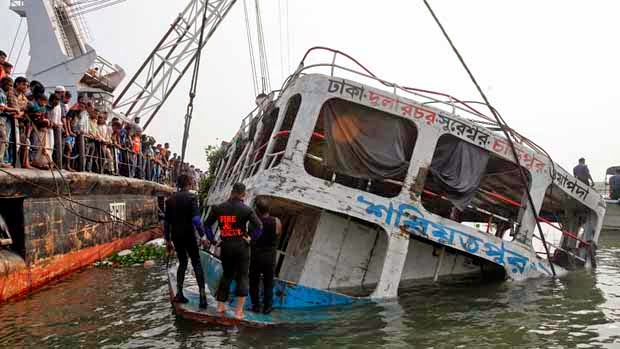
The passenger count must be the cruelest joke. Even the smallest raft in Bengal/Bangladesh is packed with dozens of people. There will be many more people who must have been on the ferry and now will remain unaccounted for.

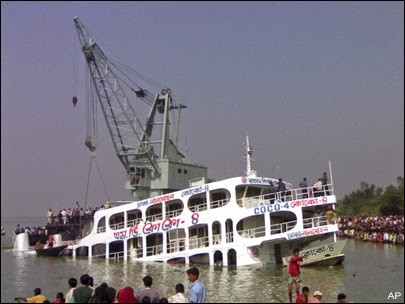
Just like that so many innocent souls sent to their death due to (criminal) overcrowding of boats, as has happened many many times before (the disaster below is from 2009). Some people (South Asians especially) never seem to be able to learn from their mistakes (but they will remember their pet hatreds over centuries).

….
A Bangladeshi ferry with around 200 passengers on board
capsized in a river near the capital Dhaka on Thursday, with police
reporting that at least six bodies had been recovered with a rescue
vessel still on the way to the site.

The M.V. Miraj-4
ferry capsized in stormy weather in the Meghna river at Rasulpur in
Munshiganj district, 27 kilometres from Dhaka. The accident occurred at
around 3:30 pm (0930 GMT). The ferry had been going to Shariatpur from
Dhaka.

“We are heading to the spot with rescue team,” said Saiful
Hassan Badal, Deputy Commissioner of Munshiganj district told Reuters.
He said the navy and coast guard were sending rescue teams and a ship
had been sent from Dhaka.

So far six bodies had been recovered, including that of a child, according to Oliur Rahman, a police officer at the scene.
……………


The death toll from the capsizing of a ferry over the weekend in
southern Bangladesh rose Monday to 77 after rescuers recovered an
additional 19 bodies.

Rescuers plucked 15 bloated bodies Monday
from River Tetulia, where the overcrowded triple-deck ferry capsized
late Friday, police official Mohammad Bayezid said. An additional four
bodies were found overnight in the river, he said.

Bayezid said
the bloated bodies were found as far away as three miles (five
kilometers) from the site of the accident. Rescuers used speedboats to
go farther downstream because some bodies may have been washed away
during high tide.

Authorities said the search for dozens of people still listed as missing was suspended for the night Monday.

“Our
divers have gone inside the submerged part of the ferry and found no
more bodies there today,” said Shahabuddin Ahmed, a fire brigade
official supervising the rescue work. “On Sunday we found bodies mostly
inside the submerged ferry. And on Monday, all the bodies were found
floating in the river.”

The M.V. Coco was packed with hundreds of
travelers leaving Dhaka to head home for the Islamic festival of Eid
al-Adha when it tilted and went down after reportedly hitting a river
shoal.

It started to take on water as it arrived at Nazirhat town
in the coastal district of Bhola, about 60 miles (100 kilometers) south
of the capital.

Authorities said there were no passenger lists,
so it was unclear how many people were aboard the vessel, but Dhaka’s
private ETV television station said it could have been carrying more
than 1,500 people. The boat was approved to carry 1,000 people.

…..
Link (1): http://www.dawn.com/news/1106503/bangladesh-ferry-capsizes-with-200-passengers-aboard
Link(2):  http://www.komonews.com/news/national/78135097.html
………

regards

Another 2 states observation

First off I liked the idea of a dichotomy between the merchantile Arabian Sea ethnicities vs. The introspective Bay of Bengal ones. It’s something interesting to explore for sure.

However I can’t help notice just how unashamed 2 States was about Ananya being a Tam-Bram. What I was even more surprised is by how accepting I was  of it, when I tell people that my fiancĂ©e is from chennai. The Indians almost always go “oh so she’s Tam-Bram?” 
It’s an interesting thought that caste privilege is probably here to stay with us. The only way lower castes have of succeeding is to either blend into the higher ones (Modi may be OBC but he does look FC) or the caste itself to solidify into a powerhouse (like the Nadars in TN?)
Brown Pundits