Sree Iyer on the Cultural Outlook of the Indian Diaspora

Sree Iyer of the Pgurus YouTube Channel came on the 20th Episode of The Indic Explorer Show, my weekly podcast to talk about The Cultural Outlook of the Indian Diaspora.

The Indic Explorer YouTube channel focusses on the interplay of Indic culture with modernity explored through different facets in the socio-cultural sphere.

Do subscribe to the channel at https://www.youtube.com/theindicexplorer

and follow me here

Twitter- https://twitter.com/theindicexplor1

Instagram- https://www.instagram.com/theindicexplorer/

Substack-https://digitaldharma.substack.com/

A Dialogue with Dr. Michael Altman, author of “Hinduism in America: An Introduction”

I just published an interview with Dr. Altman over on the Hindoo History substack. Posting an excerpt here but would encourage BP readers to read the whole thing. He’s also the author of “Heathen, Hindoo, Hindu: American Representations of India, 1721-1893”, a key contribution to the study of how the “Hindoo” has been represented in American history:


HH: Dr. Altman, first of all, thank you so much for doing this. As readers of #HindooHistory know, your work has been instrumental to this project. I really didn’t know what to do with all of these random newspaper clips that I was collecting until I fortuitously came across your first book, Heathen, Hindoo, Hindu: American Representations of India, 1721-1893. Your book gave me the intellectual scaffolding for the primary source material, so thank you for that! You can imagine how excited I was when I saw that you had written another book, Hinduism in America: An Introduction, which is the subject of our dialogue today.

To kick it off, in your introduction you note that you were hesitant to title the book Hinduism in America: An Introduction and would’ve preferred to call it Some Things Someone Somewhere Called ‘Hinduism’ in a Place Someone Somewhere Called America: An Introduction. I loved this, and I was reminded of your introduction to Heathen, Hindoo, Hindu, where you make a critical distinction: This is not about how “Hinduism” arrived in America, but rather about how it became conceivable in America. Can you elaborate on this methodological approach and explain how it informs your argument in Hinduism in America?

MA: Thanks so much, Vishal. I’m really glad you found my first book so helpful. You write these things and you never know who is going to read them or what they will do with it once they read it. Your work sharing the newspaper clippings you find is really important, and I really appreciate it. I’ve actually heard from other religious studies professors that they use your Instagram and my book together in their classes! So, thanks for the work you’ve done to bring public attention to this really interesting history.

The second book, Hinduism in America: An Introduction, was a really interesting opportunity to write a different kind of religious history. The book is part of a larger series of “ in America” introductions and I wanted to write a book that could fit in that model but also raise some questions about the very idea of discrete unified traditions or religions (Christianity, Hinduism, Islam, Buddhism, etc. ) in America (or anywhere else for that matter). For me, the job of the religious studies scholar is not primarily to identify, describe, or define these traditions. Instead, our job is to pay attention to how individuals, communities, groups, institutions, nations, and other social formations define and identify these traditions. Put another way, many people who all call themselves “Hindu” or “Christian” or “Muslim” don’t all agree on exactly what it means to be “Hindu” or “Christian” or “Muslim,” and it’s not my job to solve that. It’s my job to pay attention to how and why people use those terms to describe themselves or others and what is at stake in those processes of labeling people and groups. As I tell my students, we are not umpires and we don’t call balls and strikes. We are play-by-play analysts who describe how the game is being played and analyze why it’s being played the way it is. My approach to the study of religion is that religion is one way people create “us and them” and my job is to figure out how and why that happens.

So for this book, rather than telling readers “this is what Hinduism is” and then “here’s where you can find it in America,” I wanted to walk through the ways the categories “Hindu” and “Hinduism” have been used by a variety of people, groups, communities, and institutions in America. I also wanted to introduce readers to some basic analytical terms in religious studies (difference, Orientalism, diaspora, etc.). So, each chapter looks at a set of examples of how and why people in America described or defined or identified “Hindus” or “Hinduism” and then uses those examples to illustrate one of these analytical terms. The chapters are loosely in chronological order but it’s not a single historical narrative. Rather, it’s a variety of examples of how somebody somewhere called something “Hindu.”

Ratan Sharda on State of Cultural Deracination & Cultural Literacy in Dharmic Youth

Ratan Sharda comes on The Indic Explorer Show, my weekly podcast to talk about ‘The Causes of Cultural Deracination’ and ‘How to Improve Cultural Literacy Among Dharmic Youth.’

The Indic Explorer YouTube channel focusses on the interplay of Indic culture with modernity explored through different facets in the socio-cultural sphere.

Do subscribe to the channel at https://www.youtube.com/theindicexplorer

and follow me here

Twitter- https://twitter.com/theindicexplor1

Instagram- https://www.instagram.com/theindicexplorer/

Substack-https://digitaldharma.substack.com/

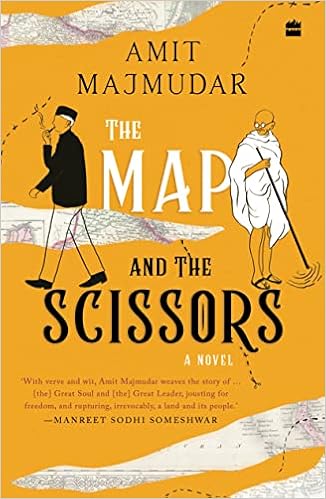
Review: The Map and the Scissors by Amit Majmudar

Amit Majmudar, a Gujrati from Ohio (he is the poet laureate of Ohio and if you have not read his poetry, do look it up, he is good) already wrote one novel about partition (called, appropriately enough, partition) but as he says in the epilogue, his views continue to evolve and another book was needed. And what a book it is; a riveting page-turner that tells the story of partition through the parallel lives of Jinnah and Gandhi, all wrapped up in very tight and carefully thought out writing, with quotes from Plutarch, the Gita and other works used as needed.

Amit has done his research and the novel is rich in historic detail and apt anecdotes. Some dialog has obviously been imagined, but wherever possible the words they speak are the words various histories and memoirs have already recorded. What emerges is a very striking portrait of two very different Gujratis who, for better AND for worse, determined the fate of British India and of the largest population group in the world (Indians in united India would exceed the population of China by hundreds of millions). Jinnah is the hugely talented and ambitious anglicized lawyer who became the most successful barrister in India before entering politics. An upper crust “brown Englishman”, he has great success politicking within the new Indian elite, but is sidelined by the rise of Gandhi and his popular politics (deftly captured in a scene where the newly arrived Gandhi is invited to a meeting of the Gujrati association which Jinnah chairs; after Jinnah has finished his perfectly modulated English speech, Gandhi opts to speak in Gujrati and the crowd goes wild. A taste of things to come.

Jinnah gradually sours on the idea of united India and is reborn as the messenger of Muslim separatism and the father of Pakistan. Gandhi has a slower start as a lawyer, but in South Africa he has found a new vocation: mahatma or great soul. Unlike Jinnah, he has world historical and prophet-level ambitions, and his impact is huge, yet he also fails at the most important task he set himself (winning independence for a united and spiritually elevated India), while Jinnah gets his moth-eaten Pakistan, but then he also gets to say “My God, what have I done?” when he sees the carnage unleashed by his campaign. Gandhi heads towards his meeting with Godse, while Jinnah’s tuberculosis finally finishes him while he lies in a hot ambulance that has broken down on the main road in Karachi. Amit is a poet and he brings a poetic touch to these events; the description may be brief, but it covers a LOT of ground.

The book also does a fine job of bringing Fatima Jinnah out of the shadows. She is the “white wolf” by Jinnah’s side, Pakistan’s virgin mother. There are many excellent books about partition, but almost none pay enough attention to Fati. Amit rectifies that error. Short but telling descriptions introduce all the other main characters of this tragedy, from Nehru and Patel to Liaqat and Suharwardy and Mountbatten and Edwina. And while it is not a very thick book, it manages to fit in almost every important event that happened along the way. Jallianwala bagh, the salt march, the Pakistan resolution, Direct Action, partition riots, it is all there, and while the coverage is not very detailed, a lot of thought has been put into every vignette, so they convey a lot more than you might expect at first glance. Unfortunately this tight pacing and compact descriptions also mean that the reader is expected to have a general idea of what went on and some of the clever literary maneuvers are best appreciated when you already know something about the events in question. Still, even those without prior knowledge will get most of it, while knowing more already will help you appreciate it more. Well worth a read.

Dream part 1

Dream 2

Nehru, Patel, Gandhi

A vision for solving India’s caste social crises

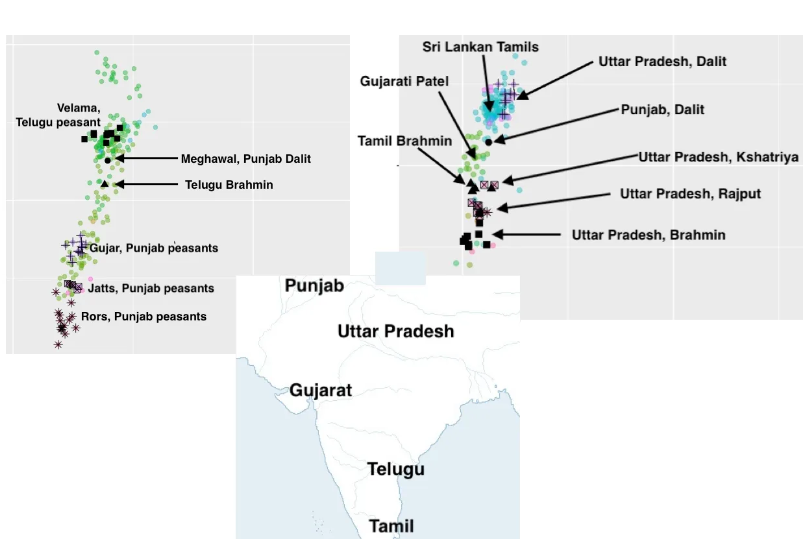
My personal belief is that jati-varna was one of the major reasons that India did not Islamicize more than it did. These sub-elite solidities “absorbed” external shocks and mediated individual relationships with the world. Collective entities like this are common across the world, but the genetic distinctiveness of these groups is like nothing you see elsewhere (with the possible exception of endogamous isolation like premodern Ashkenazim). I also believe that the jati in particular predates the arrival of the Aryans 3,500 years ago. Varna-like concepts exist in other Indo-European societies, but only jati exists in India, and I believe that genetics will uncover jati-like stratification in the IVC over time. Jati may be one reason that the IVC seems archaeologically to be an “anarchistic” society in terms of governance and politics insofar as they can infer anything from material remains (there seem to be no grand public buildings as in Mesopatamia or Egypt).

But, today, in 2022, the jati-varna system is a problem for India. In particular, I think the reservation system is socially toxic and economically inefficient. Because I have libertarian conservative viewpoints, I have always opposed caste-based reservations, just as I oppose affirmative action in the USA. This has little to do with empirical or utilitarian calculus and everything to do with deontological principles. But, from a utilitarian perspective, I believe that reservations result in the misallocation of talent, as well as emigration.

How to fix this problem? The genetics indicates endogamy rates of 99% or less for possibly a thousand years or more. Today, the jati-varna endogamy rate is lower. Perhaps 95% is the high bound from the estimates I’ve seen. This means within several centuries jati-varna as we understand it will not be viable.  The rate of genetic/social/cultural exchange will be too high to maintain traditional solidities. This will not mean that all castes will disappear; some will likely persist, but many societies have endogamous minorities. The way India is unique is that it is a whole civilization that is built around endogamous minorities. This does not scale as well to a modern economy and unitary society, and it is cannot persist if current social trends continue.

This problem will “naturally” take care of itself in both India and Pakistan (two countries where endogamous communities are ubiquitous), but, there are possible social and cultural movements that can accelerate or retard this process. The transformation of Hinduism into a more cohesive and confessional religion will probably be part of this. Like jati-varna, Hinduism’s strength was its fractious decentralization, as it absorbed and flexed in various directions to maintain its integrity in the face of proselytization. But in the world of 2022, the strategies of survival and persistence in the face of five hundred years of Muslim domination (in North India) are not appropriate; cultural involution and retreat simply invite defeat. The extremely diverse and almost contradictory nature of Hinduism allowed it to be a catchall system that integrated many jati groups with idiosyncratic beliefs and customs. The two reinforced each other as parallel institutions. Arguably, the weakness of jati will be the weakness of Hinduism unless the latter evolves and changes. One primary reason that non-Hindus never convert to the religion is that conversion still puts one outside of the jati-varna social networks of other Hindus while ostracizing oneself from one’s birth community.

Of course, some Hindus like the system the way it is. Some of these go by the term “trads,” but these types simply say out loud what the revealed preference shows is the majority viewpoint of most Hindus in India. What do they worry about? Higher-status groups do not want to become lower-status. Also, some high-caste Hindus believe they are more beautiful (lighter-skinned) and intelligent than lower-caste Hindus, and they do not want to dilute their human capital advantage. Objectively, it seems clear that many high-caste Hindus are indeed lighter-skinned and have facial features considered more beautiful than that of other Indian castes (I’m talking about Indian preferences on the whole). Additionally, whatever you may think about the heritability of intelligence, this is also certainly a possibility for differences between the groups.

But there doesn’t need to be such a great concern. Most societies have intelligent and beautiful subgroups, but they are not restricted to a particular social or political element. Restricting these traits to a particular social and political group causes problems, as you can see in India. The reality is there are beautiful/handsome and intelligent Dalits, so why not marry them if you are a Brahmin? These characteristics will persist, and the upside is that the social divisions between the jatis will diminish, and India can have a cultural matrix that’s more amenable to economic growth and individual liberty.

As someone with a conservative bent, there are natural hierarchies and status differences in any society. This is normal, and total leveling will never be possible, nor should we even aspire to it. Difference is worth appreciating. But the system of jati-varna in India as it is operationalized today is not conducive to human flourishing because it retards the development of broader social and cultural institutions that allow for national collective action. This is not abstract. China is a perfect example of a society with class status, but never has it had jati-like endogamy. Radically different dialect groups, like Hakka and Cantonese, freely intermarry with minimal conflict or controversy, so long as socioeconomic status is this. This is the future. You can delay it or ride the tiger.

The the origins of the false moral panic about caste in the USA

Caste discrimination in the US, again…Brown University bans caste discrimination throughout campus in a first for the Ivy League.

These stories are strange and silly on some level. But they are serious on another level. Multiple young brown American men have told me that they have been asked about their caste by white colleagues, usually social justice-oriented women. More recently, I was having beers with a friend who works at Google, and he mentioned offhand “I heard caste discrimination is a big problem in American tech.” Context on him: he’s American-born, his father is from China, his mother is a white New Englander, and he’s not religious, but he’s center-right politically.

Very few people in America know anything about caste. So they rely on a small group of activists to inform them. Additionally, the American elite is very worried about structural oppression, and jati-varna certainly fits that bill. So they are attracted to regulating and eliminating it.

The problems:

– Most Indian Americans don’t care about caste, and 1.5 and 2nd generation are very fuzzy on it

– Most Indian Americans who are 1.5 and 2nd generation do marry other Indian Americans, but they seem to marry outside of their caste

– Very few Indian American Hindus, about 1%, are Dalit. About 20% would be “OBC” in India, and 80% are “upper caste.” So there aren’t many “low caste” people to discriminate against

– Very few Indian Americans exist in a predominantly Indian milieu, so caste as a discriminatory framework can never operationalize

The final issue is that of course, the ancestors of Indian Americans on the whole did benefit from literal structural privilege in a broad sense, even if they came from a poor or uneducated background. Usually, on a relative scale, the people who arrived in America had resources or skills compared to the average Indian. In agreement with Greg Clark, I think this human capital persists; Indian Americans are not regressing back to a very lower socioeconomic median. Instead, they are becoming part of the American overclass.

I believe that the new salience about caste in America has less to do with caste and more to do with grappling with a dark-skinned nonwhite population that clearly has high levels of persistent and structural human capital advantage. American elites, and especially white American elites, have a very difficult time intellectually conceiving of the idea that nonwhite people can overcome discrimination and succeed because of the privilege of high endogenous human capital.

Faces of women of the world

I’m going to use Midjourney to add art to my Substack, but sometimes you get obsessed with stuff. I decided to generate images of female faces with the prompt:

beautiful [ethnicity/nationality] woman, portrait, photograph, cinematic, white wall

Then I picked what I thought was the most neutral face focused of the four images. I upscaled that, and remastered it. I’ve output the ones that aren’t ridiculous. For whatever reason, if an ethnic group is too obscure, the women turn out to look East Asian. No idea why. I’ve put the nationalities on top, and then various Indian ethnicities. Some of the outputs make a lot of sense. Some of the others, not so much. And many, I do not know.

Warning it will take a while to load all the images.

Continue reading Faces of women of the world

Proud of Rho Khanna


Recently Ann Coulter mentioned that Indians don’t have the same concept of free speech that Americans do. That is totally true and evident on these message boards. Ann’s concern is that the Indian-enriched tech work-force won’t see any problems with censoring offensive speech since that’s the norm in their society.

That being said, my chest kind of puffed up with pride to hear Rho Khanna express old-fashioned American values in this clip. With all due respect to Ann, the only Democrat who seemed persistently concerned about the free speech implications of Twitter’s suppression of the Hunter Biden laptop story is the son of Indian immigrants. Where are all those old-stock Americans now?

Brown Pundits