Indus Valley on Tides of History
Patrick Wyman interviewing a specialist on the IVC. Pretty interesting, though I’m mildly skeptical of the idea of what seems like a pre-state primitive democracy being the political system in the IVC.
Sri Lanka: Mob Rule or Color Revolution
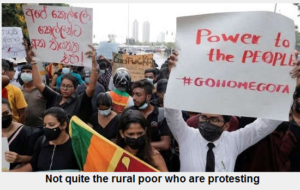
It’s Mob Rule in Sri Lanka. For its supporters it is a color revolution a la Ukraine Maidan in 2014 (more on that later). There are calls to hang and quarter President Gotabya Rajapakse. who was democratically elected by an overwhelming majority  These are not sentiments of rural folk. It’s the call from Western leaning, educated urban affluent folk, plus those comfortably living in western countries. These are the types whose platitudes are about rule of law, democracy, guilty until proven and other trope.
But then the fruit does not fall from the tree does it. The tree been that beacon of democracy, the US. Just a few weeks ago there were calls for regime change, including assassination of a world leader, not just by some nonentity but by the leader of the “free” world and one of his senior member in the government.
Then of course there is the history, much to do with oil
Eg 1: Overthrow Assassination of the democratically elected Iranian PM Mosaddegh and the Shah being installed.  When there was a popular revolution and a democratic government kept getting elected under theocratic oversight (no much different from UK monarchy) sanctions against were done done with the hope of regime change.
Eg 2 : Venezuela. Conspiracy theories of Chavez being murdered. However, very clear the US has continued using sanctions to attempt regime change and install a client Guido (is he from South Jersey). Note: Venezuela and Iran have been able to live with US sanctions because they are energy independent.
Eg 3: Korea the first division a la a possible Ukraine Vietnam, Kosovo, Libya, Iraq, Afghanistan, Syria almost all still occupied by the US/NATO
In Sri Lanka this is a class struggle, which the west oriented urban elite hope to regain power by other means That is not by democratic vote.  The small vocal (in English) is extremely against the current regime. Not just against, a visceral hatred of the rural types, (godayas or bumpkins), much like visceral hatred of Russia or the rural Evangelicals and deplorables who support Trump. It is very evident in the language used against them, extremely discourteous to say the least. The Rajapakses have continued the pro rural people, socialist policies started by the Bandaranaike in 1956..The rural people (80 % of SL) are not happy.  Who likes power cuts and shortages of diesel. But not to the extent of doing protest. They just need to cut firewood to cook.
The whole do a little protests and then go for sushi meal sums up the depth of these protests. Urban, affluent and no depth or “deep hunger” for change, so no real staying power or commitment. Much like Occupy Wall Street it will fizzle out.
Now the US connection: It’s no coincidence Victoria Nuland the architect of the Ukraine Maidan revolution visited Sri Lanka, India, Pakistan trying to drum up support for US sanctions against Russia. India said it was neutral and continued to import Russian crude. Same with Pakistan and Sri Lanka commenting they were neutral. Lo and behold a few weeks later a no confidence motion against Imran Khan the Pakistan PM, with rumors his party MP’s were bribed. The hope was that the pro US Pakistan army (they get lots of goodies from the US) would takeover. In Sri Lanka so called grassroots protests by the urban affluent for which none of the opposition parties claim responsibility.
So why the economic crisis in Sri Lanka. Lanka is being hit by a perfect storm.
a) The consequences of 2019 Easter bombing by Islamics and loss of tourism for three years (20% FX)
b) Economic shut down by a 1+ year lockdown because of Covid (30% FX, eg Garments)
c) Loss of mid east remittance for 2 years, as workers were sent back because of COVID fear. (30% FX)
d) And now having to pay for refined fuels and diesel shortages. Our only refinery Sapugaskanda built by the Iranians is to process Iranian crude or Russian crude.
In my opinion, fuel shortages are the biggest problem. 10 hour power cuts in urban areas. Lines to get diesel, petrol, kerosene and LPG if available. Again not too bad in rural areas. i.e. use firewood. I just built an outdoor fireplace.
Mid east workers started going back starting around Dec 2021. About 40 have left so far from the village.
Tourism had picked up in March. I was getting about 2 visitors a week, about a USD 200 income. Pre easter bombing in 2019 it was USD 600+. The rioting and power cuts are going to kill that goose.
Anyway this is democratically elected govt. Mob rule regardless of how urbane or affluent (and NOT representative of greater Sri Lnka) should not be allowed to stage coup or color revolution.
China: A Book and a TV serial..
I just finished Edward Rutherford’s “China, the novel” and enjoyed it. Capsule review:
![China: The Novel by [Edward Rutherfurd]](https://m.media-amazon.com/images/I/51OkcO-y3ZL.jpg)
This author writes sweeping sagas about particular places (London, New York) and clearly researches a lot before he writes. This one covers China from the first opium war to the end of the Qing dynasty. As usual, he has created characters (a British opium trader, a missionary, a Chinese mandarin, a Chinese rebel, a eunuch in the Manchu court, etc) that cover all important events (opium wars, Taiping rebellion, court intrigues, empress Cixi, etc). The book is a fun read and the history is well researched. While you can read many books about the history of the era, this one fills in the social mores, family dynamics etc in ways that a history text cannot. Well worth a read.

And happened to finish the overly long serial “Ruyi, Royal Love in the Palace” on Amazon Prime at the same time. This is a (very fictional) account of Ruyi, the Ula Nara empress in the reign of the Qianlong emperor. The details are ALL fictional, but the serial is lavishly produced and seems to capture the atmosphere of the harem (or what i imagine to be the atmosphere of the harem) very well. The novelist seems to have had some moral purpose in view, so the evil nature of the whole arrangement is perhaps a bit overdone (but it is also possible that in actual practice it was even more evil than this), and the serial is TOO long, going on for 87 episodes where 20 would have been more than enough. And some of the plot devices are also unrealistic (everyone is plotting, plots get discovered all the time, but the emperor never seems to take precautions against them; on the other hand, he too may be constrained the nature of the institution). But slowly but surely it does capture the terrible nature of this institution. Worth skimming through if you don’t have the time for a long soap opera.

How Indians view themselves vs. how Westerners view Indians

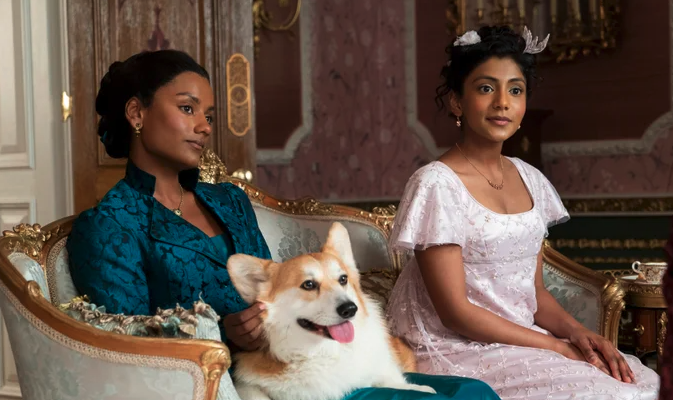
As A South Asian Woman, Seeing Two Darker-Skinned Women On Bridgerton Means Everything.
The headline is obviously a bit much. The casting of dark-skinned actresses of Indian-origin really isn’t going to change the norms of the Indian subcontinent, or the whole of Asia. But it’s an interesting window on aesthetic standards and cultural creation. Indians who I bring up this issue with routinely suggest “well, you don’t have ugly people in American films.” The implication for many people of subcontinental origin is that dark skin is ipso facto ugly (and in Asia more generally). This seems the ground truth and the rest is just commentary.
Open Thread – 4/1/2022 – Brown Pundits
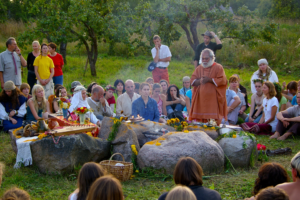
In the last week of this month I will be posting a podcast I did with Francis Young, author of Pagans in the Early Modern Baltic: Sixteenth-Century Ethnographic Accounts of Baltic Paganism (at my Substack). Over the hour and a half we talked about many topics, but one thing that struck me listening to him describe the details of the beliefs and practices of Lithuanian pagans, practices that persisted as living traditions centuries after the official Christian conversion of the state in ~1400 AD (Young estimates that in the 1500’s 30-40% of the population were what was then termed “Old Lithuanians,” baptized into Christianity but rural people who were almost totally uncatechized and continued to practice their ancestral religion), is how redolent they are of the Vedic religion. Young has convinced me that it is likely that the original Baltic branch of Indo-Europeans flourished somewhat to the south of their current distribution, which may be an outlier relic. If that is correct, they were likely positioned just to the west of the Indo-Iranian ur-heimat of the Fatyanovo-Balonov culture. Linguistically many scholars argue that Indo-Iranian and Balto-Slavic are a natural ‘clade’ within Indo-European languages.
The Wikipedia entry on Lithuanian neo-paganism (Romuva) has a section titled “Relation with Hinduism”:
…But for Lithuania’s Romuva community, which traces its traditions back to ancient folklore, it is evidence of a connection to India, Hinduism and Sanskrit that has become a part of their Romuva identity, along with its pantheon of gods and fairly standard pagan rituals. Some believe that the connection between Hinduism and Romuva made Romuva to be more than a “primitive, shamanic religious tradition”…
…
Similarly AĆĄvieniai are divine twins in the Lithuanian mythology, counterparts of Vedic Ashvins. The AĆĄvieniai are represented as pulling a carriage of SaulÄ (the Sun) through the sky. AĆĄvieniai, depicted as ĆŸirgeliai or little horses, are common motifs on Lithuanian rooftops…
Romuva and Hindu groups have come together on numerous occasions to share prayers and participate in dialogue. These events have taken place in Lithuania, Atlantic City, New Jersey, Boston, Massachusetts, Epping, New Hampshire, and elsewhere.

I had assumed that Lithuanian Catholicism derived its strength from the Counter-Reformation period (the last sacred snake groves were destroyed by priests in the 18th-century), but Young explained that the reality is that Catholicism and the Lithuanian national identity became associated only with the absorption of Lithuania into the Russian Empire, where the dominant religion was Eastern Orthodoxy. It was in the context of religious and ethnic marginalization in the 19th century that the two elements of modern Lithuanian identity finally began to become synergistic, and therefore heterodox peasants began to finally adhere more strictly to a Catholic identity.
Imran Khan Phenomenon; My Prediction in 2011
I wrote this article back in 2011 for 3quarksdaily.com, someone in Outlook picked it up this year. I think I was not far wrong..
The 12th Man Rises
Pakistanâs greatest cricketing hero and second most successful philanthropist entered politics 15 years ago, promising a progressive, Islamic, modern, corruption-free Pakistan. His position as the most successful captain in Pakistanâs cricket history, the founder of Pakistanâs finest cancer hospital (providing free modern cancer care to thousands) provided him instant cachet, but for a long time he was unable to convert this personal popularity into votes in actual elections. With a political platform heavy on slogans (particularly against corruption) but short on specifics and without any obvious connection to already existing grass-roots politics, he remained little more than a fixture on the talk-show circuit for a very long time. Brief flirtation with Pervez Musharraf also set him back, as did a tendency to spout fables about Jirgas and hobnob with jihadi ideologues like Hamid Gul. But his biggest problem was his failure to create a team that could carry his party forward. The Pakistani Tehreek-e-Insaf (PTI) was a one man show, with Imran Khan its only impressive asset. Even in parties dominated by one strong leader, there are other leaders in the wings and at least a semi-coherent ideology that delivers a section of the vote-bank on ideological grounds alone. Imran had no visible team and no clear ideology beyond a promise to âeradicate corruptionâ.
He did seem to genuinely believe in the formulaic slogans and historical framework of the 6th gradeâideology of Pakistanâ he learned in Aitcheson college. He seems to have some vague notion of âthe two nation theoryâ (basically, âwe are not Indiansâ) and an even vaguer ârespectâ for Quaid-e-Azam Mohammed Ali Jinnah and Allama Iqbal, twin icons of Pakistanâs history. But like his middle class fans, it is a superficial and shallow belief system, with little to show beyond a few empty slogans like âPakistan firstâ, âIslamic welfare stateâ and âwe are all Pakistanis now, so we are no longer Punjabis, Sindhis, Pakhtoons or Balochisâ. Behind the automatic repetition of such slogans there does lurk an odour of âone folk, one party, one leaderâ fascism (as it does behind all crude nationalisms) but this is not to imply that Imran Khan is consciously thinking of leading a fascist takeover of Pakistan. His commitment to some notion of democracy seems genuine enough, though his priority (and this is not unusual among middle class nationalists) is nationalism, not democracy; in a crisis, he can easily convince himself that we may have to kill democracy to save the country. In any case, lacking organization and experience and without a good grasp of actual grass-roots politics, he was easily brushed aside by older established political parties.
Things changed in 2008. International pressure and a worsening domestic political position forced Pervez Musharraf to accept elections and eventually to bring âfailed politiciansâ back in power. Imran Khan boycotted those elections, but came back on TV chat shows to dog the new (and admittedly, corrupt and incompetent) civilian set-up at every step. Meanwhile, GHQ managed to win back some of its tarnished reputation by staying away from public view, letting Zardari take all the blame for every disaster (even ones GHQ itself had birthed). The Zardari regime also managed to select an exceptionally bad team, from a clueless prime minister to one of the worst collections of cabinet ministers in Pakistanâs history. His opposite number in the PMLN did a marginally better job in the provincial government in Punjab, but not by much. Continuous infighting, breaking and remaking of coalitions, massive corruption at every level, and a terrorism problem that has kept the nation unsafe for international investment, all these drained the existing political parties of credibility and created an opening for an outsider.
Meanwhile, the deep state continued its âgood jihadi, bad jihadiâ policy at home and its double game with the US abroad. With the Osama Bin Laden assassination, matters seem to have come to a head with the US. The Americans want GHQ to arrange for an orderly withdrawal from Afghanistan and appear willing to pay Pakistan for help in achieving this, but they are not yet ready to hand the place back to the Taliban and the Haqqanis and their Jihadi friends. GHQ meanwhile is playing hardball and smells victory (also smells disasters to come after victory, but victory has its own momentum) and maybe feeling tempted to get rid of the present civilian setup , preferring a civilian regime that is more closely aligned with their own strategic vision. The Facebook generation and the deep state may thus both be ready to opt for Imran Khan. And Imran Khan, it seems, is ready to opt for them. He has sharpened his anti-American message (a message that appeals to both the jihadi and the left-liberal wings of the middle classes) and toned down criticism of the army. He is saying all the right things about drone attacks, peace with our Taliban brothers and an American defeat in Afghanistan. He has been well coached by Shireen Mazari and Hamid Gul and his party is using trained cadres from the Islami Jamiat e Tulaba as well as enthusiastic youngsters from the Facebook generation. The moment has produced the man.
Having produced the man, the next step was to launch him on to the political stage in suitable manner. That step was achieved in Lahore on the 30th of October. Whether the deep state helped out with the gathering or not, the crowd was impressive and enthusiastic. For most of the young people there, it was the first taste of a genuine mass event where everyone is pushing towards one goal with one voice. That this âgoalâ was being defined in the Paknationalist terms they have all been fed in school and in everyday propaganda was the icing on the cake. Grown men were seen to cry helplessly as carefully choreographed patriotic music blared and the crowd rose as one to sing the national anthem. Fed on a steady diet of news about corrupt, treacherous and unpatriotic politicians, the crowd was happy to anoint Imran Khan as the saviour who will eradicate corruption and save the nation. A generation that never saw the much bigger gatherings of Benazir Bhutto and her father seems to have been swept off their feet by the event. And why not? In addition to pushing the Paknationalist buttons, the rally had something for everyone. A prayer break (with the great leader praying alone on stage during the event) was followed by Shahzad Roy and guitar music. Bearded boys with Al-Jihad headbands mingled good naturedly with middle class families and liberal students from LUMS and NUST. For one shining evening, it must have seemed like hope has been reborn.
But it is still difficult to see how all this will translate into electoral victory unless the deep state plans to manipulate elections in a big way. Pakistan is a parliamentary democracy and established parties, even when discredited, have a grass-roots organizational advantage. In addition, Imran Khanâs personal popularity is wide, but not deep. Very different groups are currently united under his wing, but when push comes to shove, ideological and political choices will have to be made. Right now, Imran Khan has liberal followers who coexist in the party with hardcore Islamists who made their bones in the Islami Jamiat-e-Tulaba. But as he gets closer to real power, choices will have to be made. Since his own understanding of politics and the future of Pakistan is fundamentally aligned with the Paknationalists of the Shireen Mazari and Ahmed Qureshi variety, I predict his choices will turn to out to match those of GHQ to an extent that may surprise a lot of his liberal fans. This is a prediction, and I realize it is an unpopular one in the liberal blogosphere. Pakistani liberals are also hungry for a saviour and right now they prefer to latch on to whatever little bones Imran is throwing in their direction (guitar music right after Magrib prayers, women in visible positions, a modern look and feel) but I fear that Imran Khan is not just repeating his 6th grade Islamiyat and Pakistan studies slogans because repeating simplified propaganda is part and parcel of modern mass politics. He is repeating them because he genuinely believes all those fables about rightly guided caliphs, Jirga justice, Islamic social welfare, the vision of Allama Iqbal, the âleadership of the Quaid-e-Azamâ and so on. But since these stories are not too closely aligned with reality, historic or contemporary, a sincere believer is likely to become a pawn in the hands of those with a clearer vision of what they want and a more realistic view of politics and power. The Leninist term âuseful idiotâ comes to mind, but in this case it is not Pakistanâs 37 Leninists but its much more determined deep state is likely to take advantage of Khan sahibâs naivetĂ©.
Of course, this may not be a done deal yet. Imran clearly has an idealistic bent and even GHQ may not find his crusading zeal easy to contain. And while everyone from Humayun Gohar to Ayaz Amir may be excited by this rally, reality has a way of setting in in Pakistan. The Paknationalist agenda is not new. Army men sitting in mess halls have been carping about unpatriotic politicians, bloody provincialists and separatists, uneducated Pakistani masses and massive foreign conspiracies for decades. But they have failed to wave a magic wand to fix these problems, not because they held back, but because no magic wand actually exists. Wanting to clean up Pakistan and run it like a tight ship (the current model is supposedly China, though a few inconvenient details come to mind: a 3000 year old civilization, a century of revolutions and wars, a genuine mass-based party and titanic achievements and failures, modern capitalism embraced like never before, and so much more) is all well and good, but you cannot create anything you want out of thin air; you have to work with what exists and the properties of what exists are not necessarily what the Paknationalists think they are. History and society may have features that make some choices possible and others nearly impossible. Paknationalism of the GHQ type does not have a sufficient overlap with history, political realities or the various cultures of Pakistan to allow the creation of the homogenous- Islamic-modern-military-
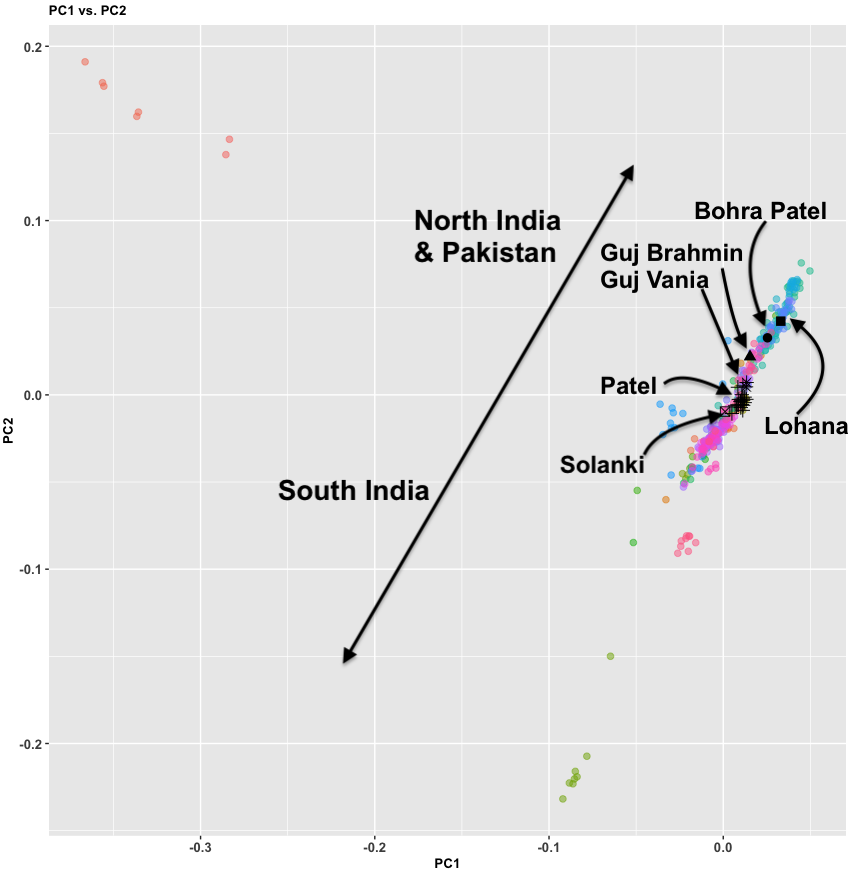
Gujurati genetics

I was working on a project and decided to check Gujus. A few things
1) A few years ago a Bohra emailed me kind of irritatingly saying I underestimated the non-South Asian ancestry in Bohras. I double-checked and that seems plausible. Looking at this Bohra Patel sample I have, that seems to be clear.
2) Guju Brahmins are positioned like North Indian Brahmins.
3) Most of you know more about Lohannas than I do. I will say that the Sindhi Lohanna sample I have is even more “north-shifted” than the Guju Lohanna.
4) Patels are a numerous cluster, obviously. The two Vania samples I have are north-shifted, but very close to the Patels (Patidars)
5) I have a Solanki sample that is clearly outside of the Patel cluster and south-shifted
Browncast: Is Imran Khan on the Way Out?
Another Browncast is up. You can listen on Libsyn, Apple, Spotify, and Stitcher (and a variety of other platforms). Probably the easiest way to keep up the podcast since we donât have a regular schedule is to subscribe to one of the links above!
In this episode Omar talks with Ambassador Kamran Shafi and Dr Mohammed Taqi, two very well known and astute observers of the Pakistani political scene. We talk about the current political crisis and why and how the military may have abandoned Imran Khan, exposing him to a no-confidence motion in the National assembly.
(spotify link did not work in Pakistan)
Episode 7: South of India from 200 BC to 500 AD
Another Browncast is up. You can listen on Libsyn, Apple, Spotify, and Stitcher (and a variety of other platforms). Probably the easiest way to keep up the podcast since we donât have a regular schedule is to subscribe to one of the links above!
The History podcast crosses the Vindhyas and heads towards the Deccan. Maneesh is in conversation with Jay and Shrikanth on all things South of India between the period 200 BC to 500 AD.
Among other things, the speakers talk at length about the Sangam literature.
Mani Ratnam’s Iruvar makes an appearance too.
@jayvtweets  @shrikanth_krish  @maneesht
Sources and References:
1. A History of South India by K. A. Nilakanta Sastri
2. The age of imperial unity (The history and culture of the Indian people Vol 2)
3. Comprehensive History of India Vol.2, The Mauryas and the Satavahanas, Edited by K. A. Nilakanta Sastra
4. The First Spring: The Golden Age of India (Part -1) by Abraham Eraly
5. A History of Ancient and Early Medieval India: From the Stone Age to the 12th Century by Upinder Singh
6. Coromandel: A Personal History of South India by Charles Allen
7. Ashoka in Ancient India by Nayanjot Lahiri
8. The Sangam Age by V.R. Ramachandra Dikshitar (ARTICLE)
9. The Beginnings of Civilization in South India by Clarence Maloney (ARTICLE)
10. Archaeology of the Sangam Age by K. V. Raman (ARTICLE)
11. Urbanization in South India: The Role of Ideology and Polity by R. Champakalakshmi (ARTICLE)
12. The Vedic-Puranic-Sastric element in Tamil Sangam Society and culture (A Study of Purananuru-First Section) by M. G. S. Narayanan (ARTICLE)13. Chera, Chola, Pandya: Using Archaeological Evidence to Identify the Tamil Kingdoms of Early Historic South India by Shinu A. Abraham (ARTICLE)14. Kalinga and Andhra: the process of secondary state formation in early India by Sudharshan Seneviratne (ARTICLE)
15. The Wonder that was India – AL Basham
16. Tamil – A Biography : David Shulman