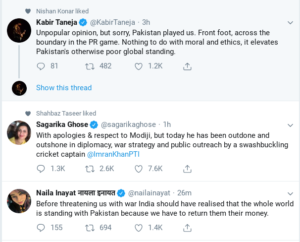
Complete Victory For Imran Khan

Pakistan is offering to return the pilot as a gesture of goodwill. Huge humiliation for India on every level.

I’m extraordinarily impressed with Imran’s handling of the crisis. This is the end of Modi, who should have been the Indian Benjamin Nethanyahu.

Pakistan has been cool, strategic and conciliatory while India has been bombastic, hotheaded and bloodthirsty. Completely outfoxed and to lose in a dogfight with Pakistan is a big shame on the Indian air-force. Continue reading Complete Victory For Imran Khan

The airstrikes

Indian Jets Strike on Pakistani Side of Kashmir Line:

Indian warplanes conducted airstrikes in the Pakistan-controlled side of Kashmir on Tuesday, Pakistani officials said, in an escalation of tensions between the nuclear-armed nations after a suicide bombing against Indian troops in the disputed region this month.

If confirmed, it would be the first time that Indian aircraft had crossed the Kashmir Line of Control to strike in years. But it was unclear what, if anything, the attack jets hit on the Pakistani side, raising the possibility that India was making a calculated bet to assuage public anger but minimize the risk of a major Pakistani military response.

Curious about value-add thoughts….

Afghan Peace Process

From Dr Hamid Hussain

My two cents of Afghan peace process.  It is based on my own limited perspective informed by regular travels to the region and interaction with many including Pakistanis, Afghans, Americans, Indians etc.  Many have been kind to candidly share their views and not ‘official’ narrative as well as hopes and aspirations of common people in streets and bazaars that they shared with me.

Hamid

Making Peace with Broken Pieces – Afghan Peace Process

Hamid Hussain

 “There is nothing further here for a warrior.  We drive bargains; old men’s work.  Young men make wars and the virtues of war are the virtues of young men; courage and hope for the future.  Then old men make the peace.  The vices of peace are the vices of old men; mistrust and caution.  It must be so”.   Prince Feisal (Sir Alec Guinness) to T. E. Lawrence (Peter O’Toole) in Lawrence of Arabia.

In the last few months, a new window opened in the seventeen years old war in Afghanistan. There was breakthrough with first serious efforts of direct negotiations between United States (U.S.) and main militant group Taliban.  It was President Donald Trump’s announcement of withdrawal of American troops from Afghanistan that got the ball rolling.  He made this decision without consulting any other government agency. Pentagon, intelligence community and State Department view rapid withdrawal as a recipe for disaster.  Trump appointed former U.S. envoy to Afghanistan and an Afghan-American Zalmay Khalilzad nick named Zal to spearhead this effort.  Saudi Arabia, United Arab Emirates (UAE) and Qatar worked as intermediaries and a bridge between Taliban, Pakistan and Americans.

Negotiations between Taliban and Unites States is only one dimension of a complex conflict.  Taliban’s strategy is simple in its execution.  It used its committed cadre of fighters and support structure in Pakistan to escalate violence to a level to achieve two goals.  First to sow enough fear and uncertainty among Afghans that will undermine the efficiency and to some extent legitimacy of the government.  Another objective is to convince fellow Afghans that without giving them a share in power and economic pie, Afghans will never see peace.  Initially, behind the scene, questions were raised by Americans whether Taliban are a unified entity to work with.  Taliban responded by announcing a three days ceasefire during Eid festival.  There were no attacks all over the country proving their point that they have a firm command and control system and all fighters follow the leadership.  When United States announced troop withdrawal plan, Taliban thought that by directly negotiating they will get the credit and fulfill one of their objectives of forcing foreign troop withdrawal.  This will help them to carve out a much larger share in power after American withdrawal. Another factor was intense pressure on Taliban from Pakistan and Arab countries.  Agreeing to direct negotiations with Americans, Taliban placated both parties and if no agreement is reached, they can claim that they entered in negotiations with good faith and put the blame of failure at American doorstep. From U.S. point of view, there is a narrow window of about six months. Domestic troubles of President Trump will take a sharp turn with completion of special prosecutor Robert Mueller’s work.  In addition, presidential campaign will start in the fall of 2019 and these two factors will suck all the oxygen in White House.  Like many other foreign policy issues, Afghanistan will also recede in the background.   Continue reading Afghan Peace Process

Witches Brew. Saudis, Iran, Pakistan

From Dr Hamid Hussain

18 February 2019

Few questions came my way.  I also keep in touch with our Jewish cousins in Israel and some interesting input came from that side

Hamid

Witches Brew

“Men never do evil so completely and cheerfully as when
they do it from religious conviction.”
          Blaise Pascal

Thanks to Israeli Prime Minister Bibi Netanyahu, we are more educated and enlightened.  Recent conference in Warsaw was an open conference and not a secret meeting. Everyone was euphoric but at the same time somehow uncomfortable and wanted to qualify his statement or simply walk back what they said.  Bibi said that ‘in a room of some 60 foreign ministers, representatives of dozens of governments, an Israeli Prime Minister and the foreign ministers of leading Arab countries stood together and spoke with unusual force, clarity and unity against the common threat of the Iranian regime”.  His official twitter account noted ‘the Arab states were sitting together with Israel to advance the common interest of war with Iran”.  This was later deleted and used the phrase ‘combating Iran’.  Bibi used the Hebrew word ‘milchama’ that means war.  Same video clip in which Bibi is speaking in Hebrew was also later edited.

Bibi’s office also shared a video with Israeli journalists of a panel that was closed to the media.  Foreign Minister of State of Saudi Arabia and Foreign Ministers of United Arab Emirates (UAE) and Bahrain were on the panel and moderator was former Middle East envoy Dennis Ross. The three Arab diplomats poured their hearts to the audience. Here are examples of some of the exact quotes.  When asked by Dennis Ross about his view of Israeli strikes on Iranian targets inside Syria, UAE foreign minister Shaikh Abdullah bin Zaid al’Nahayan justified Israeli actions by stating that ‘every nation has the right to defend itself, when it is challenged by another nation’.  Bahrain’s foreign minister Khalid bin Ahmad al-Khalifa said, “we grew up talking about the Israel-Palestine issue as the most important issue” but then ‘at a later stage, we saw a bigger challenge, we saw a more toxic one – in fact more toxic one in our history – that came from the Islamic Republic’.  Saudi Foreign Minister of State Adel al Jubair blamed Iran for Israel-Palestinian issue stating that ‘Iran’s evil behavior destabilized the region, making Israeli-Palestinian peace impossible to achieve”. 

In the opening session, Yemen’s foreign minister Khalid Al Yemeni was sitting next to Bibi.  When he came under criticism from Arab public opinion, he said that it was not his fault but fault of those organizing the conference. He then dug a deeper hole by saying that ‘participation in Warsaw was not to discuss Palestine but to rally international community to confront the Iranian expansionism in Yemen”. 

I personally believe that a genuine effort of Arab-Israeli entente is essential.  More open interaction, discussion at public level to prepare the ground and then a meaningful diplomatic effort to reach normalization.  However, they must remember that they are the defeated party and hence will get what a loser gets.  Reminds me Henry Kissinger’s words.  In the aftermath of 1973 war, when Anwar Sadat started his long list of demands, Kissinger replied. “Mr. President; you have lost the war, but you are asking for the spoils of the victor”.  On part of Israel, they are making the same mistake of aligning with tyrants of Muslim countries rather than building bridges with populations. Same euphoria over four decades ago with Shah of Iran and his repressive regime.  Ordinary Iranian saw Israel as partner of the oppressor and when the tables were turned, Israel found a new non-Arab foe.  The same fretting of Saudi Crown Prince Muhammad Bin Salman not realizing that Saudi throne is on the shakiest sand dunes of its history.  One can only guess what kinds of demons will be unleashed when Arabia turns the page of Saudi prefix. Internally, demographically and ideologically, Israel has taken a sharp right turn.  In this environment, annexation movement is gaining more strength making a two-state solution almost impossible.  On part of Palestinians, they must fight their own battles and before that put their own house in order. It is delusional to think that Arab regimes or Iran who have not given freedom to their own people will somehow take them on the freedom train. 

One does not need to be a rocket scientist to figure out the future battlegrounds.  Some one sent me a clip of Adel al Jubair’s statement of a long list of charge sheet against Iran during a press conference in Islamabad. I don’t envy Pakistani decision makers. They are stuck in a bind. Now, widening intelligence net of Iran working on Shia and Barelvi adherents and Saudi Arabia doling money to their ownsalafi brands will work on new recruits for coming sectarian wars. Everyone needs to work overtime, reach out to his neighbor to make sure that their next generation is not lost in another fratricidal war. 

To be sure, Iranian regime is no boy scout.  Clerics usurping power and now dissent is a crime as well as a sin.  Revolution’s own ideologue Dr. Ali Shariati had warned against this and in his view ‘of all dictatorships, the dictatorship of clerics was the worse’ and he called it ‘istibdad-e-rouhani’(religiously sanctioned oppression). 

In fact, regimes in Saudi Arabia and Iran are mirror image of each other.  They are poster child of what exactly is wrong with the political map of Muslim world in general. Ruling under the guise of religion both are deeply sectarian, representing themselves as savior of their respective sects and severely repressing their own people.  Mutual hatred is to a level where they are sowing the seeds of disasters all over the globe. They are in competition of who can wreck more havoc in their respective grounds of blood sport in Yemen and Syria. The only hope is the youth of these societies where they stand up and challenge their own fathers refusing to continue the sectarian wars that their forefathers started fourteen hundred years ago.

“I will say this much for the nobility: that tyrannical, murderous, rapacious, and morally rotten as they were, they were deeply and enthusiastically religious”.

Mark Twain, A Connecticut Yankee in King Arthur’s Court

Hamid Hussain

coeusconsultant@optonline.net

18 February 2019

 

Humble Address to his Majesty-

Pakistanis are great at winging it; I was just talking to a friend of mine who claimed that Pakistan couldn’t have been behind the attack in Kashmir since it has so many other issues to deal with. Furthermore when I bemoaned the lack of a large market such as India he simply held up that Pakistan had access to China.

This ability to constantly Jugaad it is admirable if foolhardy. For a nation allegedly so obsessed with Izzat, the Pak PM (who is notoriously arrogant) is essentially deferring the Saudi Crown Prince, who is less than half Imran’s age, as the new Caliph.

Well I guess beggars can’t be choosers!

What India must do to Kashmir-

Very sad news emerging out of Kashmir.

Vidhi was saying that India should retaliate whereas I think it should be a more subtle response along the Israeli lines in the West Bank.

(1.) Everytime there are protests in the Valley, India should randomly select a sample of the protestors (maybe a third or so), strip them of their citizenship and bus them to the border so they can join Pakistan. Continue ad nauseam which will help demographics and instil enough fear to dampen potential rioters.

(2.) Abolish Section 377 and bring only the Valley under Central Rule (keep Jammu & Ladakh as it is). India should actively encourage Hindu (not just KP) immigration into Srinagir. Encourage KPs (who are India’s most endangered minority not the Parsis) to breed like rabbits (or like Muslims) and make them agents of the Indian state. Both the tepid tweets by Mehbooba Mufti & Omar Abdullah show the huge disconnect Muslim Kashmiris have with the rest of the Indian State.

(3.) India should begin to demilitarise in Kashmir and retreat to defensible borders on the LOC. With an effective and ongoing occupying force it can keep the Valley sedated with only a fifth of its standing army instead of the current million strong component. The geographic trade of Pakistan conquering Srinagir is losing half of Sindh so Pak won’t engage in conventional warfare.

(4.) BJP’s shameful backtracking on the Citizenship amendment shows the bankruptcy of democracy. The BJP should simply not allow the “new citizens” to settle in NE states, which understandably want to opt out. The “new citizens” should be redirected towards Kashmir & other sensitive regions of India, one million Bangladeshi Hindus in Srinagir will help sort things out.

No one will cry for the Muslim Kashmiris; their cause isn’t as emotive as the Palestinian one. I personally can’t understand the Kashmiri Muslim problem; they are one of the few people in India lucky enough to have Urdu as the official language of their state. They have the unique position of being cultural Pakistanis who have access to the Indian economy so they should buckle down and stop making a fuss.

It is obvious that it’s the Cult of the Holy Pedophile, also known as Muslim menace, behind it all and why it’s so important that Bharat use sickle & all to castrate Islam & its sick ideology once & for all.

The immense success Israel has had in the past two decades demonstrates that tough actions bear fruit and it’s time for the Muslim Kashmiris to step up. The Palestinian cause is far more secular (much less Muslim) than the Kashmiri one and therefore much more worthy.

Kabuki Dance – Pakistan’s Balancing Act

From Dr Hamid Hussain

Following was in response to several questions regarding Pakistan’s regional challenges and current policies.

 Kabuki Dance – Pakistan’s Balancing Act

Hamid Hussain

Pakistan’s challenging regional environment has taken some new turns and new government of Prime Minister Imran Khan is trying to cope up with these challenges.  Government’s major advantage is that it has no clash with the dominant army.  In many areas of foreign policy, it has ceded significant ground to the army.

Pakistan is in a difficult spot on three issues. First is rapid pace of negotiations between Taliban and Americans with projected quick withdrawal of American troops, second is isolation of Iran and third is potential entanglement in intra-Arab rivalry with United Arab Emirates (UAE) and Saudi Arabia on one and Qatar on the other side.  Pakistan is facing these regional challenges in the background of internal political instability and very serious economic downward trend.  Part of political instability and associated economic meltdown is due to self-inflicted wounds.  Departing from the normal process of check and balance, judiciary and army played an active role in tuning up the system that will have its own set of consequences. It has widened the political gulf and added new fissures.

Regional challenges of Pakistan are directly linked with American policies.  We are living in a Trumpian world that has sowed a lot of confusion on all fronts.  Every country and non-state player is adjusting positions at such a rapid speed that it is hard to make sense of every move.  Pakistan is also caught in this Trumpian world on several fronts.

US policy is in disarray with no coordination between different government agencies.  President Trump is using single point agents without full institutional support behind these efforts.  In many cases, some power centers of Washington are diametrically opposed to President’s efforts.   It is probably right time for withdrawal of American troops from both Syria and Afghanistan. Trump may have realized what Christopher Fettweis wrote in 2008 in his book Losing Hurts Twice as Bad that “bringing peace to every corner of the globe, even those whose stability we have wrecked through our own incompetence, is not necessarily in the strategic interest of the United States”.   However, the method in which it is being done has confused both allies and foes.  American intelligence agencies are publicly disagreeing with Trump that is unprecedented.  In late January 2019, in a hearing at Senate Intelligence Committee, Director of National Intelligence and heads of Central Intelligence Agency (CIA), National Security Agency (NSA) and Federal Bureau of Investigations (FBI) contradicted Trump on security issues.  They told the committee that Iran was still abiding by the nuclear deal.  Trump had pulled out of the deal stating that Tehran had broken the deal.  Furious Trump sent his twitter tirade saying that ‘the intelligence people seem to be extremely passive and naïve when it comes to the dangers of Iran.  They are wrong’.  Continue reading Kabuki Dance – Pakistan’s Balancing Act

How Pakistan Got Divided

Review of General Rao Farman Ali’s book by Major Amin

HOW PAKISTAN GOT DIVIDED-RAO FARMAN ALI KHAN -298 PAGES – OXFORD UNIVERSITY PRESS-PAKISTAN –ISBN NUMBER 978-0-19-940698-2- YEAR OF PUBLICATION -2017

Reviewed by Major Agha H Amin (Retired)

This is yet another disappointing book in the genre that Pakistani writers write to rationalize the separation of East Pakistan and creation of the new state Bangladesh in 1971. The real causes are always simply whitewashed and not even discussed. This book does so again .

The book is divided in 17 chapters but only one deals in a very vague and rudimentary manner with the historical background. The remaining chapters are devoted to 1970 elections and its aftermath. This is a rather ultra myopic way of writing history. The bottom line of the whole issue was that ethnicity was the defining factor in Indian Muslim relations. Starting in 1906 Indian Muslim politics was dominated by United Provinces (UP) Muslims . When All India Muslim League was created in 1906 with Bengalis in the forefront , it was hijacked by UP Muslims and its headquarters shifted to Aligarh in 1907 . Bengalis were regarded as an inferior Dravidian race. The watershed moment was the Lucknow Pact under stewardship of Mr Jinnah,  where without discussing the matter with Punjabis or Bengali Muslims a twin thrust in the back was delivered to Punjab and Bengal. Punjab’s Muslim legislative majority being reduced from 54 to 50 % and Bengal’s Muslim majority reduced from 52 to 40 % . All this being done by an All India Muslim League that contained 90 % of its delegates from Lucknow city and UP. Continue reading How Pakistan Got Divided

Interview: Cecil Choudhry and MG Hidayat Niazi

Major Amin’s interview of Pakistan Air Force veteran Cecil Choudhry and Honorary Major Gen Hidayat Niazi
CECIL WAS EXTREMELY BITTER IN RECOLLECTIONS OF ANWAR SHAMIM WHEN THIS SCRIBE INTERVIEWED HIM AS ASSISTANT EDITOR DEFENCE JOURNAL- GRATEFUL THAT THE INTERVIEW WAS PUBLISHED WITHOUT ANY EDITING BY THE JOURNALS OWNER MR IKRAM SEHGAL—
THIS SCRIBE INTERVIEWED CECIL CHOUDHRY IN 2001 AND RELEVANT EXCERPTS ARE AS BELOW :—
Pakistan Army through eyes of Pakistani Generals
Q. What do you have to say about the assertion that our Intelligence agencies indulge more in petty reporting and in settling personal scores rather than solid intelligence gathering?
What can one say about something that is almost God’s truth. My personal experience during both the wars was that the way these agencies were being made to function was a complete waste of resources. We had no authentic information about our targets that we could rely on in our planning. We were provided information that was 10 years old.
Q. Who was the finest air force professional that you saw in your entire service?
This is a very difficult question to answer because we are covering a wide spectrum. The finest was Sarfraz Rafiqui. The finest Chiefs were Air Marshal Asghar Khan and Air Chief Marshal Zulfiqar Ali Khan in that order. Most professional officers I worked directly under, Syed Mukhtar Ali, Hakimullah and (late) Masroor Hussain. Highly professional officers I worked with were P.Q. Medhi (ex Chief), Aliuddin (present DGCAA) and late Hashmi.

Continue reading Interview: Cecil Choudhry and MG Hidayat Niazi

Brown Pundits