Alliance with Pakistan matters more to China than terrorism

For years, many Americans and some Indians have voiced hopes of enrolling China’s support in modifying Pakistan’s behaviour in relation to Jihadi terrorism. China’s recent decision to block efforts at the United Nations Security Council to designate Jaish-e-Mohammed leader, Maulana Masood Azhar, as a terrorist in the aftermath of the Pulwama attack points to the futility of such efforts.

China’s outlook is strategic. It has invested a lot of time, energy, and resources in assuring Pakistan that Beijing is Islamabad’s ‘all-weather friend’ and international partner of last resort. Pakistan’s establishment viewed India as a permanent enemy long before assurances of China’s support helped cement that hostility.

From the perspective of Pakistan’s establishment, it can continue to confront its ‘permanent enemy’ without risk of international isolation or significant retaliation as long as China remains on its side. For China, Pakistan serves as a low-cost secondary deterrent to India. Pakistan keeps hundreds of thousands of Indian troops tied down, making it difficult for India to join American-led efforts to contain China’s growing power in the Indo-Pacific.

Alliance with Pakistan matters more to China than terrorism

In memoriam: Brigadier (retd) Asad Munir.

From Dr Hamid Hussain. I would add that I interacted with Brigadier Munir on social media and found him always polite, inquisitive and open to many different points of view. We had talked about meeting the next time I was in Islamabad, but sadly that will not happen as Brig. Munir took his own life on March 15th (and blamed harassment by the National Accountability Bureau in a suicide note). Rest in peace. Very very sad news.

Brigadier ® Asad Munir

Hamid Hussain

 In early hours of March 15, 2019, Brigadier (R) Asad Munir committed suicide. In his suicide note, he mentioned harassment by National Accountability Bureau (NAB). Thus, extinguished the flicker of light of a fine officer and gentleman.  I have known Asad for about ten years when in 2009 he contacted me.  Few years ago, I spent a whole day with him at his apartment in Islamabad where he committed suicide. We periodically interacted and discussed issues of regional security. On my last visit to Pakistan in 2018, due to my hectic schedule, I could not meet him. 

 Asad joined Ist Special Short Course (SSC) of Pakistan Military Academy (PMA) and commissioned in 1972 in Baluch Regiment. He commanded an infantry Brigade where his division commander was General Pervez Musharraf.  The other brigade commander under Musharraf was late Major General Amir Faisal Alvi (Alvi was assassinated in Islamabad in November 2008).  Asad served as head of Military Intelligence (MI) of North West Frontier Province now Khyber Pakhtunkhwa (KPK).  Asad was close to General Ehsan ul Haq then serving as Director General Military Intelligence (DGMI). In the aftermath of September 11, 2001, there was a major shuffle of senior brass.  Ehsan was brought in as Director General Inter Service Intelligence (DGISI).  Ehsan then brought Asad as head of ISI detachment of KPK.  In this capacity, Asad was instrumental in coordinating with Americans to catch fleeing al-Qaeda leaders.  After retirement, he served as member of Capital Development Authority (CDA) Islamabad and deputy director National Accountability Bureau (NAB).  He continued his efforts about reforms in tribal areas.  In early 2018, army chief met with a dozen Pashtun retired officers including Asad for their input about reforms in tribal areas.

Related image
Continue reading In memoriam: Brigadier (retd) Asad Munir.

BrownCast Podcast episode 24: Shadi Hamid, American politics, Egyptian politics, being online

Another BP Podcast is up. You can listen on LibsyniTunes, Spotify,  and Stitcher. Probably the easiest way to keep up the podcast since we don’t have a regular schedule is to subscribe at one of the links above.

You can also support the podcast as a patron (the primary benefit now is that you get the podcasts considerably earlier than everyone else…). Would appreciate more positive reviews.

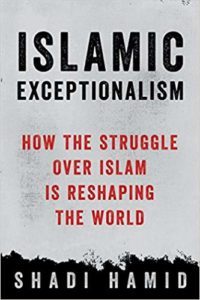
Today we talk to Shadi Hamid, a Senior Fellow at the Brookings Institution. The author of Islamic Exceptionalism and Temptations of Power.

The range of topics was diverse, from the new live-action Aladin film, the role of religious minorities in Egypt, and what it’s like to seem politically heterodox online. I say seem because Shadi’s sympathies with a sort of Left economic populism that isn’t quite exotic, but he evinces less fixation on epistemological hygiene than is common for modern public intellectuals.

We also talked extensively on his views about the role of religion in life, and religious identity in his own life, and the incentive structures of the careers of D.C. intellectual types.

Muslims and Islamophobia

I have realized this long ago and said this often in private but I feel this needs to be said more and more in public. Muslims care more about Islam than Muslims and that’s why they are inseperably attached to the term Islamophobia and cannot adopt a more appropriate term. This is also a primary reason why both Islamophobia and Muslimophobia are rising inexorably.

The Christchurch killer and his inspiration Brevik, both showed in their manifestos that how interconnected the global medium is and how America sits at the very commanding center of this globalized interconnected minds. Reading and watching some of the most famous Muslim discourse-makers in the aftermath of the shooting, it seems clear to me that beneath all the outrage about Trump, White Nationalism, far-right etc etc, what they really want to do is ban criticism of Islam. They may spew tons of words about Trump, White Nationalism, far-right but what they really hate with every core of their being are New Atheists and Ex-Muslims. I have no doubt that Mehdi Hasan eats, sleeps and breathes thinking worst things about Sam Harris. In Britain probably Majjid Nawaz would be a close rival of Sam Harris in terms of being object of hatred by media Muslims.

The saddest thing is that their efforts are all going down the drain at all corners except amng the wokes. Even after a great tragedy like Christchurch, very few joined their bandwagon to stop criticism of Islam. People like Majjid Nawaz and ex-Muslims will keep getting more and more attention. The right, not just far right, are unashamable through cudgel of atrocities. They will hurl back their grievances, big and small. A tragedy like Christchurch barely gives a short pause now in attacking both Islam and Muslims.

The center is confused, it may invite Mehdi Hasan time to time, but it understands uncomfortably that there is something very askew in this guy. Nodding along boilerplate rants doesn’t mean that very mixed thoughts about Islam and Muslims are not going on in the heads of people at the center. Even in this age of wokeness, the center knows how central is freedom of criticism of ideas to liberalism. Nobody in the center believes that Islam is in any way better than Christianity. After the buldozing Christianity faced in modernity, few would want Islam to be treated any differently. That is not just fair.

The term Islamophobia is exacerbating Muslimophobia. Protection of ideas at this day and age is very very costly. Muslims are paying the cost of protecting Islam. All decent people want to protect people, most decent people do not want to protect ideas.  Just wait till the next San Bernadino or Nice attack happen. Neither ideas nor people will be spared.



Pakistanis must give up “tit for tat”

Kabir Bhai writes:

My understanding is that “Vande Mataram” is a hymn to the mother goddess and thus goes against the monotheistic nature of Islam. It also comes from an anti-Muslim novel.

If Majlis is a group that includes both Indians and Pakistanis, then its logo probably shouldn’t refer to an Indian nationalist slogan which Pakistanis shouldn’t be expected to be comfortable with. Many Indians wouldn’t like it if the logo included “Pakistan Zindabad!” or something like that.

Then it is perfectly logical to change the name “Majlis” to Assembly or something neutral. The point is that Islamicate culture never seeped into the Subcontient through peaceful trading routes.

It was accompanied by violent conquest and if we have to ask Indians/Hindus to accept Islamicate culture, with its extraordinarily bloody history, then we have to accept the difficult bits of Indian nationalism.

I find Pakistanis are always focussed on “retaliation” and are the masters of cutting off their nose to spite off their face. Then they complain as to why their country is teetering on bankruptcy and not thriving (Survival is not enough).

In real life though I simply will never accept any alteration to the traditional logo, no matter whatever some Pakistani says. It is a matter I will simply not compromise on..

Does the nuclear arsenal “protect” Pakistan?

I don’t know the answer to this but it’s interesting to speculate.

(1.) How much stronger is India’s conventional army to Pakistan’s; specifically the airforce?

(2.) If Pakistan didn’t have recourse to nuclear warfare; what would it do in the case of a conventional army attack by India?

(3.) Would China/another power interfere; “could” they interfere?

(4.) In the last thirty years India-Pakistan have gone from a 20% per capita advantage in Pak’s favour to a 20% per capita advantage in India’s favour. What is the comparable geopolitical relationship between the two countries; is it Taiwan-China or Japan-China. What’s the closest analogue?

(5.) Is Pak’s High Command motivated to adopt unconventional warfare in the knowledge that any escalation would be nuclear-tipped.

(6.) Does the precedent of Pakistan (and maybe N. Korea/Israel) have nuclear weapons incentivise other nations (Iran, Saudi) to reach “nuclear status” to make sure that it is similarly immune to any sort of attack.

For once I’m not venturing opinions but asking for informed commentary.

The Syeds of South Asia are the sons of Hindus and Magians

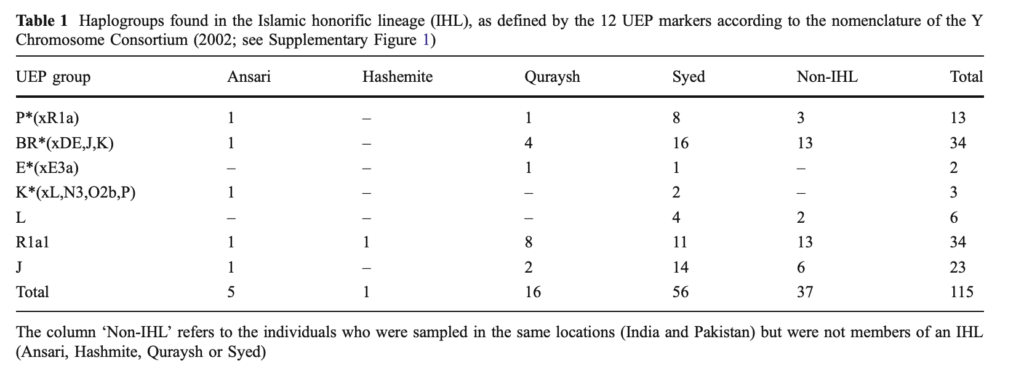
The above figure shows the frequencies of Y chromosomal haplogroups of men of South Asian who claim to be descended from the prophet or his tribe, as cross-referend with their surnames. The “Non-IHL” category indicates those who are not of these honored lineages.

The paper from which I drew the data, Y chromosomes of self-identified Syeds from the Indian subcontinent show evidence of elevated Arab ancestry but not of a recent common patrilineal origin, actually somewhat support the idea that these people descend from Muhammad or the Quraysh or the Ansar.

I think this is wrong.

But first, why do think these data results show Arab affinity? The “IHL” lineages have a higher proportion of haplogroup J, the most common haplogroup among Arabs. J is not exactly rare in South Asia (lots of <<<Brahmins>>> who are not sons of Indra have it because they are the scions of cunning Dasa priests), but there’s clearly a frequency discrepancy.

And yet this paper was published in 2010. We now know through various tests of confirmed descendants of Muhammad, and who descend in the male line from his cousin Ali, that they carry a branch of haplogroup J1.

Even among the Syeds, most do not descend from Muhammad assuredly. There are nearly as many scions of Lord Indra, R1a1, as those who bear haplogroup J. Of the J’s within the Syed community, I think the most likely scenario if they are not South Asia is that they are Iranian. J is found at frequencies of 35% in Iran, and Iranians, along with Turks, were the most common migrants into South Asia.

In other words, the Syeds of the Indian subcontinent are the sons of magians, not Muhammad.

India and Pakistan; the Fog of War

On the 14th of February 40 Indian paramilitary soldiers were killed when a convoy of the Indian Central Reserve Police Force (CRPF) was attacked in Pulwama (Indian Kashmir) by a vehicle borne suicide bomber. The attack was immediately claimed by a Pakistan-based terrorist organization called the Jaish e Mohammed (JEM, the army of Mohammed), who released a video of the suicide bomber, a local lad from southern Kashmir. JEM is led by a Pakistani cleric named Masood Azhar who had been captured by Indian security forces in the 90s in Indian Kashmir, but was released in exchange for the hostages on board an Indian airlines aircraft in December 1999. After his release he went to Pakistan and set up his Jihadist terrorist organization and has operated openly in the country ever since.

This is, of course, not the first major terrorist attack in India to be claimed by an organization based in Pakistan. JEM has been accused in the past of organizing an attack on the Indian parliament as well as many attacks in Indian Kashmir. And the biggest attack ever launched in India by Pakistani-based terrorists was the attack on Mumbai in November 2008, in the course of which ten terrorists wreaked havoc in the city of Mumbai and killed at least 165 people, including a few Israelis and Americans. Some of the more prominent attacks were followed by Indian threats of military action against Pakistan but in the end the Indian establishment opted on all of those occasions to try and isolate Pakistan diplomatically but stepped back from direct military action. This option was chosen not because of any residual Gandhian hangover in India but because of two interlocking factors: Continue reading India and Pakistan; the Fog of War

Religious change, genocide, and culture in the Indian subcontinent and Eurasia

Since many readers of this website refer to “genocides,” and all of them were born in the 20th or 21st centuries, I want to put a note here which I think will illustrate why it is important to be careful of the use of particular words and what their connotations are as a function of time. In the modern period, the term “genocide” has a particular valence. The Nazi killing of Jews, the Ottoman genocides of the early 20th century, and the killing of Tutsis in Rwanda. These were, I believe, expressions of the mass politics and mobilization. As such, they are not entirely analogous to ethnic and religious turnover in the premodern era, where death was often secondary or a side-effect.

Continue reading Religious change, genocide, and culture in the Indian subcontinent and Eurasia

Afghan Peace Process; Postscript

From Dr Hamid Hussain

Following was an exchange with an old Afghan hand of ISI.  It may be of interest to some.  His comments in normal font; mine in bold.

26 February 2019

 Thanks Sir for opening more windows;  My comments essentially of a wandering dervish in red in your main text;

Hamid

——-

Dear HH,

A very thought provoking analysis with indepth knowledge of situation in Afghanistan.  My take:

  1. No party can have total control over Afghanistan particularly psuedo democracy.(You are correct that no single party is strong enough to impose its will on the whole country.  In good old times, a chap like Amir Abdur Rahman put the fear of God by beheading a large number of tribal leaders and exiling others far away from their homeland.  In this way, he was able to impose a central state on reluctant Afghans. Times have changed.  It is time for a grand bargain and compromise although I’m not sure whether Afghans are ready for it.)
  2. Taliban will emerge as the largest group but will not be allowed total control by big powers. Fear CIS & Russians from fundamentalists will keep them supporting tajik and uzbek groups.(Correct.  Interests of many countries are divergent and each state will support its own proxy.  It is fine as long it is for political jockeying but all need to be mindful that one heated argument after endless cups of green tea can tempt one to reach for AK-47.  This urge needs to be controlled. If not then;

aur ja’am toteein gein; iss sharab khane mein)

3.hazaras & other shia gps having tasted part  powers will not easily succumb to Taliban rule. (Another reason for all Afghans to go for a bargain.  Like many highlanders, Afghans of all ethnicities have a distorted sense of honor.  They are willing to settle scores with gun for whatever perverted reason.  However, their grandmother is begging on the street, young son is molested in coal mines of Baluchistan (Shahrag mining town in Baluchistan is the most heinous place in this regard where boys as young as 8 or 9 from FATA and Afghanistan are being molested on daily basis) or daughters going into prostitution to put food on the table in Pakistan & Iran, and their honor is nowhere to be found. Reminds me the words of an American who had worked in Afghanistan.  He lived with his family among Afghans and worked in 1970s in Jalalabad for several years.  In mid 2000s, he went back for a trip to Jalalabad. He said that Afghans were poorer then but had honor.  Now they are richer but have lost their honor”. Hegel defined courage and bravery as “Courage among civilized peoples consists in a readiness to sacrifice oneself for the political community) Continue reading Afghan Peace Process; Postscript

Brown Pundits