 A new episode of ABCD Politics is out. For those of you who can, can you please subscribe on Apple Podcasts or Google Podcasts. And give us a rating too! Surya has submitted to Stitcher and Spotify, so it will be on those platforms soon too (my experience is that Stitcher approves fast, while Spotify approves slow).
The topic of the second podcast was nominally our own political evolution. It turned out to be mostly about me, and my own “conservatism.” Though Surya has followed my work, after a fashion, for 15 years, my politics are somewhat cryptic to him, so it was a useful exercise in exposition. Surya is a center-Left Democrat and ran as one in 2010. Myself, my own views are a bit more heterodox and difficult to pin down.
A simple way one can summarize my evolution is that I have gone from being a moderate libertarian in the early 2000s to more of a populist conservative in 2020, albeit of a moderate and cosmopolitan personal bent.
But when someone on Twitter asked to summarize my politics recently in five words or less, I said “family first family last.” What did I mean by this?
The issue came up on the podcast because I expressed by “pro-nuclear family” stance as one reason I aligned with the Right and was skeptical of BLM. One of Surya’s correspondents asserted that I didn’t characterize BLM correctly. As it happens, BLM has an “official” website. It has a section on the nuclear family, which I read a while back:
We disrupt the Western-prescribed nuclear family structure requirement by supporting each other as extended families and “villages” that collectively care for one another, especially our children, to the degree that mothers, parents, and children are comfortable.
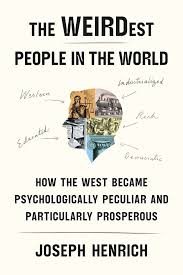
In early September the evolutionary anthropologist Joe Henrich will come out with a book, The WEIRDest People in the World: How the West Became Psychologically Peculiar and Particularly Prosperous. I obtained a review copy, so I will probably post my thoughts closer to the publication date. But, the book outlines a simple and widely discussed thesis: that unique aspects of Western Europe’s kinship and family structure that dates to the period after the fall of the Roman Empire were amenable to the emergence of economically dynamic liberal democratic societies.
The nuclear family is key to that argument. Obviously people can be happy in joint-families, clan compounds, or as part of dense tribal networks. But the nuclear family has some social and cultural consequences which I strongly favor. In the American context, the nuclear family is associated with positive outcomes for children, and a level of material and emotional well-being that many of us aspire to.
This does not mean that those who are not in nuclear families should be ostracized or thought of as second-class citizens. Rather, the idea is that society and politics should have the dominant family structure, the nuclear family, at the heart of its understanding, and that that should shape policy (e.g., tax-credits for having children). My impression and understanding are that the modern Left does not believe this privileging should occur (explicit in the platforms of groups like BLM above). Therefore, I am against the modern Left.

 Another BP Podcast is up. You can listen on Libsyn, Apple, Spotify, and Stitcher (and a variety of other platforms). Probably the easiest way to keep up the podcast since we don’t have a regular schedule is to subscribe to one of the links above!
 Another BP Podcast is up. You can listen on