
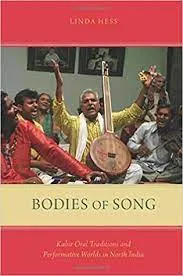
In the context of recent discussions on Indian and Pakistani music, I am cross posting this essay on Kabir Oral Traditions. It is important to remember that–despite the political tensions between India and Pakistan– there is a common culture that unites people. This essay was originally submitted as part of the coursework for my M.Mus degree in Ethnomusicology from SOAS University of London.
Bhagat Kabir (c. 1440-c. 1518) is considered one of the major poet-saints of the Bhakti movement—a social reform movement arising in North India around the fifteenth century. Characterized by an emphasis on the individual believer and a disregard for caste and gender taboos, the movement often rejected Vedic rituals and focused on the individual’s loving relationship with a personally defined god. This emphasis on love has clear parallels with Sufism, often seen as the mystical branch of Islam. It also later influenced Sikhism.
In contrast to other Bhakti poets such as Surdas and Meerabai—whose works can be placed squarely within the Hindu fold, often addressed to particular gods such as Krishna—Kabir’s poetry cannot be so neatly demarcated. He questioned the rituals of both Islam and Hinduism and was devoted to a nirgun (formless) deity, often addressed as “Ram”. According to Professor Harbans Mukhia: “In place of Allah and Ishwar he conceptualized a single universal God; in place of denominational religions he conceptualized a universal religiosity” (Mukhia 2018). This distance from the orthodoxy of both traditions perhaps explains why Kabir is revered by Hindus and Muslims across the Indian subcontinent. Some of his poetry is even included in the Guru Granth Sahib, Sikhism’s holiest scripture. In an era in which South Asia has experienced increasing polarization along sectarian lines, it is instructive to more closely examine this unique figure who served as a bridge between communities. Continue reading Kabir Oral Traditions in the Indian Subcontinent