
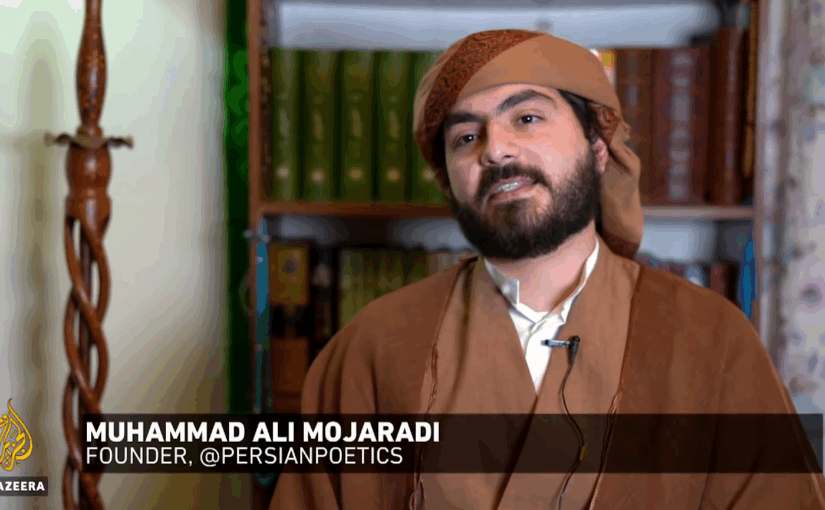
On July 14, I wrote about Ta’arof ; the millennia-old Persian art of flattery, refusal, and ritualised courtesy. It’s often misunderstood in the West as “saying no three times,” but it’s really about emotional high-context negotiation, reading the room before the room speaks.
The next day, on July 15, Sharghzadeh posted a powerful video, calling it Iranian Diaspora Fatigue. A searing takedown of the Iranian Diaspora’s toxic racial insecurities, internalised Islamophobia, misogyny masked as modernity, and cultural denialism. He’s mostly right.
What he calls fatigue, I’d call poisoned flattery turned inward. Because Tehranglos are no longer performing Ta’arof to honour guests or elders. They’re doing it to whiteness itself. Hoping if they refuse our own identity long enough, maybe the West will say: “Yes, come in.”
That’s not assimilation. That’s exhaustion. And the worst part? Even the racism feels borrowed; against Arabs, against Afghans, against Iranians back home. It’s not even Iranian. This isn’t just about cringe TikToks or awkward panel guests. It’s about who gets to narrate Persian culture. And what gets flattened when tradition becomes product. I was stunned when Zachary Newman — one of the most prominent Persian-Jewish American chefs — endorsed Netanyahu’s strikes on Iran. That moment crystallised something.
Sharghzadeh and I are saying the same thing: Persian culture is being gentrified by its own children. What survives isn’t tradition. It’s content. It’s vibes. If Iran is an unreadable poem, diaspora is turning it into a slogan. If Iran is lived, diaspora is increasingly just captioned. And they wonder why they’re tired. Is the Persian diaspora preserving a culture, or just performing it for the algorithm?
I suppose the Iranian diaspora is traumatized by the Islamic Revolution and that leads them to become Islamophobic.
Endorsing Israel’s strikes on Iran is definitely extreme though. It’s like Raza Pahlavi thinking that Israel’s attack on Iran is a good time for him to make the case for the people to rise up against the Ayatollahs and (I guess) put him in charge.
yes I think Reza Pahlavi really compromised himself over condoning the attacks but let’s see. It’s a fluid situation
From JSTOR Daily:
“The Shah, Our Man in Tehran?” By Matthew Wills
https://daily.jstor.org/the-shah-our-man-in-tehran
fascinating pithy piece
I think Netanyahu is only looking to save his own skin?
I thought he’s been wanting to do this since the 90s. Seems pretty deliberate and well planned to me.
Amoral but not insane.
Yes and quite the failure if anything.. Israel is revealing all its cards constantly
exactly like Iraq
thanks
Exactly so when everyone frames it as saving Iran; well it sounds unbelievably callous
A very interesting interview on India-Bangladesh relations:
“India must acknowledge that its treatment of Muslims has repercussions: Debapriya Bhattacharya”
https://www.youtube.com/watch?v=1ZwCmqt7nqI
I guess this is an Open Thread? If this comment is irrelevant feel free to remove.
that’s fine we should a proper Open Thread perhaps. do you want to make one and I’ll make it sticky?
iranian diaspora sees a chance for escaping from islam, when they go out of iran and they do it.
i have seen iranian females frantically searching for hijabs in airport shops in u a e for their return journey!!.
the fact is that islam, even with all its adaptation to persian ways is still seen as an arab religion imposed on iran. part of this process is not erasing the pre islamic iran from their memory.
if an iranian lady wears a hijab in west, it is more for identity and defiance.
if the mulladom falls in iran, islam and its ways will become a private matter.
in my opinion all migrant communities in west would want acceptance from the whites. for others it is not possible beyond a certain stage. fair skinned iranians probably feel that their chance of acceptance is more due to skin colour, islamophobia is an added point.
Shi’ism feels very very Persian tbh
so much so that in kashmeri shia ashura processions there were portraits of khomeni and khamanei.
Strange how much public flagellation there is about the removal of article 370 and loss of statehood but no acknowledgement of the return of Muharram processions.
https://youtu.be/Nwce9WwkcMg?feature=shared
Happily Bollywood has made a rare gem of a very watchable propaganda movie explaining 370, the effects and it’s removal.
I say propaganda but facts on the ground do seem to be matching up. What’s the word when your POV is realized?
I’ve seen this – a pretty good feature
R there Shias in the Valley; I thought mainly Kargil?
During the Iran bombing quite a few Kashmiris (in the hundreds) were airlifted back from Iran. Presumably all shia.
Muharram is one of those strange festivals where waving a sword about causes little concern.
I saw some video where they were immersing the tazieh after the procession. If it weren’t for the skull caps and curved swords you’d be forgiven for mistaking it for a visarjan.
yes I know so little about Muharram; might be a good idea for a post. lots of Iran-inflected posts of Brown Pundits recently
The nice thing about an event like muharram in Kashmir is it gives you a very clear example on how biases work in reporting.
https://www.news18.com/opinion/opinion-muharram-returns-to-kashmirs-streets-a-march-of-mourning-resilience-and-revival-9446823.html
The piece you linked also mentions why Muharram processions were banned for thirty years:
Muharram is a commemoration of a battle against injustice (Imam Hussain vs. Yazid). It’s not hard to see why for (some) Kashmiri Shias the Indian state would represent Yazid.
Two things can be true at the same time: It’s a positive thing that Muharram processions have been restored. At the same time, the fact that Kashmiri Shias were not allowed to express their pro-Palestine and pro-Iran feelings should be condemned.
that’s truee but presumably also safety reasons?
from the same site: https://www.news18.com/viral/in-rare-open-celebration-of-polyandry-2-himachal-brothers-marry-same-woman-proud-of-tradition-ws-l-aa-aa-aa-aa-aa-9449980.html
An article from Al Jazeera noted that Shias form nearly 10% of Indian-administered Kashmir’s population. I wasn’t able to find any better statistics.
Aga Syed Ruhallah Mehdi is a prominent National Conference leader. He currently represents Srinagar in the Lok Sabha. Wiki notes “He is also a well-known Shia Muslim cleric”
On Muharram processions:
“J&K Police Crack Down on Pro-Palestine, Pro-Hezbollah Support in Muharram Rallies”
https://thewire.in/rights/kashmir-police-palestine-hezbollah-muharram-rally
This article was from earlier this month.
yes it’s surprising Shi’ite populations usually have a deep Persianate influence, in a Subcontinental context
In Kashmir’s case, Islam is supposed to have been spread by saints from Iran. The chief among them was Mir Sayyid Ali Hamadani (also known as Shah-e-Hamadan)
https://en.wikipedia.org/wiki/Mir_Sayyid_Ali_Hamadani
Sufi not Shi’ite?