
During the pandemic, I experimented with translating Bilal Hassan Minto’s Model Town (Sanjh 2015)—a collection of Urdu short stories told from the perspective of a preadolescent boy growing up in Lahore’s Model Town neighborhood during the late 1970s (at the beginning of General Zia’s Martial Law). This was my first attempt at translation so I’m not sure how successful it was but I did learn a lot from the attempt.
The story I’m sharing here is called “Dr Walter”. One of the main themes of the story is the discrimination faced by minorities in Pakistan (in this case Christians).
When the Walters’ house was going up, we — Talat, Aqib, Qamar, Mazhar and I — hung around the construction site in the evenings and romped on the sand and gravel piles. At the time, most houses in Model Town had been built by Hindus before the Partition and abandoned when they fled in disorder to India so that some Muslim, trying to take over their houses, or for no reason at all, wouldn’t behead them or sprinkle oil on them and set them on fire or stab them in the stomach with a sharp knife. This precipitous departure left many unclaimed plots on which new houses were built from time to time. When construction of the Walters’ house began near us, a minor frisson of excitement entered our slow-moving lives.
Horsing around, boring tunnels in the sandpiles, Mazhar had asked a laborer:
“Whose house is this?”
“Sai,” he had said, meaning “Isai.” Christians. People who follow Jesus Christ as first among the Prophets of God, just as the Jews consider Moses. Well, what someone believes or not and why are mysterious and dangerous things about which I can’t say anything, but even before the laborer told us, we had a sense that these people were of some other religion because several signs suggested they weren’t our sort.
At this time, the obnoxious General Zia had not descended on our country like a curse and new revelations about our religion, Islam, hadn’t begun to mushroom. No one in their wildest dreams could have imagined that prayers would become mandatory in offices or that women wouldn’t be able to appear on television without covering their heads, or that punishments would be meted out to people seen eating or drinking during Ramzan. And, more surprising than all these, that every day, before the entire country, news on TV would be delivered in Arabic. All this was about to happen, just some days after the Walters built their house near us.
This last bit — about the news in Arabic — was truly astounding. Every day a man appeared on TV and, without offering a reason, just turned his face to millions of people and began speaking a language they didn’t understand at all. The millions were us Pakistanis, whom the Arabs went about calling “Bakistani, Bakistani” only because the sound “p” is not in their language although, with appropriate practice, any sound can be produced from the mouth or throat. There is nothing really difficult in this because the tongue is only a piece of muscle and training it to produce different sounds is an extremely simple task. In any case, it is fruitless to ask the Arabs why they call us “Bakistani, Bakistani,” especially when they themselves would be shocked at the weird Bakistanis who broadcast the news every day in our language and when the name of their country is mentioned, themselves refer to it as “Bakistan”. There are also no grounds for complaint if someone doesn’t want to train their tongue and it’s not their priority to produce new sounds. That’s their personal choice.
Be that as it may, broadcasting news in Arabic was extremely strange although there is no doubt that I know something even more shocking. It could even be said that what I know deserves to be added to the collection of the world’s strangest facts. It is that most “Bakistanis” go on reading the Quran — Allah’s final revelation — in Arabic but don’t think it at all necessary to read it in any language they understand and from which they might learn what great things Allah has included in his last book, what commands He has given, and what superb rules He has revealed for the conduct of life.
When the Walters’ house was under construction, General Zia’s “Bakistan” had yet to come into being, and all sorts of new prescriptions had not been written to preserve the purity and piety of women. Even at that time most Pakistani women wore the regular shalwar-kameez. Fashion advancements consisted merely of lengthening the kameez or narrowing the shalwar cuffs a bit. Nothing more than that. It was another matter if someone’s dress was a different type for a special reason, but even then it was expected to conform to the style of some other part of the subcontinent or Arabia — meaning it had to be in keeping with the mores of decency, modesty, and other such things. It couldn’t happen, either then or now, that women from Model Town or Sukkur or Chakwal or any other part of “Bakistan” could say that since this June sun is on fire let’s wear shorts and undershirts or put on swimsuits and jump into the pond or canal and emerge only when needed, to cook food or wash clothes. That way we will not die from sunstroke, nor neglect serving our husbands — the task for which we have been created.
This, and other such shameless things that conflicted with the Ideology of Pakistan, could be allowed to happen neither then nor now. At that time, if anyone wanted to wear a different kind of dress, it had to be at least from a neighboring part of the world where women knew how to cook food properly, wash clothes, and give birth to children. Zakia Khala wore one such acceptable dress, known as the “sari.” Zakia Khala would always wear this dress — in the kitchen, in the bathroom, at bedtime, while speaking on the phone, strolling on the lawn, and while mixing salt in lukewarm water for gargling. In short, all the time.
Our mothers would also dress up this way from time to time, though for them it was something special, to be worn on an occasion like a wedding reception or the head-shaving ceremony of someone’s superfluous child. But Zakia Khala had arrived in Lahore via marriage from somewhere in India and because a large number of women there go around in saris so Zakia Khala had picked up the habit although it isn’t at all necessary that if you are visiting a place or residing there you have to adopt all the habits of the locals. For example, if spitting is a common practice of a group, adopting that habit is neither commendable nor reasonable for everyone in the area or for others coming from outside. But the sari is different. It’s not a bad dress, nor is it reserved for loose women, nor is wearing it a bad habit like spitting, except for the fact that a part of the belly remains permanently visible and at times even the navel is exposed. In Arab countries and in Pakistan there are many who are infuriated by this mode of dress and attack sari-clad women.
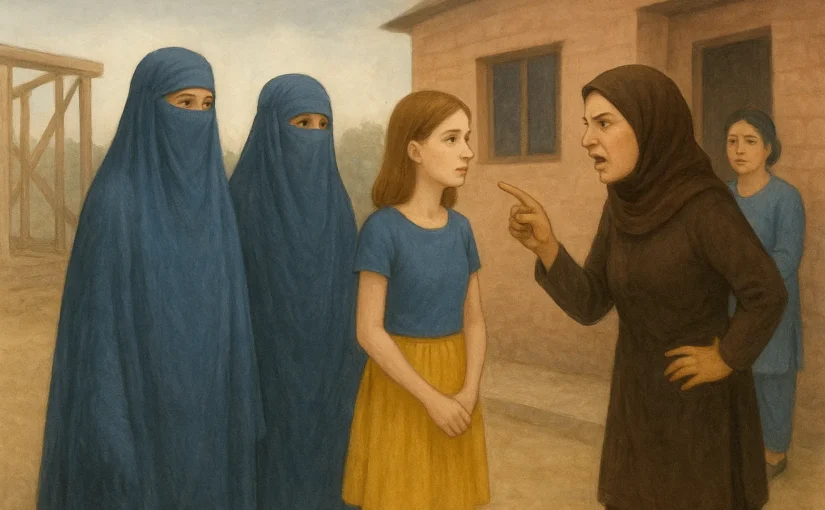
So, seeing the petite and skinny Mrs Walter in jeans and yellow or blue skirts suggested that these people were different from us in some ways. Which is why Akhtar Auntie had asked:
“Who are these people building this house?”
And Apa Sughra had added in her harsh voice, as if sounding a warning:
“What kind of people are coming here?”
Apa Sughra was not a free-thinking or modern woman and both her twin daughters, Fari and Pari, wore burqas to school. Had it been up to her, she would never have let the Walters move into the neighborhood. For one, they were ‘Sai’ and, for another, Mrs Walter dressed like a loose woman in blue or yellow skirts and sometimes even in trousers. Were there not Sai women who dressed like our mothers in a regular shalwar-kameez? There were. All over. For example, the cleaning woman in our house, Grace. So why did Mrs Walter have a special need to run around in such dresses with such brazenness? But even more shocking to the senses, horrible, and condemnable was what Apa Sughra had imagined about her and then passed on to Ammi:
“Someone who wears such clothes outside must be going around with her bony ass naked in her own house.”
These words made Ammi tremble because the thought of anyone naked, especially a woman, was so frightening that even the idea of it entering someone’s head was condemnable — whether that woman was thin and emaciated like Mrs Walter or plump and healthy. But Apa Sughra had said it just like that, out of spite, though it was completely wrong to argue that you wore less at home than you wore outside. It wasn’t like that at all. The pious women, who went out in shalwar-kameez, did they wear something else or less inside? Of course not. Maybe they didn’t always wear shoes or put on the dupatta, but not wearing shoes couldn’t be taken as a sign of nakedness or a step towards indecency. And although going outside or talking to a man without a dupatta is considered dubious, whenever such an occasion arose — for example to talk to the mali [gardener] or to sign for a parcel brought by the postman — these pious women, some of whose husbands often slapped them and some who couldn’t even sign their names, immediately covered themselves with their dupattas. Only after donning this grand symbol of modesty and spiritual purity would they open the door and converse with the postman, the mali, or whoever had brought the newspaper bill.
In Apa Sughra’s life, Christians had only one purpose: to come in the morning, clean the house, and go back to their China Basti or somewhere even further away. She wouldn’t even have them clean the house, but cleaning the toilets, which involved cleaning up one’s own mess, was a task that most people around us considered extremely demeaning and wanted someone else to do. This work was appropriate for Christians, especially in the times when there were many houses without a flush system. One couldn’t just pull the chain and send the waste underground to some unknown destination. The commode pans had to be picked up, taken away, emptied, scrubbed clean, and brought back. According to Apa Sughra, Christians were made for such work because perhaps she had never seen Christians like the Walters, who lived in her own neighborhood and in a house quite like hers. All she knew was Susan who did this work, this dirty work of removing waste from her house. Or, before Susan, Alice. But Alice had to be fired because Apa Sughra had caught her one day in the kitchen drinking water from a glass instead of from her designated steel cup. The glasses were for Apa Sughra and her veiled twin daughters — Fari and Pari. The day she caught Alice in this disgusting act, Apa Sughra was crushed and mortified by the thought of not knowing how long she had been drinking water from glasses defiled by Alice.
“Hai, Nudrat Begum,” Apa Sughra had said to Ammi, “Who knows how long we have been eating and drinking out of these foul dishes? Who knows what else she has contaminated? Now, we will have to throw out all the crockery!”
At the time, Ammi had kept quiet but after Apa Sughra left she grumbled: “Despicable woman! She herself looks contaminated to me! She keeps spouting nonsense! Dumb woman!”
“Despicable,” I repeated. “Dumb woman!”
“You be quiet,” Ammi scolded me and began grumbling again. “She keeps talking about purity and impurity but picks her nose all the time! She always smells of sweat! Does she even wash or bathe?”
After the incident with Alice, Apa Sughra threw out all the crockery in the house. She didn’t even bother to ask anyone else if they might want the dishes defiled by a Christian woman. Okay, it’s possible she might have considered it sinful to ask a Muslim this question but she could have asked a Christian — another cleaning person for example. Or the Walters. Though it was quite likely that the Walters had better and more varied crockery than she did. Wine glasses, for example, which are such that the part in which the wine is poured rests on top of a long stem which itself stands straight on a circular flat base — who knows why.
Ammi was irritated by Apa Sughra’s discourse on piety and impiety because she sensed that these were sly attempts at conveying a message. That was perhaps the case for Apa Sughra was an unsophisticated woman and because in our house the religion of the servants — or of anyone really — didn’t have any special significance and we could employ Muslims, Christians, Hindus, Buddhists, pre-Islamic Arab idol-worshippers, in short any type of servant, without compunction and could even eat food cooked in utensils washed by them. That was the reason Apa Sughra expressed her displeasure through sarcastic hints.
“You are mashallah very liberal and educated people!” or some other such pointed remark like the one she made when we hired Ismail:
“What a relief. He’s a Shia, but at least he recites the kalma. Next time, Allah will help make a better choice.
Those who are interested can follow further parts of the story at my Substack.

Amazing work!
Yes great story.
I was thinking maybe Zia was as inevitable to Pakistan as Modi was to India.
That’s an idea that popped to my head reading Dr. Walter but don’t want to derail the thread.
Great stuff Kabir
Thanks! During the pandemic I translated five of the short stories in the book.
If you continue to follow along, you will find that the treatment meted out to Dr. and Mrs. Walter (by the police) gets even more harrowing.
It’s a longish story (about 10,000 words).
I don’t think Zia was inevitable. Unlike Modi, no one elected him. He was a dictator who removed the legitimately elected prime minister and had him executed.
It is true that close to four decades after his death, Pakistan is still trying to get out of the Zia era. School curricula reflect Zia era “Islamiat” and “Pakistan Studies”. An entire generation of military leadership has been educated in the Zia-era “Ideology of Pakistan”.
I will write on this