
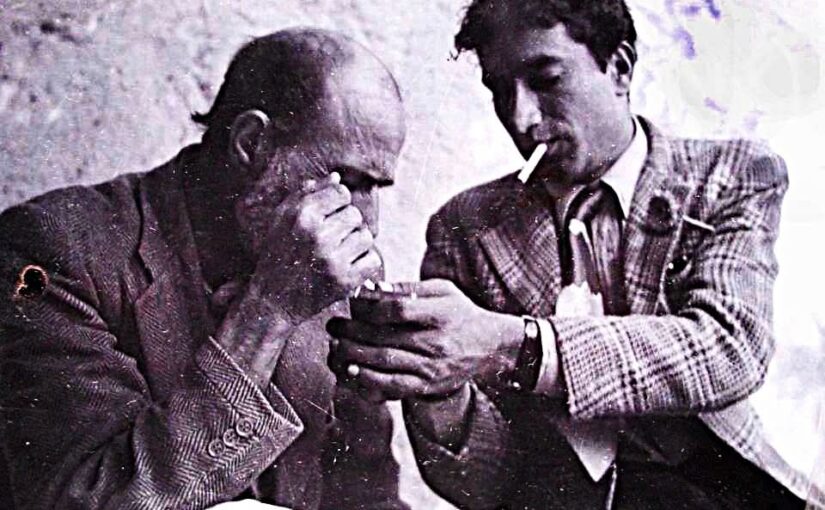
The context of this poem is an interview of the legendary Urdu poet Ahmad Faraz (1931–2008) with Naeem Bukhari. Faraz is regarded as one of the true heirs of Urdu’s laminal poetic tradition and celebrated for his bold, progressive stances and romantic verses that deeply resonated with the masses.
Though I personally rank him second to Faiz Ahmed Faiz (his contemporary), due to the universality, conceptual depth, and themes Faiz cultivated in his poetry, what I love about Faraz is his radical romanticism and mastery of language. Especially since he hailed from Kohat, a non-Urdu-speaking city in Khyber Pakhtunkhwa, this is particularly remarkable.
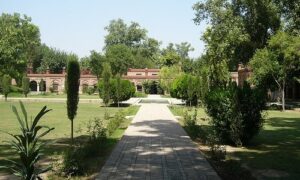
Another interesting connection between Faraz and myself is that we both attended the same institution, the prestigious Edwardes College. For those who don’t know, Edwardes College was established in 1900 and has produced generations of intellectuals and cultural figures, including Prithviraj Kapoor, the pioneering Indian film and theatre actor/director/producer; Dr. Khan Sahib (Dr. Abdul Jabbar Khan), the first Chief Minister of West Pakistan (The famous Khan Market in New Delhi is named in his honour.)
Coming back to the interview:
NB: Temperamentally aap ek romantic aadmi hain?
(Translated: Are you, temperamentally, a romantic person?)
AF: Haan, bilkul hoon. Main ek bharpoor ishq ka qail hoon. Ek mukammal insaan ke ishq ka. Main Aflatooni ishq (jo frustration ka ishq hota hai) ka haami nahi hoon. Us mein aap apne wujood ka aadha hissa zaya kar dete hain. Is liye aap mukammal mohabbat de hi nahi sakte kisi ko, jab tak apna poora wujood uske hawale na kar dein. Toh main ek mukammal insaan ki tarah, mukammal ishq chahta hoon. Jiske liye rona ho, jiske liye hansna ho, jisko aap yaad karein. Jo aapke wujood mein poori tarah sama gaya ho.
(Translated: Yes, absolutely. I believe in passionate, complete love — love for a whole person. I’m not a supporter of Platonic love, the kind that’s rooted in frustration. In that kind of love, you end up wasting half of your existence. That’s why you can’t give someone complete love unless you offer your entire being to them. So I desire complete love, as a complete person. Love for whom you cry, laugh, miss deeply — someone who becomes entirely embedded in your existence.)
And that is how I gestated this poem. Please enjoy!
Against Platonic Love
تسکین کو ہم نہ روئیں جو ذوقِ نظر ملے
[1] حورانِ خُلد میں تیری صورت مگر ملے
Sitting aimlessly on Eid day,
Thinking about the futility of the aeon,
I thought of the fractious spell
And the resultant intoxication I had, even
After years and years of encounter.
Peshawar is far more subliminal than Eden—
I can touch and lurch in the scent of the gated city
And prostrate upon it.
What maiden houris of the afterlife,
With a lightning appearance,
Pristine countenance,
And godly silhouette,
Could hold to the eyes of this crooked earthling
The wax of your ear,
The rusted steel nose pin,
Greyish, catastrophic hairs,
And the acned cheeks of yours?
Ah, the sensation of the earthly viscera,
The dysmorphia of every kind and sort—
It is incomparable to the untouchable,
and the non-sensorous holiest of holies.
Icarus [2] vaporized in this
Frenzy of the soar—
And so too the frustrated ones,
Whose beloved is exalted,
And merely and pathetically exalted
[1] taskīñ ko ham na ro.eñ jo zauq-e-nazar mile
hūrān-e-ḳhuld meñ tirī sūrat magar mile
We would not weep for solace, if we had the gift of sight—
If, among the houris of paradise, we found your likeness.
(“`Ghalib)
[2] Icarus, a figure from Greek mythology, attempted to escape Crete using wax-and-feather wings made by his father, Daedalus. Ignoring warnings, he flew too close to the sun, causing the wax to melt and sealing his tragic fall.

Faraz is perhaps best known for “Ranjish he sahi”.
Here is a YouTube clip of Faraz reciting “Ranjish he sahi” followed by Mehdi Hasan singing it.
https://www.youtube.com/watch?v=FLfQ_Vy7JKI
Here’s Rahul Deshpande singing “Ranjish he sahi” (this was just posted on YouTube today)
https://www.youtube.com/watch?v=s46tebisBy8
[…] another detour we can explore some other time). I was at Edwardes College then (see the post “Against Platonic Love” for more […]