
This short story by Dr. Samia Altaf was originally published in The Peshawar Review.
Samia Altaf is a physician specialising in Integrative Medicine. She is the author of So Much Aid, So Little Development: Stories from Pakistan (2011, 2015, 2025) and of tamasha-e ahley karam: aalami bank ki naakaam imdaad aur Pakistan ka nizaam-e sehat (2025).
Just as we finished breakfast — halwa-poori, cholay and cheese omelette washed down with mango lassi — on a bright Sunday morning, mother announced that from tomorrow, Monday morning — she did new things on Monday mornings — she would not live in the house anymore. She would live in the old jamun tree in the beautiful Bagh-e-Jinnah. There, from its top branches, she could observe the Mall Road, look through the windows of our second-floor lounge and see us as we lounged around, our faces in our phones. And she could hear us too, especially big brother as he did his daily riyaz. She loved the darbari bandish he was working on these days — anokha ladla-aaaa — and didn’t want to miss out on.
Why?
She was tired of it all. This life. The government lying, the people dying, on land and in sea; people actually killing each other for praying this way or that; the useless, selfish leaders constantly yelling, only jostling for “kursi.” The begging, the begging, the constant begging for oil, for food, for electricity, water; and no one listening, caring, or paying attention. And the children! She’s heartbroken to see girls and boys, unable to read or write, especially the little girls, so tiny, so skinny with their heads covered, scarcely able to breathe. All this suffering, so unnecessary. Sure, life is difficult; as a doctor she had seen people die, authorities lie, and no one pay attention — remember the Covid days? But now it is too much. She was teary as she ate the piping hot puris that the cook placed on her plate. She was so tired, she said, of the need to be so alert all the goddamn time; to pay attention and yet be dragged into a deeper hole. She feels she is on a treadmill that goes faster and faster, its speed controlled by some sadistic demon. She needed “out.” Interrupting the trajectory of her fork, she recited:
What is this life, if full of care.
We have no time to stand and stare.
No time to stand beneath the boughs
And stare as long as sheep or cows.
She had decided that instead of standing beneath the boughs, she would live amongst them.
What about us? — two lovely post-teen sons, talented and good looking. Understandably fashionable neurotic millennials, home after graduating college, deep in the intricate complicated process of “finding themselves” as an alternative to finding paying jobs. The house, the garden, and the enthusiastic cook, cooking endless pooris; YouTube; her books; music that she loved, vocal and instrumental recordings of Vilayat Khan sahib and his talented son, Shujaat. She raved about that concert in 1978 at the Smithsonian auditorium in Washington DC, where Shujaat, then a teenager, had played so skillfully and beautifully and so courageously while sharing the stage with his illustrious father.
And what about father? Okay, he’s a bit clueless, but he reads poetry to her as she makes intricate salads and complicated desserts. O the father and his boys! Don’t even talk about them. He who indulges the boys who won’t get on with their lives. What is this finding oneself business when there is so much to be done?
What about YouTube and the Internet? What is YouTube without the Internet? What is the Internet without stable electricity? She orders cakes, spices, bread, cheese, you name it, in the mail — all kinds of stuff. Mostly she orders shoes — pumps, sandals,wedges, flats and heels. She orders ill-fitting pumps, and then, hassled by it all, she delays returning them, then the receipts get misplaced, and then she can’t return them at all. The shoes lie around the house. On her dresser, at times on the kitchen counter, on the hall table, a tower of boxes in one corner of her bedroom. I can see the last purchase, a high heeled red leather pair sitting on the living room bookshelf right next to the hardback of Rushdie’s The Enchantress of Florence.
Her job? With this hypocritical university that pretended to be modern — and was so behind, so uncaring of the students, so cruel to the women, harassing them, bullying them into submission. Her selfish siblings who called in the middle of the night to get her to go to the hospital with them; the freezer that ices over even though it was supposed to be frost free; her sewing machine that she could not thread anymore – her cotton socks always mate-less, and her bras that always ended up being the wrong size. She was so tired of it all, she said, the tears lingering on her lashes behind her glasses as she looked out the window at the mango tree sapling she planted last year. It waved encouragingly and seemed to reach for her. Alarmed, I decided to tell the gardener to stop watering the blasted thing.
Tired of living this life, she was going to find another one, in another place. Where? Somewhere calm and sensible, without people. TREES! Well, she likes trees better than anything else. She found them comforting and protective. That’s where she would live — in a tree. She had spent her childhood almost living in trees. A guava tree was her favorite; the mango tree a few feet away, the jamun tree further down, then a couple of orange trees — ah! the heady perfume of orange blossoms — all spreading their arms to hug you. Trees loved her; they were so sympathetic.
Sympathetic? How could a tree be sympathetic? Trees are sympathetic; they care for each other; they spread their roots quietly to hug their neighbor’s; they share food and water. Jamun tree hugs the mango tree. See? She pointed through the window. They do not care about colour or zaat or religion or status or class; they recognize each other and love each other. Not just each other, they are sympathetic to us, stupid humans too. Hadn’t she told us how she spent summer afternoons perched up on the guava tree as a chubby preteen, the leaves covering her as she hid from her mother’s ministrations to make her un-fat and “fair”?
She was then twelve years old — short and fat and “not fair,” so with very low possibilities on the marriage market. Her mother worried she would hit puberty soon and the window of opportunity to fix her would close. She tried mightily to fix my mother. O! how that woman tried to make her tall and fair — all the foul-smelling unguents and creams that she applied to my poor mother’s twelve-year-old face — but no avail. My short, fat, dark-complexioned mother’s dark complexion stayed.
To make her tall, she was to do pull-ups. My poor chubby mom could not do even half a pull-up to save her life. It was not that her arms weren’t strong. They were strong, for she could play a mean game of badminton fit to beat all the neighborhood boys including her highfalutin brothers. It was her fat thighs that weighed her down, she said, as they still do. That is why she has difficulty climbing stairs. It’s gravity, she said; it pulls harder on heavy things — that’s law of physics, she explained to me. I, who was a physics major in college. She swears that her mother had once set her up to do twenty pull-ups and gone back into the house, the tree branch would lower itself and lift her up. If that is not sympathy, what is? For when she stopped crying and wiped her eyes, she found herself perched way up, sitting on the sturdiest branch with lovely green guavas nodding to her and the dusty leaves shading her from the world and the hot afternoon sun. Once she had arranged to go up with a pillow, and she remembered a peaceful nap there. Younger brother, feeling lonely without her, came up and they had a party: they came back into the house after dad and safety had returned.
And then there was Calvino’s Baron — her inspiration, who had gone to live in the trees. She said she loved the way he flitted from branch to branch, jumping from tree to tree — now in a juniper and then a short hop into a red maple; if he found an apple tree, his day was made. Come evening, he huddled amongst the leaves, watched the stars, and went to sleep, turning in with the sparrows. Occasionally his mother came out and brought him bread and warm milk to build strong bones for he was still at that age. He would jump down and drink to please the mater and then scamper up the tree again. Maybe I could bring her samosas and tea when she went to live in the tree? And I was not to forget the mint chutney.
I am thinking all along of this biblical thing — you know, Eve and the apple tree and the woman doing her own thing. Okay, maybe guava tree waters it down. But women doing forbidden things — now living in trees — what kind of trouble would that bring? Women were meant to remain firmly on ground, not go about climbing trees for who knows how high they might climb?
We told her times had changed; no one did that anymore. She would be cold and wet; birds would poop on her; they would peck at her arms and legs. What if she wanted to pee? Or, even if she could pee behind a bush, what about washing her hands? — since we are, after this Covid thing, big on hand washing. What when she ‘d need to wash her abnormally luxuriant hair? What then? She shook her head, smiled, and undid her fat bun to let her hair fall down her back all the way to her fat thighs, some silver strands shining cheekily through the lushness of dark, irreverent, undulant curls.
There are other ways to go away, little brother said. He would check into a five-star hotel and put a Do Not Disturb sign on the door. If really pushed, he would go to a hotel in Ankara or Budapest or Trivandrum where no one knew him, and he knew no one. No. the flights are so cumbersome. She did not like five-star hotels. They are like biscuit tins; does she look like a biscuit? Sure, she is roundish, and her complexion is wheatish…
I recommended she could just stay in her room, like Proust in his cork-lined one or like Big Brother in his book-lined one. He found a way of escaping into solitude when he felt incapable, I suppose, of responding to what reality required of him. And she could have samosas every evening a la Proust’s madeleine.
Or, she could quietly slide under the bed and live there with the rolled up hand-woven rugs that she had been lovingly carting all over the world for that day, one that would never come, I knew, when she would have her own house with enough rooms to spread them. The moth-eaten ones she inherited from her father’s house and the new ones she bought on her trips to Peshawar. On real bad days, she could go into the far dark corner where all the mismatched lost socks live, the ones from our middle school years, to get to a place where no human broom could reach.
Or, she could go away as father goes away. Just turn off your internal switch and with it the lights and all sounds, shut down the operating system, and pull up that invisible impenetrable shell, like the one used by Israel Defense Force to protect against outside invasion. No one, and that means no one, not even the one he professes to love till the seventh circle of hell freezes over — her — could enter that shell once it is up. She’d rant and rave and call and cry but no answer. Shop closed. Now, that is a way to go even while being here.
She did not want to do that, she said, for she knew its devastating effectiveness. Precisely because of that, its devastating effectiveness. One does not do that to people one loves. She would never shut out the people she loved. That would be terrible cruelty; she wouldn’t even do that to an animal. She loved her children, her family, this neighborhood, this cacophonous city, this demented country, this wonderful world.
She wanted to live in this world full of books, movies, music, people to talk to, listen to, and places to visit. A country of wonderful food, spectacular mountains, changing seasons, fresh-baked bread, and trusting people. She wanted to hear her children’s laughter, their broody monosyllabic answers to questions. She wanted very much to live but in a world that was honest and kind, in which we could live in harmony. One without wars that killed children or their fathers and mothers, and where people took care of each other. One where we were grateful for this wonderful world, this beautiful country.
How could humans not understand this? When even the birds did. She pointed to the sparrows who at sundown congregated on branches chattering with each other, flapping their little wings. See how they helped each other gently poking their little beaks now in their own shoulders, now in their neighbor’s looking here and there in that birdy way, as if asking “you want me to rub your tummy?” Then each one keeping to its perch, on its own feet, sleeping with its beak in its own shoulder, not in the neighbors’. She could tell that this bird family had come together after a hard day’s work—hunting worms , eating them, escaping from predators, escaping the stones hurled at them by errant urchins. And now back home they shared their experiences and enjoyed each other’s company. They seemed connected and concerned; that is all one needs to be. If birds could do it, why couldn’t we?
She pointed to a particularly fat one that was nudging a skinny one. “That is a hug,” she said. “In the world of birds,” she added when I looked skeptical, “for they do not have arms, you see.” I did see, but I also saw that lovey-dovey bird stuff is not all lovey–dovey. These are lethal creatures, selfish and self-centered. That was a rude push if ever there was one. And that too from a mother; that’s what the fat one was, I bet. Had she not seen the mother-bird push the baby birds out the nest, even as they clamoured for worms, their wings still moist and slick from the shell? Or seen the vicious birdy fights over nothing? But nothing doing. There is little arguing with the mater especially when she gets this desperate look in her eyes, as she did then, and jerks her fat shoulder up and down quite like the mother sparrow shaking out at the end of the day.
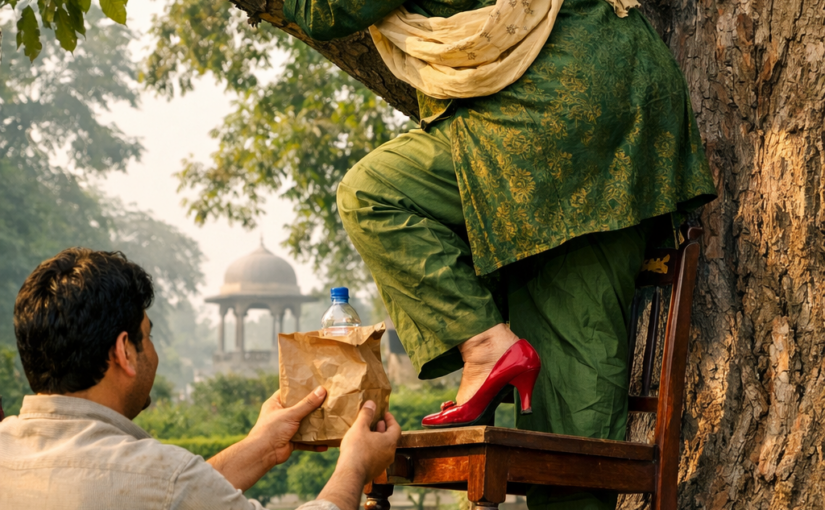
So, come Monday morning mother left to go live in the jamun tree in Bagh-e-Jinnah. She had a bit of difficulty getting up the tree — her fat thighs again — and she was unpracticed in the art of climbing for the past four decades. The high-heeled red leather pumps she wore, though so stylish, weren’t helping either. Not quite the right footwear for this expedition but she wanted to feel ”dressed” and since she didn’t need to walk, they seemed appropriate. I held steady my counsel, and the dining chair I had especially carried all the way to give her a boost up. And then handed over the little brown paper bag I had put together for her. A cucumber sandwich — on whole wheat, mind you; little brother had to make a special trip to Gulberg bakery for it. It had started out as a samosa with mint chutney, but in deference to the arboreal nature of her expedition, I changed it to something green. Then added organic cheese and a bottle of water. She told me not to bother for she could manage. It was just to get you started, I said. Next morning when I returned, I saw the empty paper bag lying at the foot of the tree and no sign of mother. And there hasn’t been one since.
It is rumored that an old woman in high-heeled red shoes lives in the trees in Bagh-e-Jinnah. The park service fellows, skinny and short sighted, but of serious intent, investigate. A couple are out in early dawn, sticks in hand, others make midnight raids, all without success. People stroll by and cast hopeful glances upwards. Some say, better leave it alone, for who knows, who lives there, and it must be good for the tree bears abundant fruit. They bring offerings to the tree; infertile women light candles and burn essence at its base as they pray for a child. The authorities serve show-cause notices to the tree, notices that they nail to all jamun trees, and for good measure to peepul and sheesham trees as well, saying this practice of allowing boarders is against municipal garden regulation 89/3/21 that has been in effect since 1864 when John Lawrence became the Viceroy of India — Bagh-e-Jinnah having been originally christened as Lawrence Gardens. These notices are found lying about, littering the park with
Return to sender, address unknown,
no such number, no such song…
scrawled on them.
In ‘On the Shortness of Life,’ Seneca wrote: “This space that has been granted to us rushes by so speedily, and so swiftly, that all, save a very few, find life at an end just when they are getting ready to live.”
