
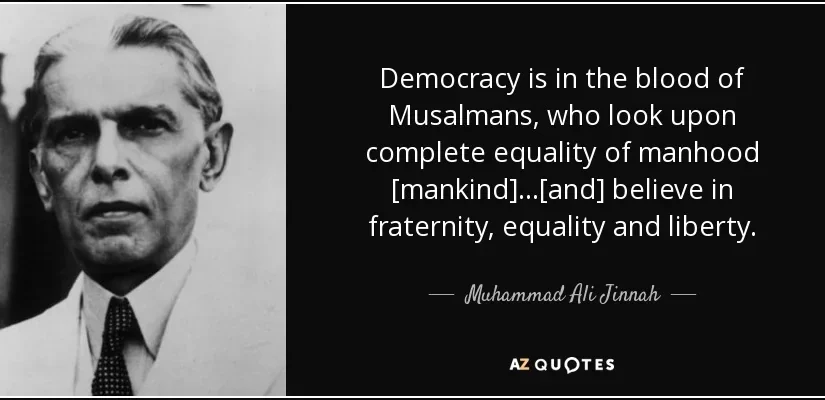
I would like Pakistan to be a secular democracy and give up its ambitions on Kashmir. Badshah
Badshah Sahib’s argument is novel: Pakistan should become a secular democracy and give up its claims to Kashmir. The implication is that this is the only path to normalcy.
Not a Carbon Copy
Pakistan was not founded as a copy of India with a different flag. It was conceived as a Muslim-majority polity with constitutional distinctiveness. Whether that distinctiveness should mean theocracy, secularism, or something hybrid is a political question for Pakistanis.
Similarly the core Hindu-Dharmic civilizational nature of India, that is Bharat, is for Indians to decide. Outsiders demanding secularism often mistake their own preferences for universal law.
The Iranian Example
Iran offers a comparison. It is not secular, yet it is not medieval. It combines elections, clerical oversight, and state bureaucracy. One may criticise its system, but it is coherent. Turkey tried aggressive secularism and is now reversing course. The Gulf monarchies combine monarchy and Islamic legitimacy. There is more than one model available to Muslim-majority states.
UK as a model
The deeper issue is institutional competence, not theological vocabulary. A state fails when its institutions are weak, its economy stagnant, and its elite extractive. It does not fail merely because it references religion in its constitution. The United Kingdom retains an established church. Israel defines itself religiously. India invokes civilisational identity. The presence of religious language does not determine state capacity.
The Centrality of Kashmir
The Kashmir question is similar. From Islamabad’s perspective, Kashmir is not a hobby but foundational to its national story. Expecting Pakistan to abandon it unilaterally is unrealistic. At the same time, perpetual confrontation has imposed costs. A state must decide whether symbolic commitments are worth material stagnation. That is a strategic calculation, not a moral lecture.
Integrating different streams
There is also a harder internal question. Pakistan’s territory contains deep civilisational layers that predate 1947: Indus Valley sites, Gandharan Buddhism, Sikh shrines, Hindu temples, Persianate courts. A confident Muslim state need not deny these layers. Integration of this inheritance does not weaken Islamic identity. It strengthens historical depth.
Uniquely Indus
A viable Pakistani model would not copy Tehran or Ankara. It would clarify its own hierarchy: civilian supremacy over the military, constitutional limits on clerical authority, predictable economic rules, and space for dissent within an Islamic framework. That would be an “enlightened” Muslim state in practical terms, not rhetorical ones.
False Dichotomy
The choice is not between secular democracy and permanent instability. The choice is between institutional reform and drift. Religious identity can coexist with pluralism if the rules are clear and enforced evenly.
Weak Governance
Pakistan does not need to renounce its self-definition. It does need to decide whether its ambitions are symbolic or structural. Ambition without reform produces stagnation. Reform without coherence produces chaos. The problem is not Islam. The problem is governance. If Pakistan wishes to demonstrate that a Muslim-majority state can be modern, prosperous, and self-confident, it will not do so by copying others. It will do so by building institutions strong enough that identity stops being the only thing holding the country together.
Pakistan is an ideological state–whether we like it or not. That ideology is the “Two Nation Theory”. The Pakistan Army is the official guardian of that ideology.
Whether that is good for Pakistan or not is a separate question. In reality, as long as aggressive Hindutva is on the rise in India, the TNT will remain the “ideology of Pakistan”.
India is of course free to re-write its constitution. Non Indians can’t do anything about that. However, as of today, secularism is a basic principle of the Indian constitution.
Bangladesh is another example. It was founded as a secular state but later on Islam was introduced as the state religion. Technically, a secular state cannot have a state religion. There is a confusion there that Bangladeshis need to sort out.
On the point about Pakistan owning its pre-Islamic history: I don’t think that our governments are against this history. Mohenjodero, Harappa, Taxila, Katas Raj etc are all promoted by the government as part of Pakistan’s history. Sikhs come every year to Nankana Sahab and Kartarpur Sahab.
I have consistently argued for Pakistan to own all the history that lies within our geographical boundaries.
yes interesting on Bdesh
The Kashmir Valley is the only part of J&K which has separatist tendencies.
Even that has died down a lot – the likes of Geelani are dead, Yasin Malik is in jail.
The population is aging and declining due to development. Lots of Kashmiris are movign to other parts of India.
This is the same thing that happened with Xinjiang and Tibet.
Also the population of Kashmir Muslims is like 6-7 million.
If Pakistan wants to jeopardize its future of 250 million people (and growing) it’s up to them.
But there is no Pakistani development without peace with India.
India is a far larger and important economy (which is growing larger and more important every passing day). Trying to keep up militarily will lead to a USSR like fate (who couldn’t keep up with the USA).
As long as Pakistani military is in charge, Pakistan will have anemic growth rates.
yes tbh I think borders should stay as they are.
I don’t think Pak is USSR
What we want and wish for is one thing, reality is another – both on the positive side in favor of Pakistan’s current borders, and the negative side, for the …fissiparous fault-lines that undeniably do exist.
Another point I’d like to make is that one should be a bit self-aware of not falling into the trap of ‘soft bigotry of low expectations’.
Why is it somehow ‘wrong’ to expect or want for Pakistanis to attain azaadi under a progressive modern day democratic governance model? Is that somehow a bad thing?
Or is it because such a desire coming from an Indian is seen as an “attack”?
The point is that non-Pakistanis have no locus standi in determining Pakistan’s internal affairs. That is for Pakistani voters through their elected representatives. There is no burning desire to replace the Islamic Republic or the Two Nation Theory. People are not out on the streets for this.
XTM has noted that non-Indians have no locus standi determining India’s internal affairs either.
You are free to have whatever opinions you wish but your opinion really doesn’t matter one bit when it comes to Pakistan’s internal affairs.
your ….”opinion on my opinion” is ..already well known on BP comment threads.
And your hypocrisy and hatchet-agenda when you try and pontificate on Indian ‘secularism’ as well.
Like I said, you’re free to have an opinion on Pakistan. I’m free to have an opinion on India.
But–if you’re at all intelligent– you will recognize that as a non-Pakistani you have no power to actually change things in Pakistan.
90% of Pakistanis are very happy with the Two Nation Theory. We don’t trust Indians to have our best interests at heart.
As for “hypocrisy” and “hatchet-agenda”: This is the pot calling the kettle black
Borders will of course stay as they are. Both India and Pakistan are nuclear states. Neither will stand for losing an inch of territory.
Technically, the LOC is a ceasefire line. It will only become a border if there is a diplomatic settlement between both countries.
A comment from a Pakistani poster on reddit:
The thing is, this is happening in EVERY FIELD. Just that it is not as publicly visible as cricket. Just to give one example, Microsoft is building billion dollar campuses in multiple cities in India. Search for ones in Noida and Hyderabad. Apple iPhone are now made in India. And not just that, every phone sold in India is made there. And this is not just assembling, but making components too.
India has 5G in entire country. Even rural areas. This means a smart kid in a village now has access to all the knowledge of the world. The result of just this one thing will be explosive when these kids come of age and enter job market, which will be about 10 years from now. And that will create growth similar to what happened in China.
Just like in Cricket, Indians gain experience working with the best international players of each industry, and that will result in exponential benefit over the years.
Logically Pakistan should have made a peace deal in 1999 with Vajpayee and Nawaz. That was the last time, an equal-power-equal-deal could have been possible. Musharraf ruined it. And after that India grew exponentially. Now, India will ask for concessions for any deal. In 20-30 years, it would be far worse.
Keep denying that India is increasingly becoming a Hindu majoritarian state just as Pakistan is a Muslim majoritarian state.
They are two sides of the same coin.
not exactly
You are free to disagree but plenty of analysts–for example Ramchandra Guha– have pointed out that India is becoming a “Hindu Pakistan”.
The only difference is that India remains–on paper– a constitutionally secular state. Pakistan is an Islamic Republic.
No honest person would choose to be an Indian Muslim or a Pakistani Hindu. Both are majoritarian states.
Except for the fact that there is no comparison with them.
Indian Muslims are like current day African Americans.
Pakistan Hindus are like Jews in 1930s Germany.
And just like African Americans live better lives than Black people in Black majority Africa, Indian Muslims will live better lives in India compared to Pakistan especially as the economies diverge.
No Indian Muslim ever got bombed while praying in a mosque which is a frequent occurrence in Pakistan.
The richest Muslims in the Indian subcontinent are Indian (Premji, Yusuff Ali, Yusuf Hameid).
The biggest known Muslim actors – again Indian, The Khans
The biggest known Muslim musicians – again Indian, AR Rahman
The best Muslim cricketers – again Indian, Mohammad Siraj
If you think about it, there is a very strong case to be made that Pakistan has indeed saved the subcontinent’s muslims – the ones who remained in India. The existence of Pakistan ..outsourced the fantasies of Islamic superiority and created a living failing example of how regressive ideas of religious superiority (a less polite word would be apartheid) simply aren’t viable in today’s day and age.
Before Pakistan could complete 25 years of existence, it carried out a genocide on its own populace.
In the 21st century, what’s left of Pakistan continues to be exploited – the average subcontinental muslim with a green passport instead of a blue one, is almost guaranteed a far better outcome across all facets of life.
you switched up blue and green by mistake, i assume
XTM has asked you to desist from using words like “genocide” for Pakistan
You cannot help yourself.
You are free to pretend that the Bangladesh genocide didn’t take place – do not presume that others have to kowtow to that Right wing Pakistani denialism.
“You are free to pretend that Kashmir is an integral part of India– do not presume that others have to kowtow to that Right wing Indian denalism”
“Genocide” is a political term. XTM is the admin of this blog. He has asked you to desist.
I’m not interested in a long back and forth with you. But if you attack my motherland, I will have to call you out on it.
“You are free to pretend that Balochistan is an integral part of India– do not presume that others have to kowtow to that Right wing Islamist Pakistani denialism”
LOL! Balochistan is not and has never been a part of the Republic of India. It is unequivocally a province of Pakistan. Kashmir is Disputed Territory.
@XTM: I take great offense to “Islamist”. This is slander.
What was Kalats status in the Raj?
Kalat was a princely state. There was also a Chief Commissioner’s Province of Balochistan which was part of British India.
https://en.wikipedia.org/wiki/Baluchistan_(Chief_Commissioner%27s_Province)
Kalat was forcibly annexed.
I’m not ‘attacking your motherland’ – acknowledging the genocide in Bangladesh is simply acknowledging reality.
“Genocide” is a political term. There was a civil war in East Pakistan and excesses were committed both by the Pakistan Army and by the India-sponsored Mukti Bahini.
I’m not interested in constantly re-litigating this.
Don’t be disingenuous. You know very well that the only reason you throw around the word “genocide” is to trigger the only Pakistani on this forum.
This is like saying that the firebombing of Dresden or the nuking of Hiroshima and Nakasaki somehow makes up for the atrocities committed by the Nazis and Imperial Japanese respectively (Holocaust, Rape of Nanking, Bataan Death March, etc.)
One thing happened before the other, and the first thing invited the second thing. Both in WW2 and in the 1971 war. Denying this is denying reality. (I’m not interested in playing word games over “genocide”, but the chain of responsibility of the events is crystal clear.)
This comparison with the Nazis is incredibly offensive to Pakistanis. XTM has asked the Indian commenters on BP to desist. There was a whole post on it.
I’m not disputing the events. However, in the Pakistani framing, it was a civil war in an undisputed part of Pakistan. Foreign intervention caused the secession of our sovereign territory. I understand India and Bangladesh see this as “liberation”. But you cannot seriously expect any patriotic Pakistani to ever adopt this framing.
Was not comparing Pakistanis to Nazis….it was supposed to be an analogy (of actions and counter-actions), which you clearly did not get.
“Which you clearly did not get”– Don’t condescend to me. It’s not appreciated.
Analogies comparing Pak Fauj to Nazis are incredibly offensive to patriotic Pakistanis. Don’t do that again.
Now be prepared to be hounded and repeatedly accused of calling Pakistanis Nazis. That’s the M.O. Its quite silly really.
.
Imposing “Pakistani framing” on a documented historical event is dishonest gaslighting. Which is pretty much your M.O.
Actual patriotic Pakistanis do openly acknowledge the war crimes committed by the PakMil in their name, and condemn them.
Until more Pakistani patriots step up and do the same thing for the hundreds upon hundreds of “non state actor” attacks hurled at India – not just J&K, but India – Disavow and condemn the murders and terrorism that was cynically deployed as a ‘war of a thousand cuts’ by the PakMil in their name – until this happens, we will not have the necessary ‘Truth and Reconciliation’ moment that is a pre-requisite for lasting real peace in the Indian subcontinent.
Until then, dishonest folks who choose loyalty to kleptocracies over their own citizens’ interests, will continue their feudal oppression of the Pakistani citizens.
Iran is in trouble
The fallout of Oct 7 continues. Hamas’s actions have led to a disproportionate response by Israel and its allies.
Closer to home, I’m………slightly concerned at the worst case ramifications of Munir’s capitulation and PakMil’s potential participation in Gaza.
Ayesha Siddiqa and many others have already documented the real risks of discord and even potential mutiny within. In such a scenario, another iteration of a Pahalgam would be a tempting option for the Failed Marshal, to yet again get a tribal circling of wagons at home.
“May you live in interesting times” is indeed a curse.
PakMil supporting US vs Iran might lead to Shia-Sunni split as well as Iran increasing support to Baloch groups.
You cannot impose Indian framing on this forum either. I will continue calling you out.
“kleptocracy” is offensive.
I’ve recognized that you are an anti-Pakistan troll. That’s why I’ve banned you from commenting on my threads.
Carry on.
And we have banned you from commenting on ours.
I’m enjoying the Royal We haha .. Touche Badshah Sahib
By any objective definition, PakMil’s domination of Pakistani governance is arguably kleptocratic. Every single ‘COAS’, ‘Chief Executive’ has been shown to be incredibly wealthy in dollar terms, while the country and its citizens languish in poverty and illiteracy.
That is a kleptocracy. If you find the truth offensive, I suggest you work on that for yourself. Attacking others isn’t the cope you think it is.
OK, we have already covered that a few Bollywood Khans do not make up for all the Muslims being lynched for eating beef etc.
I would much rather be part of a majority in any country than a member of the minority.
Pakistan has a Muslim president, PM, Army Chief. Muslims run the show.
In India, Hindus run the show.
Yeah, and being an “Islamic republic” does not make up for all the Muslims being bombed in their mosques during prayer.
The body count in the recent Islamabad blast is more than all these “lynchings” in India put together.
India has had Muslim presidents, Sikh PMs/army chiefs. Currently has CMs of all religions – Hindu, Muslim, Sikh, Christian.
Muslims are better off in India than Pakistan.
Get back to me when India has a Muslim prime minister! Never going to happen.
Where is the Muslim Chief Minister? If you are referring to Occupied Kashmir that’s not a part of India proper.
“The body count in the Islamabad blast”–
@XTM: He is again celebrating Pakistani deaths. Why did you make this person author?
yes it is very distasteful tbh; I have restored your Authorship as an offset.
Thank you.
Oh god, now more short stories about jamuns and mangoes.
You are free not to read my threads. I am free not to read yours.
What you can’t stand is that we now have equal status on this forum.
Aren’t you the one who had a tantrum and left (but returned with tail between legs) because I was made an author.
Even made a post about it lol.
You are an anti-Pakistan troll. I was well within my rights to protest you being made an author.
My tail is not “between my legs”. XTM realized my worth on this platform. I was ready to abandon it entirely.
Naah.
You are what in wrestling parlance is called a “heel”.
The commentariat enjoy beating you up and that drives views.
XTM attempts to keep balance on this forum.
“The commentariat enjoy beating you up”– You personally enjoy trolling me. Grow up.
So did we all. You are the right fit for this platform. Don’t listen to badshah ji 🙂
He is the one who was rejoicing in the “lynchings” in India.
A reminder that it is only in Pakistan where Muslims are bombed during prayers is making him chimp out.
I was not “rejoicing” in Muslims being lynched in India.
I find it deeply tragic that Pandit Nehru’s secular India is being turned into a Hindu majoritarian state.
Mosques have been attacked in other countries too–not just in Pakistan. Google is your friend.
You are being purposely dense again.
If Pakistan was suppose to be “Xanadu for Indian Muslims”, then how is it that between India and Pakistan, Pakistan is the country where Muslims are bombed during prayers?
And this is not even a one time occurrence.
Basically Muslims are a target in their holiest places.
@XTM: He is celebrating Muslim deaths again.
This is not on.
I can’t keep up
I am not “celebrating” Muslim deaths.
I am just pointing out just like Muslims are attacked for their identity in India, they face attacks for their identity in Pakistan – may not be for being Muslim, but for being Shia/Ahmadi.
This should not be happening in “Muslim Xanadu”.
ur language is unseemly
I just made a counterpoint to a point using real facts.
I didn’t “rejoice” in anything.
Don’t use unseemly language bro. Grow up. Stop the anti Pak trolling.
Learn to accept different opinions of Kabir.
Diversity is a strength.
Saying sorry makes you stronger.
Don’t attempt to speak for Shias.
I’m technically Shia.
Doesn’t change what I said, does it?
This is why I protested when he was made “author”. He cannot desist from being nasty when it comes to Pakistan.
If left unchecked, it will really impact this site’s intellectual credibility.
No it won’t. I’m just replying factually.
He is back to reposting his substack stuff instead of original stuff.
Is that the point of authorship?
I literally just wrote that review last night.
You are free to post as many things as you want. I can’t stop you.
Stop complaining like a child.
Brown Pundit is a collaborative space; I appreciate Kabir’s breadth of interests.
Thank you! This blogging site deserves talents like Kabir! Kabir adds so much intellectual heft.
Why does there need to be a Muslim PM when there has been a Sikh PM. Sikhs are an even smaller minority than Muslims.
Apart from J&K, other Indian states including Hindu majority ones have had Muslim CMs.
Why don’t you get back to me with a non-Muslim “anything” in the history of Pakistan – chief minister, prime minister, president etc.
Justice Rana Bhagwandas was Chief Justice of Pakistan in 2007.
Justice Alvin Robert Cornelius was Chief Justice of Pakistan from 1960 to 1968. He was Law Minister from 1969 until December 1971.
Once again, Google is your friend.
https://en.wikipedia.org/wiki/Rana_Bhagwandas
Again being dense on purpose. Give me a PM, CM, president.
If we go to justice, minister level we have dozens and dozens of muslims.
Salman Khurshid was “Law Minister”.
Mohammad Hidayatullah, Aziz Mushabber Ahmadi, Altamas Kabir were “Chief Justices”.
Plus these are the Muslim ones. There have been Sikh, Christian, Buddhist ones too.
Like I said.
PM, CM, President.
Do you genuinely not understand the difference between a constitutionally secular state and an Islamic Republic or are you purposely being disingenuous?
An Islamic Republic cannot have a non-Muslim PM, President or Army Chief. This is an internal matter of the Islamic Republic of Pakistan. We have never once claimed to be a constitutionally secular state.
.
Just because you write up something up in a “constitution” doesn’t make apartheid and religious discrimination somehow disappear.
You are being disingenuous. Otherwise, this is a very simple point.
Islamic Republics cannot be held to the standards of constitutionally secular states.
If India becomes a Hindu Rashtra, I will stop judging it by the standards of a constitutionally secular state.
You don’t know what “apartheid” means in English. I’m going to ignore your anti-Pakistan trolling. Keep making yourself look stupid.
stop this “body count” business, BB, or you will lose authorship. Kabir is right; it’s extremely distasteful
And how is he bringing up “lynchings” not extremely disrespectful?
It goes both ways.
Muslims have been bombed during prayers in only one country and that is a fact.
you know my point BB..
My point is even he is using “lynchings” to score points rather than have any concern for them.
It is fair game to point out that Muslims in “Muslim Xanadu” are worse off in many aspects compared to Muslims in “Saffron Mordor”.
I do not rejoice in lynchings. As far as I am concerned, even one Muslim being lynched is one too many.
Authorship is sacred. Use it responsibly.
I wish I had it but then I don’t write so well, so don’t deserve it. Don’t waste your talents badshah. Count your blessings.
There it is again, the hinduphobic refusal to be a part of a country where non-muslims “run the show”.
I don’t think that’s Kabir’s point to be fair
Why does it threaten you so much that the Muslim-majority provinces of BRITISH India–which was not a nation-state but a colony– chose to rule themselves instead of resigning themselves to being a permanent minority under Hindu rule? This is called the right to self-determination.
It’s not like we took land from Hindu-majority provinces to make Pakistan.
If the situation had been reversed and there were contiguous Hindu-majority provinces and the majority population were Muslim, you can’t seriously tell me the Hindu population wouldn’t have opted out.
You can call me a “Hinduphobe” all you want. This is again the pot calling the kettle black. It’s not productive.
I’m not interested in re-litigating Partition, but what would you get if you applied this same logic to the Hindu (and other) minorities in those Muslim-majority provinces? Maybe secular governments don’t live up to their standards, but making the religious affiliation of a country explicit (like Pakistan chose to do) results in qualitatively worse outcomes for minorities.
Yup, and they did. Hence Pakistan has a miniscule percentage of Hindus. Compare that to the percentage of Muslims in India.
My point is really not that difficult to understand. Why do so many Indians seem to think the very foundation of Pakistan is illegitimate? I get that psychologically some people feel that the formation of Pakistan and Bangladesh involved the “vivisection” of “Bharat Mata”. I don’t think you are in that category. So why this visceral aversion to the Muslim majority provinces of British India opting out of a Hindu-majority nation state?
Pakistan was founded as a homeland for the Muslims of British India. You may not think that that’s a valid choice but isn’t that an internal matter for Pakistanis?
You’re misunderstanding my second point. I’m offering a thought experiment. Suppose that the northwest of the subcontinent was made up of contiguous Hindu-majority provinces and the rest of the provinces were Muslim majority. In your view, would those Hindu-majority provinces have the right to opt out of the Muslim-majority nation state? If your answer is yes, than the same applies to the creation of Pakistan.
This comparison of percentages is disingenuous. Only two provinces (Punjab and Bengal) were divided. The vast majority of the Republic of India’s territory was not affected by Partition at all.
Punjab was ethnically cleansed (on both sides). Please make this argument to someone whose relatives didn’t have to flee Amritsar for Sialkot.
Because it is illegitimate.
Any country formed on such evil vile principles as Pakistan cannot be called a country.
Well, too bad for you Pakistan is a sovereign state recognized by the UN.
Carry on.
Well, Bangladesh is now as well.
There’s a third word using the same letters: “live”. Pakistan is the country for minorities to *live* in.
India is the SUCCESSOR state of British India.
No amount of cope changes that.
We are a civilizational state with thousands of years of history. You are like Taiwan – a rump state.
“threaten me?” I wasn’t even born then. Its history.
The American South also professed to fight the American civil war to protect their right to “self determination” and “states rights” – so that they could continue enslaving humans.
My position is simple – Pakistan was founded fundamentally on the desire to discriminate against non-muslims. Not to ‘protect’ muslims.
That is my personal subjective opinion. Just like its your personal opinion that muslims in India are somehow worse off than in Pakistan.
“Pakistan was founded to discriminate against non-Muslims”–
That’s a very misguided opinion. Pakistan was founded because a significant portion of the Muslims of British India didn’t want to live under Hindu rule. Had the situation been reversed, the Hindu-majority provinces would have opted out from Muslim rule.
Comparing Pakistan to the Confederacy is an anti-Pakistan opinion and is offensive.
The USA was a nation-state. BRITISH India was a colony. Those are two fundamentally different things.
“Muslims in India are somehow worse off than in Pakistan”– It is a fact that Pakistani Muslims rule ourselves while Indian Muslims are increasingly beleaguered minorities under Hindu rule.
Naah, Indian Muslims actually rule themselves because they get to vote who rules them – it’s called a democracy. I wouldn’t expect Pakistanis to understand.
Indian Muslims are also richer and well off with no danger of any harm coming to them during mosque prayers.
As the gap between India and Pakistan continues to widen into Mariana Trench proportions, this ….desire to be seen on an even platform the so-called… sem 2 sem – will become increasingly …facile.
You are free to disagree. Clearly your politics differs from Ram Guha’s.
But the point remains that today’s India is not a hospitable place for Muslims. Not under “Hindu Hriday Samrat”.
Pakistan has always seen itself as a homeland for Muslims.
Pakistan is not a ‘homeland for muslims’. It shut that door on even those hapless Biharis who fought for them during the liberation of Bangladesh.
Pakistan was arguably a project for the muslim elites to carve out and preserve a fiefdom free of competition from hindu elites. They cynically deployed religion to do this. A la 21st century Brexit.
Its quite telling how as the gap between modern day Ind/Pak grows across the spectrum of HDI metrics that the ‘cope’ in Pakistan gets increasingly shrill regarding TNT.
You don’t get to define our national vision for us.
We will always see ourselves as the homeland of the Muslims of British India.
The Bengali Muslims have their own country. It’s called Bangladesh.
You can see yourself as what you want – but it might not be what IS.
Pakistan is not what Pakistanis would like to believe it is.
Check this out.
https://www.brownpundits.com/2026/02/17/pakistan-the-sick-man-of-the-indian-subcontinent/
Yeah the Bengali muslims have their own country all right, After the Pakistan military tried and failed to keep them and quote “change their DNA” through rape.
Yes very tragic and upsetting – this was near genocide if not genocide (under the legal definition which does cover intent).
I’ve never defended the excesses committed by the Pakistan Army during the civil war in East Pakistan. Don’t put words in my mouth.
Secession is a red line for nation-states. Had Pakistan been nuclear armed in 1971, India wouldn’t have dared to intervene in East Pakistan, which was not a Disputed Territory (like Occupied Kashmir) but an unequivocal part of Pakistan.
If Pakistan had nuclear arms, even then 93000 of your soldiers would have surrendered.
Our brave Bengali brothers wanted to overthrow the oppressive genocidal Pakistani army and as upholders of dharma, it was India’s duty to assist them, nuclear annihilation be damned.
Sure. India wouldn’t have dared to try to break a nuclear armed Pakistan.
They would have. Just like they dared to bomb nuclear armed Pakistan last May.
Joy Bangla!!!
You all were forced into a ceasefire in four days. By President Trump.
But don’t let that stop your anti-Pakistan trolling.
Pakistan Zindabad!
.
It is……notable how even educated Pakistanis prefer to regurgitate propaganda rather than be honest about the overtly obvious outcomes of the 88 hour skirmish.
I mean, I do have a couple of Indian friends who are staunchly one-eyed and refuse to accept that Indian planes were shot down during Op Sindoor. I laugh at them just as I laugh at the silly Pakistani proclamations of ‘victory’ by the failed marshal.
https://youtu.be/RB4KUCT8hro
India lost 2-3 jets at max and only 1 Rafale, not 5-6-7 whatever number Pakistanis like to quote.
India literally flew one of the Rafales claimed to be shot down using photoshopped images on Republic Day.
India hit 11 PAF bases and 9 terror hideouts on two separate days. A Pakistani AWACs got hit also in one of these strikes. Pakistan’s Operation Baniyan Chaddi failed to hit anything.
yes everybody knows this, including Pakistanis. Its just….I fail to understand why and how even educated Pakistanis are able to manage the mental gymnastics required to buy into the “we defeated Endia” chooran
I don’t think Pakistan defeated India but it seems Pakistan has done well in a post-Pahalgam environment.
Not any longer.
Trump got them on board the Gaza police thing.
India got FTA. Pak got a visa ban.
Not to mention EU FTA, France/Russia deals, China softening.
India is big ticket. Pakistan has an economy smaller than Romania.
Getting Munir to play mall security in Gaza under Israeli command is one thing, how will he handle it when the murmurs of discontent get louder within his ranks?
There is a non-trivial risk of another Pahalgam here. Not aligned with what’s good for Pakistan or India, but the kleptocracy’s calculations and incentives are markedly different.
India should be less selective about choosing Brahmos targets then.
you keep saying this, but I don’t see concrete facts supporting this hypothesis.
As I have pointed out earlier, Pakistan’s temporary recall from geopolitical ostracization is much more driven from its utility in the middle-east for American and Israeli policies in the aftermath of Oct 7th.
Co-relating it to ‘post-Pahalgam’ optics is….spurious.
I don’t know but the environment has markedly improved
“whatever number Pakistanis like to quote”–
How many jets has President Trump claimed were shot down?
How many INDIAN jets has he claimed were shot down, bhaijaan?
Give me a quote where he says “X INDIAN jets were shot down”. Any quote.
This just proves that you have casualties on your side too, haha.
.
“Failed Marshal” is incredibly offensive. I don’t stand for Pak Fauj being insulted.
You don’t understand that for Pakistan successful deterrence against India is what counts as “victory”.
Pak Fauj is a genocidal force who are comparable to Nazis for what they did to the Bangladeshis and what they are doing to the Baloch now.
Don’t expect non Pakistanis to toe the line.
I know you have to, in case a black Vigo comes approaching.
Genocide is a legal term
Only in Pakistan do losers get to promote themselves.
What actual specific achievement did Munir crown himself “Field Marshal”?
The Field Marshal successfully deterred our enemy’s “Operation Sindoor”.
Don’t you are dare insult Pak Fauj.
sometimes, I think you just might be an AI bot playing a caricature ‘role’ on these threads.
The same can be said for you. ChatGPT can write your anti-Pakistan responses. “Kleptocracy”, “Nazis” “Genocide”.
Stay in your lane. I am not interested in ever interacting with you again.
yes I do agree those terms are loaded
You were the one who went begging to Trump for a ceasefire when you realized your missiles could not penetrate Indian AD while getting Brahmosed.
yes Indira and India did well there; they stepped in for the cause of Good.
The point remains that had India and Pakistan been nuclear armed in 1971, East Pakistan would still be part of Pakistan. The creation of Bangladesh is what caused ZA Bhutto to double down on making sure Pakistan became a nuclear power.
The secession of East Pakistan–especially India’s role in it– remains deeply triggering for Pakistanis.
“Independence” of Bangladesh.
Do you know English? There was no “Bangladesh” prior to 1971. Creation is the correct word.
There was no “Pakistan” prior to 1947.
Who said there was?
“Creation” of Pakistan in 1947 is correct English just as “creation” of Bangladesh in 1971 is correct.
What is it that they say in the backstreets of London? If my auntie had balls….
you have a very funny way of “not defending” the “excesses” of the Pakistan army then – by aggressively hurling personal insults at anybody who dares bring it up.
I object to the use of the word “genocide”– as any patriotic Pakistani would.
As for “personal insults”, you used crude and sexualized language like “hate boner”. Don’t play the innocent with me.
Never used that with you, and don’t be such a snowflake 🙂
The point is that people who use crude and sexualized language in the public sphere have no business complaining about “personal insults”.
Do not ever engage with me. If you are nasty to me, I will be 100% times nastier to you. Buzz off.
.
genocide is legally defined.
are we really going to split pedantic hairs on the Bangladesh genocide?
The only reason you throw around that word is to trigger Pakistanis.
XTM has asked you to desist.
Again this sem2sem mentality when reality is different.
Just outright lying going on now.
An article for you –
https://www.brownpundits.com/2026/02/17/pakistan-the-sick-man-of-the-indian-subcontinent/
Developmentally, “Hindu Iran” might be the better analogy for India. Apparently, India’s current per capita GDP is roughly equivalent to where Iran’s was in the year 2000, approximately 20 years after the Islamic Revolution. The current management in India has been in power for nearly 12 years.
https://data.worldbank.org/indicator/NY.GDP.PCAP.PP.CD?end=2024&locations=IR-IN&start=1990&view=chart
Except for the fact that India is not under sanctions like Iran and integrated with the global economy. You can see the weird fluctuations in the image you have given already.
I’d say more like a “Hindu Malaysia” and India will reach that level in 25 years, of course with 50 times more people.
https://data.worldbank.org/indicator/NY.GDP.PCAP.PP.CD?end=2024&locations=IR-IN-MY&start=1990&view=chart
I’m not bothering with your anti-Pakistan trash.
Carry on.
https://www.brownpundits.com/2026/02/17/pakistan-the-sick-man-of-the-indian-subcontinent/
Absolutely internationalism is going 10x India.