
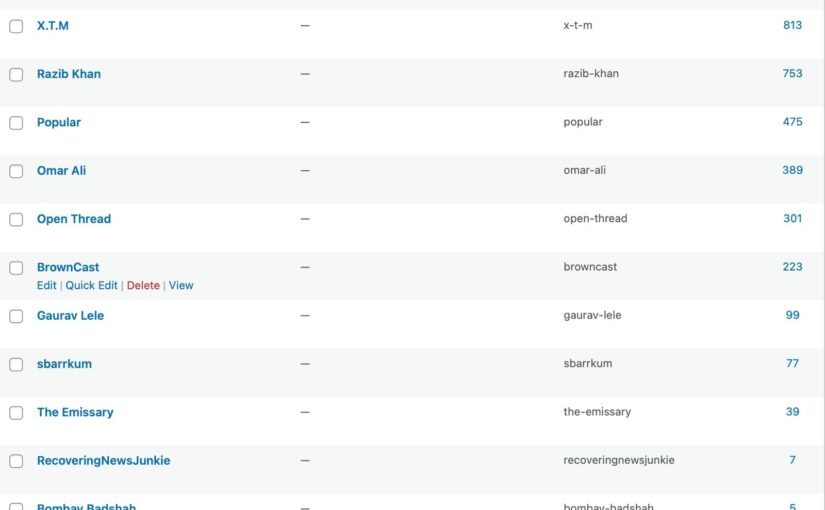
A small administrative note that matters more than it sounds. Brown Pundits now has 3,920 posts. Every single one is categorised. There are no uncategorised posts left. The entire archive is structured.
That is not glamorous work. It does not trend. It does not go viral. But it is the difference between a website and a timeline. Writing is not just producing new content. It is tending an intellectual garden. Adding categories, refining tags, standardising slugs, back-tagging fifteen years of material; this is not clerical labour. It is editorial discipline. It forces you to reread your own history. It reveals patterns. It exposes gaps. It shows where the site has been narrow and where it has been expansive.
Substack has made everyone an author. It has not made everyone an editor. Most platforms reward velocity and outrage. The incentive is to post faster and louder than the next person. Community becomes an audience. Conversation becomes branding. Writers become marketers. We are structured differently.
Different Eras of the Internet
Brown Pundits sits awkwardly between eras. The first decade of the internet was forums. The second was blogging. The third became algorithmic social media. The fourth is newsletter platforms that feel independent but are still parasitic on social feeds. We are a product of the second era. A blog with comment threads. A living archive. Not a feed.
Indexed by Google News
That difference matters. When posts are indexed, searchable, and cross-referenced, they accumulate weight. We are indexed by Google News. That is not trivial. It means the archive is legible beyond our immediate circle. It also means responsibility. Loose writing becomes permanent record. Back-tagging 3,920 posts is not busywork. It is institutional memory. It is, in a modest way, building a JSTOR-lite for fifteen years of South Asian argument. Not a platform chasing virality, but a catalogue preserving debate.
Newer Authors like BB & RNJ
What is also changing is the pipeline. New contributors are widening the field beyond the Indo-Pak core: sport, culture, arts, regional issues. That is how audiences grow; not by chasing controversy, but by layering coverage. The comment threads can be fiery. That is part of the tradition. But the mainline posts tend to converge toward clarity. We are not viral hunters. We are custodians of a conversation that has outlived several internet cycles. Archives are slow power. And for the first time since inception, ours is fully ordered.