
In the context of recent discussions on Indian and Pakistani music, I am cross posting this essay on Kabir Oral Traditions. It is important to remember that–despite the political tensions between India and Pakistan– there is a common culture that unites people. This essay was originally submitted as part of the coursework for my M.Mus degree in Ethnomusicology from SOAS University of London.
Bhagat Kabir (c. 1440-c. 1518) is considered one of the major poet-saints of the Bhakti movement—a social reform movement arising in North India around the fifteenth century. Characterized by an emphasis on the individual believer and a disregard for caste and gender taboos, the movement often rejected Vedic rituals and focused on the individual’s loving relationship with a personally defined god. This emphasis on love has clear parallels with Sufism, often seen as the mystical branch of Islam. It also later influenced Sikhism.
In contrast to other Bhakti poets such as Surdas and Meerabai—whose works can be placed squarely within the Hindu fold, often addressed to particular gods such as Krishna—Kabir’s poetry cannot be so neatly demarcated. He questioned the rituals of both Islam and Hinduism and was devoted to a nirgun (formless) deity, often addressed as “Ram”. According to Professor Harbans Mukhia: “In place of Allah and Ishwar he conceptualized a single universal God; in place of denominational religions he conceptualized a universal religiosity” (Mukhia 2018). This distance from the orthodoxy of both traditions perhaps explains why Kabir is revered by Hindus and Muslims across the Indian subcontinent. Some of his poetry is even included in the Guru Granth Sahib, Sikhism’s holiest scripture. In an era in which South Asia has experienced increasing polarization along sectarian lines, it is instructive to more closely examine this unique figure who served as a bridge between communities.
In her article “Kabir’s Rough Rhetoric”, Professor Linda Hess notes that Kabir can be described as the most personal of the Bhakti poets. While Surdas and Meerabai primarily address God, Kabir mainly addresses the reader or listener. The phrase “Kahai Kabira suno bhai sadho” (Kabir says listen sadho) “signifies Kabir’s passion to engage, wake people up, to affect them” (Hess 1987: 147). His poetry is full of provocations, which often take the form of questions “designed to ruffle us up or draw us out” (149).
In this essay, I will discuss performative traditions of Kabir poetry in India and Pakistan, focusing on how it has been included in the folk music of both countries. Of particular interest are the ways in which Kabir poetry serves as a means of Dalit—formerly known as “untouchable”—caste assertion and how it can be combined with the poetry of Sufi saints.
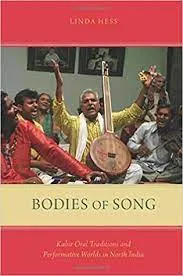
One of the contemporary Indian singers most associated with Kabir is Prahlad Singh Tipanya. He was a key part of Dr. Hess’s ethnographic fieldwork as described in her book Bodies of Song: Kabir Oral Traditions and Performative Worlds in North India (Oxford University Press 2015). Prahladji and Dr. Hess have also been involved with the Kabir Project, started by filmmaker Shabnam Virmani. His rendition of “Kahaan Se Aaya Kahaan Jaaoge” (Where have you come from, where are you going?) serves as an example of some of Kabir’s typical themes and of the style of folk performance in Malwa, a region stretching from western Madhya Pradesh into southeastern Rajasthan and Gujarat (Hess 2015: 11).
Prahladji sings while accompanying himself on the tambura. He is also accompanied by a second singer, manjira, dholak and violin. The performance begins with a doha, unaccompanied by the dholak. This significantly includes the lines “If you say Hindu, I’m not that. Muslim? Not that either. Both hold hidden truth. I play in both.” This encapsulates how Kabir refuses to be confined by any particular religion. The dholak then enters as Prahladji sings the refrain: “Where have you come from? Where are you going? Get the news from your body”. The next verse of the bhajan refers to the delusions of both Hindus and Muslims as well as how various communities such as yogis and sheikhs are “lost in greed”. The poet then goes on to criticize the hypocrisy of the Qazi (the representative of Islamic law) and the Pandit (who represents Hindu orthodoxy) before concluding with Kabir’s signature line and reminding the audience of the need to be aware of one’s own body. This bhajan thus emphasizes the need for a personal relationship with god and contrasts it with the ritualism of the Pandit and the Qazi.
Prahladji’s attraction to Kabir’s poetry—with its emphasis on a nirgun deity—can perhaps be partially explained by his status as a Dalit. Sagun bhakti requires physical images of divine beings, usually housed in temples. Because of their caste status, Dalits have traditionally been excluded from these temples. Hess notes that when Prahladji sings a song that criticizes faith in statues “we detect an extra bite in the words. First, there is the basic delusion that God is to be sought outside oneself. Second, there is the bitter collective memory of being treated as tainted, unfit to approach that exalted statue” (Hess 2015: 42). Nirgun poetry thus serves as an agent of liberation from oppressive social structures.
Kabir’s poetry not only transcends caste boundaries, but religious boundaries as well. Hess notes that Muslim singers in India and Pakistan often sing Kabir’s verses in Sufi musical styles (Hess 2015: 5). They also combine these verses with those of various Sufi saints. An example of such a combination can be seen in the performance of Mir Mukhtiyar Ali, a Rajasthani folk singer from the semi-nomadic community of Mirasis, a caste traditionally associated with music (kabirproject.org). In his rendition of the bhajan “Moko Kahan Dhoonde Re Bande” (Where do you seek me?), performed as part of the 2016 Rajasthan Kabir Yatra, Mukhtiyar Ali juxtaposes Kabir with Bulleh Shah (1680-1757), a Punjabi Sufi saint and philosopher whose works often question Islamic rituals. The combination of the two poet-saints is interesting as it reflects the similarities between the Bhakti movement and Sufism. It also underscores how difficult it is to narrowly confine Kabir and other saints within the boundaries of one religion, however much some may want to do so.
Mukhtiyar Ali is accompanied by harmonium, sarangi, tabla and dholak. He begins his performance by singing a doha from Bulleh Shah, in which the poet contrasts the text-based knowledge of the religious scholar (aalim) with the lack of inner knowledge. The translation is as follows: “[He] Read a lot and became a scholar/ But [he] never read himself/ [He] enters into the temple and mosque/But [he] never entered into his own heart” (“Bulleh Shah | Sufi Poetry | Page 2” 2009). Mukthiyar Ali then sings a second doha from Kabir which expresses similar thoughts.
Following the juxtaposition of the two poet-saints, the singer begins the bhajan itself. In this bhajan, Kabir speaks from the perspective of the deity and asks the worshiper “Where do you seek me?”. He then states that god is not found in either the temple or mosque, nor in the Kaaba or in Kailash—the holiest places of Islam and Hinduism, respectively. The next stanza goes on to state that god is not found through fasting or renunciation. Mukhtiyar Ali than breaks off the song to comment that fasting is a “stunt” which, according to Kabir, displeases god. This is in sharp contrast to the orthodoxy of both Islam and Hinduism, in which ritual fasting is required on certain holy occasions. He then concludes the bhajan with Kabir’s signature line and the message that God is found in faith (vishwaas).
Kabir is also sung in Pakistan, where his poetry is rendered in styles often associated with Islamic genres of music such as qawwali. This is exemplified by Ustad Farid Ayaz, an acclaimed qawwal from Karachi who belongs to the 700-year-old “Qawwal bachon ka gharana” of Delhi, said to be founded by Amir Khusrau, a disciple of the thirteenth century Chishti saint Nizamuddin Auliya (kabirproject.org). In his performance of “Bhala Hua Mori Gagari Phuti” (I am glad that my clay pot has shattered), Ustad Farid Ayaz renders Kabir’s poetry in qawwali style. As is typical of qawwali, he is accompanied by other singers, two harmoniums, and dholak. The poetry can be translated as follows: “Glad that my earthen pot broke, I am now relieved of the task of filling water. Glad that my prayer beads snapped, I am now relieved of the task of praying” (Rabe 2015). As seen above, this rejection of ritual is typical of Kabir. In between verses, Ustad Farid Ayaz explains the message of the song to the audience and explicitly relates it to Sufism.
Although orthodox interpretations of Islam generally frown on music, it plays a central role in many South Asian Sufi traditions. In her study Sufi Music of India and Pakistan: Sound, Context and Meaning (Oxford University Press 2007), Regula Qureshi discusses the concepts of zikr (the reciting or recollection of God’s name) and sama’ (listening to mystical music). This music normally includes the use of instruments, particularly percussion, an element which makes it controversial among more orthodox Muslims, including members of some Sufi orders. Qureshi defines qawwali as “sama’ realized in practice: mystical poetry is set to music and enhanced by a powerful rhythm as well as by repetition so as to suggest zikr”. She argues that qawwali arose when the Sufis arrived in India and realized how central devotional music was to Hindu traditions. The need to broaden the appeal of Islam led to a special emphasis on sama’. The Sufis began composing poetry in local languages such as Hindavi and later Urdu, which was sung using the North Indian ragas (Qureshi 2007: 82-83). In this way, qawwali exemplifies the syncretic Indo-Islamic culture.
In conclusion, Kabir’s poetry is performed across South Asia. Because his work rejects the orthodoxy of both Hinduism and Islam, it cannot be solely appropriated by either religious community. His emphasis on nirgun bhakti also appeals to the Dalit community, which uses his compositions as a means of caste assertion. His work is also often incorporated into Islamic musical genres such as qawwali. In an increasingly polarized subcontinent, it is important to highlight inclusive figures such as Kabir. By doing so, it is possible to focus on what unites rather than divides us.
References
ajab shahar-kabir project. 2015. “‘Kahaan Se Aaya Kahaan Jaaoge?’ by Prahlad Tipanya.” YouTube.
“Bulleh Shah | Sufi Poetry | Page 2.” 2009. WordPress.Com. Sufi Poetry. https://sufipoetry.wordpress.com/category/bulleh-shah/page/2/.
Creswell, Robyn. 2019. “An Enthusiastick Sect.” New York Review of Books, March 7, 2019.
“Farid Ayaz | the Kabir Project.” 2019. Kabirproject.Org. http://www.kabirproject.org/profile/farid%20ayaz.
Hess, Linda. 1987. “Kabir’s Rough Rhetoric.” In The Sants: Studies in a Devotional Tradition of India. Delhi: Motilal Banarsidass.
———. 2015. Bodies of Song: Kabir Oral Traditions and Performative Worlds in Northern India. New York: Oxford University Press.
Mukhia, Harbans. 2018. “Kabir in His Time, And Ours.” The Wire. https://thewire.in/religion/kabir-in-his-times-and-ours.
“Mukhtiyar Ali | the Kabir Project.” 2010. Kabirproject.Org. http://www.kabirproject.org/profile/mukhtiyar%20ali.
Qureshi, Regula. 2007. Sufi Music of India and Pakistan: Sound, Context and Meaning in Qawwali. Oxford: Oxford University Press.
Rabe, Nate. 2015. “Kahat Kabir: Five Musicians Inspired by the Mystical Poet Philosopher’s Simple Lyrics.” Scroll.In. Scroll.in. March 22. https://scroll.in/article/715275/kahat-kabir-five-musicians-inspired-by-the-mystical-poet-philosophers-simple-lyrics.
Rahaman, Mehedi. 2018. “Bhala Hua Mori Gagri || Best Version || Farid Ayaz Abu Mohammad.” YouTube.
Rajasthan Kabir Yatra. 2018. “Moko Kahan Dhoondhe Re Bande- Mir Mukhtiyar Ali #RajasthanKabirYatra.” YouTube.
P.S. I have also recorded Kabir’s bhajan “Mo Ko Kahan Dhunde Bande”. My version is set in Raga Bhairavi. It can be listened to here
