Capsule Review: Homeland Elegies by Ayad Akhtar

This is a very well written book and Ayad Akhtar has clearly come a long way from his debut novel (American Dervish) in terms of style and writing skill. The story is OK but did not really work for me. The book is said to be semi-autobiographical and I found that hard to get past. Is this his story or not? We are not supposed to ask that question, but somehow i kept getting stuck on it (perhaps because I have lived in Brookfield and have some vague notion of where he is from). But mostly I was disappointed by the narrator’s somewhat sophisticated but still very “inside the bubble wokeness”. He presents himself as someone willing to “go there” and talk about (and intelligently criticize/analyze) everything but it turns out that he is skeptical of everything but “super-elite wokeness”, which he seems to accept as just the not-so-simple truth about our world. I expect that well-off second generation desi kids will identify with a lot of what the narrator goes through (real or imagined) but that seems to be a rather narrow demographic. For the rest of us, the insights are less than advertised.
Still, he is, as you might expect from Ayad Akhtar, ready to get into hot topics (including Islam, oral sex, parent problems, racism) with all guns blazing, which can be fun. And his summary of partition and Pakistan is pretty good, and some of the other essay-like digressions (such as his explanation for the ills of late capitalism and what Robert Bork had to do with it) are also interesting; whether they are true (or useful) is not equally clear. if you are a second generation desi or are so intensely woke that think-pieces in “The Guardian” generally seem wise to you, then this is your book. But even if you are not, it is worth a quick read.

Clash of two Jats in the Indian army

From Dr Hamid Hussain

Many folks asked me about recent news item about conflict between two senior Indian army officers.  It was simply personality clash & nothing significant.  However, pedigree of both officers and some interesting historical facts were too tempting for the story teller like me.

Regards,

Hamid

Clash of Two Jats

Hamid Hussain

Recently, conflict between General Officer Commanding-in-Chief of South- Western Command (Sapta Shakti) of Indian army Lieutenant General Alok Singh Kler and his Chief of Staff (COS) Lieutenant General Kamal Kumar Repswal became public.  Chief of Army Staff (COAS) General M. M. Naravane ordered a Court of Inquiry (COI) and Respwal was posted out as COS of Eastern Command. The nature of conflict is not clear, but some suggest that it relates to command decisions and administrative matters.  There is no evidence that there was any financial irregularity or moral lapse. Continue reading Clash of two Jats in the Indian army

Book Review: The Wellington Experience

Book Review – The Wellington Experience: A Study of Attitudes and Values Within the Indian Army by Colonel ® David O. Smith

 Hamid Hussain

David Smith’s book The Wellington Experience is a detailed study of Indian army’s prestigious Command & Staff College that trains armed forces officers for higher ranks. This book is based on interviews of American army officers who attended Command and Staff College at Wellington in India spanning over four decades. Foreign Area Officers (FAO) of US army spent a year at Staff College.

Colonel David Smith is familiar with Indian and Pakistan armies in view of his professional background.  He has been a South Asia hand at Pentagon and Defence Intelligence Agency (DIA) for over two decades. In his professional career, he interacted with number of Indian officers and familiar with the terrain.

This study looks at functioning of Staff College and evolution of its curriculum to train Indian armed forces officers for higher ranks. It also looks at professional and social attitudes and threat perceptions of Indian officers.

The major conclusions of the study are conventional thinking, adhering to staff college solutions to problems, lackluster attention to joint operations and ambiguity about China. However, the most crucial finding is lack of understanding of nuclear dimension of future conflicts with Pakistan. This factor has been noted by other observers of Indian army.  In the aftermath of devastating terrorist attack in Mumbai in 2008 by Pakistan based militant group Lashkar-e-Taiba (LeT), the shocked Prime Minister Manmohan Singh asked his National Security Advisory Board for options. Ministry of Defence (MOD) Simulation and Wargaming Center suggested a surgical strike on training camps of LeT in Pakistan controlled Kashmir. Prime Minister asked what was the probability of a Pakistani response? The army officer said around 75-80%. Prime Minister then asked what is the probability that these attack-counterattack dynamics leading to Pakistan escalating to nuclear counter-strike? The officer replied about 30%.  Political leadership stopped right there as it was too high a risk.

Smith’s work provides an outside perspective of training of Indian army officers at mid-career level and attitudes of officers.  It is perspective of a little over two dozen American officers who spent only a year at one institution.  It is supplemented with input from US government officials and US Defence Attachés in Delhi.  This is main limitation of the study.  US officials and officers view India and its neighborhood through American security interests while India has a different take on security challenges of its neighborhood.  Despite such limitations, it is a very methodical and in depth evaluation of existing instructional norms and pointing to areas of improvement for training of officers for higher ranks.

This study confirms what many observers of Indian army know that conventional thinking is the bedrock of Indian army culture.  Unorthodox thinking and critical evaluation of existing doctrines is discouraged, and curriculum and training encourage conformism.  It provides a window to otherwise opaque world of Indian military officer corps training.  This study can be valuable if Indian high command sees it as a friendly criticism of weaknesses of an eminent teaching institution.  Dynamic institutions improve by introspection and course correction.

David O. Smith.  The Wellington Experience: A Study of Attitudes and Values Within the Indian Army (Washington D.C: Stimson Center), 2020

Acknowledgements: Author thanks input from many informed individuals well informed about the subject matter. 


Hamid Hussain

coeusconsultant@optonline.net

24 January 2021


Defence Journal, February 2021

Browncast: Keerthik Sasidharan, author of The Dharma Forest

Another BP Podcast is up. You can listen on LibsyniTunesSpotify,  and Stitcher. Probably the easiest way to keep up the podcast since we don’t have a regular schedule is to subscribe at one of the links above.

Would appreciate more positive reviews!

In this episode I talk to Keerthik Sasidharan, an author and columnist whose debut book “The Dharma Forest” just came out in India in December 2020. Release in the US is awaited. We talk about his book, the Mahabharata, Indian tradition and whatever comes to mind.. Image result for keerthik sasidharan

The Dharma Forest

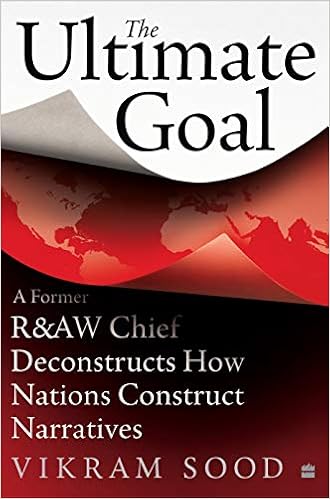
Capsule Review: The Ultimate Goal by Vikram Sood

Sood, Vikram. The Ultimate Goal: A Former R&AW Chief Deconstructs How Nations and Intelligence Agencies Construct Narratives (p. 22). HarperCollins Publishers India. Kindle Edition.

The author is an intelligence professional who was the chief of RAW, but the book has nothing to do with RAW; it is mostly a description of how great powers generate and propagate their national narratives and why India can and should do the same. Fans of Noam Chomsky will be pleasantly surprised to find many familiar themes when discussing Western narrative building, though I assume most leftists will react less positively to the Indian portion, labeling it as at least mildly “sanghi”. In any case the book is always interesting because it is chock full of interesting anecdotes and nuggets of information (for which the author provides appropriate footnotes). Whether you agree with the somewhat Machiavellian (for lack of a better word) analysis, you will still get to read some fascinating stories. it is also well written and professionally edited. Well worth a read.

For a flavor of the book, see the following excerpts:

That message must be indigenous and not borrowed. India, too, as it becomes a bigger player on the world stage and given its civilizational history, must have its own narrative, its own version of history and values. Respect comes from not only the way a country wields its strength, tackling both the stronger and the weaker, but also from how it tells its story.

when Nixon and Kissinger were making overtures to Mao Zedong, and Rockefeller wanted to get Chase Manhattan an entrée into China. Rockefeller sought Kissinger’s advice, who suggested that the former get in touch with Huang Hua, China’s permanent representative at the UN, to get permission to enter China. Eventually, one fine day, a Rockefeller representative handed over a bag containing US$ 50,000 in cash at the Roosevelt Hotel to Huang Hua. No receipts were necessary and, soon after that, the Chinese mission opened an account with Chase Manhattan. Rockefeller was able to make several trips to China,

There would inevitably be conspiracy theories about these groups, but the fact is that the rich and powerful need a common and exclusive shelter for safety and networking. The CFR and TC, as well as others, fulfil this role. The superclass and these organizations draw strength from each other, and this need not be conspiratorial beyond the obvious of protecting and enhancing their turfs. The rich and the elite give these organizations an aura, where they mingle with the high and mighty from the government and being a member of these organizations enhances the exclusivity of the superclass. This is also where the power of the ‘revolving door’, which enables lateral movement from crucial departments of administration and the legislature to appropriate corporate slots and vice versa, during changes of government, is apparent.

The Trilateral Commission was more an exclusive elite club of powerful men and women who ran the world and were citizens of the United States, Europe and Japan. They were politicians, corporate heads, former and would-be presidents of the US, senior cabinet ministers, heads of intelligence, World Bank governors, strategic thinkers, media heads backed by the might of those like David Rockefeller and his favourite strategic thinker of the day, Zbigniew Brzezinski.

Soon after the fall of Baghdad, Rumsfeld rushed there as a conqueror to congratulate and thank the troops. He praised the armed forces as photographs appeared of rapturous Iraqi crowds pulling down Saddam’s statue in Firdos Square in celebration of their ‘liberation’. The truth was that the US army’s psychological warfare unit had hired some Iraqis to remove the statue.

The story of Russia’s political warfare unfolds with Donald Trump’s announcement on 16 June 2015 from Trump Tower, New York, that he would be contesting the next presidential elections. Many Americans received this news with misgivings and others with derision. One newspaper even ran with the headline ‘Clown Runs for Prez’.23 His countrywide rating was abysmal, and he had to pay audiences to show up at his rallies. No one really gave him a chance at making it even to the nomination as a Republican candidate. That day in 2015 was probably also the day that the final phase of Russian active measures moved from a low gear to full throttle.

Sood, Vikram. The Ultimate Goal: A Former R&AW Chief Deconstructs How Nations andIntelligence Agencies Construct Narratives (p. 131). HarperCollins Publishers India. Kindle Edition.

Browncast: Akshay Alladi, Indian Conservative

You can listen on LibsynAppleSpotify, and Stitcher (and a variety of other platforms). Probably the easiest way to keep up the podcast since we don’t have a regular schedule is to subscribe to one of the links above!

In this episode we talk to Akshay Alladi, an Indian conservative. We talk about what it means to be an Indian conservative and Indian cultural and political issues in general. Check it out.

Browncast: Tim Mackintosh Smith, author of “Arabs”

You can listen on LibsynAppleSpotify, and Stitcher (and a variety of other platforms). Probably the easiest way to keep up the podcast since we don’t have a regular schedule is to subscribe to one of the links above!

In this episode (split into two parts) we talk to Tim Mackintosh Smith, author of “Arabs; a three thousand year history of peoples, tribes and empires“. We talk about his book and about Arab history and contemporary reality. Check it out..

Travel Writer Tim Mackintosh-Smith on Why Seventh and Eighth Graders Should Read These Classic Arabic Travel Tales – ArabLit & ArabLit Quarterly

Review: Advent of the Algorithm

An old review I wrote (back in 2002) for the magazine Herald.
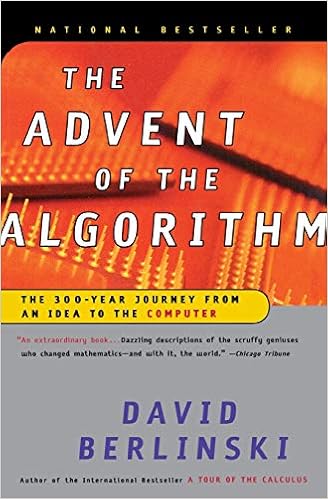
” The algorithm is …the second great scientific idea of the West. There is no third.”

This sentence at the very beginning of the book should warn us that this is not going to be science writing in the Asimov vein. Dr. Berlinski once boasted that he can be accused of many things, but shrinking from controversy is not one of them. A professor of mathematics, a novelist, something of a poet and the successful author of “a tour of the calculus”, Dr. Berlinski is also famous for his very public insistence that Darwinian evolution does not add up; that something is missing from the story and the high priests are engaged in a cover-up. In “the advent of the algorithm” he sets out to tell us about the algorithm: “a procedure, written in a symbolic vocabulary, that gets something done step-by-step without the need for any intelligent assistance”. But he ends by questioning the ability of science to explain the mind: the intelligence that fashions and uses these algorithms and infuses them with meaning.

The book begins and ends with Gottfried Leibniz. Between inventing the calculus, imagining the monads and carrying out his diplomatic duties, Gottfried Leibniz also laid the foundations of mathematical logic and the science of computing. He is followed by Guiseppe Peano, Gottlieb Frege, George Cantor and others, till we get to the great David Hilbert and his challenge to mathematicians to show that mathematics is consistent, complete and decidable (in principle, if not in practice). Within a few years, Kurt Godel was able to show that this is not possible. After an explanation of Godel’s revolutionary result, Alonzo Church, Alan Turing, Emil Post, Claude Shannon and others are introduced and the reader learns about the developments in logic and mathematics that form the foundations of our modern digital world.

Berlinski’s explanations of these developments are lucid, even brilliant, and someone with little mathematical knowledge beyond high school should still be able to understand what he is saying. But he does not want to stop at the bare bones of the theories. He is determined to give his readers a hint of the larger import of these matters, and he presses into service a number of stories, asides and literary flourishes. Sometimes the prose is so purple, it throbs and begs to be deflated, but the overall effect is not unpleasant. Here is a typical fragment about Liebniz:

“And then, by some inscrutable incandescent insight, Leibniz came to see that what is crucial in what he had written is the alternation between God and Nothingness. And for this, the numbers 0 and 1 suffice.

Twinkies and Diet Coke in hand, computer programmers can now be observed pausing thoughtfully at their consoles.”

And here are the last days of Hilbert in Nazi Germany:

“Hilbert closed his remarks with words that were later inscribed on his tombstone: we must know. We will know.”

“We realize now that that was the last time those words could have been uttered without irony…the mathematicians who had heard his voice and fallen under his command had scattered, some going to the US or South America or even China, others, for all their sophisticated and intellectual cunning, finding themselves packed in freight cars, grinding their way to some place in the east.”

This powerful and humane sense of history and tragedy is accompanied by an almost wicked sense of humor and an absolute unwillingness to submit to fashionable opinion. The stories and asides are generally delightful, though the author could easily have spared us his own amorous adventures and multiple marriages without any loss to the book. The math is challenging, but not overwhelming and worth the effort to understand it. In the last chapters, he takes on the issue of whether the mind is simply an algorithm, albeit a very sophisticated one? The question is not if the mind uses algorithms or if many of its functions can be reduced to algorithms (it does, and they can). The 300-pound gorilla in the room is consciousness: an algorithm is merely symbols, manipulated according to rules (themselves strings of symbols) but an intelligence creates those symbols and assigns them meaning. When the mind sees, something is seen by someone. Who is this someone who sees? Berlinski knows that even the scientists do not know the answer to that. The attack on scientific monotheism in the last chapters may upset those who suspect that such “attacks from within” will provide ammunition to those who wish to bludgeon us into more extreme monotheisms of their own. But Berlinski believes that doubt has brought us this far, it is too late in the day to stop. All the emperors are naked, why should the emperor of science get special treatment? And so he ends with Heraclitus:

”you could not discover the limits of the soul, not even if you traveled down every road. Such is the depth of its form”

General AAK Niazi, Military career

The following is a note from Dr Hamid  Hussain about the military career of Gen Niazi, who later earned infamy in the eyes of humanists for the genocide in East Pakistan and in the eyes of Paknationalists for surrendering Pakistan’s Eastern Command on Dec 16 1971.  Based on these events, most people imagine that he was an incompetent buffoon at every stage in his career, but as this note makes clear, that is not entirely true. While no Rommel or Guderian, he had done reasonably well in various positions until he got promoted above his level of competence..

26 December 2020

Someone had asked about Lt. General Niazi’s career especially early days.  The journey ended up picking many interesting points.  I thought would be interesting to document a chapter of history of Pakistan army.

Hamid

 Lieutenant General Amir Abdullah Khan Niazi – Career Profile

Lieutenant General Amir Abdullah Khan Niazi was commander of Eastern Command in December 1971 when East Pakistan seceded with the help of Indian army and emerged as an independent nation of Bangladesh.

Niazi was born in 1915 in a small village near Mianwali district of Punjab.  He joined Indian army as a sepoy.  Details of early part of his career are not available and even in his own autobiography, Niazi did not mention it.   He joined the army probably in 1935 (this estimation is based on the information that in a news item published in 1946 about him when he commanded the guard of honor for Lord Mountbatten during his visit to Java in May 1946 stated that he had eleven years of military service).  He probably joined the ranks of Ist Battalion of 7th Rajput Regiment.  Class composition of this regiment was fifty percent Hindu Rajputs and fifty percent Punjabi Muslims. Continue reading General AAK Niazi, Military career

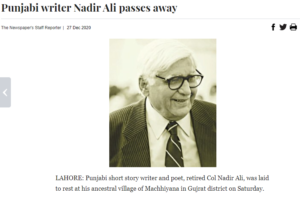
Nadir Ali 1936-2020, RIP

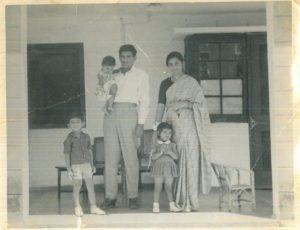
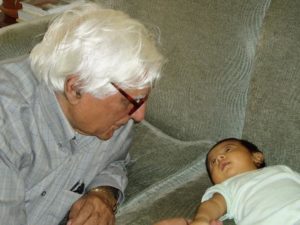
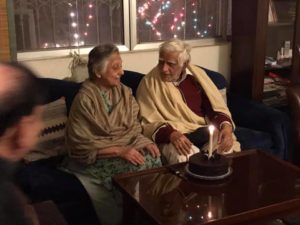
My father, Colonel Nadir Ali, was born in Kohat (KPK) in 1936 to a Khatana Gujjar lawyer who was the first in his village to go to school, to college and then to Aligarh. The family soon moved back to Gujrat (district Gujrat, in Central Punjab) where he grew up in our village (Machiana) and the city of Gujrat. As a precocious 11 year old he helped his father to rescue some kidnapped Sikh and Hindu girls during the partition pogroms (because he was young enough to be allowed to go into the women’s quarters to talk to them). He attended Normal School Gujrat and Cadet College Hasanabdal before joining the Pakistani army in 1958. He got married to my mother in 1960 (what in Pakistan used to be called a “love marriage”) and for 61 years the two of them showed the world, through thick and thin, what true love could be like.

He served three tours in the SSG and was a much loved instructor at PMA when he volunteered to rejoin 3 commando battalion as it conducted “internal security” duties in East Pakistan in April 1971. He returned to West Pakistan in October having been, in his own words, driven mad by the experience (link to  a speech he delivered in Bangladesh about these events is attached at the end of this post and can be read for more details).

After a spell in psychiatric care he left the army and started a new life that eventually saw him become a Punjabi poet, an award winning short story writer, an active participant in Najam Hosain Syed’s Punjabi literary circle and the patriarch of a large and growing family. He always idealized his childhood in the village and refused to adapt to the pretensions and sterile isolation of modernity. He was also a fan of Marx (who he usually referred to as “nabi akhir uz zaman”, the last prophet of the age) but his well-developed bullshit detector saved him from falling blindly for any party or political movement. Above all else, he loved children. His own children, grandchildren and great grandchildren were endlessly indulged and unquestioningly and unstintingly loved and supported in everything they ever wanted to do, but his love was not limited to his own family. Every child was his child and every child felt this and responded to him with affection and joy.

It is impossible to put in words how much we will miss him.  And “we” are legion: his wife and kids and their spouses, kids and grandkids will never forget his affection, his jokes, his songs, his wisdom and his high spirits. But then, neither will his brothers Colonel Azam Ali and Sarwar Ali, his sisters Safia Choudhry and Razia Choudhry, his brother in law Justice Sajjad Sipra, his sisters in law Zohra and Shahida Sipra, his boon companion Altaf Malik, his best friend Brigadier Aslam Malik, his mentor and teacher Najm Hosain Syed, his cousin Major Akram, his countless other friends and admirers, the list goes on and on. And so many that have left us already; who knows, he may be up there right now singing and dancing with friends and family who left us before he did. I at least would like to believe this is indeed the case and he and Professor Haider Ali, Choudhry Sher Ali, Choudhry Hakim Ali, Imtiaz Sipra, Riaz Sipra, Iftikhar Sipra, Ayaz Sipra and so many others are right now looking down at us, drinking and singing old Indian film songs. And of course, he is with his father, Choudhry NIamat Ali, who came in his dreams recently, asking him to join him.

Details of his talk and interviews regarding 1971 can be found here.

Nadir Ali Reading one of his stories:

Ae sab sael bahar da hai ee.. (this is a voyage on a trackless ocean, without ship  or shore..

Banhan jinhan diyan pakRiye, sir deejay, banh na choriye..  (once we take someone’s hand, we should be willing to lose our head, but not let go of the hand)

Brown Pundits