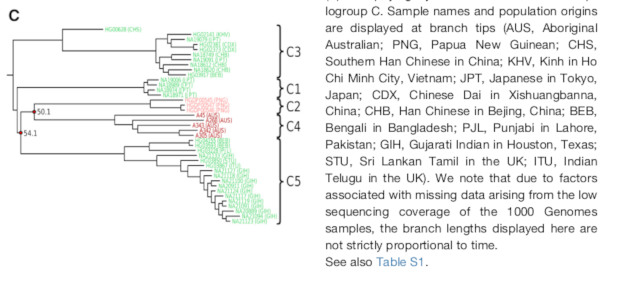
 One of the major findings from Narasimhan et al. is that when it comes to total ancestry, Brahmin groups are enriched in the groups which have more “steppe” ancestry than you’d expect (West Eurasian ancestry is a function of steppe + IVC). That being said, Narasimhan et al. could not find evidence that Brahmins are a monophyletic clade. What this means is that Brahmins do not descend from a common group of founders, but a heterogeneous ancestral population.
How can we reconcile the consistently higher steppe ancestry with the fact that Brahmins seem to have diverse origins?
I think the answer has to do with the social ecology of India and the Brahmin role within that ecology.
 In the period between 2,000 to 3,500 years ago, there was considerable genetic and cultural heterogeneity within India. This heterogeneity and population structure were “broken” and reconfigured through significant admixture. For example, where Brahmins in Uttar Pradesh have 25-30% steppe ancestry, Dalits in Uttar Pradesh are closer to 5-10%. In South India castes such as Reddys also have steppe ancestry, in the range of 5% or so. This is indicative of the spread and admixture of steppe enriched people all across the subcontinent.
But the flip side of the spread of steppe ancestry is that steppe people themselves mixed with local groups. ~25% of the ancestry of Uttar Pradesh Brahmins is from indigenous “Ancient Ancestral South Indians.” This is above and beyond the AASI ancestry from the Indus Valley population (in contrast, the Jat Rors are ~10% AASI, and well above ~30% steppe). Brahmins in Bengal and Tamil Nadu are very distinctive from non-Brahmin populations, and in their overall genome more like Uttar Pradesh Brahmins, but, both populations clearly have ancestry from local groups (~25% of the ancestry).
The reasons for why populations lose their distinctiveness are straightforward. Endogamy is not perfect. But, I would hold that the cultural customs of endogamy are going to be more persistent and strict among ritual priestly castes. My hypothesis that the original Indo-Aryan populations were invariant in terms of ancestry fraction (steppe, IVC, AASI). But the non-priestly castes would not enforce endogamy so strongly, because their status was accrued and obtained through other means than ritual purity. For the Kshatriyas, for example, status is obtained through power and domination. For Vaishyas, it is through primary and secondary production. Both these groups intermarried with local people who were militarily and economically of high status. In contrast, there were no equivalents for the Brahmins, who were spreading a particular ideological self-conception.
This is not a universal explanation. That is one reason I allude to Jat Rors. But, I think it gets at why Brahmins stand out as being steppe enriched.


 Recently on Twitter someone asked why people of subcontinental backgrounds who leave Islam don’t refamiliarize themselves with the religion of their ancestors. One response could be “well actually, my ancestors weren’t really Hindu…” I think this is a pedantic dodge. In places like Iraqi Kurdistan and Tajikstan some people from Muslim backgrounds are embracing a Zoroastrian identity.