Reducing Hindu nationalism to the Enemy

Politico has a silly piece up, How Hindu Nationalism Could Shape the Election. The silliness is in the title: Hindu nationalism will not shape the election. No one in the USA knows what it is. No one in the USA cares. But headlines need to justify the “deep-dives.”

The author clearly had a preconceived conclusion, and it’s pretty much a paint-by-numbers article in that light. There is zero chance that any Indian Amerian journalist will write a sympathetic portrait of Hindu nationalism, and develop a “strange new respect.” The conclusion is baked into the cake.

With that said, why do many Indian Americans get so angry at these sorts of pieces? I would appreciate comments (unhinged and somewhat concise please, I know many of you are going “bug-eye” over this piece, so calm down).

First, this quote jumps out: “Savarkar made clear that he saw Nazi Germany’s treatment of Jews as a model for dealing with India’s Muslims.” Any mention of Nazi Germany in a Western context as an analogy is poisonous. It’s like having an expensive multi-course meal at the French Laundry, and then they tell you there’s a touch of feces in one of the items. The totality of what you’re eating no longer matters, you are not going to eat even a little bit of shit. Any mention of Nazis is going to ruin and color the whole thing. You know what the audience will take away, and you know what the writer intends.

But that brings us to the point that from a liberal perspective there were many unpleasant things associated with early Hindu nationalist ideology, and Hindutva-identified people have been associated with atrocities for decades, from Godse down to leaders in the Gujarat riots. Isn’t this fair?

I think the problem here is that the same journalists who would reject the reduction of Islam to Sayyid Qutb or shrug off the relevance of the Nazi sympathies of the Mufti of Jerusalem have no problem engaging in reductionism in relation to Hindu nationalism and Hinduism. Basically, many Indians see that Islam and Muslims are treated with generosity, and not judged by their lowest moments, while the converse is true for Hindus and Hinduism. Muhammad, the notional founder of Islam, engaged in sex slavery. This is just a fact. But Muslims are not judged by Muhammad’s illiberality, while Hindus are judged by illiberal interpretations of Manusmriti. Why? (some scholars and politicians in the Gulf have used sex slavery as a justification for the tolerance of Russian sex workers, so it’s a live issue)

For reasons that are only partly clear over the last few decades, the global Left and the West’s intelligentsia has taken a default philo-Islamic stance. Modi’s India can be depicted in very negative terms, while there is benign neglect of persistent and massive human rights abuses in Pakistan. The differing standards obviously enrage many Hindus, but the deeper question is why. Is this a “bottom-up” process, or, are there larger institutions that have made particular decisions? Remember, most Westerners are very vague about Hinduism, and have never seen the word “Hindutva.” These journalists and publications are shaping first impressions. Where are their marching orders coming from?

The same people who would decry demands that Rashida Tlaib denounce her own kith and kin as guilt by association are demanding that Preston Kulkarni do exactly that. Where do these double-standards come from?

In the future, I expect we’ll see more “think pieces” and “investigations” of American Hindus and Hinduism which sheds light on dark developments in this subculture. Meanwhile, there will be benign neglect of the illiberalities among American Muslims and Islam. The media’s attention and energy are finite, and they are quite selective about what they devote their focus to. Focus is clarifying, because it tells you what they care about, and what their motives are.

A Hindu nationalist in the House?

Slate has published a transparent “hit piece” on Preston Kulkarni, who is likely to win a seat for the Democrats in Houston. I say hit piece because it doesn’t seem deeply reported, but sourced from Pieter Friedrich, who I have mostly seen online as a rather inflammatory activist, not a dispassionate scholar.

A reporter in the area, Chad Washington, notes that believe it or not, people in and around this area of suburban Houston are not very interested in the fact Kulkarni might have “ties” to the Hindu Right.

There are two issues I want to highlight here as to why I’m putting this post up (which to be frank does amplify what I think shouldn’t be an issue at all):

– The demand that people denounce all sorts of things that they claim to barely even understand in the interests of solidarity and popular fronts is pretty ridiculous. Kulkarni is aiming to represent suburban Houston in the House. His opinions on Indian politics are unimportant. There are cases where Muslims are asked to ritually denounce everything under the sun and everyone they may have shared a stage with. That’s bullshit. And this is bullshit.

– It is strange to me how the “Left” can so naturally use the language of xenophobia to attack xenophobia. Here is the title: “Why Are Democrats Backing a House Candidate With Reportedly Shady Foreign Ties?” Foreign ties? I mean, his last name is {{{Kulkarni}}}. He worships elephants! His white mother married a foreigner. What’s wrong with her!

Obviously, the Indian American writer of the hit piece isn’t anti-Indian as such, but this opportunistic recourse to this rhetoric and guilt-by-association won’t end well.

Update: OK the Republicans/Christian Right are now after him.

Comments!

They say blogs are dead. They say comments are dead. To my surprise, this website has surprised me. In the later years of the Sepia Mutiny weblog the number of comments started dropping off. The theory was that people were commenting more on Facebook (Twitter wasn’t huge then). Google Analytics says that more than 20,000 people are reading this website in a given month. That’s not trivial, but it’s small. That being said, the comment threads are often “hopping.”

This is good and nice. How do we maintain this? I don’t moderate much at this point but am worried about things getting out of control. That being said, this is not a job and I have lots of other things to attend to. Thoughts?

Not all societies are identical

There is some discussion on “Hindu Twitter” and elsewhere about the French response to the murder of Samuel Paty. In short, France is going “medieval” on the asses of a lot of Muslims, even nonviolent but very conservative organizations. To use a German phrase, the French state is entering into a Kulturkampf against militant Islam. Or at least it is signaling that it is.
To all this, some on the Hindu Right are asking why some liberal or Left intellectuals are applauding or tolerating France’s reaction, which is hitting down hard on the Muslim community. Would they be so tolerant of India clamping down on Muslims? My own answer is simple: different nations have different histories, and abstract universal values and standards are often not useful.

Continue reading Not all societies are identical

Tibeto-Burmans, Munda, and Bengalis


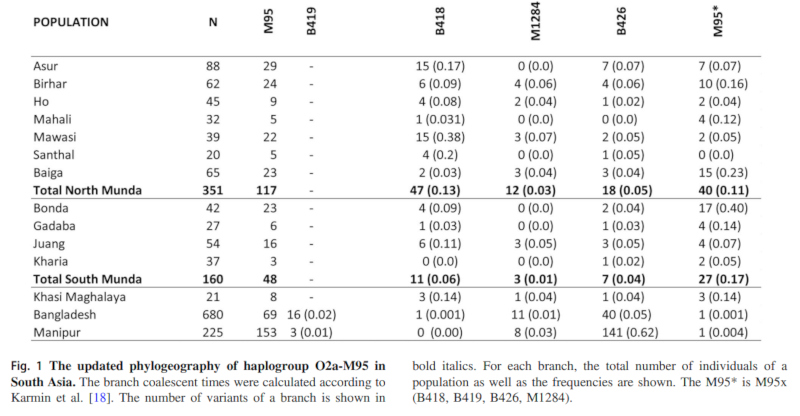
I’m pretty sure I posted this Chaubey lab work as a preprint, but it’s now a published paper. For those who can’t understand the table, it illustrates a big difference between Tibeto-Burmans and Munda. The samples from Bangladesh look to be generic Bangladeshis, the 10% frequency for O2a seems to match the other data I’ve seen for East Bengalis.

This confirms that the East Asian admixture into Bengalis was not Munda. And, the Tibeto-Burmans of the nTibeortheast have no assimilated Munda ancestry. I think it does lend more credence to the idea that the Munda arrived in the Indian subcontinent across the Bay of Bengal, landing in Odisha, rather than from the northeast.

The rise of Indicus!

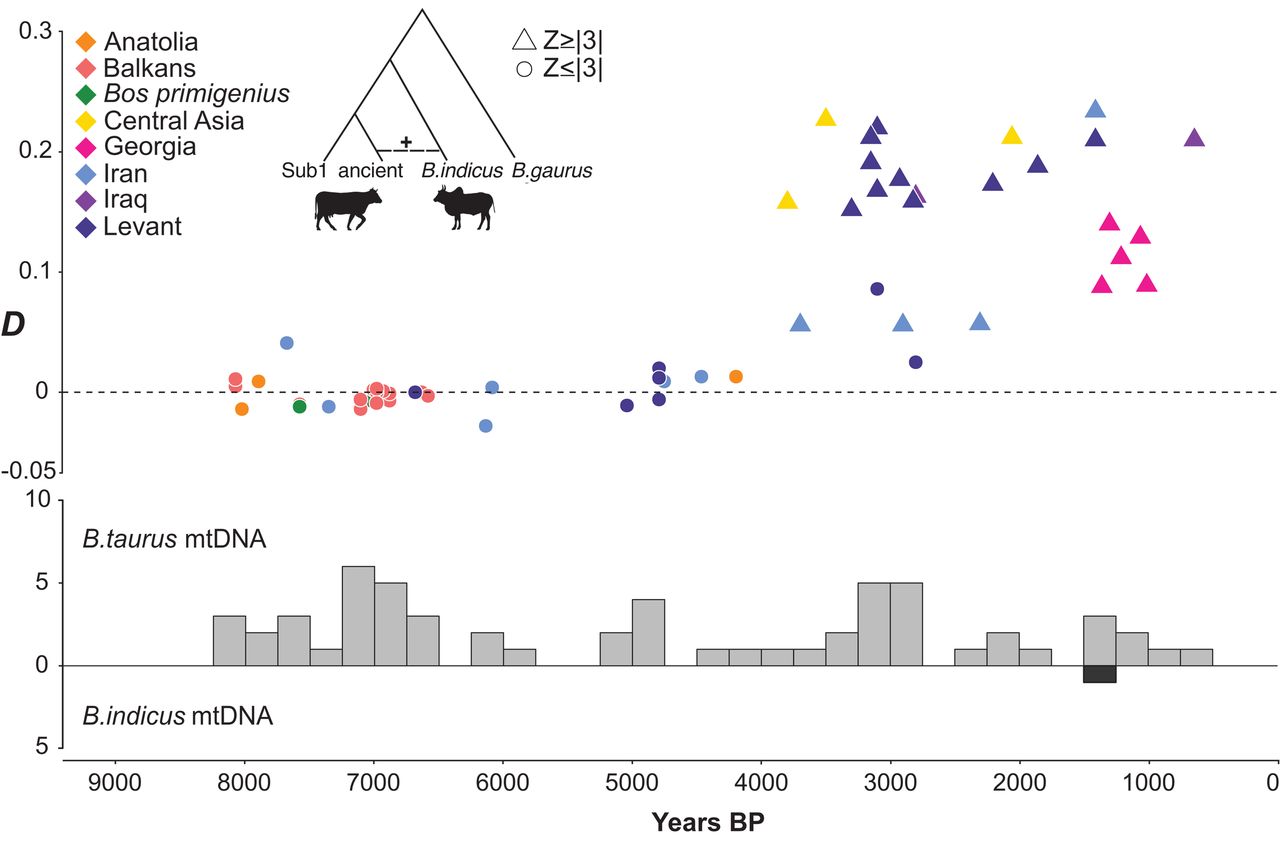
A few years ago an ancient DNA paper on cattle was published, Ancient cattle genomics, origins, and rapid turnover in the Fertile Crescent. It’s a pretty good paper with interesting results. The paper confirmed pretty strikingly that there was a punctuated and massive expansion of indicus ancestry across the Near East between 3,500 and 4,000 years ago.

The interesting aspect of cattle is that there are really two species that intermix. Using mtDNA researchers estimate indicus and taurus diverged 300,000 to 2,000,000 years ago. But the main thing you have to remember is cattle generations are about 20% as long as human generations. So 300,000 cattle years are equivalent to 1.5 million human years. And, for technical reasons (smaller effective population size) one should probably assume mtDNA underestimates the divergence.

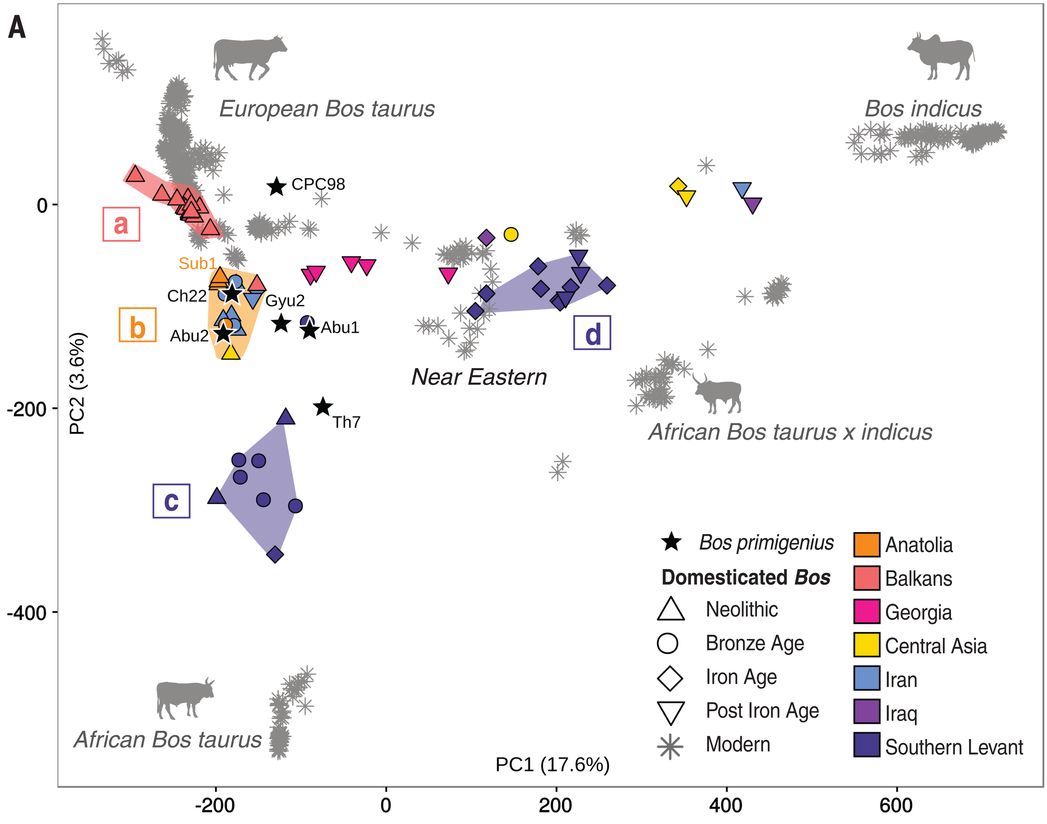
Ancient cattle from the Near East are all taurus. The PCA plot shows that most of the variance is on PC 1 which separates indicus and taurus (a secondary dimension is PC 2, between African and Near Eastern/European lineages). The figure at the top of this post shows that there is a massive jump in genome-wide indicus ancestry across the Near East between 2000 and 1500 BC. As the authors note this can’t be diffusion; the jump is too sudden and sweeping.

So what happened during this period? As noted in the paper: Bronze Age civilization almost collapsed around ~2000 BC. More concretely, after 2000 BC is when we see evidence of Indo-Europeans in the Near East. The Indo-Aryan Mittani show up in Mesopotamia in ~1600 BC. The Indo-European Hittites, the Nesa, are known from Anatolia a bit earlier.

This is also the period that small, but detectable, levels of “steppe” ancestry show up in some ancient samples.

Before this paper, I would have leaned to the position that the Mittani Indo-Aryans migrated directly from the Sintashta homeland without much contact with Indian Indo-Aryans. These data are too suggestive of a widespread zone of expanding agro-pastoralists that existed between western South Asia and the Near East between 2000 BC and 1500 BC.

One of the things we know from the barbarian period during the Fall of Rome is that barbarian groups had strong channels of information flow. For example, a group of Saxons arrived with the Lombards in Italy in the second half of the 6th century. But, through various channels, these Saxon warriors learned that their co-ethnics had established dominance in what was to become England, and there are texts which allude to the reality that they decamped and crossed the Alps, presumably on the way to what was going to be England. The point here is that there was a “Saxon international.”

Aside from the Mittani the evidence of Indo-Aryans in the Near East is tenuous, though some of the Kassites of Babylonia may have had Indo-European affinities. There is not nearly as strong a genetic imprint of steppe in the Fertile Crescent as in Northwest India. The Hittites were very different from Indo-Aryans, who seem to have the closest relationship to the Slavic language family.

The indicus breed is adapted to tropical dry climates. It seems plausible that the Indo-Aryan international facilitated the spread of this breed in the centuries before 1500 BC.

Their Muslim Problem—And Ours


Every now and then there is a controversy on Indian-Twitter which bleeds over into my timeline that I have to notice.

Some quick observations:

– There are those who lambast the critics of this ad. Many of the critics are low-IQ vulgarians. So the criticism is not without foundation. But, most of the responses dodge the gendered nature of the objection. The fact is that in Islam it is understood that Muslim men can marry non-Muslim women. It is also tolerated for Christians and Jews to retain their religion after marriage. The children are considered Muslim. This practice in a patriarchal society was seen as a boon to the Islamic nation.

The advertisement plays into this Islamic trope. The converse of this is that most interpretations of sharia ban the marriage of Muslim women to non-Muslim men. Again, the rationale for this is straightforward: the children inherit the religion of the father, and therefore the children are lost to Islam. If the supporters of the beauty of the advertisement of interfaith marriage believe in this custom, then they should support more speech. In particular, they should support an advertisement where a Hindu man marries a Muslim woman in a Hindu ceremony to show that there is nothing wrong with this act so long as the people consent freely.

Continue reading Their Muslim Problem—And Ours

Climate change is a development problem

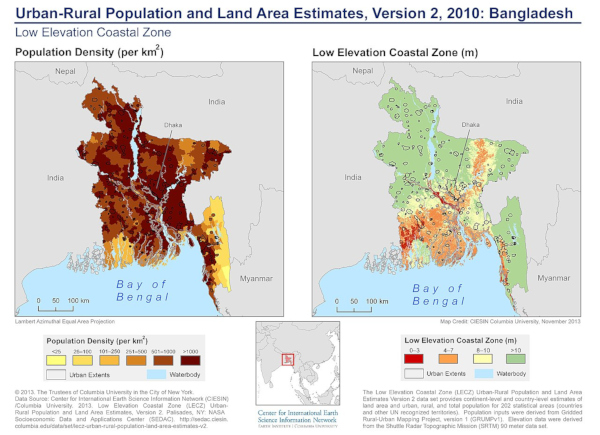
In the comments below there is some mention of the problems that Bangladesh will face due to increases in global sea level. The hypothesis is that there will be a mass migration to India as Bangladeshis flee low-level zones which are going to be inundated. I don’t think this is capturing the real issue: if millions of Bangladeshis are still subsistence farmers on marginal maritime zones then there has been a massive development failure.

Even extreme sea-level scenarios by 2100 posit a 2.5-meter rise, which means only a small proportion of the territory of Bangladesh would be inundated. If by 2100 Bangladesh is not a predominantly urban society after 80 years of economic development from 2020, there are much deeper structural problems to deal with than climate change.

Development and wealth change the downsides of risk a great deal. The 1970 Bhola cyclone caused hundreds of thousands of deaths. Something that is unlikely to be replicated in the region for various reasons (e.g., information technology and coordination are far better!).

I’ve been paying attention to climate change since the late 1980s. As someone whose family is from Bangladesh I have been very worried…my image in 1990 was of peasants fleeing inundated paddies. But things have changed a great deal. In 2020 nearly 40 percent of Bangladeshis live in cities. By 2100 a substantial majority should…

Beyond the Bangladeshi basket-case

Coronavirus has been an economic disaster all across South Asia. But, beyond that, there are changes that have occurred before the pandemic and will continue after. For example, Bangladesh’s per capita GDP now higher than eastern and northeastern India:

Bangladesh’s per capita gross domestic product (GDP) is now higher than most Indian states in eastern and northeastern India, with the exception of small hill states such as Mizoram and Sikkim. According to the data from the International Monetary Fund (IMF), Bangladesh’s per capita GDP was $1,905 in 2019, against West Bengal’s $1,566 in 2018-19 (FY19) — economically the most developed state in eastern India.

Bangladesh is not really comparable to India, which is a diversified economy that is more than an order of magnitude larger. But, it is comparable to West Bengal. On economic matters, I am broadly sympathetic to right-liberal economics, so I’ll spare you my interpretation of what’s going on.

Brown Pundits