
Talk about whatever you want. Perhaps the Pakistani readers can brag about how they surpass Indians in covid-19 infections?
Category: Razib Khan
The Problem With The Juggernaut Is Its South Asianness
For whatever reason, Facebook recently thought I might be interested in the subscription South Asian themed webzine and newsletter The Juggernaut. I don’t mind paying for media. I pay for The New York Times, Bloomberg, The Washington Post, and The Wall Street Journal. But why should you pay for The Juggernaut? Here’s a snippet from their about page:
It’s like your other email briefings. But browner. Join thousands and get the newsletter that curates the best global news on South Asia(ns) every Sunday. We also send updates on events, giveaways, our original reporting, and more. Unsubscribe anytime.
There are some good stories in The Juggernaut. I especially liked “Not Indian Enough” by Sabrina Malhi, a Guyanese American of East Indian ethnicity. This is a good piece of journalism because it shines the light on a topic and experience that’s underexposed, the liminality of being of Caribbean East Indian background. I learned a lot.
But the problem with The Juggernaut is that it strikes a pose as “South Asian,” which like “Social Justice” or “Family Values” is innocuous on the face of it, but connotes particular affinities, identities, and preoccupations, which are exclusionary of vast swaths of its potential audience. Back when the Sepia Mutiny blog was a thing I went to some meet-ups, and one thing that I noticed is that despite the focus on inclusive South Asian language on the internet, privately most people were conventionally nationalistic in regards to where their parents came from.
People didn’t talk about Desi or South Asian, they talked about Indian identity.
Since then the political and social cleavages have polarized. The Juggernaut is a pretty conventional distillation of progressive Diasporic poses. It focuses a great deal on marginalized elements of the brown experience and is lockstep with the global Left in a deep skepticism of Hindu nationalism.
There is nothing wrong with that. But it’s just one viewpoint and a viewpoint that seems extremely overrepresented among the Diasporic media class. There are potential readers who are somewhat outside of this progressive South Asian American exoteric box. I wish publications like The Juggernaut had enough viewpoint diversity to reflect and attract them.
Two coronavirus podcasts
– An Italian in the time of coronavirus. From 5 days ago in Verona in Veneto.
– British scientist in Shanghai talks coronavirus. A British geneticist I know who works and lives in Shanghai. Two days ago.
Patreon here, but perhaps more important share the podcasts.
India and COVID-19
India Is the World’s Second-Most Populous Country. Can It Handle the Coronavirus Outbreak?:
India has conducted nearly 5,000 COVID-19 tests so far, according to the World Health Organization, which says that the “country is responding with urgency as well as transparency.” But so far, India has only reported 74 confirmed COVID-19 cases and one death, on Thursday. Dr. Ashish Jha, director of the Harvard Global Health Institute tells TIME that count is “just not right.” He believes there must be many more cases, but they have just not been identified. “I’m deeply worried that there’s a lot of community transmission and we are just not aware of it because there is not widespread testing,” he says.
Kushal Mehra assures me the hospitals don’t report anything crazy. It’s been a while, how come there hasn’t been a major outbreak? Some researchers suggest a warm climate (others are skeptical).
What are you guys hearing? While India and Pakistan have very few cases, Iran is now above 10,000 (likely far more). There are mass graves being dug outside of Qom.
Browncast Episode 83: An evolutionary anthropologist on the GRE, Bo Winegard and the nature of his discipline
Another BP Podcast is up. You can listen on Libsyn, Apple, Spotify, and Stitcher (and a variety of other platforms). Probably the easiest way to keep up the podcast since we don’t have a regular schedule is to subscribe to one of the links above! d
You can also support the podcast as a patron. The primary benefit now is that you get the podcasts considerably earlier than everyone else. This website isn’t about shaking the cup, but I have noticed that the number of patrons plateaued a long time ago.
I would though appreciate more positive reviews! Alton Brown’s “Browncast” has 30 reviews on Stitcher alone! Help make us the biggest browncast! At least at some point.
This week I talk to Cody Moser, an evolutionary anthropologist with strong opinions on the GRE (against) and the firing of Bo Winegard (sad about). But when it comes to what his field of study is…that’s a little vaguer.
In relation to the GRE discussion, Cody has provided a document with references. Enjoy!
Open Thread
The usual. Please post random thoughts here (OK, real-talk, post your Indo-Pak flamewars here).fopen thr
A North Indian in Uzbekistan at 1550 B.C.
I was rereading the supplements for Narasimhan et. al. for the purposes of trying to adduce the best model to calculate “steppe” proportions in Iranians (someone asked I do this). In the process, I noticed this passage again:
Third, we find that one of the outliers, Bustan_BA_o2, is consistent with being admixed between an individual related to people on the Indus Periphery Cline and Middle to Late Bronze Age Steppe pastoralists, a type of admixture event we also observe in the Late Bronze-Iron Age Swat Valley that we will examine later, suggesting that the admixture events that led to the formation of the SPGT in Pakistan also occurred between outlier individuals at the BMAC and Steppe pastoralists who arrived at the end of the 2nd millennium.
Here is some detail on the site of the sample: UZ-BST-015, Site 4, Grave 4, 57-27 (I11520): Date of 1613-1509 calBCE (3280±20 BP, PSUAMS-4605). The earliest date possible on the Swat samples is 1200 BC (though 1100 BC is more likely). That means that this outlier individual is the earliest example of the genetic mix that would come to characterize much of northern India. A mix of steppe, and Iranian-farmer-related, and Ancient Ancestral South Indian (AASI).
The text of the supplements seems to imply that this individual is sui generis, a mix of Indus Periphery and steppe, which prefigures what was to come later in South Asia. But I will offer another hypothesis: this individual is a migrant, or the child of migrants, from the earliest phase of the ethnogenesis of the Indo-Aryan matrix of Northwest India.
Browncast episode 81: An Israeli in the world
 Another BP Podcast is up. You can listen on Libsyn, Apple, Spotify, and Stitcher (and a variety of other platforms). Probably the easiest way to keep up the podcast since we don’t have a regular schedule is to subscribe to one of the links above! d
You can also support the podcast as a patron. The primary benefit now is that you get the podcasts considerably earlier than everyone else. This website isn’t about shaking the cup, but I have noticed that the number of patrons plateaued a long time ago.
I would though appreciate more positive reviews! Alton Brown’s “Browncast” has 30 reviews on Stitcher alone! Help make us the biggest browncast! At least at some point.
 On this episode Razib talks to his old friend David Boxenhorn. Raised in New England as an American Jew, David made aliyah to Israel in his early 20s. There he married and raised a family, and now he considers himself an Israeli of the. National Religious persuasion.
We discuss the diversity and discrimination in Israeli society, the difference between anti-Zionism and anti-Semitism, and how international geopolitics is impinging on Israel.
The white acting mother of a white presenting daughter
My Daughter Passes for White: She belongs in a way I never could. I’m comforted — and worried:
I stand in the aisle of the school bus while the other seventh graders snicker and block me from sitting next to them, as they have for the entire school year. Taking my seat next to the bus driver, I look out to the road with resignation. My great-aunt, adorned in a colorful sari, waves goodbye to me while the entire school bus looks on. I want to disappear into the dingy brown vinyl bus seats. With the newfound cruelty of adolescence, I scoff and loudly tell my classmates, “That crazy lady is just my maid.”
…
I now find myself in a mixed marriage, mother to a 3-year-old mixed-race girl who easily passes for white. Her fair skin, auburn hair and light brown eyes do not even hint at her Pakistani background. When I tell people at gatherings that I speak Urdu at home, some are very concerned about whether my daughter will be confused. Yet some are the same families clamoring for their children to get accepted into French-immersion kindergartens. Strangers have asked me whether I am her real mother or have assumed that I’m her nanny. It’s not their belief about my profession that’s disturbing — it’s their certainty that my daughter and I can’t be related because of the colors of our skin.
The author is Seema Jilani. She is a pediatrician. The surname is a form of Gilani:
Gillani is the sub-caste of the Syed/Sayyid family who are descents of the Prophet Muhammad and trace their lineage back to Imam Ali, who was first cousin and close companion of Prophet Muhammad. The family lineage of the Gilanis refers to Sheykh Abdul Qadir Gilani, a famous 12th century Sufi Scholar from Gilan-e-Gharb, Iran, hence the surname…
I don’t know if the author’s father claims to be a Syed…but it seems likely that they did not come from the bottom half of Pakistani society. The author’s husband is a journalist at an elite publication (it is easy to find who she is married to). As a brown person with children who also “pass” as white, I have had some uncomfortable experiences. Since I am a male I am not usually confused for a nanny, but rather someone who kidnapped sweet little white children. But by and large, life goes on. It’s not that bad or oppressive. I assume white people also experience rudeness. They bleed. They are human. They have feelings.
Pieces such as the above fulfill a particular role in modern cultural ecology. Affluent white liberals who have experienced the “Great Awokening” on race present a demand for authentic experiences of racism from “people of color.” Many of these affluent white liberals don’t know “people of color” personally, so they “educate themselves” through the media which they consume. Unsurprisingly, the people who produce the sort of media which fulfills the demand are themselves socio-demographically exactly like affluent white liberals (to give credit to Ta-Nehisi Coates, he is the exception). Ask yourself, when was the last time you read an op-ed or think-piece from an Indian convenience store clerk or a Bangladeshi cab driver? Almost always the op-eds and think-pieces come from professionals who likely experience the least “macro” aggression and the most “micro” aggression, and, who can speak the language of affluent white liberals and know exactly how to say the correct things (very educated people in low-wage service sectors jobs who do ‘freelance’ writing are never immigrants, and almost always graduates of liberal arts colleges).
No working-class person says “white presenting.” No immigrant says “white presenting.” I have had friends in academia tell me that my children “present as white.” Their race is a “performance”, masking their essential non-whiteness which is passed down by blood from me. There’s a lot of “interrogate” here. But that’s not the point. Normal people, who don’t have a college degree, don’t talk or think like this.
The point of this post is to point to the reality that a particular type of assimilated upper-middle-class privileged brown American speaks for the brown experience, but their own experience is very curated, the most “comfortable” for affluent white liberals to process. The frankly racist (against black people) immigrant Bangladeshi cab driver who is spending all his disposable income on sending his children to test-prep academies to get them into Stuy is less relatable. Alien. You won’t hear his voice, and since many affluent white liberals don’t many nonwhites personally he’ll be invisible to them. “Erased” as they say.
These op-eds are basically white affluent white liberals in “brown face.”
Western civilization is Indo-Islamic under its skin
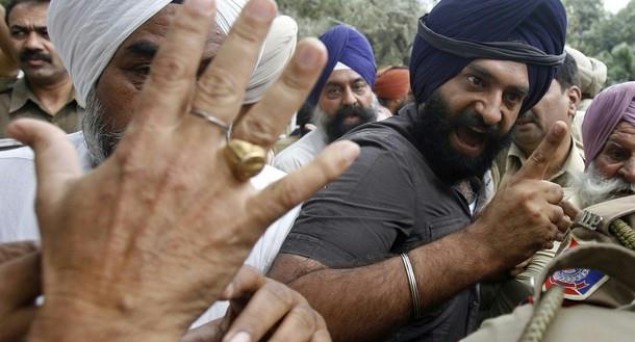
I’ve been in this game for a long time. Back in the middle of the 2000s, I observed that people of Muslim and Indian origin had sensitive and peculiar reactions to criticisms of their religion. Muslim cases are well known. Less well known is the violence and menace associated with the Birmingham Repertory Theatre play which affected Sikh sensitivities.
Then there was this, 5 Die in India During Protests Over Falwell:
Five people were killed in western India today in clashes between Hindus and Muslims that started during protests over remarks by the Rev. Jerry Falwell in which he called the prophet Muhammad a terrorist, the police said.
An American preacher says something offensive about Muslims, and Hindus and Muslims start killing each other in India! Absurd. Ridiculous. Barbaric.
I may not have said it in those words but that’s what I was thinking. In contrast, in the West religious beliefs are not sacred, and we can express content and derision without worry.
Or so I thought. Over the past few years, there has been a tendency in American culture to emphasize sensitivities, hurt feelings, and emotional reactions, over reason, when it comes to offense. Indians, and Muslims, were offended at criticisms of their religions and identities because religion and identity were sacred for them. Well, it turns out that in the West we’re going back to that state of affairs as well.
It seems that human cultural forms have the lowest energy state. And that state is a sort of identitarian honor culture.
I still think your religions are dumb. But when in glass houses…