Sri Lanka, Tamils, Genocide, Ethnic Cleansing?

There have been a few comments with accusations of Genocide, Ethnic Cleansing of Tamils by the Sri Lankan Govt.

First the numbers which are thrown around.

Lankan Tamils Living among Sinhalese
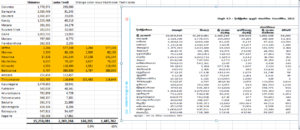
65% of the Sri Lankan Tamils live in Sinhalese majority areas.  After adding up, I was shocked as I was expecting somewhere around 30%.
The numbers are from the 2012 census.  The third column (in Sinhala) are the Indian/Upcountry Tamils.  In comparison less than 1% Sinhalese live in Tamil majority regions.

Diaspora Sri Lankan Tamils
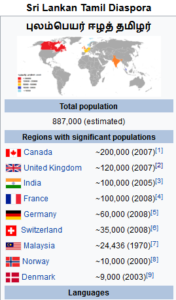
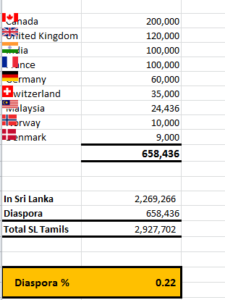
A number that has been thrown is 30% of Sri Lankan Tamils live outside the country.   The numbers say that it is 22%.
Not all of the Diaspora are refugees
a) Some migrate for economic and education reasons
b) The LTTE one child policy.  The LTTE required one child per family to become cannon fodder.   If the family had money, the LTTE would arrange to smuggle the child out to a Western country as a refugee. Thereafter the refugee would have to make monthly donations too.


Religious War
The SL Army or the Budhists would never intentionally destroy a Hindu Temple.  The Buddhist, specially those in the Army make vows and pray to Hindu gods for their protection.  Buddha cannot provide protection (like a God), he is a teacher in the Theravada Tradition.  No question Hindu temples were shelled in the North and East when the LTTE used them as shields.  During the last couple of years the Army has been engaged in rebuilding and repairing Hindu Temples

ex LTTE leaders as Govt Ministers
Chief Minister of Sri Lanka’s Eastern Province Sivanesathurai Chandrakanthan, popularly known as Pillayan and Vinayagamoorthy Muralitharan, also known as ‘Colonel’ Karuna was a deputy minister in the Rajapakse govt.  Karuna was responsible for killing of 600 Sinhalese and Muslim police officers who surrendered to the LTTE.   Ahh the vagaries of power politics.

Some Links, all by Tamil authors.

Mass expulsion of Muslims from Batticoloa, Mannar and Jaffna
http://dbsjeyaraj.com/dbsj/archives/26412

Rajini Rajasingham Thiranagama: Unforgettable Symbol of Sri Lanka’s Tamil Tragedy
http://dbsjeyaraj.com/dbsj/archives/33112

The Broken Palmyra, the Tamil Crisis in Sri Lanka, An Inside Account 1992by Rajan Hoole (Author), Daya Soma sundaram (Author), K. A. Sritharan (Author), Rajani Thiranagama (Author)
https://www.amazon.com/Broken-Palmyra-Crisis-Inside-Account/dp/B000OGS3MW/

Sinhalization of the North and the Tamilzation of the South
http://www.srilankaguardian.org/2011/06/sinhalization-of-north-and-tamilzation.html

Other articles by Sebastian Rasalingam
https://www.slguardian.org/category/clms/columnists/sebastian-rasalingam/page/2/

Lanka and Kalinga

Sauvrav said “ I did my schooling in Orissa and there is no mention of any thing remotely Sri Lankan in their school textbooks. The other day i was talking to a friend who is a oriya and he laughed it off as myth

Many references to Kalinga in Sri Lanka primarily the Mahavamsa and Culavamsa and the Rock edicts of Nissanka Malla (1187–1196)

The Coming of Vijaya (Mahavamsa Chapter 6)
In the country of the Vangas[1] in the Vanga capital there lived once a king of the Vangas. The daughter of the king of the Kalingas was that king’s consort.
http://mahavamsa.org/mahavamsa/original-version/06-coming-vijaya/

Nissanka Malla (1187–1196)
Son of Queen Parvati and King Jayagopa. This is mentioned in a rock inscription made by Nissanka Malla at Galpota. This inscription describes Jayagopa as being the reigning king of Sinhapura.  Nissanka Malla had two wives named Kalinga Subadradevi and Gangavamsa Kalyanamahadevi.[2] He was also a son-in-law or nephew of Parākramabāhu

Magha of Kalinga (Culavamsa CHAPTER LXXX: THE SIXTEEN KINGS 58-62)
of the day lotuses ? that is of peace ? (a man) by name Magha, an unjust king sprung from the Kalinga line, in whom reflection was fooled by his great delusion, landed as leader of four and twenty thousand warriors from the Kalinga country and conquered the island of Lanka. The great scorching fire ? King Magha ? commanded his countless flames of fire ? his warriors ? to harass the great forest ? the kingdom of Lanka3. While thus his great warriors oppressed the people, boasting cruelly everywhere: “We are Kerala warriors”, they tore from the people their garments, their ornaments and the like, corrupted the good morals of the
The reference is raw OCR
http://books.lakdiva.org/culavamsa/vol_1.html

Mahavamsa and Culavamsa are one of the longest continuous histories. Oral tradition since 3rd century BC and written down in 6th century AD.  It has a consistent dating system, i.e from the death of the Buddha. To quote “It is very important in dating the consecration of the Maurya emperor Asoka,”

Asoka had been lost in India. He was found and identified and dated using the Mahavamsa.

To quote from the Mahavamsa Chapter 5; This Chapter references the Moriyas, Bindusara and Chandragupta among others.
Be it known, that two hundred and eighteen years had passed from the nibbana of the Master unto Asoka’s consecration.

Excerpt from a review of Allens two books by my Uni batch mate Sunil Koswatta.

The story of how Lankan chronicles helped British orientalists discover India’s lost emperor Ashoka

James Prinsep (1799-1840) in his excursions in North India, he and his colleagues like Alexander Cunningham, had come across many an inscription where the letters were clearly inscribed but the Indian scholars whom he and others before him had consulted had been unable to help as they had completely lost knowledge of the alphabet in which these inscriptions were written.

It is said that during medieval times Firoz Shah Tugluk who shifted the Asokan pillars from Topra and Meerut to Delhi invited scholars to read them and none was able to do so.

By this time, scholars studying Indian antiquities had progressed a great deal in the study of Sanskrit, the great classical language of India, and understanding what the inscriptions had recorded did not pose much of a problem. It was clear to Prinsep that the authority who had got these inscriptions installed was a King (raja) calling himself Devanampiya, literally meaning ” the beloved of the gods.” But what was baffling Prinsep and his associates of the Bengal RAS was, who was this Devanampiya Raja?

From his readings of the Mahavamsa and its commentary, the Mahavamsa Tika, Turnour knew of a king named Devanampiya Tissa. This fact was intimated to Prinsep who, not knowing the details contained initially believed that the edicts in North India had been installed by the Sri Lankan king in his overwhelming devotion to the new faith. Not long afterwards Prinsep came across an inscription of a grandson of that Devanampiya Raja and realized that the personage in question was an Indian ruler. Turnor in the meantime having read the Buddhist mission to Lanka, communicated to Prinsep that the Devanampiya Raja of the Indian inscriptions was none other than Dharmasoka, the “patron” of Devanampiya Tissa who had bestowed many gifts, including a second consecration on Mayuryan models and the title Devanampiya on his colleague, the ruler of the small island kingdom called Tambapanni off the southern tip of Jambudvipa.

http://www.dailymirror.lk/news-features/The-Buddha-and-the-Sahibs/131-158316

English Lit and Science, 70’s Sri Lanka

This is a lot of reminiscing, and hopefully some  guidance for young people who read this blog.

I think I am a Science guy, and became IT/Finance guy in my 50’s.
I loved Chemistry, specially Organic Chemistry, Benzene Rings and all that. By the age of 14  (O/L) I wanted to be a Chemical Oceanographer.  I had a cousin (Ranjan Perumal) who was one of the early divers in SL.  Arthur C Clarke and Mike Wilson (Siva  Kalki) were some of the first modern divers in Sri Lanka.  Mike Wilson became a hermit, my cousin Ranjan is an Evangelical Pastor, in my opinion a real Christian (or people person).

Anyway, back to Science and English Literature.   In year 8 (age 12)  we had to chose between Science and Arts.  For O/L (year 9 and 10 in 70’s) we had to do 8 subjects.  English, Sinhala/Tamil, Math and Divinity (religion).  The smart Buddhists and Hindus did non RC (Roman Catholic) Christianity.  It was easy, almost like Geography/History. No necessity to remember stanzas.

So for O/L  (age 14) my optional subject was English Lit. I did Macbeth, Emma (Jane Austen) and some book of poetry.  Vaguely recall John Dunne (?) and Ozymandias.  Rubaiyat of Omar Khayyam, I had read a few years before bcos my father had it on his bookshelf.

To be honest Shakespeare did not rock my boat, possibly bcos my father liked it too much.  Emma was not OK either, though a few years later I read Pride and Prejudice and liked it.
Vanity Fair by Thackeray (?), Moonstone by Wilkie Collins.

The punch line, I was an alcoholic/heavy smoker by the age of 12-14. I worked around my Protestant work ethic parents.

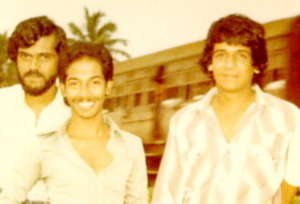
Photo below, I am the guy in the middle with the big grin, probably when I was 22. My classmate on right of me in photo Lakshan Amarasinghe  (RIP), long dead (1998).  On left of me Dayananda Kapuduwa.  A another drinking pal.  In the US married to an First American.  He paid  for 3 of my US Grad Uni Application fees (about USD 25 in 1987).  And the other 3 applications by my maternal cousin, Ranjans Sister.

I was not much different in size/looks when I got into the US.  The Uni guys were cool, but not at my level of alcoholism.   So hooked up with some eastern Long Island red necks.  Greg Linka, Jim, Kevin, Isaiah Brown (the Jamaican guy), give a shout if you see this.   I would drink these six footers under the table.  Then I lost funding and stopped drinking  for 10 years.

Anyways, there has to be some moral to the whole story.
So
a) a goal in life, and the goals can change
b) A privileged background. Many/somebody to step in and help upto a reasonable screw up.  More important than a)


11 dead in Thoothukudi (Tuticorin) Protests

Multi nationals are the same all over the world, exploitative.

10 persons were shot dead when police opened fire on a rally against a Sterlite copper plant.

As anger and resentment against Tuesday’s police action continued to smoulder, the Tamil Nadu government ordered several measures to control the unrest. Internet services were suspended in Thoothukudi and neighbouring districts of Tirunelveli and Kanyakumari .

Tuesday’s violence came on the 100th day of demonstrations against the plant, which environmentalists and residents claim is contaminating water sources — a charge the company (Vedanta Resources) denies.

The plant, one of India’s largest such facilities, has had a troubled history since it began operations in 1996. People have blamed it for their failing health and a major gas leak in 2013 led the Supreme Court imposing a Rs 100- crore fine. The plant has been closed down repeatedly in the past two decade, the last time by the Madras high court in 2013 over similar pollution concerns.

https://www.hindustantimes.com/india-news/thoothukudi-tense-as-another-anti-sterlite-protestor-killed-internet-services-suspended/story-CQcIpFdA0BdFG2LTta1rYP.html

https://thewire.in/rights/tuticorin-sterlite-copper-plant-vedanta-modi-human-rights

Harlem (NY) as I knew in mid 1990’s

This is Harlem in NY as I knew it in the mid 1990’s.

Now its so, gentrified.   My friends from upper Harlem (145th Street) are my family in the US.  I am no citizen or Green card holder of the US.  Hopefully, I will get my Social Security that I paid into with 3 H1B  Visa Employment.  I am not holding my breath for another  3 years.

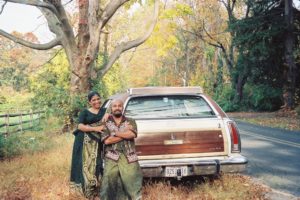
With my wife Chandra Wimalasiri (RIP, 2018; we separated in 2004) in Stony Brook, NY, 1991.  USD 600 for the 1975 Ford LTD  station wagon with 150K miles.  Went to Louisiana, and another time to Florida.

Then got  Chevy Celebrity for free (Prof Akira Akubo thank you) with  160K and crossed the US three times.  Life and reminisces are great

https://www.youtube.com/watch?v=pQewMLnXX7I

A must watch

For those who like world/ethnic music + Rock. This is the entire movie, just saw clips 10 years ago. Something for all. WWF (wrestling), Child Birth, Travelogue, ethnic and rock music. My favorite clip is at 00:42, the Bauls.  Whats with the Afro of the Baul singer.  The young Baul kid is Paban Das Baul.  He is quite well known in Europe. (YouTube search here).   Maki Kazumi in the Baul Clip I posted a few days back is still a Baul performing/evangelizing, monar manush. (Dont understand the words except manush which I assume means man).

I think, just intellectualizing by reading books about the world does not cut it.  Travel (wish I could do more) and into the hinterlands.  I have crossed the US three times with a tent, in an old Chevy Celebrity (had 160K miles when a Professor (Akira Akubo) gave it to me.   Montreal/Toronto to Florida and New Orleans at least 3 times. The Bronx before it became gentrified.  Camden/Baltimore.
Plus Myanmar backpacking in 2005 when the county just opened.

Vagabunden Karawane: A musical trip through Iran, Afghanistan and India in 1979 (1 hr 28 mins)

Stolen Loot in British Museum

Any artifacts out in the UK that should be returned.

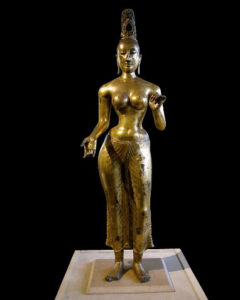
Gilded bronze statue of the Tara Bodhisattva, from the Anuradhapura period (8th century).

The Bodhisattva Tara. Gilded bronze, Sri Lanka, 8th century CE. With her right hand, the bodhisattva makes varadamudra, the gesture of charity or gift-giving, while her left hand may originally have held a lotus. The image is solid cast and would once have had semi-precious stone or crystal inlaid eyes. The niche in the head-dress would have contained a figure of a Dhyani Buddha. This sculpture was found on the east coast of Sri Lanka between Batticaloa and Trincomalee and is evidence of the presence of Mahayana Buddhism in the Anuradhapura period of Sri Lanka. These doctrines are generally more associated with the north of India. Given by Sir Robert Brownrigg.

I like the word “Given”.  Robert Brownrigg, was Governor of Ceylon who finally captured the Kandyan Kingdom

https://en.wikipedia.org/wiki/Buddhism_in_Sri_Lanka#/media/File:British_Museum_Asia_45_(cropped).jpg

Carbon Steel and Zinc in India

Inspired by a comment by bharata bharatavanshi.

Zinc: 
The production of zinc by conventional smelting methods presents considerable difficulties; instead of a liquid metal forming at the base of the furnace, zinc forms a highly reactive vapour (with a boiling point of 913°C) which exits the top of the furnace and promptly re-oxidises. Clearly, some method of containing and condensing the vapour out of contact with the air was needed
1217CW - Science in India - Plate 6.12
By the early second millennium AD, these descriptions had become more detailed. The retort was to be shaped like a brinjal, or aubergine, the condenser shaped like a datura, or thorn apple flower, and the zinc ore was shaped into small balls, still using the exotic organic ingredients.

Carbon Steel (Wootz)

The Carbon steel from India and Sri lanka are thought to be source for the famed Damascus Steel Swords, used by Saladin to defeat the Crusaders.

It is the pioneering steel alloy matrix developed in Southern India in the 6th century BC and exported globally. It was also known in the ancient world by many different names including Wootz, Ukku, Hindvi Steel, Hinduwani Steel, Teling Steel and Seric Iron.

Wootz steel originated in India. There are several ancient Tamil, Telugu, Greek, Chinese and Roman literary references to high carbon Indian steel since the time of Alexander’s India campaign. The crucible steel production process started in the 6th century BC,[citation needed] at production sites of Kodumanal in Tamil Nadu, Golconda in Telangana, Karnataka and Sri Lanka and exported globally; the Tamils of the Chera Dynasty (Kerala) producing what was termed the finest steel in the world, i.e. Seric Iron to the Romans, Egyptians, Chinese and Arabs by 500 BC. The steel was exported as cakes of steely iron that came to be known as “Wootz”. Wootz steel in India had high amount of carbon in it.

The Chinese and locals in Sri Lanka adopted the production methods of creating wootz steel from the Chera Tamils by the 5th century BC. In Sri Lanka, this early steel-making method employed a unique wind furnace, driven by the monsoon winds. Production sites from antiquity have emerged, in places such as Anuradhapura, Tissamaharama and Samanalawewa,

http://wilpattuhouse.com/MiscStuff/juleff-monsoon-steel.html

Steel

Brown Pundits