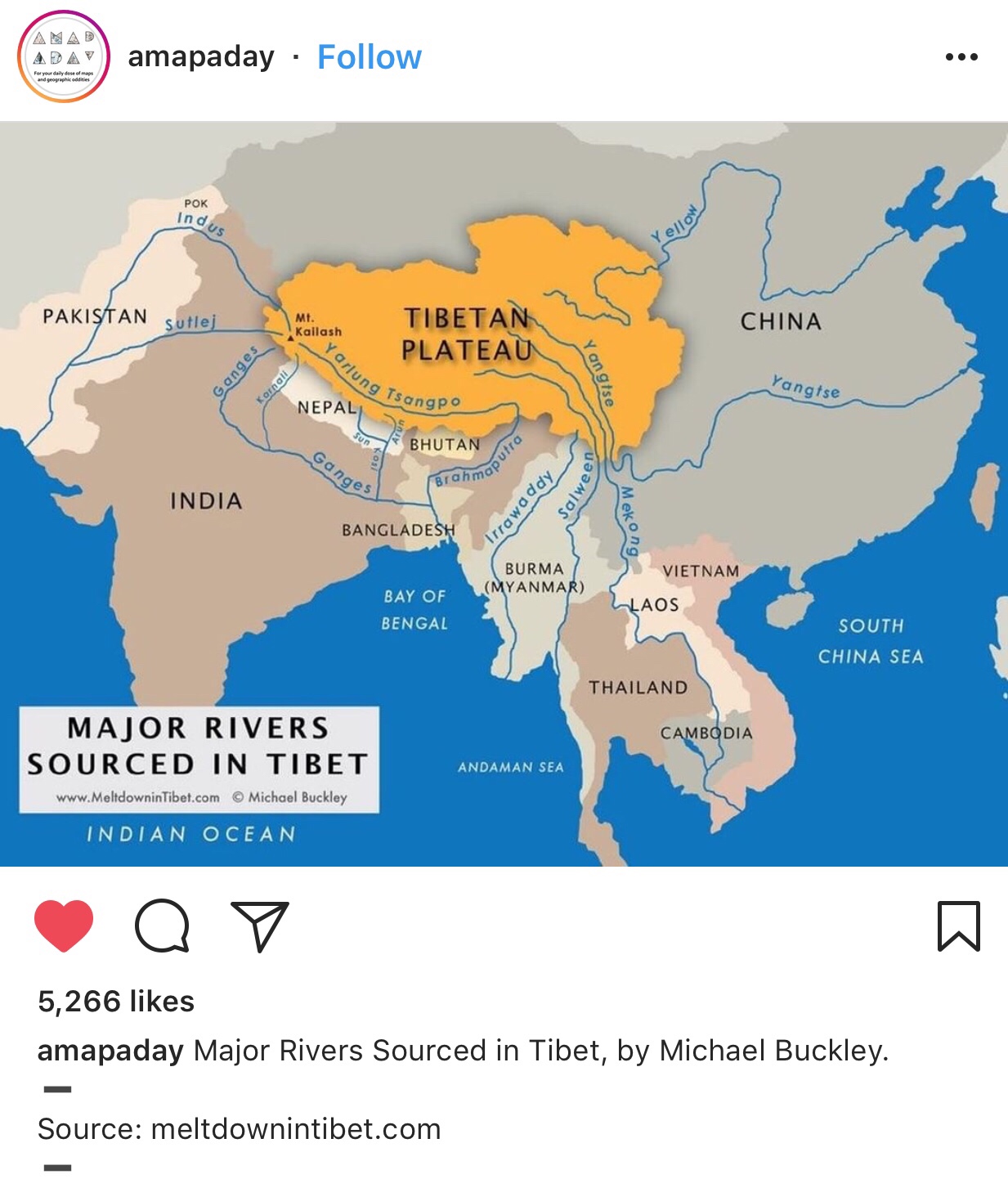
A few things jump out of this map:
(1.) Tibet is important, real important. These rivers feed half the world and these are the population centres of what we mean by “Asia.”
(1a.) Continents ultimately are arbitrary political constructs; what geographic feature cuts off Europe from Asia (is it really the Urals)? This map represents “core Asia” and more than ever I can see why the Middle East has an entirely different orientation. If a world government did ever come about; for fairness sake there would have to be some redistribution in how the Asian super-continent is treated; Africa’s population is burgeoning but difficult to see how it can match this.
(2.) It’s interesting to see how all the South Asian rivers have a common source (the Ganges has another source); a poetic meditation on the unity of the Subcontinent.
(3.) invaders or not; foreign or alien what is admirable about the Aryans is the extent to which they co-opted local traditions. As most readers of this blog know, Mt. Kailash is known as the home of Shiva and it literally feeds the Subcontinent.
(3b) Each initial wave seemed to have weaker and weaker ties to the land. The AASI seemed to have settled in the mists of pre-history, the (Elamitic?) Dravidian farmers may have fused with them to found the Indus Valley Civ.
(3c) the best way to think of the Aryan invasion is the Mongol conquests. The demographics of Central Asia and Mesopotamia shifted (and collapsed) as they did not (only) because of the rapacity of the Mongols but because of the failure to maintain the qanat (complex irrigation systems). I know that for a fact in Greater Iran whereas I can’t be sure that they used qanats in Mesopotamia.
(3d) At any rate either the Aryans filled in an ecological collapse (which seems unlikely since they spread with a rapidity elsewhere meaning that they had some technical and military advantage) or they triggered it. The indigenous compounded Dravidian-Negrito/Australasian (sorry for the loaded terms but easier to use Arya/Dravid than the newfangled terms) collapses and the remainder population did a Latin America where Aryans males were polygamous and high status.
(3e) the Aryans were the last invaders to both fully merge and embrace India as their core civilisation. The Muslim (Turkic?) invaders were oriented West and the British even further West. Each succeeding invasion wave was invested in India by an order of magnitude less than the preceding wave. The English returned to their colonies, the Muslims created Pakistan and the Aryans kept Aryavarta while the Dravidians have their local politics that tie them (especially in TN; the heart of the Dravidian movement).
(3f) I know it’s contentious but I would imagine the AASI would be like the Negrito coastal population and a related equivalent further upriver in the Indus prior to the Dravidian farmer wave. Prehistory was probably pretty ugly and tragic we just don’t know about it as we don’t have records but think the New World repeated time and time again.
(4) a final point as to why Iran may not have had as much a genetic impact. The Iranian plateau is exactly that a plateau. As I was told in Tehran a couple of years ago by a geographic; the mountain is life, every city in Iran is based on hills and mountains the rest is all desert (fertile plains are in short supply). It’s probably why it’s difficult to effect population replace in Iran as it is in its neighbours (Turko-Mongols introversion in Central Asia, Arabs influx in Mesopotamia, Aryan “invasion” in the Indus).
That’s all I can think for now btw the title is a bit misleading since Aryans are always a good lede lol.