MP Tulip Siddiq & her aunt Sheikh Hasina

https://www.channel4.com/news/tulip-siddiq-questions-over-links-with-bangladeshi-ruling-party

This is why I dislike the Labour Party; they constantly make Faustian pacts with ethnic minority candidates.

However after seeing the full video I also feel it’s a hit-piece on MP Siddiq. It’s the perils of rising as a high-flying coloured woman; so many British MPS are so morally compromised that they don’t get the same scrutiny.

So it’s a very delicate mix of stubbornness, racism (so invisible as to not be noticed) and the need to “template” Bangladesh in a certain way.

I was speaking to a Bangladeshi friend of mine, who’s an Awami supporter. He would prefer a healthy opposition but Bangladesh’s economy seems to be glowing and people are happy.

He also mentioned that Bangladesh’s exports are higher than Pakistan’s now and that it’s doing better in many metrics; he couldn’t believe it until he heard Imran Khan say so himself.

So in many ways I feel that even though Sheikh Hasina is morally compromising herself, if she is able to rouse a sluggish Bengal tiger into full strengthen well then she mustn’t be so bad. Maybe Pakistan can do with a Sheikh Hasina, which ironically it may have had it the 1970 election had proceeded and her father had won it. We may have had alternating governments between a West & East Pakistan..

Toward a mature conservatism

India scientists dismiss Einstein theories:

In 2014, Prime Minister Narendra Modi told medical staff at a Mumbai hospital that the story of the Hindu god Ganesha – whose elephant head is attached to a human body – showed cosmetic surgery existed in ancient India.

I don’t comment much on Indian politics for two reasons. First, I think macroeconomic conditions and trajectories are more important than politics as such for a developing nation like India. Second, the details of the cultural and political dynamics within any given nation are really hard to grok from the outside.

That being said, the widespread percolation of this sort of pseudoscience and pseudohistory on the Indian Right is a problem and has analogs with instances in other nations (e.g., Mike Pence is almost certainly a Creationist). These beliefs are often (though not always) harmless in and of themselves, but they are indicative of deeper maladies in terms of epistemological hygiene.

I have Hindu nationalists who are broadly on the same empirical page as me. We differ on details of values and emphases. And I know they are somewhat embarrassed by these weird ideas about nuclear weapons in ancient India. The key is to keep a lid on it so it doesn’t capture the commanding heights (ergo, why I’m quoting Modi).

Addendum: One issue for me is that I have a hard time taking Indian pseudoscience seriously just as I have a hard time taking Creation Science seriously. Sincere, earnest, and sometimes bright, people taking absurd claims seriously and constructing models out of them strikes me as farcical and funny more than threatening.

Irano-Scythian Origins of the Pallavas

In an example of art imitating life; I was in Mahabalipuram last week reading up on the Persian origins of the Pallavas and then somehow there was a thread about it here on BP.

https://www.google.co.uk/amp/s/www.thehindu.com/todays-paper/tp-features/tp-metroplus/The-Pallavas-and-the-Pahlavas/article15376550.ece/amp/

https://books.google.co.uk/books?id=92zsCgAAQBAJ&pg=PA26&lpg=PA26&dq=pallava+iranian&source=bl&ots=Zi67DOl_c9&sig=FQhjHCOl4d7N00KKv6JJkH4sdwM&hl=en&sa=X&ved=2ahUKEwjGg9G3ydvfAhXV5-AKHbOUAXYQ6AEwGXoECAcQAQ#v=onepage&q=pallava%20iranian&f=false

The article I was actually reading (note it’s hideously jingoistic and downright offensive at times):

https://www.google.co.uk/amp/s/iranian.com/2003/05/14/indias-parthian-colony/amp/

Our South Indian podcast sort of fell through after the lead guest flaked out at the last minute (rather annoying in light that he insisted that we have a Dravidian focus).

We’ll probably now do a more general linguistics-genetics podcast and take it from there.

Ever since I got back from Chennai I’ve been ruminating on the “deep Hinduism”‘of the south. I have a few thoughts on it but it’s difficult to express them succinctly..

Books for 2019 on Central Asia and Islam

A comment below:

Need book recommendations. What are some great books on history of Islam and history of Persian Empire and Central Asia?

Empires of the Silk Road: A History of Central Eurasia from the Bronze Age to the Present
Lost Enlightenment: Central Asia’s Golden Age from the Arab Conquest to Tamerlane
The Silk Road: A New History
A History of Iran: Empire of the Mind
The Great Arab Conquests: How the Spread of Islam Changed the World We Live In
When Baghdad Ruled the Muslim World: The Rise and Fall of Islam’s Greatest Dynasty
In God’s Path: The Arab Conquests and the Creation of an Islamic Empire

South Indian Languages podcast

We are hoping to record a podcast on this important topic this weekend. Please share any questions you may have in the comment thread.

Of course we won’t be limiting ourselves to this topic but it was the request of our guest commentator, who is looking to correct the “North India” bias in our discourse.

It is not lost on me that apart from our Bang-Pak commentariat, virtually all of our regular commentators either are South Indian or based in South India.

It seems Aryavarta has boycotted BP?

Book Review: Flat Earth News by Nick Davies

One of the many things in life that fascinate me is the way something becomes news. In my previous life in Pakistan, I had the opportunity to explore this issue further. I interacted with plenty of journalists, both as a source of news and sometimes as a reporter. I was never involved in decisions that happened in the newsroom or any particular editorial decisions but I saw journalists working at close quarters. I was intrigued by many things and asked a lot of questions. One of my friends who used to work at BBC Urdu service once said that BBC’s way of reporting a story is to give everybody a chance to speak. If a bicycle is stolen from an apartment complex, BBC journalists would like to talk to the owner, the thief and if possible, even the bicycle. BBC’s standards are not widely followed in Pakistan (based on my limited view) and a lot of local reporting by correspondents of major newspapers and TV channels is cursory. I also became aware of this issue when I talked to people working at Punjab Lok Sujag, a non-gvovernmental organisation with local roots which had previously worked in making Punjab’s culture more popular (by staging plays in Punjabi, translating major works of fiction in Punjabi and holding an annual Punjabi mela [fair]).

I recently read a excellnt book that dealt with issues of all things ‘news’. It was published in 2007-8 by British journalist, Nick Davies. He spent most of his career working at the Guardian and The Observer in England but he did oversees stints in Australia and United States as well. The book starts off with an exploration of the ‘millenium bug’ story that gripped the attention of a lot of people at the turn of the twentieth century. I’ll let Mr. Davies do most of the talking here.

Where did the millenium bug story start?

“As far as I can tell, the story first hatched one Saturday morning in May 1993, in Toronto, Canada. Inside the city’s Financial Post, on page 37, there was a single paragraph. Under the headline, ‘TURN OF CENTURY POSES A COMPUTER PROBLEM’, the story recorded that a Canadian technology consultant called Peter de Jager was warning that many computer systems would fail at midnight at the start of the new century and that few companies had taken steps to head off the problem.

Rather like the B-movie egg which is laid by the alien in the dark corner of the peaceful suburb, this little story broke out of its shell and slowly started to distribute its offspring around the undefended planet. By 1995, it had spread out of North America into Europe and Australia and Japan. By 1997, bug stories were being sighted all over the globe. By 1998, they had multiplied tenfold, infiltrating media outlets of every kind, and they were still mutating and dividing, still penetrating more and more newspaper columns, more and more broadcast news bulletins until finally, as Millennium Eve approached, they achieved a global conquest of the media, tens of thousands of bug stories infesting almost every news outlet on the planet.”

The financial cost of the story

“Journalists reported that the British government had spent £396 million on Y2K protection. They also reported that it had spent £430 million. And that it had spent £788 million. The American government had spent far more, they said – $100 billion, or $200 billion, or $320 billion, or $600 billion, or $858 billion, depending on which journalist you were reading. Anyway, it was a lot. Beyond that, the private sector had spawned a mini-industry of companies selling millennium bug kits, while publishers turned out bug books and bug videos, and estate agents sold bug-resistant homes, and a few families sold their houses and fled to remote cabins in order to give themselves a chance to survive the coming bug-related chaos.”

How he defines ‘Flat Earth News’

“This [millenium bug story] is Flat Earth news. A story appears to be true. It is widely accepted as true. It becomes a heresy to suggest that it is not true – even if it is riddled with falsehood, distortion and propaganda”

An issue that befuddles ordinary consumers of news (like myself) is the difference between objectivity and neutrality. Should journalists be telling the truth (Objectivity) or just giving both sides of the story (Neutrality)?

“Neutrality requires the journalist to become invisible, to refrain deliberately (under threat of discipline) from expressing the judgments which are essential for journalism. Neutrality requires the packaging of conflicting claims, which is precisely the opposite of truth-telling. If two men go to mow a meadow and one comes back and says, “The job’s done”, and the other comes back and says ‘We never cut a single blade of grass’, neutrality requires the journalists to report a controversy surrounding the state of the meadow, to throw together both men’s claims and shove it out to the world with an implicit sign over the top declaring, ‘We don’t know whats happening-you decide’.

The damage goes further than merely abandoning the primary purpose of journalism. It actually transfers the truth-telling judgments out of newsrooms and into the hands of outsiders.”

Mr. Davies mentions that most of the news stories in major newspapers are lifted straight from news agencies, which could be local and global. Two global agencies that he talked about are Associated Press (AP) and Reuters.

“Just like PA (Press Association, England), their concern with accuracy is deliberately different from a newspaper’s concern with truth. One man who has spent many years as a senior executive from Reuters echoed Jonathan Grun from PA explaining to me that Reuters was not concerned about the truth. The agency would try to provide an accurate amount of an opposing point of view: ‘But it isn’t an agency’s job to start choosing between these voices and saying who is telling the truth’. All the great flat earth news stories have travelled via wire agencies into the unprotected global media.  It was AP and Reuters who told the world about the millenium bug and the weapons on mass destruction, who carried the myths about drugs and crime and radiation and education and all the other Huckers, big and small. All these stories were accurate, in that they faithfully recorded what somebody had said; none of them were true”.

The epilogue of the book starts with some golden words from The Simpsons: “Journalists used to question the reasons for war and expose abuse of power. Now, like toothless babies, they suckle on the sugary teat on misinformation and poop it into the diaper we call the six ‘o clock news”.

Marathas, Mauryas & Moghul

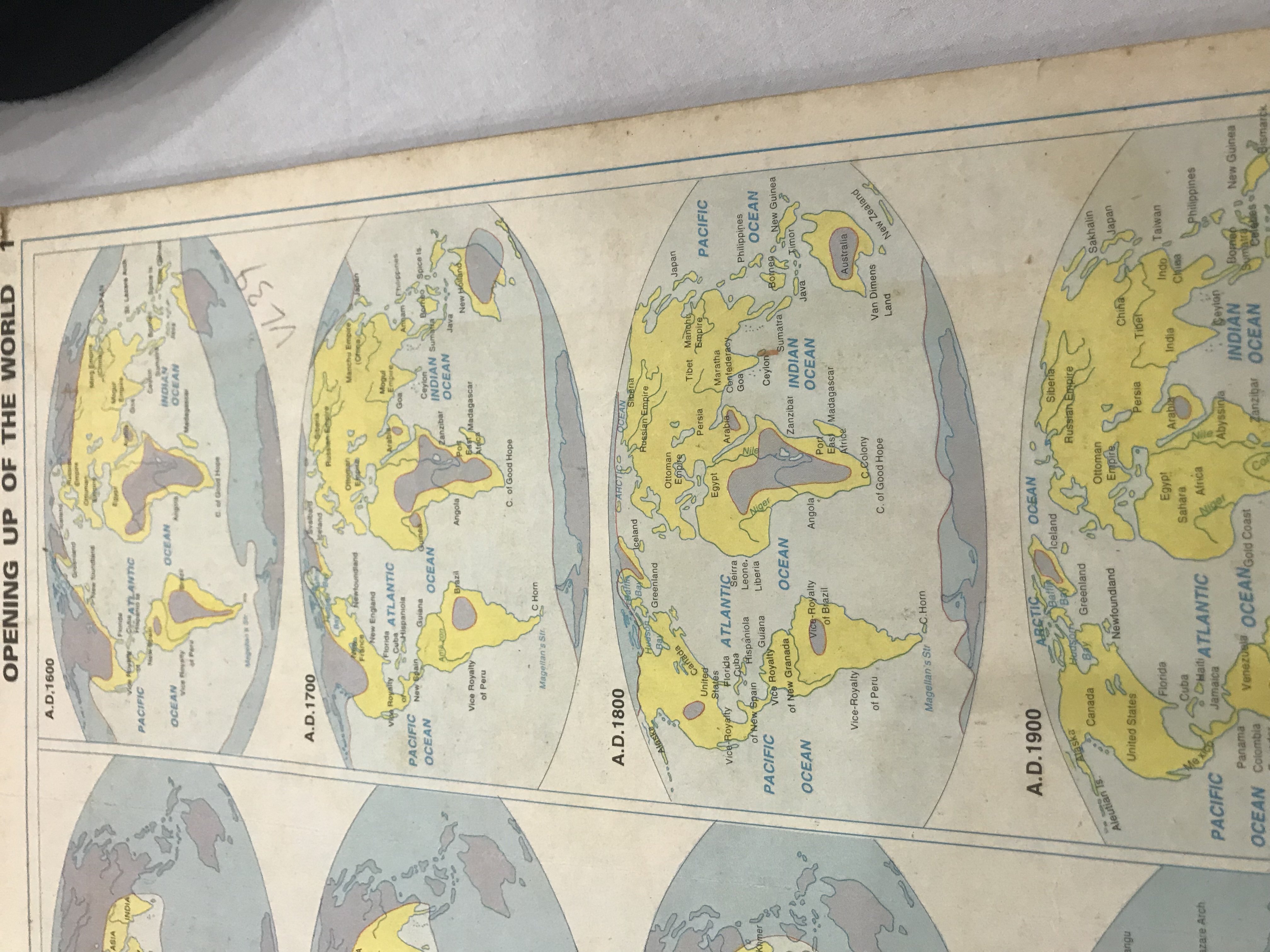
The comments thread talked about the education history of Indian school kids. This is LV’s atlas book that I came across. I found it interesting that India went from Moghul to Maratha to Independence. If only it were so 🙂

On an unrelated topic I have noticed why Desis and third worlders (partially) obsess over skin colour to the extent that we do. People in the third world (generally) have bad complexions in comparison to the West. The skin clarity is poor because of grooming & pollution. So fairness creams are a “hack”‘ to simply improve the “quality” (transparency) of the skin. Also the unfortunate fact remains that colour is correlated with caste & class.

Bangladesh elections

Update: This win seems too big to be credible. But I don’t really know…. Bangladesh Prime Minister Wins 3rd Term Amid Deadly Violence on Election Day

End Update
Bangladeshis Must Choose ‘Lesser of Two Evils’ in Election:

Per capita income has increased by nearly 150 percent, while the share of the population living in extreme poverty has shrunk to about 9 percent from 19 percent, according to the World Bank.

Electricity generation has also increased drastically under Mrs. Hasina’s rule, helping to boost factory production and spreading out to homes in rural areas. The rates of maternal mortality and illiteracy have also declined.

Sultana Kamal, a Bangladeshi activist who was once close to Mrs. Hasina but has become increasingly wary of her, said a win by the current government would be seen as an indifference by voters to rights concerns.

From what I know most of my family generally supports the Awami League. My parents do, and I have an uncle who is an activist in that party. As an atheist I sympathize more with parties less keen on allying with Muslims who are excited to kill atheists. But….the Awami League seems to have gotten quite a big head, and Sheikh Hasina is becoming Bangladesh’s Indira.

If it’s the choice between economic growth and human rights, I think voters would choose the former. But I suspect that many will bet that economic growth is due to endogenous forces which are not controlled by the government, and will switch parties to rebalance the political system.

Brown Pundits