Tony Joseph’s Early Indians

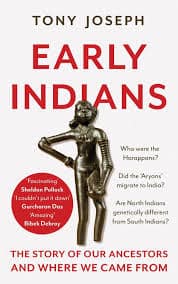
My review of Tony Joseph’s new book, Early Indians: The Story of Our Ancestors and Where We Came From, is now up at India Today.

In general, I liked the book, and have only minor quibbles with Joseph’s reportage of the genetic results. He has very particular interpretations of results on some questions, but his core audience of Indians will be focused on this, not the minutiae of D-statistics. For example, it seems to me that he gave a great deal of emphasis to the aboriginal heritage of South Asians in quantity and impact. This is a defensible stance, but it’s not a necessary one dictated by the results from the data.

The non-genetic assertions I had less background on, and so did some literature review by following Joseph’s copious citations. In these “fuzzier” fields it is harder to establish a consensus from what I can see (the number of opinions of linguists on any topic seems to equal the number of linguists!). The downside is certain conclusions are not there yet. The upside is there is still scholarship that will be done.

Overall, get Early Indians. But read with some caution and use it as a sourcebook for follow-up queries.

No such thing as South India

The original article by Mahatma’s grandson is equally intriguing, People of the South constitute an equal and single community: Rajmohan Gandhi.I don’t have too many opinions on this (for a change) but my inclination is that caste (and then creed) have dramatically reduced regional identities in India.

The states that have been most problematic to the Indian Union (East Punjab, Srinagar area, 7 sisters) have more homogenised profiles (and incidentally happen to be on the periphery). Continue reading No such thing as South India

Mother India is Communal

I don’t really know what to say but it’s absurd. I can’t understand what’s so offensive about “Mother India.”

I’m walking around Chennai and so many Muslim ladies are wearing Niqabs (the eyes are only seen).

https://twitter.com/seedsofdoubt3/status/1078530333585346560?s=21

Continue reading Mother India is Communal

I stand with Sajid on Pakistani Pedophilia

Speaking to BBC Radio 4’s Today programme, Javid said stripping offenders of British citizenship would happen only in extreme cases involving individuals with dual nationality.

He was pressed on the issue by the programme’s guest editor, the Pakistani-British writer Kamila Shamsie, who pointed out that the lack of sex offender registers in Pakistan would make it easier for offenders deported from the UK to repeat their crimes.

Javid responded: “I’m the British home secretary. My job is to protect the British public.”

Seeking to clarify, Shamsie asked: “If you are sending members of grooming gangs to Pakistan, knowing that there is not a sex offenders registry, what they do there is not anything to do with you?”

Javid said: “My job is to protect the British public.” Continue reading I stand with Sajid on Pakistani Pedophilia

Demonetisation will lead to DeModisation-

The Indian Property prices took a wobble after demonetisation and despite my admiration for PM Modi, what deeply upsets me is that he attacked the middle classes.

The whole idea of “cleaning up India” is that it needs to be a top down effort. Beyond chasing Vijay Mallya and Nirav Modi there are oligarchs in India who cripple the country. Continue reading Demonetisation will lead to DeModisation-

Why India must become the Hindu Israel!

https://twitter.com/dvatw/status/1077870550163300353?s=21

Happy Boxing Day; just had a lovely walk around Chetpet EcoPark. I was shocked to find out that allegedly it cost 25 Crores (allegedly).

There is a trend in the West that the Parties of the Left can only unite their diverse coalitions of minorities (gays, blacks & feminists) with straight middle class male WASPs (Justin Trudeau, Jeremy Corbyn, Beto O’Rouke). Continue reading Why India must become the Hindu Israel!

Structural Conflicts between Bharat and India

The Indian Republic has a problem. It is deep and structural and vexing. The wheels of industrialization have brought half the country in conflict with the other.

The country is seemingly convulsed with agrarian distress and farmer unrest. Some have located these issues in climate change, others in the prominence of neo-liberal reform. But the issue is far more structural. Half of India knows only to make a living from farming, and they are seemingly getting better at it every year.

India’s farmers have been outperforming the world in terms of growth quite comfortably.

So if we are having year after year of record agrarian yields and remain a next agro-exporter, whats the problem ? The problem is that the other half wants food at the cheapest prices possible. This other half lacks the decisive political numbers that the rural group does, but lives in the more vocal and wealthier urban areas. Farmers obviously  want better prices for their work, but urbanites are understandably wary of overpaying for food when they know they can spend their hard earned monies on modern goods and services.

But the conflicts dont end there. They extend into the realm of international trade relationships. India’s urbanites want to interact with the industrial world for personal growth and opportunity. India’s IT, pharmaceutical exports and remittances provide valuable foreign exchange for its fuel imports, and investment needed for modernizing its economy. But the industrial world is also super efficient at growing food and sees food as an important export. One American farmer can still produce what 50 Indian farmers can.

The Indian farmer thus requires protection from foreign competition, which is far more advanced technologically and is not constrained to small land holdings like he is. But such protection is not in congruence with the freer trade that its urbanites want and need for industrial growth.

Food inflation and international trade are thus two critical parameters on which rural and urban India face a structural conundrum. It is not that other cultures have not faced this crossroads before. Every country that has industrialized (Germany, Russia and China) has dealt with the question of its unproductive agrarian class. Authoritarian political structures meant that the ‘solution’ pursued by these countries brutalized the rural populace.

India’s democracy is deep and will prevent the urban elites from executing such brutality, despite their cultural and historical obsessions. Gaon tatva might seriously blunt Hindutva.

 

Brown Pundits – Episode 6, Chinese history, pop culture and strategy, with Tanner Greer

The latest BP Podcast is up. You can listen on Libsyn, iTunes and Stitcher. Probably the easiest way to keep up the podcast since we don’t have a regular schedule is to subscribe at one of the links above.

Thanks to everyone who reviewed the podcast! Please leave more 5-star reviews. If this podcasts interests enough people I’ll be getting us on other platforms.

This week a very special episode of Brown Pundits’ BrownCast with Tanner Greer of The Scholar’s Stage, one of my favorite weblogs. If I’m a philosopher in the armchair, Tanner is a practitioner in the field. He lived for several years in China, and his observations have a contemporary salience that our discussion last week probably lacked.

Brown Pundits