Twitter Thoughts

I took some time out from BP after the torrid comments section. I had deleted the WordPress app off my phone and that was that. But everything seems to have arranged itself quite nicely in my absence so it’s a good time to dive right back in. England of course are likely contenders to win the World Cup and if so – we will have a very good Brexit.

It’s also been a very humid July and I’ve reflected on why Social Media silently murdered the Blogsophere. The winning quality of Social Media is that one is interacting with individuals whereas on Blogs it’s scattered thoughts in the wind. There is no context or real depth to a comment thread because of the anonymous factor, which I think really detracts from conversations.

Other than that I spent some time sprucing up my Twitter. I left Twitter after the June 2017 elections because they refused to give me a blue tick (vanity upon vanities). After the link are a few excerpts of my recent Twitter threads. I want to eventually expand them into posts but the good thing about a Twitter thread is that it suits my “stream of consciousness” writing style.

Continue reading Twitter Thoughts

Passing as Black

In 2015, Indian-American Vijay Chokal-Ingam, brother of actress Mindy Kaling, went public with his story of posing as a black man to benefit from race-conscious admissions policies at medical schools. He claimed in a CNN story that affirmative action “destroys the dreams of millions of Indian-American, Asian-American, and white applicants for employment and higher education.”

Chokal-Ingam applied to 14 schools and was admitted to just one, St. Louis University. He only applied using his false “black” identity, and although he never applied as an Indian-American, he assumes that he got into St. Louis University because he was “black.”

Image result for Vijay Chokal-Ingam

Bhadralok are made not born

Tanushree Dutta is a Bengali Kayastha

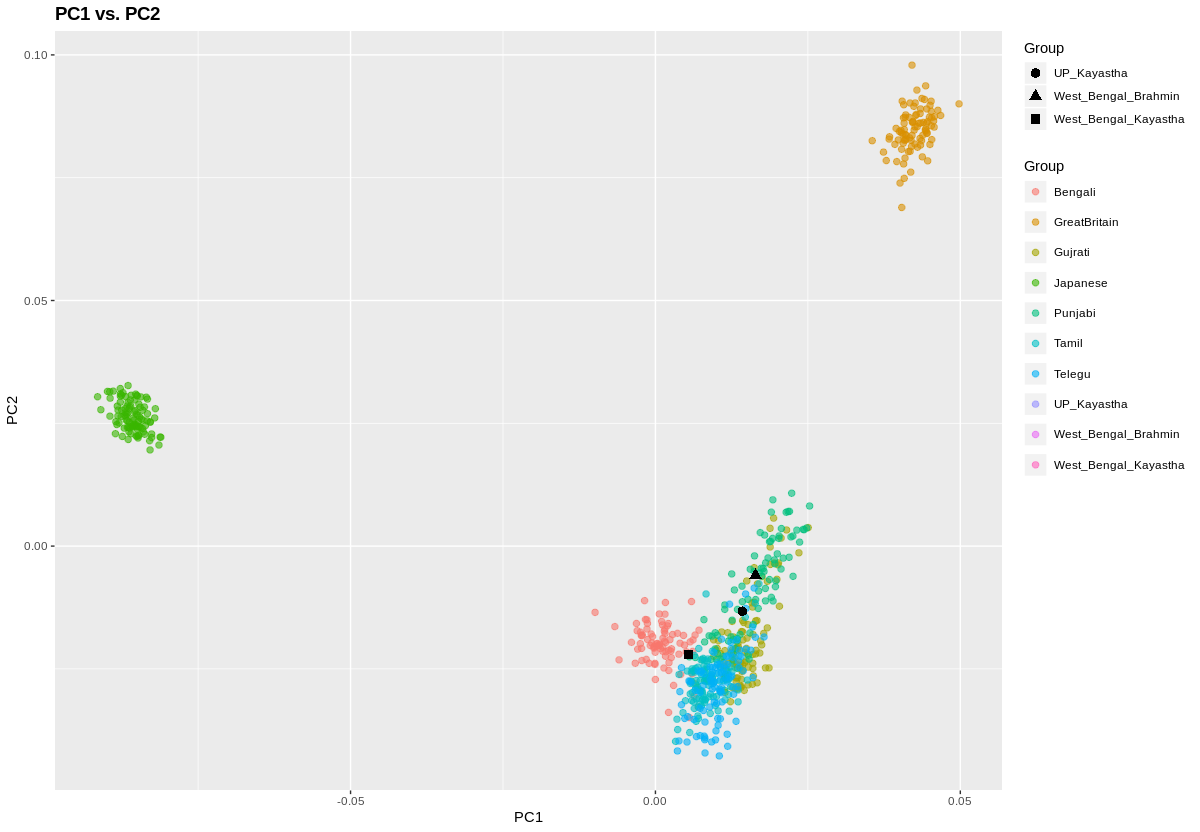
I have two samples of full ancestry from West Bengal. A Kayastha and a Brahmin. You can see where they plot.

Bengali Brahmins are very similar to North Indian Brahmins (often they have some “eastward” shift). In contrast, the Kayastha individual looks like the Bangladeshi samples, except with far less East Asian ancestry.

I do want more samples. Though I’ve gotten a few Bengali Brahmins and they exhibit the sample pattern as above. I am curious about non-Brahmin West Bengalis. But from the above, I think I will conclude that the hypothesis that Kayasthas are a cultivator caste which uplifted themselves occupationally is probably the right one.

Muslims and Urdu in India

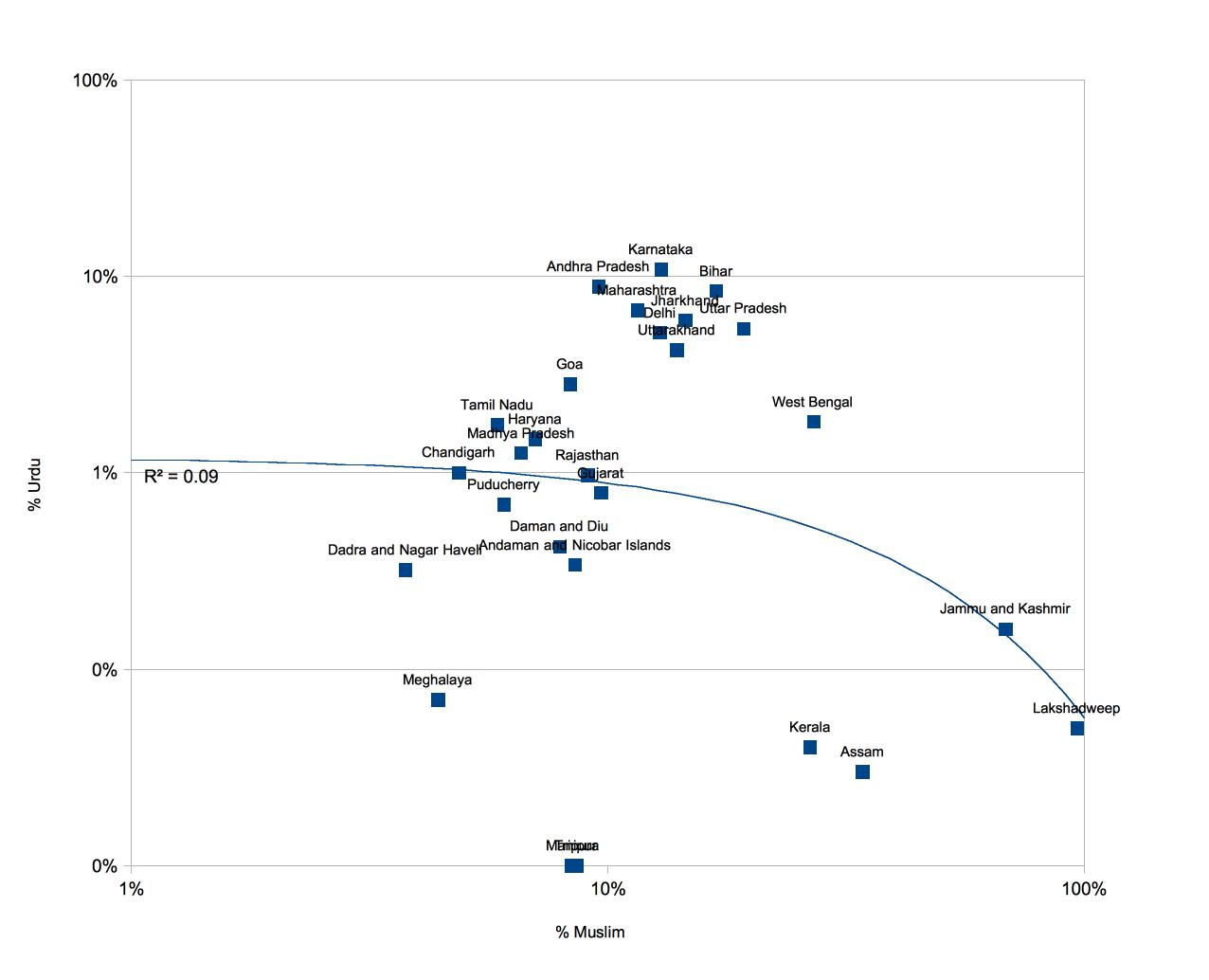
The plot above shows the % Urdu speakers vs. % Muslim in states where Muslims are 4% or more of the population. The data is from Census 2011 (thanks for Vikram of the language data). There are some interesting trends. Assuming that the vast majority of Urdu speakers are Muslim, it seems that in India the core Urdu-identified region is in the Deccan and to the east of its traditional heartland, in Bihar. In South India, 30% of Muslims in Tamil Nadu may be Urdu-speaking. But in Kerala the fraction is almost zero, while in Gujarat and West Bengal less than 10% of the Muslims are Urdu-speaking.

Below the fold is the table.

Continue reading Muslims and Urdu in India

Post Modernism (a)

This is a follow up to:

A much longer article on post modernism is planned. For now, please see Professor [Dr.] Stephen Hicks’s 153 minute summary of how post modernism emerged from European Enlightenment, Modernism, Kant, Friedrich Wilhelm Nietzche, Marx, the failure of Marx’s economic predictions 1800s to 1950s (about the gradual reduction in the number of middle class, rich people; and the stagnation of proletariat wages), the moral catastrophe created by Nikita Sergeyevich Khrushchev’s 1956 revelation of Stalin’s atrocities communist regime atrocities.

For the record Professor Hick’s acknowledged that his short summary is a very inadequate and incomplete summary of the foundations of post modernism. For example the roles of Jean-Jacques Rousseau, Ferdinand de Saussure and Freud are not mentioned.

I would start watching 1 hour 17 minutes to 22 minutes. In the 1950s four bright very far left academics [Leotard, Foucault, Derrida, Rorty] tried to create a new left [also called post modernism] to revive the globally devastated leftist brand image.

Start watching again 1 hour 42 minutes in as Prof Hicks discusses the internal logical inconsistencies of post modernism. I would slightly modify the good professors’ arguments and summarize these inconsistencies as follows:

  • post modernists say all truth is relative yet imply their cultural ethnocentric view is true
  • all cultures are equally deserving of respect yet Eastern Arya culture and to a lesser degree western culture are especially destructive and bad
  • values are evil yet sexism, different perspectives on LBGTQ and racism are really evil
  • Technology is bad and destructive, yet it is unfair that some have more technology than others
  • Tolerance is good and dominance is bad, yet when in power political correctness (a lack of freedom of art, thought, intuition and feeling) dominates

Foucault is described 2 hours and 1 minutes in as a pro Maoist  socialist. Friedrich Wilhelm Nietzche is described 2 hours 3 minutes in as in some ways the inspiration for post modernism. However if he were alive today he would likely be strongly opposed to post modernism’s celebration of victimization, slave or weakness mentality.

On the whole this is a very informative presentation on post modernism. You can also watch this video by Stephen Hicks (who many consider to be part of the intellectual dark web):

https://www.youtube.com/watch?v=lkfH87CgKOQ

Dalits in Bangladesh

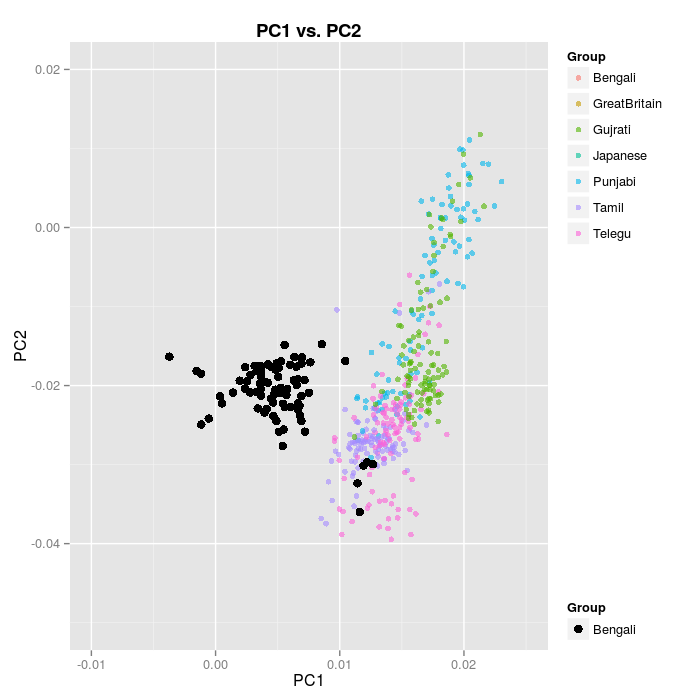
When I looked at the 1000 Genomes data five samples collected in Dhaka, did not align with the others. Most Bengalis are shifted away from other South Asians because of East Asian ancestry. These five individuals, in contrast, clustered with Tamil and Telegu Dalits. Importantly, their identification numbers indicate they were sampled at the same time.

This highlights the fact that a large community of Dalits live in Bangladesh, Dhaka Dalits push for anti-discrimination law:

A considerable number migrated into what is now Bangladesh between 1835 and 1940, during a British-sponsored urbanisation plan. They worked in jobs such as road sweeping, clearing sewage, shoe repair and tea harvesting. This historical legacy of working in low-paying, difficult jobs continues today.

The genetic data suggest to me that they are indeed descendents of migrants.

The decline in South Asian poverty

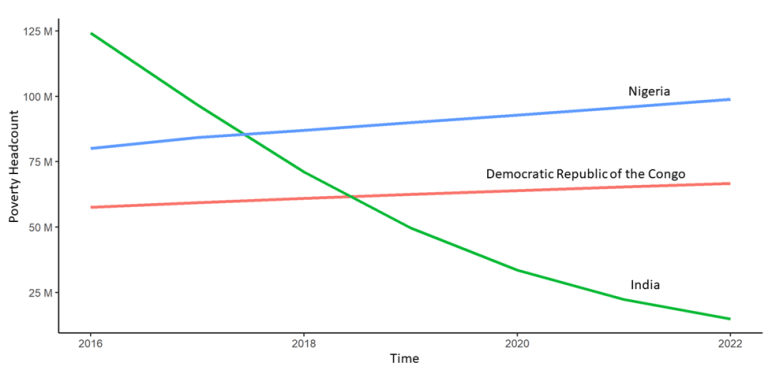
It has long been asserted that South Asia may make average strides economically, but it is still in absolute terms the locus of most of the world’s grinding poverty. This may not be true much longer. In particular, some estimates now suggest that India is no longer the world’s “leader” in extreme poverty in absolute terms. From Brookings, The start of a new poverty narrative:

According to our projections, Nigeria has already overtaken India as the country with the largest number of extreme poor in early 2018, and the Democratic Republic of the Congo could soon take over the number 2 spot (Figure 1 below). At the end of May 2018, our trajectories suggest that Nigeria had about 87 million people in extreme poverty, compared with India’s 73 million. What is more, extreme poverty in Nigeria is growing by six people every minute, while poverty in India continues to fall. In fact, by the end of 2018 in Africa as a whole, there will probably be about 3.2 million more people living in extreme poverty than there are today.

Bangladesh has been making progress as well, from the World Bank:

Bangladesh has made remarkable progress in reducing poverty, supported by sustained economic growth. Based on the international poverty line of $1.90 per person per day, it reduced poverty from 44.2 percent in 1991 to 13.8 percent in 2016/17. In parallel, life expectancy, literacy rates and per capita food production have increased significantly. Progress was underpinned by 6 percent plus growth over the decade and reaching to 7.3 percent in 2016/2017, according to official estimates. Rapid growth enabled Bangladesh to reach the lower middle-income country status in 2015. In 2018, Bangladesh fulfilled all three eligibility criteria for graduation from the UN’s Least Developed Countries (LDC) list for the first time and is on track for graduation in 2024.

Here’s GDP for South Asian countries in 2005 dollars:

I left Bangladesh in 1980. Not too long after I was born. I went back to visit in 1989 and 2004. In relation to 1980, per capita GDP was 1.15x. in 2004 it was 1.6x. In 2016 it was 2.9x. So over the past 14 years there’s been a 2x increase in GDP per capita in Bangladesh! The equivalent figure in the United States is 1.1x.

Why not Persian for the pre-1971 Pakistan ?

Update: I’ve undeleted this since Zach has admitted that he overreacted below. If you want me to trash this post again Vikram just leave a comment below and I’ll do so. -Razib

I understand the nostalgia and desire for an Islamicate language among the Ashraf elite of British North India. After all, Hindus have a similar desire to live in the house of classical Indian languages, and the vast majority of Hindus give their children names from these languages.

But what baffles me is the the Ashraf insistence on Urdu. Choosing Persian as the national language of Muslim South Asia would have had many benefits:

  1. Just like Hindus, whether Kashmiri or Marathi, have a reverence for their classical languages (currently mainly Sanskrit for North Indian Hindutva types, but with a bit of maturity this sentiment also extends to other Indian classical languages), Muslims whether Sindhi or Bengali see Persian and Arabic as their classical language. This would have dramatically reduced the internecine conflicts amongst South Asian Muslims due to language.
  2. Persian as a national language would cement Pakistan’s relation with the Iranic world (and thus the core Muslim world), which is the ancestral land of much of the Muslim Ashrafi in South Asia. South Asian Muslims would come into deeper contact with a sophisticated and highly cultured Muslim population.
  3. Muslims of South Asia would have access to a true, expansive classical literature (including heroic epics, not just romantic poetry) dating back to antiquity, much like Indians have access to classical literatures in Sanskrit, Pali and classical Dravidian. This would diminish the need for extreme religiosity as the glue for holding the Muslim nation together, and produce a far larger, self confident cultural output.

On the other hand, the choice of Urdu created quite a few issues for the preservation and growth of Islamicate culture in South Asia:

  1. At the end of day, Urdu is an Indo-Aryan language with Sanskrit grammar and substantial Sanskrit vocabulary. Even the most Arabo-Persianized version of Urdu (Pakistan’s official Urdu) has at least 40% Sanskrit and Prakrit vocabulary. More so, since Hindus speak Hindi, which has the same grammar, but a steadily increasing Sanskrit vocabulary, it leaves Urdu perpetually vulnerable to an increase of Sanskrit vocabulary.
  2. Some key words in Urdu like aap and sakna have roots in Hindu concepts (aap comes from aatma, the higher self) and sakna derives from Sanskrit shakt, which has a higher meaning in Shakti, the feminine divinity of Hinduism, walla from pal, which means protector.
  3. Muslims in Pakistan and Bangladesh, already have their own languages and literatures, especially the Pashtun, Bengalis and Sindhis. No wonder the imposition has led to substantial conflicts instead of synergy towards the ultimate goal of a sophisticated, modern Muslim culture in South Asia, which is also shared by these populations.

All this leaves me baffled as to why the Muslim Ashrafi were so insistent on Urdu. My best guess is that they mistakenly felt that Urdu was a variant of Arabic and Persian, with no real Sanskrit influence. This is quite possible since the different language families would not have been widely known then, and since Urdu was written in the Arabic script, which is dramatically different from Indian ones.

In any case, the Ashrafi insisted on Urdu. This led to a breakdown of Muslim nationalism when Bangladesh separated. Bangladesh now uses an Indic script, and speaks a language with mainly Sanskrit vocabulary. On the other side of the subcontinent, for the first time in more than two millennia Pashtuns could be under more Indic influence than Iranic (this might change as Iran rises again). Within India, Urdu has declined dramatically, as Muslim families in UP and elsewhere have reconciled themselves to Hindi[1]. Knowing Urdu leaves Pakistani Muslims vulnerable to a substantial amount of Hindu literature and concepts via television shows and Hindi movies.

None of these could have been the goals of the Ashrafi when they demanded a Muslim homeland.

[1] – Urdu is the only scheduled language in India that registered a decrease in the absolute number of speakers between 2001 and 2011. Its proportion of first language speakers has decreased from 5.22% in 1971 to 4.19% in 2011, despite an increase in Muslim population percentage.

Brown Pundits