Women In Vedas | Aryaa – An Anthology of Vedic Women | Shivakumar GV

I spoke to Shivakumar GV on The Indic Explorer Show who curated an anthology collection of multiple writers on different stories representing the women in the Vedas and other Hindu classical Literature.

The Indic Explorer YouTube channel focusses on the interplay of Indic culture with modernity explored through different facets in the socio-cultural sphere.

Do subscribe to the channel at https://www.youtube.com/theindicexplorer

and follow me here

Twitter- https://twitter.com/theindicexplor1

Instagram- https://www.instagram.com/theindicexplorer/

Substack-https://digitaldharma.substack.com/

Spotify – https://spotifyanchor-web.app.link/e/MobfQp83uzb

The Indic Explorer Show Ep 35 – State of Modern English Theatre in Chennai

On the 35th Episode of The Indic Explorer Show, I spoke to Theatre Director Ajit Chitturi on the status of Contemporary English Theatre in Chennai.

The Indic Explorer YouTube channel focusses on the interplay of Indic culture with modernity explored through different facets in the socio-cultural sphere.

Do subscribe to the channel at https://www.youtube.com/theindicexplorer

and follow me here

Twitter- https://twitter.com/theindicexplor1

Instagram- https://www.instagram.com/theindicexplorer/

Substack-https://digitaldharma.substack.com/

Spotify – https://spotifyanchor-web.app.link/e/MobfQp83uzb

The Indic Explorer Show Ep 34 – History of Goa & The Horrors of Goa Inquisition- with Archeologist Sawani Shetye

On the 34th Episode of The Indic Explorer Show, I spoke to Archeologist Sawani Shetye from Goa. She spoke the history and culture of the state, its portrayal in the media & popular cinema and most importantly we had a detailed discussion on the Portuguese Inquisition of Goa.

The Indic Explorer YouTube channel focusses on the interplay of Indic culture with modernity explored through different facets in the socio-cultural sphere.

Do subscribe to the channel at https://www.youtube.com/theindicexplorer

and follow me here

Twitter- https://twitter.com/theindicexplor1

Instagram- https://www.instagram.com/theindicexplorer/

Substack-https://digitaldharma.substack.com/

Spotify – https://spotifyanchor-web.app.link/e/MobfQp83uzb

Unraveling an Unequal Night in Boston

In a charming North End Italian café, DLV and I encountered an odd closing time scenario. The white presenting waitress told us that the cafe was closing in 10 minutes on our arrival, but when a white couple entered roughly 6 or 7 minutes later, she mentioned that the cafe would be closing in 15 minutes within our clear earshot.

Amid Boston’s historic charm, I noted the waitress, seemingly “ethnic white,” spoke Spanish (until that moment I hadn’t assumed Hispanic but rather Italian), which somehow dissuaded me from leaving a review as this lent an additional complexity to the matter.

Upon deeper reflection on the encounter, it became apparent that the white adjacent waitress was navigating her internalized racial preferences, manifested in a slightly delayed service (though I did not skimp on the tip). In the diverse context of Boston, where overall demographics show 44% white, certain historic neighborhoods like the North End and Beacon Hill exceed 90% white, revealing profound and unspoken hierarchies.

This incident sparks an intriguing discussion on privilege and its intersection with race. I chose not to make a fuss or challenge the matter, a decision that might have differed in a high-end restaurant in central London, where such disparities would have been much more conspicuous. I observe that the restaurant and hospitality industry in the United States resembles a glass of beer, with white supervisors overseeing teams predominantly comprised of black and brown individuals, so it’s not as straightforward to challenge.

Racial microaggressions (immediately post the pandemic was terrible as hospitality staff were just annoyed to be back at work) within the British restaurant industry have notably diminished as South Asian students are becoming a large part of the workforce. These individuals demonstrate an immediate understanding of how to navigate Desi clientele, although I cannot speak to their interactions with other demographic groups of customers.

The India They Saw: When Socrates Met the Sindhu

Time was a cycle for the wise ones. The glittering stars of the heavens danced to the rhythm of the gods. A thousand mind-born Manus had birthed a thousand humanities. The Blessed Lord had sung his sacred song to a thousand suns and a thousand Arjunas. The divine comedy of karma had crossed a thousand ironies and a thousand tragedies. So for thousands of years, those believers of this great cycle, the Indians, did not write their histories. Indian history became stories moving from ear to ear. A magical tongue rang around sacred fires as these stories soon morphed into a society.

Soon etchings would erupt along the Indus, the Saraswati, the Ganga, the Yamuna, and more and more rivers. Many were lost with time as the history of India captured in its early construction returned to the soils and sands from whence it came. But some etchings evolved. The Itihasa and Puranas would form a cultural encyclopedia of ancient India. Poetry and prose defined its people.

The successors of these great reservoirs of Dharma were the Sramanas. Lord Mahavir and Lord Buddha would turn the wheel of Dharma as a grand march of fire-cloaked mendicants began across India and beyond into the unknown realms of Asia. India entered the Axial Age with a turning of the mind. In the golden shadows of these Mahatmas, we find some of the first records of those who journeyed to India – of the Greeks and the Romans. This is the India they saw.

Continue reading The India They Saw: When Socrates Met the Sindhu

The Denizens & Dilemmas of Indo-Amerikhana

Migrations have defined the story of humanity. From the great exodus out of Africa to taming the Patagonian wilds, layer upon layer of settlement would create continuums of people across the world. Jawaharlal Nehru, India’s first Prime Minister, would describe this layering of society as a palimpsest, a parchment on which the original writing had been reused or refaced with new writing yet fragments of the old remain. No two societies fulfill this idea of a palimpsest better than India and America, albeit in different ways. Rhodes and Romans and the Renaissance and Rousseau would form a chain of thought bursting into a revolution as America recognized the Atlantic and ripped itself from Great Britain. Integral to this upstart nation was immigration. Echoing their fantastical Roman roots, Americans would be raised by wolves in this new wildland and welcomed any man dogged enough to join their ranks.

BHICAJI BALSARA, THE FIRST INDIAN TO GAIN AMERICAN CITIZENSHIP

A dream was promised and sung across the world of this virgin country of opportunity and tenacity. This torch-bearing democracy would soon attract denizens of a land that hosted one the earliest forms of democracy in the world. Small numbers of Indians would settle on the golden coast of California in the 19th century. The iconic American revolutionary zeal and thirst for democracy would inspire some Indians to found the Ghadar Party in San Francisco in order to fulfill the destiny of a free India. Bhicaji Bhalsara, a Parsi from Bombay, was the first Indian to gain naturalized US citizenship in 1909 after a lengthy court battle. A small trickle of immigration would continue until the 1965 Immigration and Nationality Act did away with national quotas paving the way for larger amounts of Indians to migrate.

Continue reading The Denizens & Dilemmas of Indo-Amerikhana

New England’s terrible Desi Food scene

As I prepare to return to the Old World later tonight, I find myself reflecting on one of the most challenging aspects of my time in New England this past month—the notably subpar quality of Indian cuisine in the area (I also tried Desi Pizza).

With the exception of Madras Dosa Company in Harvard Square, the local culinary landscape is disappointingly lackluster. While some restaurants may boast high Google ratings, they fall short of meeting the standards I’m accustomed to in the UK.

London, in contrast, offers an exquisitely diverse Indian food scene that allows enthusiasts to explore various regional cooking styles, with places like Fat Pundit leading the way in innovating Indo-Chinese fare.

In any case, I’ve encountered difficulties with the flavors in the USA. Ingredients seem oversized, yet their flavors often appear muted. I’ve come across information suggesting that chicken in the 1960s was smaller but possessed more distinctive flavor (as evidenced by Julia Child’s recipes, which apparently assumed chicken to be inherently flavorful).

I’ve also observed that white Americans, or those not of Indian descent, don’t seem to embrace Indian cuisine in the same way that the British do. In the United Kingdom, Indian food is almost a culinary religion, even if the takeaway options may not meet the standards of native Desis. This fervor has created an environment for Indian food giants like Dishoom to flourish. On the other hand, Americans appear to have a stronger affinity for Chinese and Mexican cuisines as their primary choices of ethnic fare.

I’ve heard that Manhattan and the West Coast offer a more diverse and satisfying array of Indian food options, likely due to the critical mass of desi communities. I also suspect (Dr. Lalchand smirks at this last residue of ethnic chauvinism) that Pakistani restaurants might offer more tantalizing experiences in the US, which is the opposite of the situation in the UK, where Indian-owned and run establishments tend to excel as a rule.

Two Zacks meet in New Cambridge

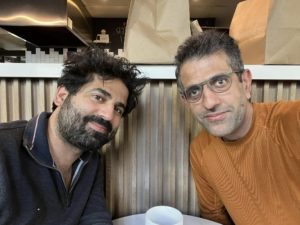
Zack & I met in real life for the first time (in Cambridge USA) on the 10th of October even though we have known each for nearly two decades.

Dr. V is an Eric & Wendy Schmidt postdoctoral fellow at the Broad Institute of MIT & Harvard so she’s relocated to the United States (as of this month) and we’re now going to be doing trans-Atlantic hops between Old & New Cambridge, with of course Chennai in the mix.

Since Brown Pundits seems a bit moribund these days; I thought I’d share this update here. I don’t look my best as it was the end of Phase 1 of moving (I’d just returned the rental car after a fortnight and went off to meet Zack).

Kaivalyadham- 100 Yr Institution in the field of Yoga & Scientific Research | Subodh Tiwari on The Indic Explorer Show

On the 57th Episode of The Indic Explorer Show, I spoke to Subodh Tiwari CEO of Kaivalyadham- A 100 Yr old Institution in the field of Yoga & Scientific Research.

We spoke about Yoga, the role of this institution especially in producing academic papers and also some interesting stories of prominent leader of the Indian Freedom movement who visited the institution including MK Gandhi, Motilal Nehru, Dr. Ambedkar & Pandit Madan Mohan Malviya.

The Indic Explorer YouTube channel focusses on the interplay of Indic culture with modernity explored through different facets in the socio-cultural sphere.

Do subscribe to the channel at https://www.youtube.com/theindicexplorer

and follow me here

Twitter- https://twitter.com/theindicexplor1

Instagram- https://www.instagram.com/theindicexplorer/

Substack-https://digitaldharma.substack.com/

Spotify – https://spotifyanchor-web.app.link/e/MobfQp83uzb

World of an Ayurvedic Instagram Influencer in the US – Salila

On the 33rd Episode of The Indic Explorer Show, I spoke to Salila on all things related to Ayurveda. She is a 4th generation practioner of Ayurveda and a very popular instagram influencer with 124k followers.

The Indic Explorer YouTube channel focusses on the interplay of Indic culture with modernity explored through different facets in the socio-cultural sphere.

Do subscribe to the channel at https://www.youtube.com/theindicexplorer

and follow me here

Twitter- https://twitter.com/theindicexplor1

Instagram- https://www.instagram.com/theindicexplorer/

Substack-https://digitaldharma.substack.com/

Spotify – https://spotifyanchor-web.app.link/e/MobfQp83uzb


Brown Pundits