Caste in US medicine?

My last name “Theetha Kariyanna” has its origin from a small village Theetha and added to it is my dad’s name Kariyanna (a local folk god). Back in my school days, the name was weird to my friends as the name Kariyanna also literally translates to “black brother.” As a kid who was hesitant to loudly say his name clear and loud, I have grown up to say my name loudly with pride as I often do: “Hello there, I am Dr. Kariyanna, your heart doctor today.” I was likely hesitant to say my name loudly because of its literal translation and the fact that it easily discloses my roots in the Kuruba community — sheepherders of south India who fall into the shudra category of the caste system. The fear and hate for the caste system started very early on in my life.

The caste system is thriving in medicine in the U.S. via  Continue reading Caste in US medicine?

Swara Bhaskar’s comments on Pakistan the Failing State

https://youtu.be/QYKxr7gW8Ho?t=15m

Swara Bhaskar doubles down on her Pakistan comments that Indians shouldn’t care what the unsecular failing Pak state does.

I don’t have an opinion on her particular remarks but Pakistan was wrong to ban Veere di Wedding.

Otherwise I agree with Rajeev Masand’s masterful review where he gave it a 2 out of 5 though V&I agree it should be a 3.

Continue reading Swara Bhaskar’s comments on Pakistan the Failing State

Is American culture sharply increasing crime?

The US is currently experiencing the second largest increase in crime since statistics began to be tabulated, the largest increase in crime being in the 1960s and 1970s. From “Crime in California 2016” Table 5, page 9 in document, page 13 in PDF, the total number of forcible rapes in California increased by 49.3% between 2014 (8,562) to 2016 (12,785). From Table 1, page 5 in the document, page 9 in the PDF:

  • Homicides increased 13.7% between 2014 (1,697) and 2016 (1,930)
  • Robberies increased 12.6% between 2014 (48,650) and 2016 (54,769)
  • Aggravated Assault increased 13.8% between 2014 (91,681) and 2016 (104,307)

To better understand the massive US crime wave, I decided to calculate crimes committed  by various ethnic groups.

This article will use California crime data since US national level data on crime for Latino Americans and Asian Americans is usually not publicly released by the US government; perhaps for fear of what such data would show. I suspect that US and Canadian nationwide data would show similar trends. California demographic data by ethnicity is taken from 2015 US Census Bureau estimates. From “Crime in California 2016” Table 30, page 33 in document, page 37 in PDF, “Felony and Misdemeanor Arrests” 2016:

  • Caucasions were 4.99 times more likely to be arrested than Asians
  • Hispanics were 5.91 times more likely to be arrested than Asians
  • Blacks were 17.04 times more likely to be arrested than Asians
  • Non Asian Others (mostly native Americans) were 3.38 times more likely to be arrested than Asians

Arrest data by Asian country are also available; but Asians commit so few crimes that such data would be skewed by the law of small numbers. However you are free to research it yourself. The spreadsheet used for these calculations is available upon request.

Total crimes committed by caucasions, hispanics, blacks and “other” are released by category. “Other” is not broken down into Asian and non Asian other. However if we assume that non Asian others commit 3.38 times as much crime as Asians (a stretch to be sure), then:

Total homides by race from “Crime in California 2016” Table 31, page 34 in document, page 38 in PDF:

  • Caucasions were 2.44 times more likely to commit homicide than Asians
  • Hispanics were 4.44 times more likely to commit homicide than Asians
  • Blacks were 17.23 times more likely to commit homicide than Asians

Total robbery by race:

  • Caucasions were 4.63 times more likely to commit robbery than Asians
  • Hispanics were 7.96 times more likely to commit robbery than Asians
  • Blacks were 44.19 times more likely to commit robbery than Asians

Total rape by race:

  • Caucasions were 3.13 times more likely to commit rape than Asians
  • Hispanics were 5.44 times more likely to commit rape than Asians
  • Blacks were 12.24 times more likely to commit rape than Asians

Total assault by race:

  • Caucasions were 4.44 times more likely to commit assault than Asians
  • Hispanics were 5.48 times more likely to commit assault than Asians
  • Blacks were 15.44 times more likely to commit assault than Asians

Total kidnapping by race:

  • Caucasions were 3.92 times more likely to commit kidnapping than Asians
  • Hispanics were 6.52 times more likely to commit kidnapping than Asians
  • Blacks were 18.42 times more likely to commit kidnapping than Asians

If we assume that non Asian others are 3.38 times more likely to be incarcerated than Asians, then from 12.31.2.10:

  • Caucasions were 4.18 times more likely to be incarcerated than Asians
  • Hispanics were 5.8 times more likely to be incarcerated than Asians
  • Blacks were 25.2 times more likely to be incarcerated than Asians

Continue reading Is American culture sharply increasing crime?

World War 2’s impact on the racial balance of the world

This clip was interesting in WW2’s effect on the racial demographics of the West and white supremacy (that all Western powers including the Allies were keen to maintain).

Much as we lionise the role of Britain in this country for both World Wars; there is a feeling we are living in the aftermath of a massive decompression (lingering on because the Sovereign is still a living link to that period).

The hubris of Empire ultimately culminated in a reality where white people had to share the world and more importantly power. Unless there is a string of right-wing authoritarianism, genocide and/or ethnic cleansing the West is now perpetually multi-racial and multi-ethnic.

As the commentator above makes the point the first coloured migrants were “invited” to help rebuild society in the wake of post-war. It’s an important to remember that it’s rather churlish to invite a generation, then try to somehow disenfranchise them and then tell their children to go “back home.”

The once and future “Brown Pundits”

Country Users Rank % Rank
 China 746,662,194 1 53.20% 109
 India 391,292,631 2 29.55% 143
 United States 245,436,423 3 76.18% 54
 Brazil 123,927,230 4 59.68% 90
 Japan 117,528,631 5 92.00% 15
 Russia 110,003,284 6 76.41% 53

The “Brown Pundits” blog was formed on a lark about 7 years ago. The Sepia Munity weblog was clearly winding down, and people like Zach and I didn’t feel too well represented. What I mean is that weblog in its latter years reflected a certain activist Left-wing South Asian American perspective which naturally didn’t include all Diaspora South Asians. In some ways this was a shift away from its original years, when it was more politically eclectic, with some center-Right and libertarian voices, to go along with conventional center-Left viewpoints.

Two of the co-founders I knew personally before the blog was founded, and we had a small e-list where we discussed cultural and social issues. To a great extent, I think the Sepia Mutiny blog reflected a decade in transition for South Asian brown Americans. Most of the contributors were of an age where they would be routinely asked where “they were really from,” and all of us understood that we were seen to be a novel and exotic contribution to the American landscape.

Things have changed a lot since then. Most particularly in 2008, Barack Hussein Obama was elected president of the United States. Where black Americans rejoined in the election of a black man, I suspect many Americans of Asian background noted his exotic background and name. If a man with such a foreign name could become head of state of the United States could we be such aliens after all?

I do understand that some people feel that the election of Donald J. Trump has rendered us aliens in our own land again. Overall, I disagree. In a Spenglerian sense, I see the election of Trump as a crying in the wilderness of an old America which is feeling less at the center of our culture, as well as the more general atavisms triggered by globalization.

South Asian Americans, which mostly means Indian Americans, have a place and a role in American culture that can’t be denied. Most Indian Americans have followed a “Jewish model”, aligning with the political and social Left, especially a small activist class.

A framework to understand the trajectory of young 2nd and later generation South Asian Americans that I outlined over 10 years ago I think is a useful model. Roughly, there are three broad classes of South Asian Americans (with overlap):

  • Assimilators. Unlike some groups, South Asian Americans are physically distinct enough that assimilation doesn’t involve “passing” into another identity. Rather, assimilation involves intermarriage and socialization with a broad set of Americans and a very loose attachment to distinctively South Asian cultural markers ad community institutions. Most of the children of assimilators will be mixed, and so will not have a singular South Asian identity in an authentic way.
  • South Asian Americans. This group is perhaps equivalent to Indian identities in the West Indies, which have become distinct from Old World self-conceptions while retaining a sense of South Asianness. In some ways, I think this was a core group for the Sepia Mutiny blog. These are the sort of people who might marry other Indian Americans, but these marriages are often cross-regional, cross-caste, and even cross-religion. To give a concrete example, I know that two of the original Sepia Mutiny bloggers married and had children with someone whose family was from a different ethnoreligious tradition from their own. The sort of marriage which would raise eyebrows in South Asia, but wouldn’t be viewed that strange in the American context.
  • Finally, traditionalists. There are American-born and raised Patels who marry other Patels. There are Dawoodi Bohra Muslims who marry other Dawoodi Bohra Muslims. This group would be most recognizable to people from South Asia.

But to me, that’s the past. I think it’s done. I don’t see Brown Pundits contributing to that discussion or cultural space, for various reasons (the primary one being most that none of the contributors are of the second class). Rather, I’ve started to get interested in Brown Pundits in large part because it seems that Asia, including South Asia, is getting to be a bigger and bigger part of the discussion. There are now more Indians browsing the internet than Americans!

Yes, it’s mostly on mobile phones, but most Americans were on dial-up until the mid-2000s.

The Crime of Being a Dalit

RAJKOT: A 23-year-old youth was bludgeoned to death near Palara Central Jail in Bhuj on Tuesday night. Police said the murder was the result of a love affair. Police said the victim, identified as Jaideep Garwa, a Dalit resident of Kotai village of Bhuj taluka was in love with a woman from the Muslim community.

Youth murdered over love affair

For the sake of balance. South Asia is a complex and crazy place perhaps it would be better at BP if we all (including myself) took a breather and assess a broader positive outlook.

The Crime of being a Muslim

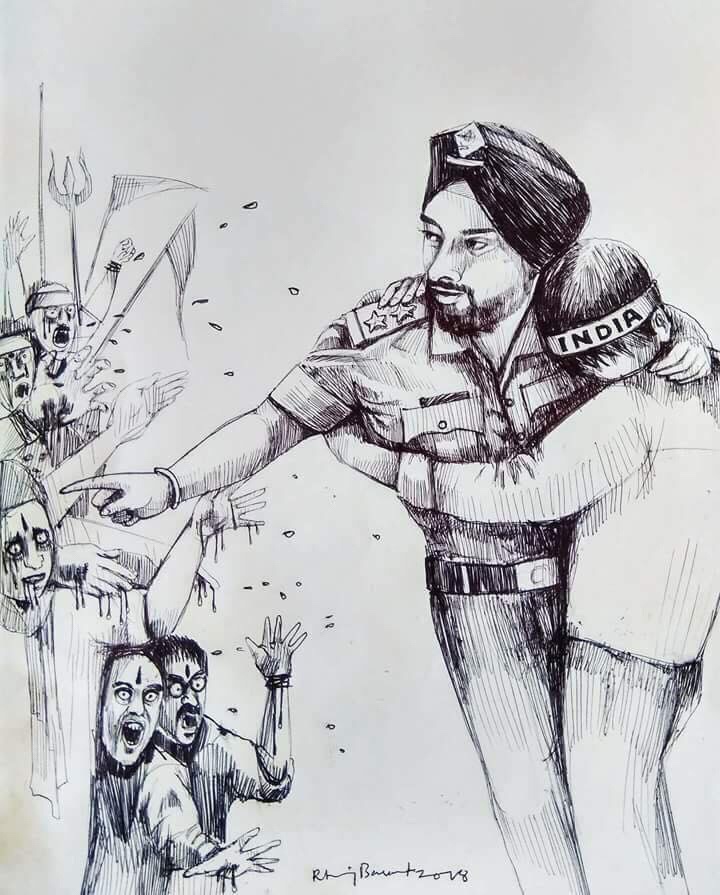
Last week a Sikh police officer in India saved a Muslim man from being lynched by a mob, merely for standing near a temple with a Hindu girl.

This is a poignant illustration on that, by student Umar Khalid.

He wrote: “Salute, Gagandeep. You stood up against not just some local hooligans. You were effectively standing up against the forces of hate who are right now ruling our country, and ripping apart its social fabric!”

Sunny Hundal

Brown Pundits 2018 Reader Survey

I created a SurveyMonkey poll. Check it out….

(after you are done, you can check out the results)

Create your own user feedback survey

Brown Pundits