Book Review: Friendly Fire by Ami Ayalon

From Dr Hamid Hussain

Book Review – Friendly Fire by Ami Ayalon

Hamid Hussain

“As you prepare your breakfast, think of others
(do not forget the pigeon’s food).
As you conduct your wars, think of others
(do not forget those who seek peace).
As you pay your water bill, think of others
(those who are nursed by clouds).
As you return home, to your home, think of others
(do not forget the people of the camps).
As you sleep and count the stars, think of others
(those who have nowhere to sleep).
As you liberate yourself in metaphor, think of others
(those who have lost the right to speak).
As you think of others far away, think of yourself
(say: “If only I were a candle in the dark”).”                   
  Mahmoud Darwish

Ami Ayalon’s book is a compilation of an autobiography including his own personal journey from a warrior to a peacemaker and a review of Israeli-Palestinian conflict.  He narrates his adult life fighting for Israel’s security as naval and internal security officer.  He builds his case to his country men that he is not advocating two state solution as a favor to Palestinians but sees this as the only solution to preserve Israel as a Jewish democratic state.  He fears that continued occupation of Palestinians will end up Israel as ‘a dystopian society that is tyrannical for those under our boots, and toxic and self-defeating for all’.

Ami has the audacity of hope in a very depressing situation.  My own two trips to Israel and Palestinian territories were focused on visiting Crusader era and First World War era landmarks related to Indian army.  However, I interacted with number of Israelis and Palestinians and found hardening of attitudes on both sides.  Tech savvy Israeli youth are focused on advancing their careers and number of young Palestinians making every effort to get away from what to them is a large prison and seek a better life away from their homeland.  Both these groups don’t care much about everyday politics. Israeli society and politics have taken a sharp right turn.  They are using a single verse of Bible in the Book of Genesis 15:18 ‘To your descendants I give this land’ as a property deed for Jewish people and view Palestinians as mere squatters and holders of a stolen property.  If this is the basis of the claim then they have to quote the whole verse that “On that day the Lord made a covenant with Abraham and said, “To your descendants I give this land, from the Wadi of Egypt to the great river, the Euphrates”.   Will they simply be happy with the half of the covenant and not go for the whole inheritance from Nile to Euphrates?

Palestinians are rapidly losing the hope of a two state solution in view of expanding Jewish settlements and rest of the Arab world moving on with their lives.  This impasse has given rise to many trends, but two prominent ones are two extremes of a single state where they will try to get their rights based on universal democratic principles and the other extreme of a continued war until final victory over Jews.

In 1981, when Ami was attending a course at US Naval War College, a Pakistani Colonel approached him and told him that ‘Don’t permit the Israeli-Palestinian conflict to become a contest between Judaism and Islam.  Don’t lift the lid off that Pandora’s box.  We can live with Israel, and your fight with the Palestinians is of no interest to Pakistan.  Just don’t fool around with the Islamic holy sites or use religion to justify your claims.  That would tear apart the entire world”.  Thirty years later, Ami saw both sides taking refuge in religion from their fears. As head of Shin Bet, for the first time, Ami had to run informants among hardline religious settlers and haul them in for interrogation.  Ami has understood this dilemma that ‘the way we understand our history is the barrier to a real compromise because it controls our actions and fears, and therefore our future”.  The religious right of Jews and Muslims are thumping their scriptures to claim holy land.  Jewish Rabbis and Muslim Imams are arguing about who are the chosen people of the Lord and resigned to the coming Armageddon.  I reflected on these claims when I was visiting Megiddo; the place where this Armageddon is supposed to take place.

Ami is not a leftist or a peacenik.  He is a realist who is willing to sit with opponents whether right wing religious fellow Israelis or Palestinians to understand their point of view.  He comes on the peace table with stellar credentials.  His whole life was spent as a warrior.  He was a naval commando and commanded elite naval commando force Flotilla 13, served as chief of Israeli navy and head of internal security Shabak (Shin Bet).  Later, in pursue of peace, he joined politics and became member of Israeli parliament Knesset.

He brings hope to his people as well as Palestinians.  He is not alone in this endeavor. In 2012, he helped Israeli documentary film maker Dror Moreh that was considered as coup when five former Shin Bet heads sat in front of camera and reviewed the policies of internal security.  They concluded that continued occupation of Palestinian territories was bad for Israel.  The film The Gatekeepers was the best documentary film in Academy Awards nominations.  Over two hundred former senior security officials from Israeli Defence Forces (IDF), Mossad, Sin Bet and police have formed an organization named Commanders for Israel Security.  They see two state solution as a guarantee for Israel security. Ami has made the correct diagnosis that ‘We’re so trapped behind our own walls; we can’t see what seems obvious to outsiders’.  Israelis don’t’ need goyim (non-Jew) to tell them what is good for them? They need to listen to fellow Israelis who spent their lives defending the country.

“Tombstones break,

words pass, words are forgotten,

lips that uttered them turn to dust,

languages die like people, and other languages are resurrected,

gods in the heavens change,

gods come and go.

Prayers remain forever.”                               Yehuda Amichai


Ami Ayalon with Anthony David.  Friendly Fire: How Israel Became Its own Worst Enemy and the Hope for Its Future (Lebanon, New Hampshire: Steer Forth Press), 2020

Hamid Hussain

coeusconsultant@optonline.net

25 October 2020

Defence Journal, November 2020

A Hindu nationalist in the House?

Slate has published a transparent “hit piece” on Preston Kulkarni, who is likely to win a seat for the Democrats in Houston. I say hit piece because it doesn’t seem deeply reported, but sourced from Pieter Friedrich, who I have mostly seen online as a rather inflammatory activist, not a dispassionate scholar.

A reporter in the area, Chad Washington, notes that believe it or not, people in and around this area of suburban Houston are not very interested in the fact Kulkarni might have “ties” to the Hindu Right.

There are two issues I want to highlight here as to why I’m putting this post up (which to be frank does amplify what I think shouldn’t be an issue at all):

– The demand that people denounce all sorts of things that they claim to barely even understand in the interests of solidarity and popular fronts is pretty ridiculous. Kulkarni is aiming to represent suburban Houston in the House. His opinions on Indian politics are unimportant. There are cases where Muslims are asked to ritually denounce everything under the sun and everyone they may have shared a stage with. That’s bullshit. And this is bullshit.

– It is strange to me how the “Left” can so naturally use the language of xenophobia to attack xenophobia. Here is the title: “Why Are Democrats Backing a House Candidate With Reportedly Shady Foreign Ties?” Foreign ties? I mean, his last name is {{{Kulkarni}}}. He worships elephants! His white mother married a foreigner. What’s wrong with her!

Obviously, the Indian American writer of the hit piece isn’t anti-Indian as such, but this opportunistic recourse to this rhetoric and guilt-by-association won’t end well.

Update: OK the Republicans/Christian Right are now after him.

Caste in 2nd Generation American Diaspora

Saw some very interesting conversations on caste in America in the recent Open Thread and wanted to hear more perspectives as well as sharing my own.

Growing up, I wasn’t aware of my caste nor my friends’ caste. I still am unaware of most other Indian-Americans’ castes (besides obvious ones like Sharma and a few Gujarati ones I know) and never thought too much of it. Caste just doesn’t seem to factor into 2nd Gens…except this trio of exceptions:

  1. The SJW Brahmins

  2. The Victim Card Dalits

  3. Poonjabi (NOT INDIAN!!!!) Jatts

Group 1 seems like a case of White Guilt with a few drops of saffron. Read any BuzzFeed-esque article written by this group and you could easily Find & Replace “White” with “Brahmin” (or “Hindu” if they are really deep in the hole) and “Black” with “Dalit.” Simple transpositions on an infinitely more complex topic.

Group 2 is enrolling in the grand Oppression Olympics that is underway in America. While I recognize the dire need to address the discrimination against Dalits in India, I cannot for the life of me understand how any 2nd gen would even be aware enough to discriminate against another 2nd gen based on caste. I can’t memorize that many last names and their associated caste. Maybe it happens amongst immigrants, but I can’t imagine any impact between Indian-Americans born in the US.

Equality Labs is probably the vilest and most prominent example of this new vehicle in action where they even want to make caste an official marker in the USA.

Both Group 1 and 2 label any “Hindu” practice, no matter how inconsequential or innocent (like Holi, vegetarianism, pujas, tilaks, the literal color orange, etc…), as Brahminical Patriarchy, fascism, and/or casteism. The agenda is pretty clear cut. See my “Brahminism” post. 

Group 3 is honestly a conundrum to me. I just don’t understand the “why” in this group. But the lack of understanding makes it the easiest group to lampoon. Can only listen to music where the word “Jatt” is rammed into the song at least 40x, or else it’s Hindi music. This clique proudly flaunts their caste like they’re back in India (oops, sorry I meant Punjab). They’re in an intermittent digital war with Hindu E-Trads (who are already a shitshow themselves), many times because of some unnecessary and out the way slandering of India/other Indian ethnic groups or E-Trads disgusting edgelording over 1984. There is a heavy pour of Punjabi/Jatt chauvinism (and Scythian???). In the end, it goes back to what I said at the beginning – I don’t get the “WHY” for this group.

When I initially asked my fairly religious Punjabi Sikh friends why the singers keep saying “Jutt” in all the bhangra music I listened to – they rolled their eyes, explained it’s a caste, and then called them dumbasses and we laughed off. They then told me to call anyone who engages in that behavior a “tatti di sabzi.” I think that’s a fair response for all of the above.

Save for these 3, I don’t think caste is that important to most Indian-Americans, including normal Brahmins, Dalits, Jatts (note – I am none of these so it’s just my outside perspective).

Comments!

They say blogs are dead. They say comments are dead. To my surprise, this website has surprised me. In the later years of the Sepia Mutiny weblog the number of comments started dropping off. The theory was that people were commenting more on Facebook (Twitter wasn’t huge then). Google Analytics says that more than 20,000 people are reading this website in a given month. That’s not trivial, but it’s small. That being said, the comment threads are often “hopping.”

This is good and nice. How do we maintain this? I don’t moderate much at this point but am worried about things getting out of control. That being said, this is not a job and I have lots of other things to attend to. Thoughts?

Open Thread – 10/24/2020 – Brown Pundits

Going to post some notes on the latest podcast here. I talked to Fred Martin, who is of Haitian origin, but pretty stridently French, and a liberal. We discussed the killing of Samuel Paty, and Islam and Islamism in France. We also mooted the differences in relation to race between the USA and France, and our contrasting experiences. Finally, we talk about the coming winter of coronavirus in Europe.

A lot of the discussion centered around the contrast between France and the USA, which is always interesting to explore.

Thanks to everyone who is a Patron. I’ve started posting podcasts which you can’t find elsewhere yet there…

On Twitter, Suhag Shukla has been pushing back on the “caste is a huge problem for Indian Americans” narrative. I think she’s right on the specific issue. But, I am skeptical when she seems to attribute caste to colonialism, or, that it is not tightly integrated into Hinduism. I think Hinduism has a caste problem like Islam has a religious oppression problem. Religions are made by humans, and how they play out is a human matter. For whatever reason, Islamic societies have not been pluralistic in an egalitarian manner to other religions, while Hinduism in India is hard to disentangle from caste and jati. This doesn’t mean they’re necessary connections. Caste and jati are not major issues in Balinese or Cham Hinduism, though varna does exist.

The major dynamic which needs to be reiterated is that American Hinduism is very distinct from Hinduism in India, just as American Islam is very distinct from Islam in the Near East. I’m 99% sure that the Indian Americans I know (Generation X) would exhibit no caste bias of any note because in the USA it’s just not relevant in any way.

Brown Pundits Subreddit.

Not all societies are identical

There is some discussion on “Hindu Twitter” and elsewhere about the French response to the murder of Samuel Paty. In short, France is going “medieval” on the asses of a lot of Muslims, even nonviolent but very conservative organizations. To use a German phrase, the French state is entering into a Kulturkampf against militant Islam. Or at least it is signaling that it is.
To all this, some on the Hindu Right are asking why some liberal or Left intellectuals are applauding or tolerating France’s reaction, which is hitting down hard on the Muslim community. Would they be so tolerant of India clamping down on Muslims? My own answer is simple: different nations have different histories, and abstract universal values and standards are often not useful.

Continue reading Not all societies are identical

Tibeto-Burmans, Munda, and Bengalis


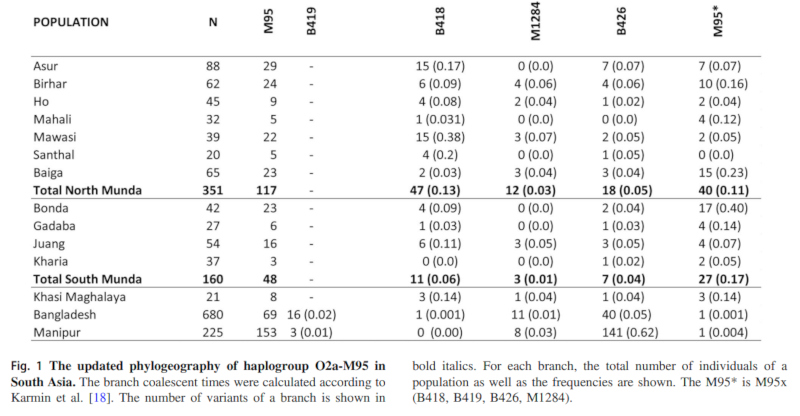
I’m pretty sure I posted this Chaubey lab work as a preprint, but it’s now a published paper. For those who can’t understand the table, it illustrates a big difference between Tibeto-Burmans and Munda. The samples from Bangladesh look to be generic Bangladeshis, the 10% frequency for O2a seems to match the other data I’ve seen for East Bengalis.

This confirms that the East Asian admixture into Bengalis was not Munda. And, the Tibeto-Burmans of the nTibeortheast have no assimilated Munda ancestry. I think it does lend more credence to the idea that the Munda arrived in the Indian subcontinent across the Bay of Bengal, landing in Odisha, rather than from the northeast.

Scale – In Satyagraha, Societies, and Statecraft

One writer who caused an evolution of my thought is the fiery Nassim Nicholas Taleb. His brash yet precise style, swashbuckling smashing of intellectuals, and ancestral Mediterranean insights provided an alternative thought diet in a world that force-feeds the same message to me on television, social media, and amongst my friends here in a buffet of American coastal elites. From the jest of randomness, the beauty of black swans, the advancement of antifragility, and piercing skin in the game, Taleb created a dancing sequence of jabs and hooks to create a battle-hardened mentality to approach the world and knowledge.

One of the biggest yet most nuanced lessons I learned from Taleb was that of scale – how inputs yield outputs differently, depending on size and magnitude. An easy example of this common-sense concept is the difficulty in enforcing an exercise and diet regimen for oneself versus one’s entire family versus one’s entire community and so on. Trying to do good things is easier and possibly more effective in the long run when done on a smaller scale.

It’s one thing to change oneself on an individual level, another to create a visible shift in societies, and another to execute proper governance accounting for different groups along with the externalities and the headaches that come along with policies.

The Search for Truth

Satyagraha or the holding of truth paved the road in Mahatma Gandhi’s non-violent struggle for India’s independence. Inspired by the ahimsa of Hinduism and Jainism, Gandhi brought his own interpretation taking an ancient concept to new frontiers.

The principles of satyagraha:

  1. Nonviolence
  2. Truth
  3. Not stealing
  4. Non-possession (not the same as poverty)
  5. Body-labor or bread-labor
  6. Control of desires
  7. Fearlessness
  8. Equal respect for all religions
  9. Economic strategy such as boycott of imported goods (swadeshi)

Admirable qualities that built the legend of the Mahatma, the great soul. Selflessness at its apex captured the hearts of Indians across the subcontinent in a mass non-violent movement at such a scale that it has no parallels in world history before or since. While an individual taking on satyagraha is highly laudable, expanding it to society proved a double-edged sword.

With the British reeled from a cataclysmic World War at home and a cracking crown jewel in the Raj, their leaders eventually acquiesced to the rightful demands of an independent India. Truth had met victory in the eyes of the Mahatma’s disciples, but this satyagraha would now face a much older foe that had made its home in the subcontinent over centuries.

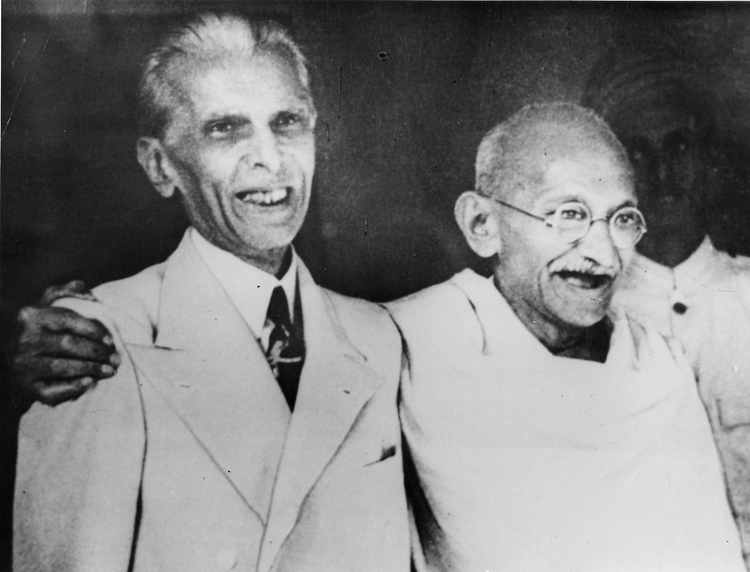
Jinnah and Gandhi Prior To Their Falling Out Early On In The Indian Independence Movement

Naiveté crept into a population until it was maimed by the madness of a maniac with Muhammed Ali Jinnah’s call of “Direct Action” severing the dreams of Gandhi and millions of other Indians for a united India. What Gandhi and his ideological descendants, Gandhians, got wrong is how values apply at scale. Stunningly noble principles for individuals could not be forced upon a people who were facing a polar opposite ideology filled with aggressive malice and cultivated by despicable men to match.

“Hindus should never be angry against the Muslims even if the latter might make up their minds to undo even their existence.” —Mahatma Gandhi, Birla Mandir, New Delhi, on April 6, 1947; Partition Would Occur 4 Months Later

The beauty of satyagraha was smeared with the ugliness of Islamism and this duality incarnated by way of a bloody partition. An assassin would cite the suicidal idealism of Gandhi as the gunpowder to his fatal and fateful bullet that transformed a man into a martyr and Gandhi into a god. The last breath of Gandhi permeated throughout Indian politics since.

Forsaking looking at others’ faults and focusing on your own to improve are great actions on an individual level. Trying to apply this mentality at a large scale is impossible and can be disastrous. Gandhi’s goal to apply the kindness and tolerance that he practiced throughout his life at a larger level provides a testament to the dangers of this ruinously beautiful ideal.

Primus Inter Pares

While I may have been harsh on Gandhi, his satyagraha was a very inspirational movement that achieved its primary aim (with the help of several violently resisting Indians of course, too) and would echo in the minds of different generations and geographies. Its failures would only truly come to fore when reciprocity broke down as scale increased and satyagraha faced the sinister.

A communal concoction that had been boiling for centuries spilled over once again just as Gandhi tried to ease the concerns of an ambitious Jinnah and company who were decided in their choice to break India. What went so wrong here?

Good behavior scales badly. Bad behavior scales goodly.

An essential lesson to impart here is that the kindness that we should all so admire shouldn’t be extended frivolously in the world at large scales. Strive to be exceedingly kind to all the individuals in your life, but expect less of a return as familiarity decreases and quantity increases. The world of geopolitics and governance is witness to how might towers over magnanimity as scale maximizes. And it is here where we need to examine a powerful chapter across world history for the past several decades – social justice.

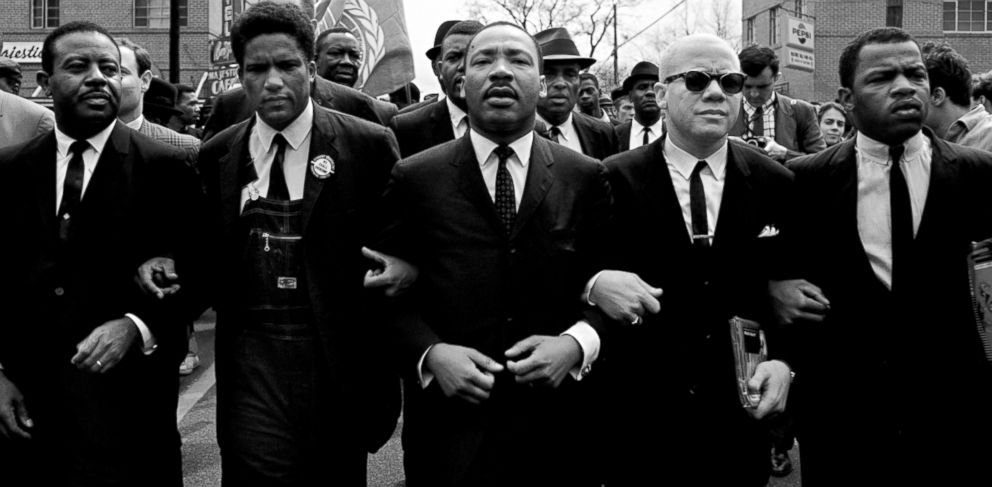
Inspired By Gandhi’s Non-Violent Movement, Martin Luther King Jr. Marched For Civil Rights and To End Segregation

Social justice has yielded some of the greatest moments in politics as policies such as apartheid and segregation were thrown into the abyss, while reservations in India helped lower castes climb out of the abyss. Tangible benefits were born through simple and actionable policies and goals.

Today, however, social justice movements have been plagued by vague goals and a lack of dynamic leadership. Faceless protests descend into rioting at an alarming rate with politicians taking advantage of the chaos and righteous movements thwarted by themselves. No Gandhi’s, no Dr. King’s, no Mandela’s lead the wave of change today. The absence of these emissaries who create a dialogue between the masses and politicians means that when social justice is applied at scale, it descends into disarray with vultures disguised as politicians picking and prodding at a soon to be carcass of a movement. Justice has inherent danger when applied at scale and needs the right leaders and values to guide it properly.

On the flip side, there are also the potential horrors of hyper-local justice such as in the panchayat system of rural India, where a clan of elders decides the fate of the accused, sometimes with cruel and Hammurabi style punishments. We are seeing this hyper-local eye for an eye type justice now extrapolate to larger scales amongst many intelligentsia and political leaders, a notion that would lead to disastrous strife if the scale continues to ramp up.

Virtualism

Bruno Maçães, a prominent political analyst and now part-time philosopher, proposes that America is entering a period where fantasy supersedes reality. The digital world at your fingertips is shaped by the hand of technology. What you see and consume on your timeline is a lens with a distorted scale of the world. What is anecdote becomes amplified into annals as the speed of the extreme races past the mundane on the information superhighway.

THE SPREAD OF SOCIAL MEDIA AND TECHNOLOGY HAVE BLURRED THE LINE BETWEEN FANTASY AND REALITY

Outrage oscillates the Overton Window wildly as technology’s reality distortion field melds our perception. This pendulum pushes our politics in an increasingly divisive direction as upstart politicians wield clout and clicks on social media steering agendas into fantastical territories that are disconnected from realities and history. Technology and social media have brought notions of the past closer to us than ever as rabid battles over who oppressed who pan out in the digital theatre of war.

Elite consensus is upended by guerrilla historians, sometimes erroneously but many times rightfully. These intellectual insurgents zoom out and in on specific instances to promote their perspective, occasionally out-of-context but every so often right on the money. The thin selection of stories published by establishments has given way to an explosion of untold chapters bypassing traditional media and academia, all with the help of technology.

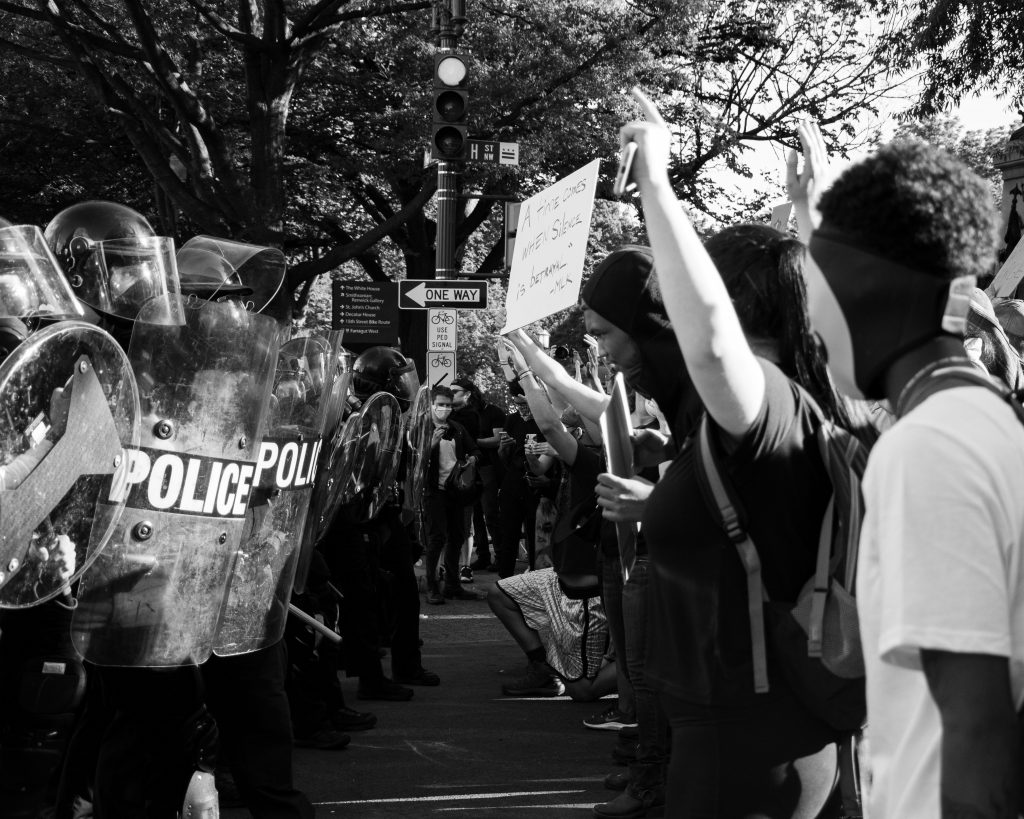
Protests Have Quickly Descended Into Riots Across The US As No Leader Stands On The Same Platform As The Giants of the Past

However, this has directly lead to an exacerbation of the application of justice. Crimes of the past are scaled out to include those in the present. Justice morphs into its fraternal twin, revenge. Now, I don’t believe it’s right to silence the discussion of the horrors of the past as that is essential to reconciliation. However, this discussion must be joined with efforts to bring real justice – opportunity and truth – to those who have been oppressed and not extend the hatred of the past to the descendants of oppressors in the present. Funny enough, the answer to opportunity may lie in economics (whether welfare reform, access to capital, ease of business, tackling inequalities, etc…) rather than culture wars.

Today’s society values performatives over pragmatism. In the quest to fight historical injustices, we can’t ask for revenge that spirals into a wheel of fire. We should remember the great effort to organize mass non-violent movements such as satyagraha and civil rights in an era today where the embers of violence quickly follow the gasoline rhetoric of many of our politicians and “activists.” For only great men, great women, and great movements transcend the limits of scale and sculpt our tomorrow.

This is a repost from The EmissaryPlease visit the blog for more content and thanks to Brown Pundits!

Run up to the Kashmir War of 1947-48, Pakistani POV

From Major Amin.

  • There was duplicity on Pakistan side in not agreeing to simple formula proposed by Lord Mountbatten that Muslim majority states join Pakistan and non-Muslim majority states join India-Thus Pakistan was unrealistically hoping to get Hyderabad Deccan , Jodhpur ,Bikaner and Junagadh–
  • Thus technically and legally Maharaja of Kashmir’s joining India was legitimate
  • Nehru’s agreement to plebiscite in Kashmir was the most stupid blunder of the whole
  • Ideally Kashmir should be demilitarized and made independent after a plebiscite but this is not acceptable to Pakistan, India or China.

Also for general interest an extract from my book HISTORY OF PAKISTAN ARMY VOLUME ONE

History is made by those who seize fleeting opportunities in the critical time span in any particular situation and relentlessly execute their plans without second thoughts, subduing inner fears, overcoming procrastination and vacillation, and above all by those who are propelled by the burning desire to defeat the enemy rather than any halfhearted judiciousness and timidity. Ninety years of loyalism and too much of constitutionalism had however made the Muslims of 1947 slow in taking the initiative and too much obsessed with consequences of every situation. This attitude was excellent as long as the British were the rulers, but not for a crisis situation, in which geography, time and space, alignment of communications and weather temporarily favored Pakistan, in case initiative and boldness was exercised and simple but audacious plans were executed in the shortest possible time! Today, it is fashionable to blame the Indians, Mountbatten, Gracey etc. as far as the 1947-48 War is concerned. A dispassionate study of the events of 1947-48 clearly proves that victory was closer in 1947 than ever again as far as the Pakistan Army was concerned. Opportunities were lost because very few people who mattered at any level apart from Mr. Jinnah, Brigadier Akbar Khan and some others were really interested in doing anything! Continue reading Run up to the Kashmir War of 1947-48, Pakistani POV

Reflections on Nadir Shah’s exploits in India

Last year marked the 280th anniversary of Nadir Shah’s invasion of the city of Delhi – an event as catastrophic as the invasion of the city by Timur in 1398.

It is worth reflecting on this remarkable event in early 18th century – an episode that underscores the perils of a weak state.

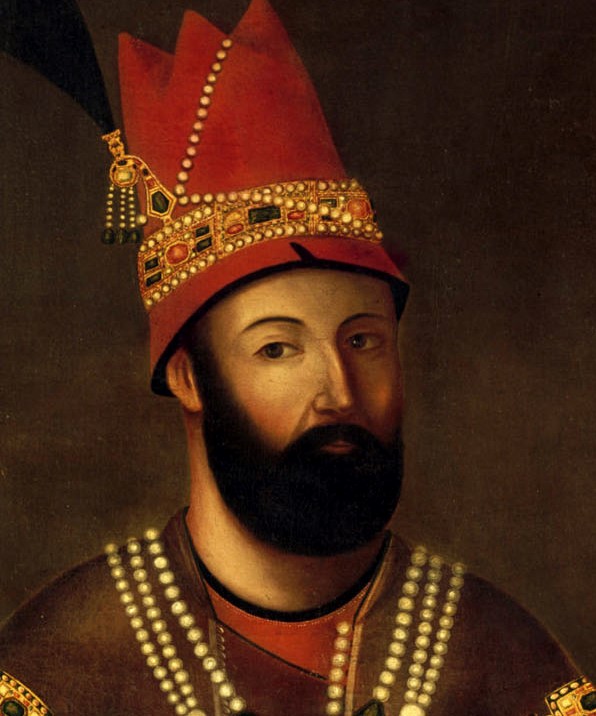
Source : wiki images

State of the Empire in the 1730s

What’s remarkable about this invasion is that it happened barely 32 years after the death of Aurangzeb in 1707 – a time when the Mughal Empire was still very formidable and pan Indian in extent (albeit a tad over-extended). By 1739, the decline of the empire was well underway. The Mughal emperor at the time of Nadir Shah’s assault was Muhammad Shah, Aurangzeb’s great grandson.

Now it is well known that Aurangzeb was just the 6th Mughal emperor, between 1526 and 1707. But Muhammad Shah who ascended the throne in 1719, was the 12th!

So you had six new emperors in the ten years following Aurangazeb’s death – as many emperors as the number between 1526 and 1707 – a commentary on the chaos at the head of the empire in the years succeeding Aurangzeb.

Now let us do a quick summary on the state of the region just before Nadir Shah’s assault –

  • Bengal was already semi-independent, with Murshid Quli Khan becoming the first Nawab of the region circa 1720.
  • Avadh was on its way to autonomy with Saadat Khan becoming its first Nawab in 1722.
  • The Marathas were clearly in the ascendant. By 1737, they had gained tax collection rights in Deccan, Gujarat, Bundelkhand. In 1737, two years before Nadir Shah’s raid, Baji Rao attacked Delhi and scored a remarkable victory – despite having an army half as large as the Mughals. Post the battle of Delhi, Malwa was ceded by the Mughals to Baji Rao’s Marathas. In 1738 on the eve of the Nadir Shah invasion, the Mughal crown was already weakened considerably.

The other point to note is that even after 2 full centuries of Mughal rule, the nobility of the land was largely foreign born. So power was wielded by men who felt no patriotism for India, and had no affinity to the traditions and culture of the land.  Let’s take some examples –

      • Nizam Ul Mulk, perhaps the most influential noble in early 1700s, was of Uzbek ancestry. His grandfather had migrated from Samarkhand
      • Saadat Khan, the Nawab Avadh, was a native of Nishapur (north eastern Iran), who had moved to India in early 1700s

This goes contrary to the perception pushed by many historians today that Mughals shouldn’t be regarded as foreigners as they were “thoroughly assimilated” and “rooted” in the Indian soil. Hardly the case.

The foreign origins of much of the creme-de-la-creme of the nobility meant a somewhat weak affinity to the land, and susceptibility to treason against the state. Saadat Khan in fact later advised Nadir Shah to assault Delhi, and ask for a large ransom.

Now let’s examine the situation in Persia in the decades leading up to Nadir Shah’s invasion of India.

The Safavid empire ended in 1722 following an Afghan rebellion. But this proved shortlived, with Nadir Shah defeating the Afghans and establishing his rule over Persia starting 1736.

With respect to Afghanistan – Mughals had lost Southern Afghanistan (including Qandahar) to Persia in the mid 1600s. However they retained control of Kabul / northern parts of the country.

Right from the start of his reign, Nadir evinced great interest in the Mughal Empire. He could see the waning power in Delhi as an opportunity. Also the Persian hold over Qandahar meant a strategic advantage for Persia, lost to the Mughals for nearly a century.

Failed Diplomatic efforts

What’s interesting though is that Nadir didn’t simply launch an assault on India with a savage horde. He engaged in extensive diplomacy, with multiple communications with Mughal crown!

E.g. in 1736, Nadir Shah sent an envoy to Delhi, informing of his intent to expel Afghan rebels from Qandahar, and requesting that the Mughal power in Kabul should obstruct these Afghans and not give them refuge. The Mughal emperor Muhammad Shah responded agreeably. But when the expulsion of Afghans happened from Qandahar in early 1737, the Afghan rebels did flee to Kabul. The Mughals breached on their promise!

When Nadir Shah sought an explanation for this breach through an envoy, Delhi gave him no reply. And on top of that detained the Persian envoy!

Even communication between Delhi and Kabul was terribly slothful! When the Mughal governor in Kabul sought funds for his troops, his repeated requests were turned down by Muhammad Shah the emperor. So clearly you had a situation when the frontier regions of Afghanistan and Punjab grew gradually defenceless through neglect, at a time when Persian power under Nadir Shah was on the rise.

This was an empire waiting to be assaulted.

The Battle at Karnal

Nadir conquered Northern Afghanistan in 1738. Peshawar and Lahore soon followed. Then the Shah marched to Karnal, where a decisive battle awaited him. In the great battle that ensued at Karnal (February 1739), the Persian army numbered at 55K cavalry. The Mughal army was likely larger, but heavily reliant on elephants – a ponderous and outmoded carrier.

What’s also remarkable is that the Mughal armies took for ever to assemble at Karnal! Saadat Khan, the noble from Awadh, took a whole month to arrive with his troops in Karnal.

It took him 3 days to travel from Delhi to Panipat – a mere distance of 55 miles! This is in sharp contrast to the blitzkrieg raids that Marathas were undertaking elsewhere in India at the same time. The Mughal army (in part perhaps because of its reliance on elephants) was not mobile enough. Not nimble enough.

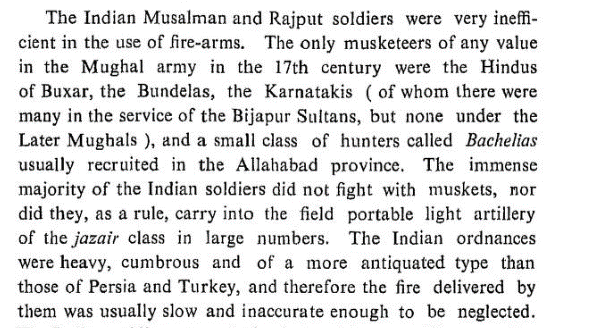
The other major difference was in the familiarity and comfort with fire-arms. The Persian army revelled at fire-arms. The Mughal army still relied a great deal on swordsmanship and “felt a contempt for missile weapons” (to quote Jadunath Sarkar)

Here’s Sarkar elaborating on the Indian inefficiency at fire-arms

So the result at Karnal was a resounding victory for Nadir Shah. But what followed was not a raid on Delhi rightaway, but extensive negotiations for peace!  This included face-to-face conversations between Nadir Shah and the Mughal emperor Muhammad Shah at the Persian camp near Karnal.

Negotiations post battle

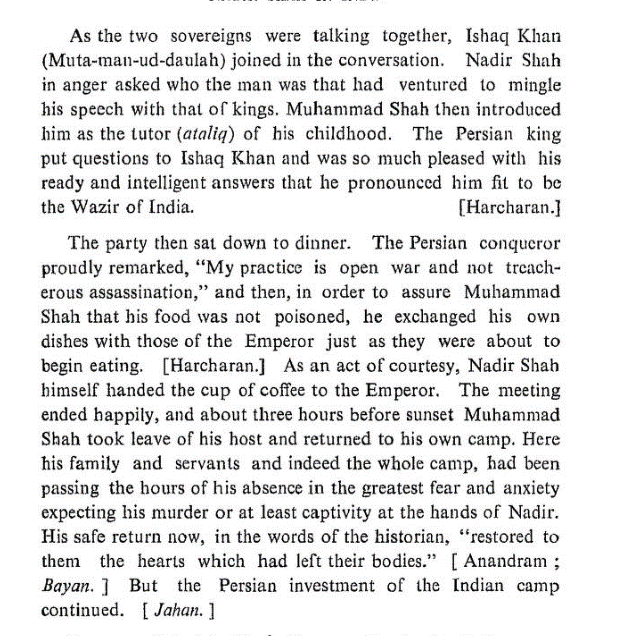
Here’s an account from Sarkar drawing on the primary sources of Harcharan, Anandram et al on the first meeting between Nadir Shah and Muhammad Shah.

But the emperor reneged on his word and did not pay the requested ransom of Rs 20 crores! This angered Shah and eventually led to a second meeting with the emperor and the latter’s house-arrest

Raid on Delhi

What followed was the famous raid on Delhi, which lasted about 50 days. But a point to note is that the provocation for this trigger came from the Mughal side. Saadat Khan in particular – the Nawab of Oudh.  While Nadir originally had an indemnity of 50 lacs in mind, it was Saadat who told Nadir after the Karnal battle, that if he were to go to Delhi, he could get 20 crores! As opposed to 50 lacs.

Nadir’s raid on Delhi was focused mainly on collection of ransom. Not just from the treasury, but also from private mohallas, with the consent of the Mughal emperor. But he did not intend to engage in a massacre. What triggered the massacre was an uprising in Delhi against the stationed Persian soldiers. Some 3000 Persian soldiers were killed by Delhi-ites. Nadir had to retaliate with a massacre, which likely claimed some 20K Delhi civilian lives in a span of a few hours. This is a conservative estimate, with other estimates as high as 4 lacs.

Consequences and Takeaways

So that brings us to the end of this brief account of Nadir Shah’s raid of Delhi. What were its consequences?

First of all the raid did not trigger the empire’s decline per se. The Mughal empire’s decline had started long before Nadir Shah set foot.  But Nadir Shah’s invasion unlike Timur had some political consequences – it resulted in the loss of Afghanistan and the modern Frontier province to Persia. Eventually it led to the loss of Punjab to the Afghans (under Ahmed Shah Abdali) a few decades later. The Maratha raids on Bengal too ensued a few years after Nadir’s raid.

So it could be said that Nadir Shah’s invasion hastened the decline of the empire, though not necessarily the cause of it.

More importantly it has some lessons for our times. We tend to think of “invaders” as ravaging hordes lacking in civilization and human values. But Nadir was a shrewd diplomat. He engaged in multiple diplomatic overtures, though the Mughals bungled every one of them.  Even the ransom amount to him was suggested by a Mughal insider, Saadat Khan. So was the idea to raid Delhi. Even the massacre at Delhi that ensued was in large measure a retaliation of the massacre of his own soldiers by Delhi civilians

We live in an age of constitutional patriotism, where deference to the state has to transcend ethnic ties. But Nadir Shah’s episode has lessons for us in this respect.

The reason the invasion was facilitated was because of high treason, which in turn was caused by the fact that much of the Mughal nobility was of foreign origin, and felt little patriotism towards India.

Some 30 years ago, there was a debate in India around “Foreign origin” of Sonia Gandhi and whether this should bar her from public office and electoral politics. The debate settled in Sonia’s favor

But then when we reflect on episodes like these from the past (Saadat Khan’s treason for instance), you wonder if an ethnic connect to the land is a pre-requisite to expect a high degree of patriotism.

We will conclude on that note.

References: Jadunath Sarkar’s “Nadir Shah in India”.

The author tweets @shrikanth_krish

Brown Pundits