Keenie Meenie Services – the most powerful mercenary company you’ve never heard of – was involved in war crimes around the world from Sri Lanka to Nicaragua for which its shadowy directors have never been held accountable.
Like its mysterious name, Keenie Meenie Services escaped definition and to this day has evaded sanctions. Now explosive new evidence – only recently declassified – exposes the extent of these war crimes, and the British government’s tacit support for the company’s operations. Including testimonies from SAS veterans, spy chiefs and diplomats, we hear from key figures battle-hardened by the Troubles in Northern Ireland and the Iranian Embassy siege. Investigative journalist Phil Miller asks, who were these mercenaries: heroes, terrorists, freedom fighters or war criminals?
This book presents the first ever comprehensive case against Keenie Meenie Services, providing long overdue evidence on the crimes of the people who make a killing from killing.
British mercenary pilots helped Indian troops in their battle against the Liberation Tigers for Tamil Eelam (LTTE) rebels in Sri Lanka in the 1980s, a new book reveals for the first time.
The Indian Peace Keeping Force (IPKF) received air support from these for-hire British pilots despite Indian diplomats publicly condemning the presence of UK mercenaries in Sri Lanka, according to the book, ”Keenie Meenie: The British Mercenaries Who Got Away With War Crimes”, authored by UK-based investigative journalist Phil Miller.
However, India”s attitudes gradually began to shift and the envoy to Colombo, Jyotindra Nath Dixit, said New Delhi had to publicly deplore the use of UK mercenaries in Sri Lanka but privately he accepted there was “a large pool of ex-military personnel” in Europe and North America who wanted to “market these skills” and if it was not KMS then it would be another “cowboy” outfit involved.
Climate scientists caught on first, then the US military, and now financial risk analysts. Things are shifting: if BlackRock ‘s C-suite officers (they control a dime out of every dollar in the world) were the jurors, the current US administration might not like their verdict.
Charles Cameron · February 7, 2020 · Comments Off on Poems: climate, impeachment, climate
Scorched earth
Scorched earth used to be a military tactic —
Samson caught three hundred foxes,
and took firebrands,
and put a firebrand in the midst between two tails,
sending them through enemy fields —
but what if nature out-flames the foxes?
What if floods engulf
those waterboarding Khalid Sheikh Mohammed?
Hosing down used to be a police tactic —
against dissenting crowds,
with dissent almost a badge of honor,
police visor and shield
almost an admission of guilt —
ah, earth, water, air, mind — all ablaze!
**
For sure
No sense in wasting a poem on impeachment,
those things pass
like leaves in the wind,
Nixon, Clinton,Trump, and
by the time you read this
another fistful, maybe no doubt —
on second thought, poems too
are leaves in a high wind, sacred altitude at best.
Han Shan sent his poems floating downstream,
scribbled them on the walls of caves
and hermitages,
wrote them on beech-bark
on the off-chance someone would find them —
Pulitzer-winner Gary Snyder for sure found them!
**
Forecast
Floods and firestorms:
the planet is not so much burning as oscillating,
floods, the element of water,
fire would evaporate them,
but only after bringing them to boiling point,
firestorms, wrathful,
water would quench them,
but boiling point is hardly the issue.
We are deep into future problems,
the courage of our blind denial
blithely fire-walking
with water-walking ability
granted us solely in scriptures —
prediction succeeds, prophecy fails, what next?
We use administrative data linked to parish records from NorthernSweden to study multigenerational inequality in education, occupations, and wealth from historical to contemporary times. Our data cover seven generations and allows us to follow ancestors of individuals living in Sweden around the new millennium back more than 200 years, covering the mid-18thcentury to the 21st century. In our sample of around 75,000 traceable descendants, we analyze (a) up to 5thcousin correlations and (b) dynastic correlations over seven generations based on aggregations of ancestors’ social class/status. With both approaches, we find that past generations structure life chances many generations later, even though mobility is very high. The persistence we find using cousin and dynastic correlations is much higher compared to a simple Markov model limited to sequential parent-child transfers, but we also find that direct ancestor associations are very small. This suggests that there is a weak but constant kinship influence that attenuates slowly over generation.
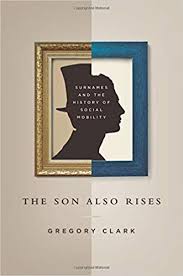
These results align with Gregory Clark’s work in The Son Also Rises: Surnames and the History of Social Mobility. Last summer Clark told me that he is done with a draft of a new book that confirms and extends the data and argument from The Son Also Rises: though generational mobility is high in the short term, there is a long term persistence of social and economic status across lineages.
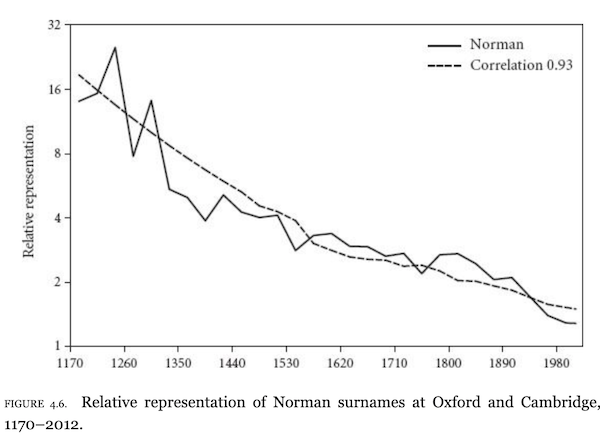
To me, the most striking element of Clark’s data is the persistence of Normans in the British elite. Though 0.30% of the British population at most, they were 16% of the student body at Oxbridge in the 12th-century. The proportion of Norman surnames at Oxbridge did not converge to the population proportion until the late 20th-century! This means it took nearly 1,000 years for Normans to regress (they are still over-represented in the British officer corps).
This tells us that social mobility over the generations is a thing. But, it also tells us that social mobility converges very slowly. This is intuitively surprising because single generation-to-generation changes in status are so extreme that one would predict the converge would happen much faster. Often one sees generation-to-generation correlations of income on the order of 0.50. But Clark’s data suggests that the systematic biases across many generations of status are such that the correlation would be closer to 0.90 to explain these results without an underlying phenomenon.
Why is this relevant? Clark had more access to surname information from Europe. But his data now extends internationally, and Clark claimed that this pattern is a cross-societal, and, the “intergenerational correlation” is very high. This includes India (in fact, some of the material in The Son Also Rises indicates that the correlation is higher in India than elsewhere).
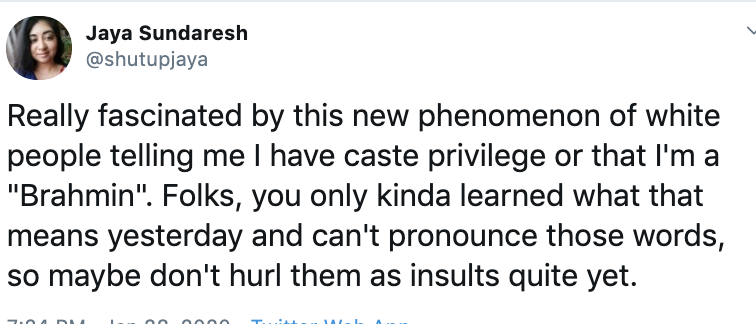
This is the context where we have to understand comments like this:
There are two major dimensions to understand this.
When people are beating you down for being a “terrorist” it doesn’t matter if you are a Brahmin or Dalit, a Hindu, Muslim or Sikh. North Indian or South Indian. Light-skinned or dark-skinned. All that matters is that you are brown. There are some people who are white-passing or black-passing among subcontinental origin individuals, but these are the small minority.
Insofar as “white supremacy” is what you think determines the lot of non-white peoples in the United States, talk of caste privilege seems quite silly. It is correct that Indian Americans tend to come from “upper castes” and the socio-economic elite. But what if you think that the only thing relevant about an Indian American with a Ph.D. is that they are a “person of color” (or as they say now a “black and brown body”)? Then that caste/class privilege really doesn’t matter in this country. All that matters is what white people think about you.
But I think this view is wrong. No one in the United States cares you are an Iyer. But what Greg Clark’s data suggest is that it’s not just your name, it’s not just what other people think of you Your inherited “capital” matters. A very dark-skinned Nasrani from a line of doctors may not be comparable to the descendants of slaves and farm laborers. It’s not because they’re Nasrani. It’s because they’re the descendants of doctors.
Buddhist logic from the beginning differs from its Aristotelian cousin, featuring the chatushkoti or tetralemma:
India in the fifth century BCE, the age of the historical Buddha, and a rather peculiar principle of reasoning appears to be in general use. This principle is called the catuskoti, meaning ‘four corners’. It insists that there are four possibilities regarding any statement: it might be true (and true only), false (and false only), both true and false, or neither true nor false.
speaking of the Buddha, Nagarjuna states that the Buddha’s teaching is “emptiness is suchness, not suchness, both suchness and not suchness, and neither suchness nor not suchness.”
Furthermore:
The suchness of the Tathagata is the suchness of all phenomena.
Rumor therefore has it that there’s a fifth possibility, a refuge from all dualities: the shining suchness of the Tathagata.
I don’t personally know Ammar Rashid, but I know many people like him and many people who either went to school with him or moved in the same circles. Unlike many (most?) Pakistani students who study abroad and develop a deep understanding of the mess that is Pakistan, Ammar Rashid chose to return to his country. He lives his life according to what he believes in (no matter how unpopular those beliefs and ideas may be), and not a lot of people in Pakistan can say that. I heard him singing Faiz Ahmad Faiz’s Intesaab (Acknowledgement) many years ago, and that is my favorite version of that verse ever sung. I do not agree with everything that Ammar believes in (Listen to him eloquently explain his positions here: soundcloud.com/howtopakistan/episode-14-awami-workers-party-the-pakistani-left), he is an officeholder for the Awami Workers Party (AWP), an artist, writer, and a teacher. He participated in the 2018 national elections for a National Assembly seat. He was one of the leaders of the movement to preserve katchi-bastis (slums) in the I-11 sector, Islamabad.
Why was he arrested?
He was protesting alongside his comrades against the arrest of PTM leader, Manzoor Pashteen. Pashteen galvanized the youth and adult population in former federally administered tribal areas (FATA) that border Afghanistan. The presence of PTM threatens the ‘national narrative’ put forth by Pakistani establishment that they ‘cleared’ FATA of all militants during the Zarb-e-Azab operation (2014-2017). PTM contends that during and after the operation, military demolished homes and business places of non-militants living there and killed (or facilitated the killing of) many tribesmen who were actually anti-militant (Pashteen wrote about this for the NYT, read here. )
Following Ammar’s arrest, there were more protests in different cities in Pakistan. In Faisalabad, many protestors were picked up by the police today for protesting against the arrest of Ammar, who was protesting the arrest of Manzoor Pashteen. This suppression of dissent is reminiscent of fascist regimes around the world. There are not a lot of people as well-read and politically conscious as Ammar and his fellow protestors and muzzling their voices by force merely exposes the fragility of the military’s narrative. The number of people who think like Ammar in Pakistan is probably less than five hundred. Compare that to the numerical strength of Army proper: half a million (and millions of admirers). Since January 2017, when bloggers were abducted by agencies (and later released), there has been an uptick in ‘disappearances’ of progressive activists and students. Due to the abovementioned numerical mismatch, these abductions don’t always get the media coverage they deserve, and mainstream political parties almost never defend these dissenters. In such dark times, just a safe release of these protestors would be a welcome step.
P.S A twitter thread of tributes to Ammar by creative comrades: https://twitter.com/tooba_sd/status/1224025720873275394?s=21
I could have been in Junaid Hafeez’s place. He was born in a small town in Punjab and was ‘foolish’ enough to leave a career in medicine to pursue the arts. He got a Fulbright scholarship and studied literature, photography, and theatre at Jackson State University in Mississipi before returning to Pakistan and working as a guest lecturer at Multan’s Bahauddin Zakariya University. In 2013, he was arrested on charges of blasphemy. In 2014, his lawyer, Rashid Rahman, was killed in broad daylight, and some lawyers in Multan celebrated that killing. According to witnesses, when Rahman’s body was being bathed before being buried, someone was beating the dhol (signifying happiness) outside their house. This month, Junaid Hafeez was sentenced to death (link from BBC). He has been kept in solitary confinement for years, for his own protection. What was Junaid Hafeez’s fault?
He chose to say (or just think) things that are not supposed to be said or thunk in Pakistan. He could have chosen to return to the United States or to another country where his life was not in constant danger and where he would not be held in solitary confinement for his own sake. He also chose to teach younger generations and give back to the country, which is also a grave sin in the land of pure. (Read my friend Komail’s experience in his recent piece here).
Sometime during medical school, I myself got disillusioned with medicine and thought about alternative careers. It took me a few years to figure that out and in the meanwhile, I graduated from medical school and completed the necessary medical training. I also got a scholarship to visit the United States and was writing for blogs and newspapers during that interim period. I got sick and tired of sitting at home and applied to be an instrutor in Anatomy (never my favourite subject but that was the only job open at the time) at a private medical school in my hometown. I had never formally taught a class, much less a class of fresh faced medical students on their first day. I did my best effort to hide my nervousness (using my experience as an actor during med school) and hopefully succeeded. There is not a lot of ‘concept-based’ teaching in Anatomy which made my life hard and the fact that in Pakistan, most med schools spend an inordinate amount of time teaching anatomy that students will never use (2-3 months on upper limb!!). I tried to mix things in, just because i wanted them to pay attention. Some of my first lectures would include a mention of the theory of evolution and anatomic signs of that alongside the scientific method. I once started a presentation with a small biography of Karl Marx that I had written for an urdu newspaper, as the day was Marx’s birthday. I tried to not bring up religion or politics in class (other than that one Marx episode, and I wasn’t even a Marxist!) because i wasn’t teaching them social sciences and didn’t want to get into trouble. I was however once asked what an atheist is, to which i gave a very diplomatic answer. The place was run by a political family, who had bought the land for that med school when one of their members was a local nazim under in the Musharraf era. They ran the school like a traditional patriarchy. Female students were prohibited from openly mingling with their male classmates. They eventually started giving ‘tickets’ to such micreant girls and started calling their fathers when they were ‘found’ talking or sitting with a male. I taught at that place for about a year and then moved to Lahore to start my residency.
During residency, we were supposed to oversee students during their labs but there were very few opportunities to actually engage them in a conversation. I took a break from residency after ten months to study for USMLE exams and got a teaching job at another med school in Lahore. That place was the worst of my three experiences mostly because it was a diploma mill. It was also a hybrid campus, so med students would attend classes alongside pharmacy, physical therapy and social sciences students. The social sciences segment was a net-negative for the med school since there was a lot of reactionary views (Orya Maqbool was a frequent guest at their events) going on. One day, I was studying in the lab (the only reason I went to campus every day) when a media student came in and asked if he could do a mock interview for his project to which I agreed. He wanted to ask generic questions so I fed him generic answers without delving too much into specifics. Otherwise, that place was quite toxic. The lab staff (high school graduates and diploma holders) treated female teachers (all of them doctors) as their equivalent and misbehaved with them. One of the lab staff tried to sell the annual exam questions to the highest bidders and was caught on tape (thanks to WhatsApp). Before anything could be done against him, he had fled. I felt sorry for the students and their parents who spent millions of rupees on their offsprings’ education.
No wonder the best and the brightest (not including myself) don’t bother coming back to Pakistan.
Reposting this piece by @JuggadiJatt, originally published on his blog, The Sikh Mindset:
FOREWORD
It is a wonderful (if not sad) coincidence that on the day before I finished writing this post, Nikki Hailey came out with her statement about Sikhi “acknowledging Jesus as the Son of God”. If that doesn’t justify an article of this nature being written, I don’t know what does. Unfortunately, Hailey’s blunder is but the latest in a long line of misconceptions held about the Sikh faith, many of which belong to Sikhs themselves. The community’s meteoric transformation from a rural South Asian demographic into a global entity has brought with it a whole host of novel challenges, the root of all stemming from the difficulty in navigating a Western conceptual framework of ‘religion’ with the realization that Sikhi is wholly unsuited for that category.
I felt writing this that each paragraph topic could have an essay dedicated entirely to itself. I don’t think this is an exhaustive look at how Sikhi differs from Abrahamic theology in any way, but hopefully it can be a start. Unlike most content of this variety this is not an academic journal entry written for scholars so should hopefully be able to resonate with and speak to normal people. If it becomes a reference point for future discussion on the matter, helps just one person see things differently or even just acts as a link-able piece when misinformation about our faith sprouts up in the future, this write-up will have fulfilled its purpose.
INTRODUCTION
The Western World has been the dominant civilizational force on the globe for much of the past 500 years, and its hegemonic power is demonstrated in full force through the Sikhs it has been responsible for producing. The erosion of traditional Sikh theological context is evident when speaking with young Sikhs born and brought up in nations from the Americas to Europe and Australia. The internet is awash with questions about why bad things happen if God is good, comments indicating disbelief in God and concerns that “religion,” including Sikhi, “is hopelessly outdated in modern times”. Though perhaps all fair game, the lack of any semblance of historical Gurmat framework in which these queries are rooted is strikingly noticeable.
When we think of globalisation our brains tend to focus on intercontinental communication at the click of a button, migration patterns giving rise to diverse nation-states and visits to exotic lands nothing but a day’s air travel away. What we often overlook is the impact of the cultural, social and ideological shifts taking place as a result of our planet being connected like never before. In the space of 50 years, our very understanding of our faith has transformed to such an extent that it may be almost completely unrecognizable to previous generations.
In this post I want to devote a bit of effort aimed at addressing the problem. And while I am aware this is too complex an issue to resolve completely here, I hope I can at least offer a starting point towards doing so. It is my belief that Sikhi is too important a way of thought with far too much spiritual value to offer to allow the tides of time to dilute it beyond recognition.
On August 15, 1947, an ancient civilization manifested into a new nation. Near the stroke of midnight, Jawaharlal Nehru, freedom fighter and India’s first Prime Minister, would make one the greatest speeches of the 20th century – “A Tryst With Destiny.”
One passage stands out the most which is integral in this piece:
“A moment comes, which comes, but rarely in history, when we step out from the old to the new, when an age ends, and when the soul of a nation, long suppressed, finds utterance.”
The Soul of a Nation
The idea of the soul, or Atman, has been a central topic in Indian philosophy. Most strands posit it as eternal, unchanging, and inherently good. Liberation is achieved when one identifies with the soul and disassociates with the body.
But what defines the soul of India?
The Ancient Indian Motif of Reincarnation and Rebirth
Nehru tried to define this soul or “idea” of India in his book, The Discovery of India. Nehru idolized India’s diversity, tolerance, and tradition of pluralism. Most Indians today and in the past would agree with these values.
But problems arrived with the body of this newly born India state. Its hands were tied by excessive government regulations where profit was a plague, and a mercantile people’s instincts were silenced. The feet of the masses marched behind the banners of caste (for Hindus) and religion (for minorities) rather than behind the Indian tricolor or tiranga. The brain or “intellectuals” of India veered into a Red Sea where Marxists rewrote books to vilify India’s indigenous culture and deify its conquerors as civilizers of the heathen brown savage.
Post-colonial India became a state ruled by Brown Englishmen exploiting mass corruption while spitting on mass tradition. To maintain this equation, balance was achieved by pitting community against community; while feudal lords doled out sops and calculated political arithmetic. This all changed when a new variable entered the board – unity.
Truth is One
Ekam Sat Viprā Bahudhā Vadanti – Truth is one, the wise know it by many names.
— Rig Veda (1.164.46)
I’ve quoted the above several times before. The reason I do is because how integral this verse is in explaining India. Nehru’s idea of India indeed traces itself to this verse spoken thousands of years ago. However, what Nehru and his disciples did not acknowledge is that their “Idea of India’s” origin was rooted in this Vedic verse. They would think of any and every reason to explain India’s inherent diversity and tolerance other than its actual cause – the soul of India: Dharma.
Ekam Sat is the social contract of the Indian experience. As long as people abide by it, sectarian peace can prevail and has in India for millennia. When ideologies came that did not accept Ekam Sat, India has witnessed terrible bloodshed in the name of God or lack there of. This is not to say that India was some peaceful fantasy land for all of its history, but it is reasonable to say that inter-and intra-religious violence amongst Dharmic sects has been extremely minimal compared to its foreign analogues.
But how did this unity manifest itself in modern India – an India of hundreds of colonial and cultural divisions filled with struggle and strife?
The Price of Saffron
Two currents would force the struggling streams of the Indian state into the beginnings of a singular and mighty river: saffronization and economic liberation.
It was in the late 1980s/early 1990s was when India’s reincarnation truly began.
Movie Poster of Shikara – Based on the Kashmiri Pandit Exodus; Capturing the Initial Refugee Flight From Kashmir
Across the Arabian Sea, Saddam Hussein launched an invasion into Kuwait in 1990. Oil prices and India’s oil payments jettisoned while exports slumped with its balance sheet teetering. India was now forced into an IMF bailout conditioned on massive economic liberalization. The curse of the Kuwaiti invasion would turn into India’s blessing.
Political whirlwinds would give air to an upstart party in the BJP, which would grow in strength and numbers over the years. Reaching a zenith in 2014 with a massive victory of Prime Minister Modi, the BJP now began laying ground for a new India. On a foundation of welfare, infrastructure, and promotion of indigenous tradition, Modi would build the first pillars of rebirth in 2019 with an even greater mandate than prior.
Through this trident of tectonic maneuvers, Modi and the BJP signaled their intent to the world in 2019 – India would no longer sit by and be defined by haughty intellectuals or journalist editorials; India would define itself, and it was now defined by reclamation.
Amongst hyperventilating outlets publishing misinformation after mischaracterization, much of the international public has been caught dazed by what is happening in India. The BJP’s shambolic public relations department does not help either. In all 3 actions, India is placing primacy on indigenous tradition and history. It is addressing the festering scars that have been open since partition and caused by conflict from ages past.
In Narendra Modi, they have found the Special One. His background, achievements, and character have captured the Indian imagination. He is an every man coming from humble roots who has given a precedent of defiance to those of doubt. Modi has not only given hope to the average Indian, but also a mirror.
He has laid out the corruption and hypocrisies of the old elites. His orations give the tales of an ancient people, speaking to the deep seated cultural trauma and perseverance of India. Modi’s Hindutva is breaking the Brown Englishman’s idols and killing its sacred cows, while reminding India of its old ideals and sanctity.
Narendra Modi Worships At Kedarnath Temple in the Himalayas
But the old elites also have an even more alarming fire at their doorstep – caste is breaking down.
With urbanization, increased economic mobility, and indeed with the strengthened of Hindutva, people are identifying as Indian or Hindu first rather than their caste like in the old days. Social media and the internet have broken the stranglehold of academia and mainstream media to deliver narratives that are much more in tune with reality today, history yesterday, and the future tomorrow. The carefully carved world of postcolonial India is crumbling to ashes. And the BJP is intent on dashing those ashes away as a preparation for reincarnation.
Jawaharlal Nehru’s “Idea of India” was only partially correct. India is not just the land of diversity and pluralism. India is the land of Dharma, of ancient traditions, and uniquely indigenous narratives. It is the land of Ram, of Krishna, of Buddha, of Mahavir, and of Nanak. It is the land of Chanakya, with a state that seeks to improve diplomacy and statecraft. It is the land of Yoga and meditation. It is the land of science and spirituality; of Aryabhatta and Aryavarta. It is a land of the Dharmachakra, where the wheel of change forever turns on the spokes of Dharmic virtues.
It is the land where the soul of a civilization, long suppressed, is reborn today in a new avatar.


 I don’t personally know Ammar Rashid, but I know many people like him and many people who either went to school with him or moved in the same circles. Unlike many (most?) Pakistani students who study abroad and develop a deep understanding of the mess that is Pakistan, Ammar Rashid chose to return to his country. He lives his life according to what he believes in (no matter how unpopular those beliefs and ideas may be), and not a lot of people in Pakistan can say that. I heard

