It’s a commentary on our times that the 21st-century “space race” is between India and China (and Elon and Jeff). As for me, I’m pretty happy, because no matter who wins the race, the human race will benefit from inspiration, science, and technology.
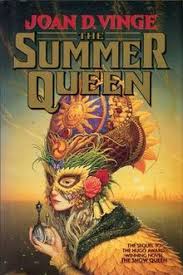
The only “brown” thing I will note is that Joan D. Vinge’s space opera Summer Queen features a dominant civilization which is obviously based on that of the Indian subcontinent. Brownz in space!!!
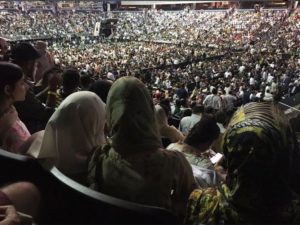
So, thirty thousand Pakistani-Americans gathered in DC to hear PM Imran Khan, billed as the largest gathering of Pakistanis in North America ever. I am seeing that Bangladeshi and Bangladeshi-American social media is somewhat impressed. It is doubtful that any Bangladeshi leader can even pull half that crowd in North America. This is also a little bit puzzling. By most measures and in popular discourse, Bangladesh has been doing far better than Pakistan economy and society-wise in the last ten years. So how come a Pakistani leader, in midst of economic stagnation, fiscal crisis, currency crisis etc etc back at home manage to pull such a crowd? Is Imran Khan really popular among Pakistanis? Is there a home-expatriate divide? I am curious to know from Pakistanis.
I left India many years ago to live in Britain but having said that I have always felt deeply connected to her. I was born and raised in Madras (now Chennai) and like many Indians living abroad would attest; one feels tethered to her in ways that transcend culture or habits.
I invariably gravitate to news on India and Indians as a default, despite 12 years of living away, my Facebook and Twitter are overwhelmed with stories about India (this is of course a result of the accounts I follow).
I’ve always kept loose track of the big Bollywood releases, and have never been successful at adapting my palette to anything away from desi food. Then of course it is hard to ignore Indian politics, no matter where you live in the world; the news finds a way to your timeline or twitter feed.
I don’t think this has anything to do with patriotism, it is a default. It is the inability to shake away some aspects that are hard-wired. If you lived in India long enough to soak in her distinctive and unique qualities, you remain tethered for life.
If someone asked me to describe what it means to be Indian?
I would say we come in all colors, shapes and sizes, between the length and breadth of India.
There are innumerable dialects spoken, there are groups, sub-groups and sub-sub-groups people like to organize themselves into. These could be religions, languages or other clustering factors.
We don’t dress the same, speak the same or even think the same way.
It is quite possible to find two Indians who share nothing in common except the country they belong to.
This lack of tidiness has never been a cause of dismay but the very essence, the very description of India, her distinguishing trait in the world.
It’s what makes us better than our neighbors.
To try and mask over this amazingly messy, glorious, mixture would be a travesty and something that needs to be safeguarded against. This strong heterogeneity has no influence on how people interact at a micro-level. Within the country people migrate to states they didn’t hail from and find ways of flourishing, magically.
Hence, a really succinct definition of being Indian would be ‘being liberal’.
It were these — liberalism and secularism, the founding principles of the state of India. By and large Indians everywhere in urban and rural areas have lived by and embraced these principles.
In the India I grew up in, it was not important whether you were a temple or a church goer but if you can help someone make headway. There was no time or room to focus on subjects inconsequential to ones prosperity. In a country like India, to prosper is the underscoring dominating aspiration.
Have things changed in today’s India?
Here is my take: While the mainstream news will tell you otherwise, (and frankly enough virtual and physical ink has been spilled on discussing the rise of Hindu nationalism post 2019 national elections) I don’t think the government in the world’s largest and perhaps most untamed democracy can so easily sweep through and change the way people fundamentally behave.
While it is important to fight illiberalism, barbarism and racism; we cannot be so consumed by dissent that we forget to focus on issues of material significance and our growing superpower status in the world. For India, the ruling government or its leanings have always been extraneous. The individuals and the institutions have mattered much more.
As a country we have several pressing matters at hand, we are trying to make our mark alongside China as one of the world’s largest economies. We need to clean up our cities and preserve our monuments, we need to educate more people and give jobs to a lot more.
We need to make things better for millions of farmers. We need to market our culture, food, art, literature in an increasingly globalising world. We need to make better films, write better books, do better science and retain our brilliant minds.
We need to stay relevant. We need to sell more to the world so we can be more prosperous. With over a billion people in tow we cannot afford to lose this race, but we will if we continue to squabble over matters of little material significance.
There is so much we can already offer to the world and so much more to work towards. This is both our burden and our duty. Let’s not get distracted.
I’m pretty busy these days with work but I have taken the early morning off to catch up on all of my extra-circulars (I’m trying to steel myself to work out in the mornings but that’s still a step too far).
This is an amazing clip by the comic Saikiran. He speaks truth to power and more tellingly the Casteocracy as a Dark Brahmin(?).
I liked his point about how there are 50 women to 100 men on Telugu Matrimonial.com
The NRIs take the top 20 women and then the other 20 are taken by the Two “Eyes” of India (IIT & IIM).
I usually don’t like Indian stand-up comics because they are riffs on Western comics (one could write whole books on the relationship between contemporary Indian culture and the West).
I like his authenticity very much and I found him hilarious; so did 8-9mm people.
In our last politics podcast there is definitely a trend among Indians to shake off Westernised identity (they tried hacking off the Saracenic one 70years ago to mixed success I still haven’t heard a popular Shuudh Hindi song yet) and go their own way in Modi’s India. This is a good example of cultural authenticity even if the language of choice is not. I don’t know the origins of stand-up comedy but it’s entirely appropriated dominated by the Anglo-Saxon West.
It’s very unlikely that he had more than a 1,000 geniune white Westerners see his video of 8+million views but even to reach maximum audience, effect and positioning he had to rely on English.
Finally he alludes to his grandmother who was not South Indian fair, not even North Indian fair but Afghanistani fair (albino).
He could have just said Kashmiri fair. While her partner, Advocate Guruswamy, has height on her side; Ms. Katju immediately screams Srinagar and I’m not even familiar with the community. I find it interesting that the cast-iron Indian rules of hypergamy are even hardwired operate in a lesbian relationship; the lipstick is fair & demure, the chapstick is tall and dusky (I’m assuming their roles but it’s a sensible guess).
The idea of course is that more often than not, in a Hindu context (I used Hindu in an ethnographic not religious term), is that caste, colour and class are so tightly wedded together that the most angst is concentrated are in those who happen to have 2 out of 3 as in the case of Mr. Saikan.
Most court days you'll find me in a sari! Something about the 6 yards makes me sit up a little straighter, collect my thoughts and energy for arguments… #SareeTwitterpic.twitter.com/U9HDEyT70C
— arundhatikatju अरुंधती काटजू (@arundhatikatju) July 18, 2019
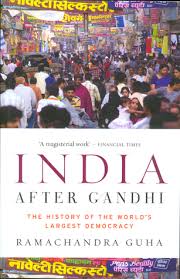
I know many people are critical of Ramachandra Guha’s India After Gandhi: The History of the World’s Largest Democracy (e.g., my friend Reihan Salam is not a big fan), but Amazon is running a Kindle Deal on it (at least in the USA). So it’s $1.99 currently.
The original book was published in the 2000s, but this is a “revised and updated” version. So I assume it has a bit more on the last 20 years. Whatever you think about it, it is probably worth reading at some point.
I did mention to V that I was shocked that I had only learnt about this story (and that too from a Pakistani not Persian Baha’i).
She immediately replied that’s because he was “a black man Zach.” While I’m proud of this story, which frankly is more impressive than any temple built by our institutions, I’m also ashamed of the endemic and silent racism within the community.
It is always interesting to me that in our avowedly “non-racist” (and non-sexist faith) it’s always Persian & White Men (and their Spouses) who become the Superstars of the Faith.
So it is interesting that while I’m busy with my one-man crusade online to Persianise Pakistan (restoring our High Culture is a difficult but worthwhile task) I’m fighting a very different battle to find moral equity within our Persianate Faith.
I didn’t understand the desire to install the statue of the divisive Ranjit Singh. I recently saw the movie Kesari and frankly found it rather offensive that Bollywood chose to celebrate the Slave-soldiers of the Raj rather than the Pashtun freedom fighters.
I do feel a good solution to Pakistan’s identity dilemma would be a constitutional monarchy with Afghanistan (Union of the Crowns, which is what England & Scotland had from 1606-1707).
It would have to be solely Persian-speaking (I haven’t researched enough on what standard of Persian but Dari possibly approximate Sabki-Hind fairly well) but Sunni (in the manner of the Mughals being Sunni, which was eclectic but still distinct enough from the Safavids) and probably the last Afghan dynasty will do with enough Mughal Muslim nobility thrown in for good measure. This would offset the Punjabi-Sindhi dominance since frankly most of the notables would be the traditional ruling tribes of Muhajirs and Afghans (the only royal tribe in Pakistan that comes to mind are the B’s; Brahuis, Baltis and Bahawalpur).
As the last cricket World Cup showed it’s not the Radcliffe line that must be erased; after all it is a civilisational border of sort but rather the Durand line. The fact that Afghanis and Pakistanis were at each other’s throats while the Indians & Pakistanis were super-cordial demonstrates that the former is a familial relationship the latter is a formal one.
There is also a serious possibility that such a constitutional monarchy might have to accommodate the rising tide of Muslim migrants from Modistan.
Then statues of Ranjit Singh and Raja Dahir would make sense as the indigenous expression of Pakistan’s Indian provinces (Punjab & Sindh).
But like all things Pakistani, the national project is still half complete and we must look West to Turan. The Arabs only came once and only manage to transform Sindh; it was the Turanians who reshaped the map of India.
Of course this is constitutional optics and nothing would really change on the ground but the restoration of an Sunni Persian-speaking Afghan-Mughal Monarchy would solidify AfPak and tie it solidly into its Persian & Central Asian neighbours.
It would be a fitting tribute and victory to those noble Afghans who sacrificed their lives at Saraghari under the orders of the British and their Ghulams. Then we can be politically correct and build as many statues of Ranjit Singh & Raja Dahir as we like.
Razib Khan · July 19, 2019 · Comments Off on We have hit peak podcast!
Back in the 2000s, when blogging was a thing, I was at a party and someone mentioned offhand that I had a blog. Someone else blurted out, “Oh, me too!” We left it at that. But a friend asked me why I didn’t let on that my blog got hundreds of thousands of visitors per month, or that millions of people had read me over the years. The point is that there were people who had blogs, and other people who had blogs.
I was reminded of that by this piece in Have We Hit Peak Podcast?. I first heard about podcasting in the middle of the 2000s. I started listening to podcasts around 2008 or so, on my old iPod shuffle. It wasn’t until 2016 that I actually started contributing to my own podcast (on genetics and evolution).
About ten months later we started the Browncast. I’ve now done 67 podcasts for The Insight. I’ve been on the majority of the 50+ podcasts for the Browncast.
So let me quote from The New York Times piece:
But six episodes in, when neither Casper mattresses nor MeUndies had come knocking, the friends quit. Today, Ms. Mandriota says the same D.I.Y. spirit that made having a podcast “alluring” is precisely what doomed the project. “You can talk about the trees outside as much as you want, but if you’re not going to serve listeners and do it in a way that’s engaging, your chances of going viral are low,” she said, calling her show “the most makeshift podcast, with mediocre advice.”
If folks over here are not already aware, a major ancient DNA paper on cattle came out last week in the Science magazine. It had an unprecedented 67 ancient cattle samples.
Here’s the abstract,
Genome-wide analysis of 67 ancient Near Eastern cattle, Bos taurus, remains reveals regional variation that has since been obscured by admixture in modern populations. Comparisons of genomes of early domestic cattle to their aurochs progenitors identify diverse origins with separate introgressions of wild stock. A later region-wide Bronze Age shift indicates rapid and widespread introgression of zebu, Bos indicus, from the Indus Valley. This process was likely stimulated at the onset of the current geological age, ~4.2 thousand years ago, by a widespread multicentury drought. In contrast to genome-wide admixture, mitochondrial DNA stasis supports that this introgression was male-driven, suggesting that selection of arid-adapted zebu bulls enhanced herd survival. This human-mediated migration of zebu-derived genetics has continued through millennia, altering tropical herding on each continent.
Well the widespread Zebu presence in the LBA Near East is not exactly a new discovery. It has been known for quite sometime now among archaeologists. This article gives a good overview on the subject.
Nevertheless, with this new study, we now have conclusive evidence that the widespread Zebu admixture in the Near Eastern cattle did indeed start around 2000 BCE.
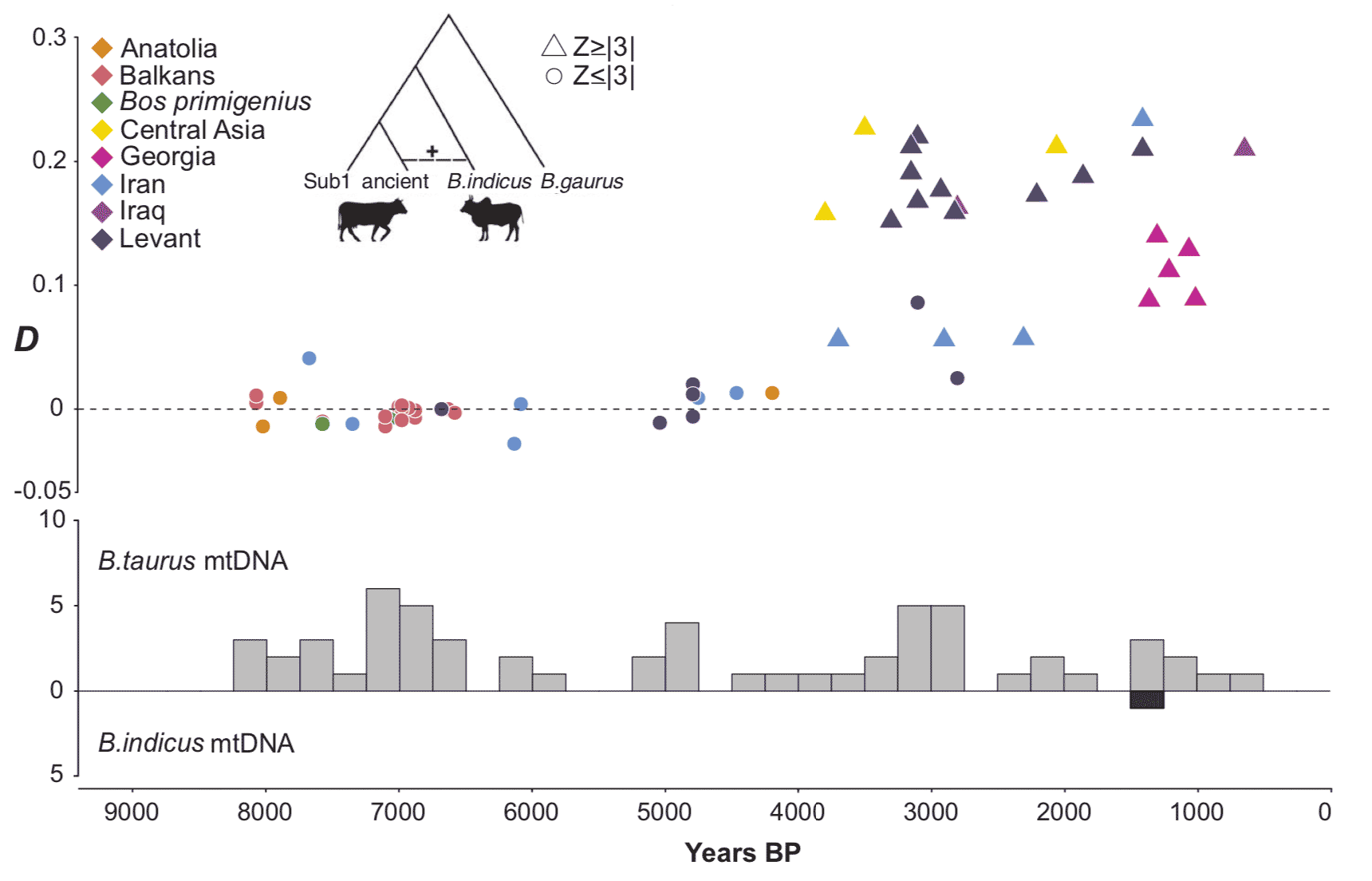
(figure courtesy : twitter/johnhawks)
As can be seen from the above figure, after 4000 YBP, there is a sudden spurt in indicine or Zebu admixture across nearly all the ancient samples of Near Eastern Cattle including cattle samples from Central Asia, Iran, the Caucasus, Levant, Mesopotamia & the Balkans.
Again quoting from the paper,
…despite archaeological evidence for contact between civilizations of the Fertile Crescent region and the Indus Valley (9), the influence of the zebu genome is detectable in ancient Southwest Asian cattle only 4000 years later (Fig. 2). However, after ~4000 yr B.P., hybrid animals (median 35% indicine ancestry) are found across the Near East, from Central Asia and Iran to the Caucasus and Mediterranean shores of the southern Levant (table S2 and fig. S1). During this period, depictions and osteological evidence for B. indicus also appear in the region (9, 13). In contrast to autosomal data, but similar to earlier work (14), we find persistence of B. taurus mitochondria, suggesting introgression may have been mediated by bulls (Fig. 2).
As the bolded portions note, the indicine admixture in the ancient cattle samples from the Near East post 4000 YBP, show on an average 35 % indicine admixture but that this mostly through the Indicine bulls as there is indicine mtDNA in these admixed samples. This widespread and major admixture in the Near Eastern cattle post 4000 YBP, is clearly a major turning point in the history of the Near Eastern cattle.
What lead to this major turning point ?
It is now widely accepted that there was a major 4200 YBP climatic event that brought about a prolonged phase of drought perhaps extending to several centuries which affected all major civilizations of the Near East extending all the way to the Indus civilization. This event is also considered a major reason for the apparent ‘collapse’ of the Indus civilization.
The Large Harappan Footprint across Middle Asia
Most if not all movements of cattle across large distances in prehistory are usually associated with movement of humans. Did the large influx of Zebu autosomal DNA into the Near East cattle also result due to South Asian population expansion into the Near East post-4000 YBP ?
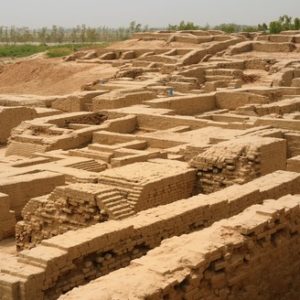
What we do know from archaeology is that the Harappans were operating across a vast landscape and their presence and influence can be detected in Central Asia, Eastern Iran( Jiroft & Helmand), the SE Arabian coast (Oman & Bahrain) and in Mesopotamia already in the 3rd millenium BC. The Harappans even had their own colonies in these different regions.
It appears that a minority but nevertheless a significant and arguably influential community of Harappans were present in most of these regions away from the Greater Indus region as far as atleast Mesopotamia. Infact, in a lot of these places, the Harappans were apparently living in those places for many generations. It is conceivable that they would have brought and maintained the Zebu cattle in their new homelands.
Therefore, already in the 3rd millenium BC, it is quite probable that the Zebu cattle was already a minor but regular feature of the Middle Asian landscape.
However, after the onset of the 4.2 kya event, with the onset of aridity, it is believed that the Harappan civilization finally collapsed around 3900 kya (1900 BCE). One of the consequences of this collapse is apparently the end of Harappan trade and interaction across Middle Asia.
So the questions is – how did the Zebu admixture in the Near East shoot up all of a sudden in a period when we are led to believe that the Harappan or Indus civilization ceased to interact with this region ?
And it is not just Indian cattle admixture that becomes widespread into the Near East during this post-4000 kya period. As the authors of this paper state,
Westward human migration has been documented around this time(19,20) along with archaeological evidence for the appearance of other South Asian taxa such as water buffalo and Asian elephants in the Near East(21), suggesting the movement of large animals by people.
Infact, the presence of Asian Elephant in the Near East dates to from the end of 3rd millenium BC to the 8th century BC and is centred around Syria and hence this ancient elephant population is also known as the Syrian Elephant.
The authors of the study cited on Asian Elephants in our cattle aDNA paper above state something very interesting,
…ancient accounts indicate that live elephants roamed and were hunted in the Orontes Valley, the Upper Euphrates Valley and the Middle Euphrates Valley around modern Ana in Iraq, at least between the end of the 16th and 9th centuries BC, possibly into the 8th century BC (Breasted 1906–07; Gardiner 1964: 179, 201; Moorey 1994: 117; Scullard 1974: 28). The core of this region comprises the area of influence of the Mitanni Kingdom, the main local political player in LBA northern Syria…
The Mitanni were an Indo-Iranian, possibly Indo-Aryan elite ruling over the native Hurrian population in present day Syria in the mid 2nd millenium BCE. And we observe that Asian Elephants, most likely imported from the Indus civilization, only appear in the Near East during the 2nd millenium BC and in a geography that was under the political control of the Mitanni. Is this merely a co-incidence ?
A New Interaction Horizon in Middle Asia in the LBA ?
It is quite probable that with the collapse of the old Bronze Age empires all across the Near East and South Asia, this entire Middle Asian region entered into a new era of interaction which is archaeologically not so well-defined. The widespread Zebu admixture in the Near Eastern cattle along with the presence of Asian elephants as also the first attestations of the Indo-Europeans such as the Hittites & the Mitanni and the associated horse-drawn chariots are evidences of this new horizon.
But while the Zebu and the Asian Elephant came from South Asia, one may argue that the Hittites, Mitanni and the horse drawn chariot must surely come from the steppe.
Well, the strong correlation of the geography of the LBA ‘Syrian’ Elephant population with the boundaries of the Mitanni empire, does suggest some sort of interaction of the Mitanni with South Asia.
And if this is not all, we have now possibly a very strong evidence of the presence of chariots in South Asia which is as old and probably older than the Sintashta chariots in the steppe.
It maybe noted that before the discovery of the chariots in Sintashta which gave the steppe chariot the distinction of being the oldest known one, it has been argued for long that the invention of chariot is mostly likely in the Near East and not in the steppe due to several factors inimical for the use of chariots on the steppe. You can read more about it here.
The discovery of the Sanauli chariots is likely to revive that debate. Along with this, we also have the prospect of horse aDNA from the Mature Harappan Phase no less.
Genetic evidence of Horses in mature Harappan period. The findings will be published soon.
So could the appearance of the Zebu, the Asian elephant, the Buffalo as well as the Hittites & Mitanni and their horse drawn chariot in the 2nd millenium BC in the Near East have a common cause in their probable migration from South Asia after the Indus civilization collapse.

 Congrats to India on launching the Chandrayaan! Here is an explainer. And an older WSJ piece, India Looks for Its Own Elon Musk to Win the Space Race with China.