A Quick Question- when did Hindus revenge themselves?

We just wrapped up another podcast but I listened this time and didn’t say anything. It was really dense and informative!

As I was clearing away everything (well past my bedtime) a random thought popped into my head.

At what point pre-1947 did Hindus (or Sikhs) revenge themselves on Muslims? What I’m trying to establish is that was there a justifiable fear on the part of the Muslim League to assert that a Hindu-majority India would be a no-go zone.

I’m specifically excluding the Partition events but I’m looking for a Hindu equivalent of Direct Action Day, where legions of Hindus set themselves on Muslim localities.

My distinct impression is that these mob riots emerged in the bad blood post Partition. In comparison to the Greeks, Israelis or even now the Chinese; Hindus and Indians have been particularly partial towards their Muslim population.

At any rate this is my short note and remember I’ll be (iA) live blogging tomorrow’s lecture.

Image

I’ve discovered the South Asian Centre at Cambridge and I’m rather kicking myself for not availing it sooner. I missed an interesting talk on Lahori resistance in the 19th century on Monday.

I’ll try to live blog the lectures where I can; there’s also the Shahnama Institute and the Ancient India & Iran Trust.

https://screenshotscdn.firefoxusercontent.com/images/2df9a5cd-1181-4544-b6ad-a410e2eea154.png/Screenshot_2019-05-14_What's_On_The_Centre_of_South_Asian_Studies.png

I’ll try to live blog lectures where I can and of course ask speakers onto Podcasts (I’m still pending some questions to Professor Foltz but since there weren’t too many, I’ll putting that on ice for now).

If commentators are interested in particular lectures please do let me know so I can make sure to attend.

Islamic Extremists, Human Rights and Evangelical Christians

Abstract:

Is Sri Lanka (and similar small states) going to be the frontline between Islamic Caliphate versus Human Rights/Evangelical Christian Empire. Like Vietnam was a proxy War/battlefield between the goal of a Communist vs Capitalist World Empire.

Post WW2, Evangelical Christianity (thru the US) and “Human Rights” (thru US and Europe) have been terrorizing the Mid East for over half a decade.

What is the difference between

  • a) Bombing multiple countries to install “Human Rights” compliant with the Empire of the West.
  • b) or Bombs with the goal of establishing Sharia Law compliant Caliphate Empire.
U.S. bombsĀ  southern Baghdad, killing another six civilian

Pre WW2 Europe (2) was the foremost in promoting “Christian Values” while obviously exploiting and looting the resources of brown and yellow heathen savages.
Post WW2, Europe and the US has redefined itself as advocates of Human Rights illegally supporting war either (see the box below for examples)

      • by acting unilaterally
      • using false evidence for UN resolution
      • acting beyond UN resolutions

In order to invade Iraq, Colin Powell stood on the UN floor and assured that Iraq had WMD. Colin Powell later regretted his speech.
A spokesperson for the Peace Research Institute Oslo (PRIO) falsely defended the bombing of Libya as within UN resolution. The UN resolution was only to establish a no fly zone. The Norwegian aircraft dropped 588 bombs

To Europe, US markets the wars as protecting Human Rights or the (in)famous Right to Protect (R2P) of Samantha Power and Hillary Clinton. At home in the US sellsĀ  Human Rights as Gods Wish/A Just War to the very important Evangelical home base to garner support for Iraq War and bombing of Libya.

No MSM writeup says, Christian Presidents George Bush and Barack Obama instigated a Just War.Ā  However, George W. Bush is a member of the United Methodist Church. Barack Obama is and has been a member of Evangelical Churches. Evangelical leaders post 9/11 signed an open letter to Bush approving war on Iraq satisfied the criteria of Christian “Just-war” theory. ( see here and here)

“Iraq represents that existential threat we have from global Islamic Jihadists. “We must defeat it in Iraq, Afghanistan and then act preemptively to destroy it wherever it emerges.”.

ā€œThroughout Scripture, there is evidence that God favors war for divine reasons and sometimes uses it to accomplish his will. He has also given governments and their citizens very specific responsibilities in regards to this matter,ā€ Charles Stanley, Televangelist, pastor First Baptist Church of Atlanta and In Touch Ministries said in a sermon broadcast internationally on his television program.,

As one can see, there is not much difference between Christian and Islamic priests advising people and countries to wage war.

Two examples of US and European Post World War 2 atrocities
1953 Iran: CIA coup overthrows the democratically elected MP Mosaddegh .

1980-1988 Iraq Iran War:

  • Support for Iraq
  • USS Vincennes shoots down Iran Air Flight 655 on 3 July 1988, killing all 290
  • Chemical weapons supplied to Iraq by US, UK,Ā  Netherlands and German companies

It is pretty clear, the US and Europe with the blessings of the Evangelicals/Human Rights Religion has been the first instigators in the Mid-East.Ā  The Muslim response has been slow and generally localized to places of regime change and invasions.Ā  With the creation of Al-Qaeda and ISIS the war has been fought on a larger geographical terrain.

Now the war between Evangelicals/Human Rights Religion and Islamic Jihad has been taken worldwide. Suicide bomber cells now include family groups including children. Suicide bombers attack churches, tourist hotels and beaches where westerners congregate.Ā  T

Unhappily, Islamic extremism is also an opportunity for Western powers to establish a foothold.Ā  In Sri Lanka.Ā  The US wants to sign aĀ  secretive Status of Forces Agreement (SOFA) with clauses to exclude the American soldiers from the local jurisdiction.Ā  Liberal Human Rights types and WesternizedĀ Ā  Sri Lankans (many are Christians, like current PM Ranil Wickremasinghe) would welcome the West with open arms.Ā  This would result in Sri Lanka being a proxy battle field for Western powers and the Islamic Caliphate.Ā  Sri Lanka should find its own solution to keep Christian/Islamic wars out of its shores.

(1)Disclosure. Author is a Tamil by Heritage, Atheist, though born to anĀ  Evangelical Christian family, post graduate education and work in the US.
(2) The Catholic Church has much blood in the past. Post WW2 as far as I know, no war has been justified by the Vatican.

Other readings

Islam, Extremism & Hypocrisy, Nur Yalman (2017)
Short history of Wahabism to ISIS

https://www.colombotelegraph.com/index.php/islam-extremism-hypocrisy/

History of Wahabi violence in Sri Lanka.
http://www.sundaytimes.lk/190505/sunday-times-2/the-need-to-identify-the-enemy-within-347960.html

From Sri Lanka to Indonesia, more mothers are becoming suicide bombers
– and killing their children too
https://www.scmp.com/week-asia/society/article/3008808/sri-lanka-indonesia-more-mothers-are-becoming-suicide-bombers-and?

Browncast Ep 35: Tahir Andrabi on Primary Education in Pakistan

Another BP Podcast is up. You can listen onĀ Libsyn,Ā iTunes,Ā Spotify,Ā  andĀ Stitcher. Probably the easiest way to keep up the podcast since we don’t have a regular schedule is toĀ subscribeĀ at one of the links above.

You can also support the podcast as aĀ patronĀ (the primary benefit now is that you get the podcasts considerably earlier than everyone else…).

Tahir Andrabi

This week we have a twofer about education in Pakistan. In part one we talked to Dr Sohail Naqvi about higher education, and in this episode Omar and Zachary talk to Professor Tahir Andrabi. Tahir is the Stedman-Sumner Professor of Economics at Pomona College and is currently working as the founding dean of the school of education at the Lahore University of Management Sciences. He has a professional interest in primary education and public policy and has written extensively on these topics. He shares his views about primary education in Pakistan. I was especially taken by his observation that the 10th grade examination (the “Matriculation” examination) in Pakistan is one of the reasons why primary education in Pakistan is so sub-par. And that the entire colonial era educational system is meant to identify “winners” (the top 1 % of the students) instead of meeting the needs of the majority of students (the modal student in Pakistan is headed for failure). His points about educated girls having sparked a revolution in (private) primary education in the rural areas, and lax enforcement being the reason (onerous and useless) state regulation of education has done relatively little damage in Pakistan, are also spot on. I hope we get Dr Andrabi on again to discuss some of these topics in greater detail.

We would definitely appreciate moreĀ positiveĀ reviews. Many of you listen to us, but don’t leave any reviews!

Browncast Ep 34: Sohail Naqvi on Higher Education in Pakistan

Another BP Podcast is up. You can listen onĀ Libsyn,Ā iTunes,Ā Spotify,Ā  andĀ Stitcher. Probably the easiest way to keep up the podcast since we don’t have a regular schedule is toĀ subscribeĀ at one of the links above.

You can also support the podcast as aĀ patronĀ (the primary benefit now is that you get the podcasts considerably earlier than everyone else…).

Related imageThis week we have a twofer about education in Pakistan. In this episode Omar and Zachary talk to Dr Syed Sohail Hussain Naqvi. Dr Naqvi is currently the Rector of the University of Central Asia. Prior to that he has been vice chancellor of the Lahore University of Management Sciences, executive director of Pakistan’s Higher Education Commission and Dean of electrical engineering the Ghulam Ishaq Khan institute of technology. He shares his views about higher education in Pakistan and his own experiences in that field. In the next episode, we speak to Dr Andrabi about primary education.

In the next episode, we talk with Professor Tahir Andrabi about primary education.

We would definitely appreciate moreĀ positiveĀ reviews. Many of you listen to us, but don’t leave any reviews!

Why I hate the Hijab

The Hijab is a part of the Middle Eastern-Levantine cultural matrix so I don’tĀ  have a problem when I see Arab women wear it . But it’s risible when Desi Muslims try to flaunt what is essentially an alien garment. If one wants to be modest why not just wear a salwar kameez and elegantly drape the dupatta?

After I ranted to V about yet another uppity Hijabi (the offending lady in question had secured herself a booth for 4 people in a crowded cafe); V made a profound remark.

V didn’t mind the Hijab per se; women should be allowed to wear what they want. However what she found to be so strange about the Muslim hijabi activists in the West is that they had no sympathy for their Iranian sisters who are dying for the right to dress as they please.

Continue reading Why I hate the Hijab

Sri Lanka ā€˜can’t see the wood for the trees’ – Post incident?

Excerpts and link to article written by a classmate of mine a former Senior Intelligence Officer in the Army.
——–

he 1998 bomb attacks in Coimbatore, India have been the base for this research. Why? The attacks took place under similar circumstances and still holds water. Coimbatore, for some time, had been a hotbed of Islamic fundamentalism.

February 14, 1998 saw the group killing 58 people and injuring more than 200 people by carrying out 12 bomb attacks within an area of 12 sq km.

Suddenly, he (Abu Bakr al-Baghdadi ) appeared on April 29 and surprised the world. His message was loud and clear. He said: ā€œYour brothers in Sri Lanka have healed the hearts of the monotheists, with their suicide bombings, which shook the beds of the crusaders during Easter… Continue reading Sri Lanka ā€˜can’t see the wood for the trees’ – Post incident?

Contemplating the weave of the world

    [ exploring various versions of how the world of concepts can itself be conceptualized ]

.
**

Have patience with me: Omar Ali has invited me to post here, an honor I greatly appreciate, and I am introducing myself.

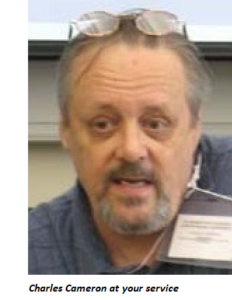
I’m an outsider. I’m your guest, and I only just arrived.. To be precise, I’m a Brit, resident in the United States:
If I’m to write on BrownPundits, I need to you know how ignorant I am in many respects, before I shed some of what knowledge I do possess — and also to focus myself in the Brown direction, because this place is devoted to “a discussion of things brown” — and while I’ll no doubt wander far afield as I post, I want to acknowledge and honor the purpose of this blog as I introduce myself here.

**

My interest, my fascination, my obsession even, is with the weave of the world. And indeed, if my friends Omar Ali, Ali Minai, and Hasan Asif can be any indication, the Punditry of Brown extends intellectually across all of history, geography and genius, to encompass the world of ideas and the world world to which the ideas refer in their combined entirety..

And thus the weave of the thing. That’s how the Kathasaritsagara, or Ocean of the Streams of Story, comes in to my story. Somadeva Bhatta’s concept of the oceanic streams of story caught Salman Rushdie’s eye, and Rushdie reference to it —

He looked into the water and saw that it was made up of a thousand thousand thousand and one different currents, each one a different colour, weaving in and out of one another like a liquid tapestry of breathtaking complexity; and Iff explained that these were the Streams of Story, that each coloured strand represented and contained a single tale. Different parts of the Ocean contained different sorts of stories, and as all the stories that had ever been told and many that were still in the process of being invented could be found here, the Ocean of the Streams of Story was in fact the biggest library in the universe. And because the stories were held here in fluid form, they retained the ability to change, to become new versions of themselves, to join up with other stories and so become yet other stories; so that unlike a library of books, the Ocean of the Streams of Story was much more than a storeroom of yarns. It was not dead, but alive.

— it’s a universal mapping of the sort that enchants the likes of Jorge Luis Borges and Umberto Eco, librarians both, encompassing the realm of human thought in narrative terms. And it’s one subcontinewntal form of the universal map, or model, or metaphor — the Net of Indra in the Avataṃsaka Sutra would be another.

Outside the subcontinent — but well within the compass of Brown Punditry– there are other such metaphors for the whole of the whole. Teilhard de Chardin’s oosphere is another, as is Sir Tim Berners-Lee’s >World Wide Web, in which complex weave of thoughts we now find ourselves.

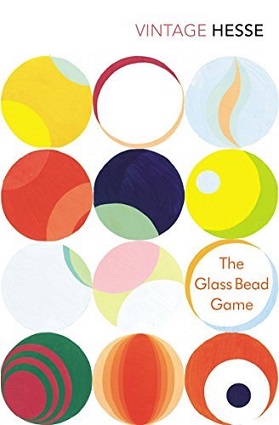
But for my own purposes, the most interesting figure of the whole, the universe as we are able to think and name it, conceptually speaking, is the Glass Bead Game as described by Hermann Hesse in his Nobel-winning novel of that name
**

My own personal predilections run from cultural anthropology through comparative religion to depth psychology, and from violence to peace-making. But that’s a huge sprawl at best, and to bring all that into some kind of focus, to learn how to map that immense territory, and the vaster universe beyond it, I turn not just to strong>Hesse’s novel, but particularly to the Game which he describes in that book:

The Glass Bead Game is thus a mode of playing with the total contents and values of our culture; it plays with them as, say, in the great age of the arts a painter might have played with the colors on his palette. All the insights, noble thoughts, and works of art that the human race has produced in its creative eras, all that subsequent periods of scholarly study have reduced to concepts and converted into intellectual values the Glass Bead Game player plays like the organist on an organ. And this organ has attained an almost unimaginable perfection; its manuals and pedals range over the entire intellectual cosmos; its stops are almost beyond number. Theoretically this instrument is capable of reproducing in the Game the entire intellectual content of the universe.

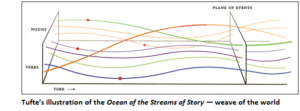
You’ll see how that description covers much the same ground as Rushdie’s description of the Kathasaritsagara, and Edward Tufte’s image of the Ocean of Story which I’ve placed at the top of this post could also be a depiction of Hesse’s great Game.

There are many voices in the Ocean, and many voices in the Game, and they are interwoven: they form which a musician would recognize as a polyphony — their concepts and narratives at times clashing as in musical counterpoint, at times resolving, at least temporarily, in a refreshing harmony.

And what better model of the world can we contemplate at this moment, that one in which a multitude of at times discordant voices wind their ways to concord?

**
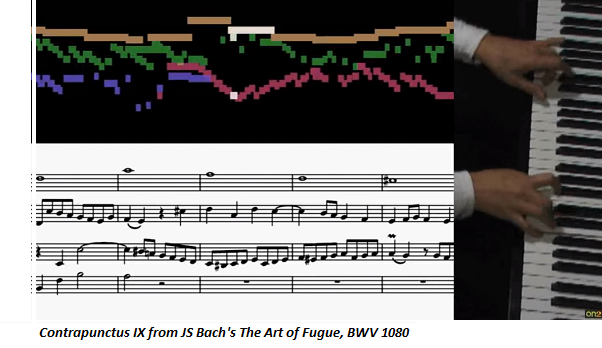

[ above: conventional score, bar-graph score and keyboard recordings of JS Bach, contrapunctus ix

Johann Sebastian Bach is the master of contrapuntal music, and, be it noted, a great composer for and improviser on the organ. And it is Bach whose music I listen to as I approach the business of modeling the world of ideas.

My mantram ca 1999/2000 was:<To hold the mind of Bach..

Where Bach devises and holds in mind melodies that collide and cohere, I want us to hold thoughts in mind — at times clashing thoughts — and learn to weave them into a coherent whole..

That’s my approach to making the Glass Bead Game which Hesse conceptualized, playable. And my playable variants on Hesse’s Game, the HipBone family of games, will be the topic of my next few posts — thanks to the kind inquiries of my BrownPundit friends, and Omar’s generous invitation to me to post here.
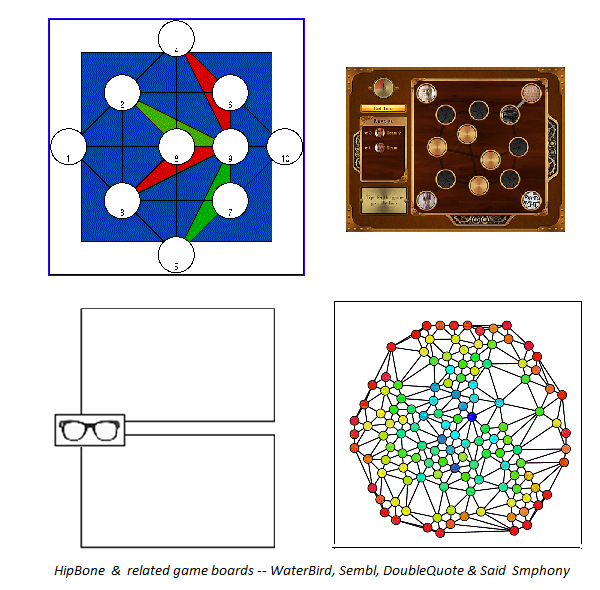
And perhaps, if you’re interested, we’ll play a few rounds of my games, or explore across the world of ideas and your and my interests, what I’ve come to think of as the HipBone style of thinking..

___________________________________________________

Charles Cameron is a poet and game designer, managing editor of the Zenpundit blog, and now an invited guest at BrownPundits. You can hear a discussion of the overlap between the Glass Bead Game and Artificial Intelligence featuring Omar Ali, Ali Minai and myself on this BrownPundits podcast — with an appreciative bow to Razib Khan.

Questions for Professor Foltz

I live blogged yesterday’s lecture and the speaker, Professor Foltz, has very kindly agreed to a written question and answer session. I’ll collate 10-15 questions.

His speciality is in Iranic studies though ironically his talk happened in the ā€œIndian Roomā€ at the Ancient India & Iran Trust.

Please post your questions in the comments below- it would be worth beforehand scouring his impressive profile. I imagine we can focus more on the early Aryans as that would be more interesting to this blog.

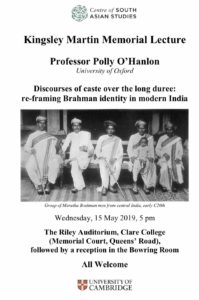
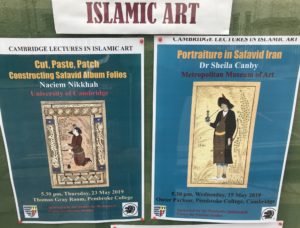
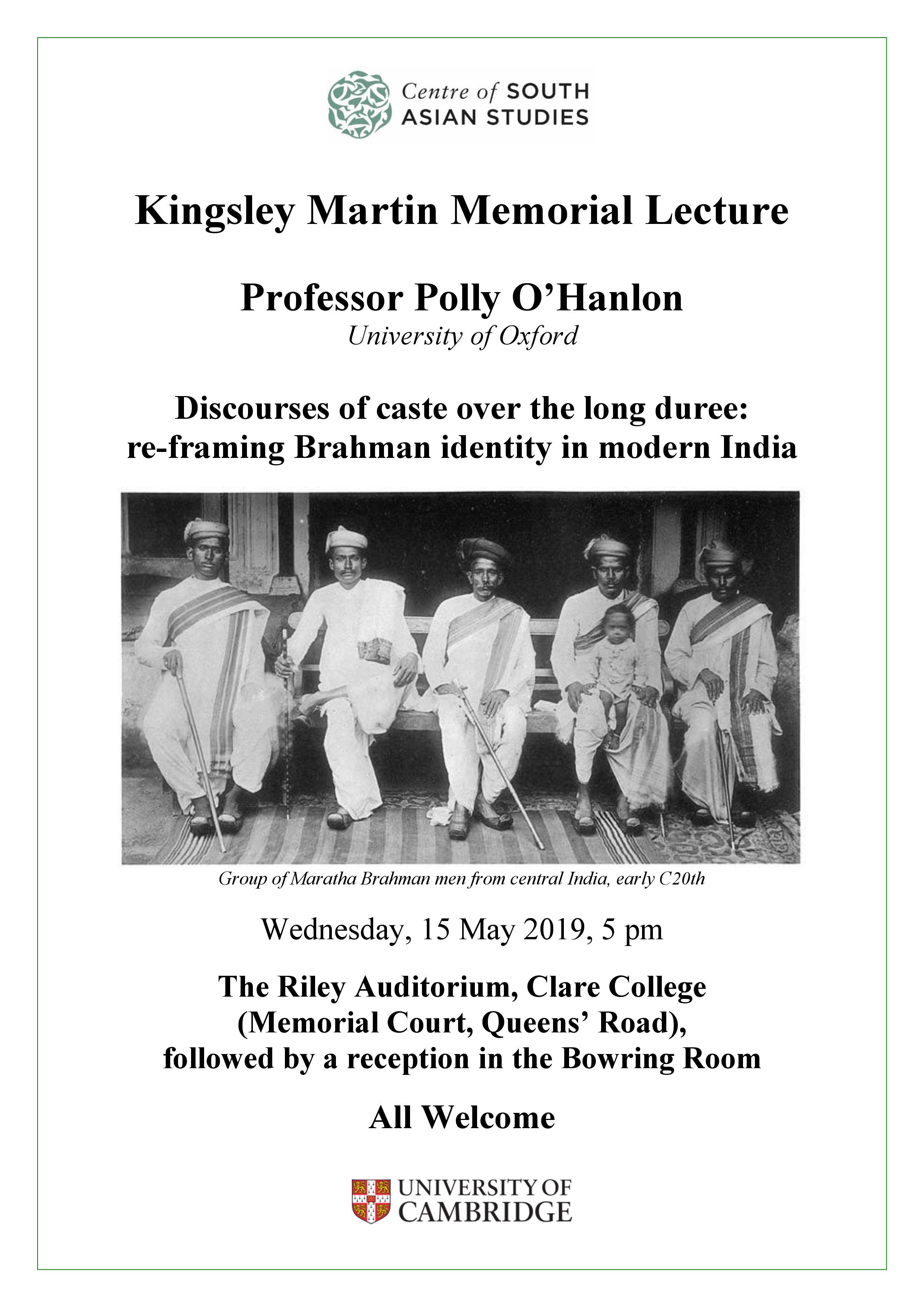
I’m hoping to attend another very interesting lecture on Wednesday-

I’ll be sure to live blog this one. Incidentally it will conflict with another lecture I had been looking forward to.

However I have a distinct feeling that living blogging a Cambridge lecture on Brahmins will be orders of magnitude of more interest to our readers than Portraiture in Safavid Iran!


The Indian Muslim question

I can see BP Open Thread has exploded into a flame war about Pakistani Hindus vs Indian Muslims.

I thought I would share my experience. The moment I go to India; I subconsciously de-Muslimfy. Indians & Hindus are just not comfortable and since I’m the non-confrontational type (only Kabir can role me up) I adapt accordingly.

When I’m with Pakistanis I tend to change colours accordingly however I have increasingly made my personal (and increasing) distaste of Islam known.

Pakistan is very riven with a class dynamic so it doesn’t matter what religion you are so as you belong to the right class. There are issues with Ahmadis.

Both societies have so much to do in improving minority rights but I do feel they mirror their ideological priors. Indians look at Muslims almost as a caste and Pakistanis internalise accordingly to class divisions (certain minorities belong to certain stratas).

Continue reading The Indian Muslim question

Brown Pundits