
Please keep the other posts on topic. Use this for talking about whatever you want to talk about.
Book Review: India’s Wars. A Military History 1947-1971
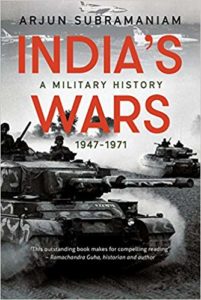
India’s wars by Air Vice Marshal Arjun Subramaniam is a history of the wars (external wars, not counter-insurgencies) fought by the Indian army from 1947 to 1971. It is a pretty good summary, but does have it’s weaknesses.
The book starts with a bit of the “pre-history” of the Indian army. Interestingly Subramaniam chooses to highlight two distinct streams that he believes should get credit for the internal culture and ethos of the Indian army. One is obvious: the British Indian army, which was the parent organization that was split (unequally) between Pakistan and India to create the Indian army. The second is an angle that would not have been included by an official observer/author in 1950, but that has obviously grown since then to the point that a Pucca Air Marshal gives it near-equal billing in his book: i.e. the armies of the Marhattas and the Sikhs. I think this reflects contemporary politics and cultural arguments in India more than it reflects the reality of the Indian army from 1947 to 1971, but will be happy to be corrected by people who have better direct knowledge of the Indian army in that period. Anyway, the author gives a quick and very brief account of the British Indian army. The origins and growth of that force are dealt with very quickly and summarily, but there is more details about developments closer to 1947. This is not a book that is heavy on relevant numerical data (i.e. this is not the sort of book where you get tables showing “The caste/religious/ethnic composition of the British Indian army from X to 1947”) and this is a weakness that persists throughout the book; the author is not big on tables or data. Perhaps as someone who grew up with some of that history, I did not find it detailed or insightful enough, but most readers may not mind this omission too much. And even if you are a British Indian army brat, the sections on the origins of the Royal Indian Air Force and the Royal Indian Navy are likely to add to your knowledge. Incidentally, many of the early aviators in the Indian air force seem to have Bengali surnames; the author does not comment on this, but I wonder if anyone has more information about this. If you do, please add in the comments section.
Continue reading Book Review: India’s Wars. A Military History 1947-1971
Global alliances and wheels within wheels
 Over ten years ago I read Adam K. Webb’s Beyond the Global Culture War with some skepticism. In it, Webb outlined the future revitalization of non-Western societies and cultures and their ultimate face-off with global liberalism. It’s a really strange book, which talks positively about the Iranian Revolution and Rabindranath Tagore.
But I think elements of the thesis are coming to fruition in ways I couldn’t have imagined. For example, the Western Left has a very strong animus against Hindu Nationalism. case in point, the Western (mostly American) feminist website, Feministing, has published a piece documenting a protesting a Hindu meeting in Chicago: Why These Activists are Protesting Hindu Nationalism in Trump’s America.
Here’s a thought experiment: can you imagine left-wing activists protesting an Islamic Society of North American meeting? Curiously, the atheist ex-Muslim activist Armin Navabi, who was at the meeting in Houston this summer, observed that the people who were most hostile to the ex-Muslims were not the Muslims themselves (most of whom were curious), but philo-Islamic Communist activists. These activists were apparently shouting Islamic slogans at right-wing anti-Islamic demonstrators.
Navabi even reported that the Muslim attendees talked to him and seemed disturbed and confused by the specter of hammer & sickle brandishing Communists, and could not understand why or how they were pro-Islam.
The Wani exception
When I came across news of slain Kashmiri militant Burhan Wani, I was struck by his last name. I had known for a while that Kashmiris had castes or as they call it ‘krams‘, like most other people of the subcontinent. And the Wanis are the kram of converts from the mercantile castes of Kashmir. On the wikipedia page linked above, Burhan Wani is listed as the only notable Wani. To understand how odd this is in the broader context of the subcontinent’s mercantile castes, imagine a (fictitious) militant ‘Altaf Agarwal’ being the only notable Agarwal or ‘Afzal Singhania’ being the only notable Bania.
To reflect further on the oddness of Kashmir’s Wanis, note that conversions of upper caste Hindus (Brahmin, Kshatriya, Vaishya) to Islam, although not completely absent, were quite rare. For example, in Punjab, Dr. Gopal Krishan (Punjab University) tells us,
Conversion was negligible from the higher castes such as Brahmins, Aroras, Khatris and Aggarwals.
There seem to be two major exceptions to this rule. The first are Sindhi, Punjabi and Kashmiri Rajputs (Soomra, Janjua, Bhatti, Rathar), who converted heavily to Islam. The other, less talked about exception are the Vaishya Wanis of the Kashmir valley. I have never heard of a Hindu Wani and the conversion to Islam seems near total. Such a total conversion of mercantile castes to Islam is not seen in any other region of India.
It would be interesting to know what explains the exceptional status of Wanis. This is not just interesting from a historical perspective, but could also be important in understanding contemporary developments. Consider the issue of Kashmir’s industrialization. A crude model of India’s early industrialization would be Brahmin technical/management education + Bania enterprise. Indeed, Aakar Patel points to the Brahmin-Bania complex as a hegemonic force in the economy of modern India,
HDFC is run by a Bania (Deepak Parekh), Hindustan Unilever is run by a Brahmin (Nitin Paranjpe), ICICI Bank is headed by a Brahmin (K.V. Kamath). Jaiprakash Associates is run by a Brahmin (Yogesh Gaur), L&T is run by a Brahmin (A.M. Naik), NTPC is run by a Brahmin (R.S. Sharma), ONGC is run by a Brahmin (also called R.S. Sharma). Reliance group firms are run by Banias (Mukesh and Anil Ambani), State Bank of India is run by a Brahmin (O.P. Bhatt), Sterlite Industries is run by a Bania (Anil Agarwal), Sun Pharma is run by a Bania (Dilip Shanghvi) and Tata Steel is run by a Brahmin (B. Muthuraman).
More examples are given in the linked Aakar Patel article. We can see that the Bania-Brahmin complex is spread across India, from South to North, West to East. In more recent years, there has even been a diffusion of skills and attitudes, with Brahmins moving into entrepreneurship and Banias into higher studies. In important ways, urban Brahmin-Banias are merging into a single caste.
Is it possible that the religious schism between the Kashmiri Brahmins and Wains possibly precluded such a complex from forming ? One could conjecture that this played an important part in slowing the industrialization of the region, and its economic integration with the rest of India.
In summary, what explains the total conversion of Kashmiri trading castes to Islam, a pattern not really seen anywhere else in the subcontinent ?
Did this effect industrial growth in Kashmir, and provide more reasons for the emergence of an insurgency there ?
Twitter trouble..
Razib with his thoughts on Indus in the Mekong & Aryans in China (I should be moonlight as a copy-editor; I just know how to sex things up for the BP readership). I butted into a thread involving Omar and Richard but I’m linking to the controversial bit:
Pakistan is an Islamic republic, though not a theocracy, and makes no bones about it. India, on the other hand, is a Hindu State masquerading as a Secular Democracy. It is this 70 year hypocrisy that has led to the problems of the subcontinent
— Richard Harris (@HarrisRichard77) September 26, 2018
No comment..
This is America
 As you may know, Reihan Salam, who I would consider a friend (albeit, one I see in person three years or so!), has a new book out, Melting Pot or Civil War?: A Son of Immigrants Makes the Case Against Open Borders.
It won’t be a surprise to know that I generally agree with him on a lot of issues relating to immigration. The first time I met him in person in 2007 we actually talked about the positive externalities of high skill immigration streams. Since then my views haven’t changed much, though my faith in these United States has declined some to be honest.
I will pass along this interview with Reihan today, A Son Of Immigrants Makes The Case For Tighter Immigration Policy. Reihan, as you may know, is the son of Bangladeshi immigrants who arrived in the late 1970s. The woman interviewing him happens to be ethnically Bengali herself (though her family is from India), raised in Oregon around the same time I was (we’re about the same age).
This is America 2018. An American of Bengali ethnic extraction writes a book and happens to be interviewed by happenstance by another Bengali American. Definitely not a world we could have imagined in the 1980s.
Review: The Forge of Christendom by Tom Holland
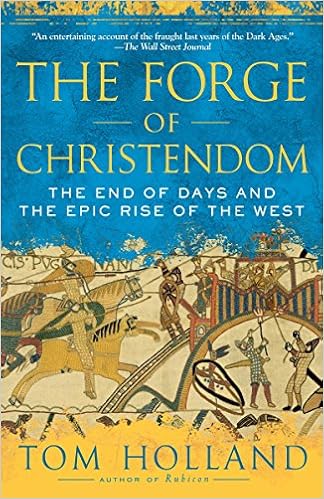
Tom Holland’s latest book is about the slow recovery of Western Europe between 900 and 1100 AD, a period that he sees as the beginning of Western Europe’s transformation from a decaying and dilapidated backwater to the mastery of the world. Tom Holland clearly thinks Christianity had much to do with this rise and presents the violent elimination of paganism in Scandinavia and Eastern Europe as positive achievements of the age. This is mostly done not by direct editorializing; it is done by using the language of the invading Christians (not as quotes from ancient books but as the text of the book itself) to describe the pagans. What the pagans thought of this transformation is rarely mentioned or is explicitly presented as a quote, not as the author’s own text.
He sort of claims that this great transformation had something to do with rising apocalyptic expectations about the end of the first Christian Millennium, the disappointment of which was followed by the channelization of these energies into this-worldly revival and expansion. He does not really prove this hypothesis and it may be that it is mostly a device to frame the book and is not taken completely seriously by Tom Holland himself. Certainly I more or less ignored it while reading the book and you can get some value out of the book without paying this theory any mind either.
(The book’s Amazon.com intro presents this as the central thesis of the book: “At the approach of the first millennium, the Christians of Europe did not seem likely candidates for future greatness. Weak, fractured, and hemmed in by hostile nations, they saw no future beyond the widely anticipated Second Coming of Christ. But when the world did not end, the peoples of Western Europe suddenly found themselves with no choice but to begin the heroic task of building a Jerusalem on earth.” I did not find it convincing and I think you can ignore it too). That said, the book is still fun to read. Tom Holland always wants to make history fun, to tell stories, to quote contemporary accounts and to paint vivid pictures of life in those times. He is always interesting, but the reader will have to read other books to find out if the slant presented here is the most reasonable one or if Mr Holland is letting his storytelling side (or his Christian/English side) dictate how events and characters are presented.
There is definitely an element of subtly (and occasionally not-so-subtly) challenging the more “woke” interpretations of history that are currently popular in some elite Western universities. He wants the readers to see Christianity (specifically Catholicism) as an overall force for good (separation of church and state, suppression of elite violence, etc) and as an important source of cultural unity, growth and creativity in those troubled time. He is not necessarily wrong about this, but he rarely makes a solid evidence-based case case (with alternative views systematically evaluated and rejected) for his preferences, relying instead on eloquence and (selective?) presentation to convince the reader.
If you don’t mind (or already approve of) his Christian and “Eurocentric” viewpoint, this is the book for you. Even if you do mind, it is a very entertaining read, full of zany anecdotes and interesting factoids. A reasonably good overview of the age and worth a read. But it will be a good idea to read other books about the period before you decide that the trends were exactly as described in this book.
Open Thread
Please keep the other posts on topic. Use this for talking about whatever you want to talk about.
Seven Beauties of Sindh
It was remarked overnight that my role in BP is that of agent provocateur.. So I have decided to own my infamy and instead share the latest episode of the Turanameh*; the marriage of Prince Dastan..
*The title of the post is a wordplay on Turan’s love for the number 7; 7 Sisters, 7 Queens and 7 Beauties.
Podcast on South Asian genetics this week
 As some of you know I co-host a podcast on genetics and history with Spencer Wells. The very first podcast we recorded in late June of 2017 was about India, but we were still getting the hang of it to be honest, and we didn’t cover much territory.
A lot has happened between then and now, and so it’s time for an “update,” which is going to cover many more topics. That being said, we haven’t recorded yet and so I’m open to “questions from the audience” that we might integrate. So please use this post to leave comments about specific topics…. (please note we have only ~1 hour or so so might not get to everything)
Update: Podcast recorded.