Lanka and Kalinga

Sauvrav said “ I did my schooling in Orissa and there is no mention of any thing remotely Sri Lankan in their school textbooks. The other day i was talking to a friend who is a oriya and he laughed it off as myth

Many references to Kalinga in Sri Lanka primarily the Mahavamsa and Culavamsa and the Rock edicts of Nissanka Malla (1187–1196)

The Coming of Vijaya (Mahavamsa Chapter 6)
In the country of the Vangas[1] in the Vanga capital there lived once a king of the Vangas. The daughter of the king of the Kalingas was that king’s consort.
http://mahavamsa.org/mahavamsa/original-version/06-coming-vijaya/

Nissanka Malla (1187–1196)
Son of Queen Parvati and King Jayagopa. This is mentioned in a rock inscription made by Nissanka Malla at Galpota. This inscription describes Jayagopa as being the reigning king of Sinhapura.  Nissanka Malla had two wives named Kalinga Subadradevi and Gangavamsa Kalyanamahadevi.[2] He was also a son-in-law or nephew of Parākramabāhu

Magha of Kalinga (Culavamsa CHAPTER LXXX: THE SIXTEEN KINGS 58-62)
of the day lotuses ? that is of peace ? (a man) by name Magha, an unjust king sprung from the Kalinga line, in whom reflection was fooled by his great delusion, landed as leader of four and twenty thousand warriors from the Kalinga country and conquered the island of Lanka. The great scorching fire ? King Magha ? commanded his countless flames of fire ? his warriors ? to harass the great forest ? the kingdom of Lanka3. While thus his great warriors oppressed the people, boasting cruelly everywhere: “We are Kerala warriors”, they tore from the people their garments, their ornaments and the like, corrupted the good morals of the
The reference is raw OCR
http://books.lakdiva.org/culavamsa/vol_1.html

Mahavamsa and Culavamsa are one of the longest continuous histories. Oral tradition since 3rd century BC and written down in 6th century AD.  It has a consistent dating system, i.e from the death of the Buddha. To quote “It is very important in dating the consecration of the Maurya emperor Asoka,”

Asoka had been lost in India. He was found and identified and dated using the Mahavamsa.

To quote from the Mahavamsa Chapter 5; This Chapter references the Moriyas, Bindusara and Chandragupta among others.
Be it known, that two hundred and eighteen years had passed from the nibbana of the Master unto Asoka’s consecration.

Excerpt from a review of Allens two books by my Uni batch mate Sunil Koswatta.

The story of how Lankan chronicles helped British orientalists discover India’s lost emperor Ashoka

James Prinsep (1799-1840) in his excursions in North India, he and his colleagues like Alexander Cunningham, had come across many an inscription where the letters were clearly inscribed but the Indian scholars whom he and others before him had consulted had been unable to help as they had completely lost knowledge of the alphabet in which these inscriptions were written.

It is said that during medieval times Firoz Shah Tugluk who shifted the Asokan pillars from Topra and Meerut to Delhi invited scholars to read them and none was able to do so.

By this time, scholars studying Indian antiquities had progressed a great deal in the study of Sanskrit, the great classical language of India, and understanding what the inscriptions had recorded did not pose much of a problem. It was clear to Prinsep that the authority who had got these inscriptions installed was a King (raja) calling himself Devanampiya, literally meaning ” the beloved of the gods.” But what was baffling Prinsep and his associates of the Bengal RAS was, who was this Devanampiya Raja?

From his readings of the Mahavamsa and its commentary, the Mahavamsa Tika, Turnour knew of a king named Devanampiya Tissa. This fact was intimated to Prinsep who, not knowing the details contained initially believed that the edicts in North India had been installed by the Sri Lankan king in his overwhelming devotion to the new faith. Not long afterwards Prinsep came across an inscription of a grandson of that Devanampiya Raja and realized that the personage in question was an Indian ruler. Turnor in the meantime having read the Buddhist mission to Lanka, communicated to Prinsep that the Devanampiya Raja of the Indian inscriptions was none other than Dharmasoka, the “patron” of Devanampiya Tissa who had bestowed many gifts, including a second consecration on Mayuryan models and the title Devanampiya on his colleague, the ruler of the small island kingdom called Tambapanni off the southern tip of Jambudvipa.

http://www.dailymirror.lk/news-features/The-Buddha-and-the-Sahibs/131-158316
The once and future “Brown Pundits”

Country Users Rank % Rank
 China 746,662,194 1 53.20% 109
 India 391,292,631 2 29.55% 143
 United States 245,436,423 3 76.18% 54
 Brazil 123,927,230 4 59.68% 90
 Japan 117,528,631 5 92.00% 15
 Russia 110,003,284 6 76.41% 53

The “Brown Pundits” blog was formed on a lark about 7 years ago. The Sepia Munity weblog was clearly winding down, and people like Zach and I didn’t feel too well represented. What I mean is that weblog in its latter years reflected a certain activist Left-wing South Asian American perspective which naturally didn’t include all Diaspora South Asians. In some ways this was a shift away from its original years, when it was more politically eclectic, with some center-Right and libertarian voices, to go along with conventional center-Left viewpoints.

Two of the co-founders I knew personally before the blog was founded, and we had a small e-list where we discussed cultural and social issues. To a great extent, I think the Sepia Mutiny blog reflected a decade in transition for South Asian brown Americans. Most of the contributors were of an age where they would be routinely asked where “they were really from,” and all of us understood that we were seen to be a novel and exotic contribution to the American landscape.

Things have changed a lot since then. Most particularly in 2008, Barack Hussein Obama was elected president of the United States. Where black Americans rejoined in the election of a black man, I suspect many Americans of Asian background noted his exotic background and name. If a man with such a foreign name could become head of state of the United States could we be such aliens after all?

I do understand that some people feel that the election of Donald J. Trump has rendered us aliens in our own land again. Overall, I disagree. In a Spenglerian sense, I see the election of Trump as a crying in the wilderness of an old America which is feeling less at the center of our culture, as well as the more general atavisms triggered by globalization.

South Asian Americans, which mostly means Indian Americans, have a place and a role in American culture that can’t be denied. Most Indian Americans have followed a “Jewish model”, aligning with the political and social Left, especially a small activist class.

A framework to understand the trajectory of young 2nd and later generation South Asian Americans that I outlined over 10 years ago I think is a useful model. Roughly, there are three broad classes of South Asian Americans (with overlap):

  • Assimilators. Unlike some groups, South Asian Americans are physically distinct enough that assimilation doesn’t involve “passing” into another identity. Rather, assimilation involves intermarriage and socialization with a broad set of Americans and a very loose attachment to distinctively South Asian cultural markers ad community institutions. Most of the children of assimilators will be mixed, and so will not have a singular South Asian identity in an authentic way.
  • South Asian Americans. This group is perhaps equivalent to Indian identities in the West Indies, which have become distinct from Old World self-conceptions while retaining a sense of South Asianness. In some ways, I think this was a core group for the Sepia Mutiny blog. These are the sort of people who might marry other Indian Americans, but these marriages are often cross-regional, cross-caste, and even cross-religion. To give a concrete example, I know that two of the original Sepia Mutiny bloggers married and had children with someone whose family was from a different ethnoreligious tradition from their own. The sort of marriage which would raise eyebrows in South Asia, but wouldn’t be viewed that strange in the American context.
  • Finally, traditionalists. There are American-born and raised Patels who marry other Patels. There are Dawoodi Bohra Muslims who marry other Dawoodi Bohra Muslims. This group would be most recognizable to people from South Asia.

But to me, that’s the past. I think it’s done. I don’t see Brown Pundits contributing to that discussion or cultural space, for various reasons (the primary one being most that none of the contributors are of the second class). Rather, I’ve started to get interested in Brown Pundits in large part because it seems that Asia, including South Asia, is getting to be a bigger and bigger part of the discussion. There are now more Indians browsing the internet than Americans!

Yes, it’s mostly on mobile phones, but most Americans were on dial-up until the mid-2000s.

The Crime of Being a Dalit

RAJKOT: A 23-year-old youth was bludgeoned to death near Palara Central Jail in Bhuj on Tuesday night. Police said the murder was the result of a love affair. Police said the victim, identified as Jaideep Garwa, a Dalit resident of Kotai village of Bhuj taluka was in love with a woman from the Muslim community.

Youth murdered over love affair

For the sake of balance. South Asia is a complex and crazy place perhaps it would be better at BP if we all (including myself) took a breather and assess a broader positive outlook.

The Crime of being a Muslim

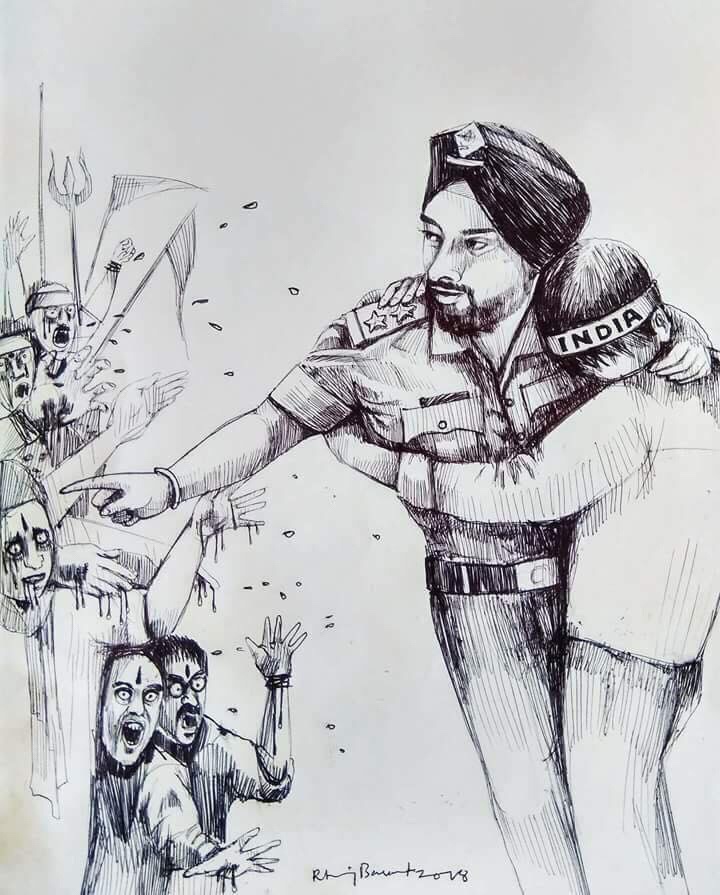
Last week a Sikh police officer in India saved a Muslim man from being lynched by a mob, merely for standing near a temple with a Hindu girl.

This is a poignant illustration on that, by student Umar Khalid.

He wrote: “Salute, Gagandeep. You stood up against not just some local hooligans. You were effectively standing up against the forces of hate who are right now ruling our country, and ripping apart its social fabric!”

Sunny Hundal

Brown Pundits 2018 Reader Survey

I created a SurveyMonkey poll. Check it out….

(after you are done, you can check out the results)

Create your own user feedback survey

Economic Modernization in Late British India: Hindu-Muslim Differences

I. The Question of Why India’s Muslims Are Poorer than Its Hindus India’s Muslim minority—as of the early twenty-first century, around 12% of its ethnically and religiously diverse population—lags behind the country’s Hindu majority economically. The average household income for Muslims is 76.6%, and per capita income 72.4%, of the corresponding figure for Hindus. In rural areas, the typical Muslim-owned farm is only 41.1% as large as the typical Hindu-owned farm. Muslims have relatively lower labor participation rates and higher unemployment rates in both cities and the countryside ðShariff and Azam 2004, vii; figs. 12, 15, 16, 18; tables 6, 7Þ. The 2011 Forbes list of the 100 richest Indians includes just three Muslims.1 The underperformance of Muslims is particularly striking in the management of its private companies. Shortly after India gained independence from Britain in 1947, only one of India’s 80 largest publicly traded companies had a Muslim at its helm ðGovernment of India 1955Þ. A half century later, in 1997, just one of India’s 50 largest business groups was headed by a Muslim ðTripathi and Mehta 1990, 340–42Þ. 2 In describing the economic performance of Muslims in independent India, Omar Khalidi ð2006, 88Þ infers from such statistics that Muslims “lack the ability to organize and plan enterprises on modern lines.”

My reading of the paper is that Muslim inheritance law (which divides the estates more or less equally) prevented capital accumulation to the same extent as Hindu family law. Essentially the Hindu joint family concept was very similar (structurally) to the joint-stock corporation; allowing mercantile Hindu families (especially in Western India) to rapidly accumulate capital and also move on to professional management sectors (as Sereno mentions in the previous post; privilege encompasses both financial, educational and social capital).

Furthermore Islam’s prohibition on credit made the waqf’s (essentially Islamic family trusts) less liquid and unable to allow Muslim families to fully take advantage of the assets that they controlled.

After the jump I’ve excerpted two paragraphs from the paper that touch on both the above points.

The four non-conforming Muslim castes (Khojas, Memons, Bohras and Ghiarasis – the last I had never heard of) were the only ones who maintained their pre-conversion Hindu family practises (Dina Wadia argued that the Quaid’s family estate should be divided as per Hindu law owing to his Khoja origins).

Continue reading Economic Modernization in Late British India: Hindu-Muslim Differences

Political Engineering in Pakistan. The Military View

From our regular contributor, Dr Hamid Hussain

Following piece about recent clouds on Pakistan’s scene was mainly for non-Pakistani audience as many questions/confusions came my way. 

 This is an attempt to understand the view from barracks although I strongly oppose such moves from military.  This is first of two part. Second part will deal with modus operandi.

 Hamid

Political Engineering – View from the Barracks

Hamid Hussain

In July 2017, disqualification of Pakistan’s Prime Minister Mian Nawaz Sharif by Supreme Court again opened the debate about the role of country’s powerful army.  This was one of the most politicized decision of country’s Supreme Court.  In April 2017, Supreme Court not only ordered formation of a Joint Investigation Team (JIT) but went ahead and nominated its members.  It included a serving Brigadier Kamran Khurshid of Military Intelligence (MI) and a retired Brigadier Nauman Saeed of Inter-Services Intelligence (ISI). Supreme Court disqualified Sharif based on JIT investigation.  In the aftermath of Sharif disqualification, many political changes including change of provincial government in Baluchistan achieved by defection of several members, defeat of government’s nominee for Senate chairman position and defection of many politicians from ruling political party Pakistan Muslim League (Nawaz) (PML-N) to rival Pakistan Terek-e-Insaaf (PTI) were alleged to be orchestrated by the army brass.

Continue reading Political Engineering in Pakistan. The Military View

English Lit and Science, 70’s Sri Lanka

This is a lot of reminiscing, and hopefully some  guidance for young people who read this blog.

I think I am a Science guy, and became IT/Finance guy in my 50’s.
I loved Chemistry, specially Organic Chemistry, Benzene Rings and all that. By the age of 14  (O/L) I wanted to be a Chemical Oceanographer.  I had a cousin (Ranjan Perumal) who was one of the early divers in SL.  Arthur C Clarke and Mike Wilson (Siva  Kalki) were some of the first modern divers in Sri Lanka.  Mike Wilson became a hermit, my cousin Ranjan is an Evangelical Pastor, in my opinion a real Christian (or people person).

Anyway, back to Science and English Literature.   In year 8 (age 12)  we had to chose between Science and Arts.  For O/L (year 9 and 10 in 70’s) we had to do 8 subjects.  English, Sinhala/Tamil, Math and Divinity (religion).  The smart Buddhists and Hindus did non RC (Roman Catholic) Christianity.  It was easy, almost like Geography/History. No necessity to remember stanzas.

So for O/L  (age 14) my optional subject was English Lit. I did Macbeth, Emma (Jane Austen) and some book of poetry.  Vaguely recall John Dunne (?) and Ozymandias.  Rubaiyat of Omar Khayyam, I had read a few years before bcos my father had it on his bookshelf.

To be honest Shakespeare did not rock my boat, possibly bcos my father liked it too much.  Emma was not OK either, though a few years later I read Pride and Prejudice and liked it.
Vanity Fair by Thackeray (?), Moonstone by Wilkie Collins.

The punch line, I was an alcoholic/heavy smoker by the age of 12-14. I worked around my Protestant work ethic parents.

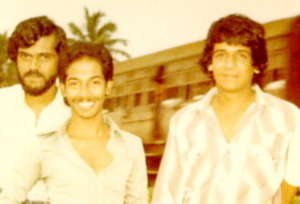
Photo below, I am the guy in the middle with the big grin, probably when I was 22. My classmate on right of me in photo Lakshan Amarasinghe  (RIP), long dead (1998).  On left of me Dayananda Kapuduwa.  A another drinking pal.  In the US married to an First American.  He paid  for 3 of my US Grad Uni Application fees (about USD 25 in 1987).  And the other 3 applications by my maternal cousin, Ranjans Sister.

I was not much different in size/looks when I got into the US.  The Uni guys were cool, but not at my level of alcoholism.   So hooked up with some eastern Long Island red necks.  Greg Linka, Jim, Kevin, Isaiah Brown (the Jamaican guy), give a shout if you see this.   I would drink these six footers under the table.  Then I lost funding and stopped drinking  for 10 years.

Anyways, there has to be some moral to the whole story.
So
a) a goal in life, and the goals can change
b) A privileged background. Many/somebody to step in and help upto a reasonable screw up.  More important than a)


Brown Pundits