Not all Aryans are Indian, though most Indians are part Aryan, and most Aryan ancestry is in India

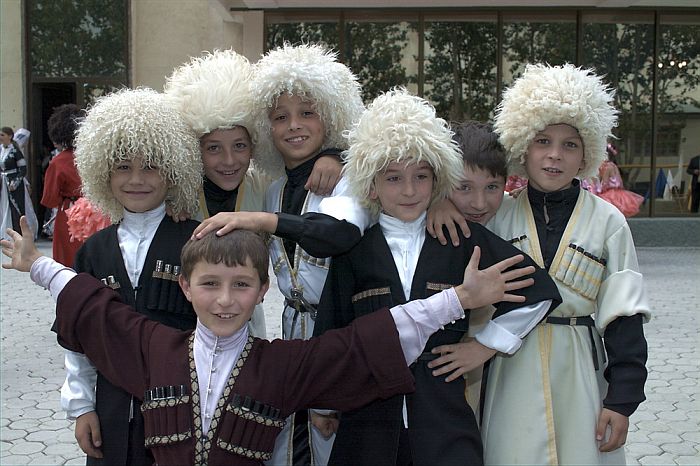
Ossetian boys

This post needs to published mostly to clarify some issues in relation to terminology. The genetics is moving fast, and people are going to get overwhelmed.

First, the term Aryan, or Arya, is not exclusive to South Asia. As most of you know it was used by many (though not all!) Iranian peoples. The Indic and Iranian branches of the Indo-European language family are close enough they form a very tight clade. The only comparison might be Baltic and Slavic, though some have asserted that that is due to the fact that Baltic peoples have lived so close to Slavic peoples for such a long time.

Though in the main Iranian peoples are in close proximity to South Asia, or in West Asia (e.g., Kurds), one group is exceptional in that it has no connection to West or South Asia: the Ossetes.  These people on the northern fringes of the Caucasus are descended from Iranian steppe pastoralists who never went south. You know them as Scythians, Sarmatians, and Alans.

To my knowledge these northern Iranian peoples never called themselves Arya, so perhaps the world itself was some sort of loanword? (internet resources are of differing opinions on the provenance)

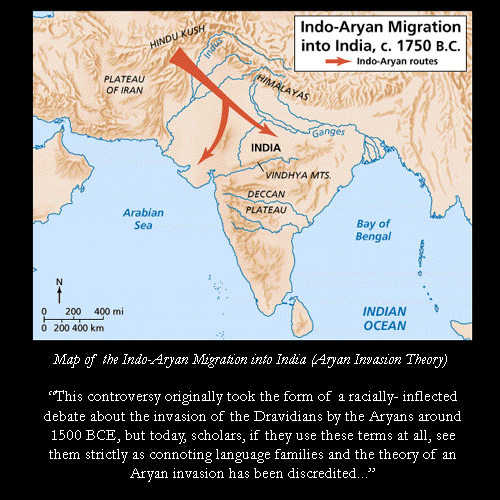
Second, the division between Indo-Aryans and Iranians predates the  arrival of the latter into the Indian subcontinent and to West Asia. The latest genetic work indicates that steppe signal did not show up at BMAC until ~2000 BC. We also know that a group of Indo-Aryan provenance was in Upper Mesopatamia 1500 BC. In contrast, Iranian peoples show up to the east of Assyria ~1000 BC, and there were Iranian peoples to the north of Turan deep into antiquity (the Sarmatians who harried the Pannonian frontier were Iranian heirs to the Scythians).

The “Indo-Aryans” who were integrated into the kingdom of Mittanni/Hanigalbat may never been resident within South Asia. Where the major pulse of migration went to the India subcontinent after 2000 BC, another wave probably sent outriders to the west.

But where the Indo-Aryans in South Asia would have  encountered collapsing IVC order, the societies of West Asia bounced back reasonably from the time of troubles around the turn of millennium, when barbarians from the northern and eastern peripheries (“wild Guti”) collapsed the Third Dynasty of Ur and Semitic pastoralists took the reins of Mesopatamian civilization.

There are suggestive but very clear Indo-Aryan aspects of the Mitanni elite culture. But, by and large it was absorbed into the Hurrian substrate of the region. The analogy here might be what happened to the Turkic Bulgars in what became Bulgaria, as they were cultural absorbed by the Slavs over whom they ruled (or, the Scandinavian Rus).

Let’s call these steppe people “Aryans.” Iranians and “Indo”-Aryans.

How many are there around today? Let’s say 10% of South Asian ancestry is Aryan. This is very conservative (see this post). That’s 150 million people, 0.10 x 1.5 billion. There are ~200 Iranian speakers. There’s no way that 75% of the ancestry among this group is steppe. It is high in Turan and eastern Iran, but in populous western Iran and in Kurdistan the steppe fraction declines (Haber et al. found 7% “pure steppe” signal in Lebanon, so it’s not trivial even in western Iran, but it’s probably not going to be more than 50%).  Most of the Aryan ancestry in the world is in India.

That being said, one should not confuse South Asian culture with Aryan culture and Aryan culture with South Asia. The two are distinct. It is hard to deny that South Asian culture was strongly shaped by the Indo-Aryans; most of us (or our recent ancestors) speak an Indo-Aryan language. The Hindu priestly caste seems to have more Indo-Aryan ancestry, and some of their rituals and customs date back to the Vedic period. Only a few groups have zero evidence of steppe ancestry, even in South India.
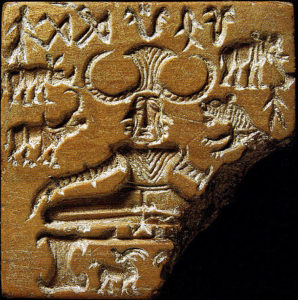
Indus Valley artifact

But Indian culture and Indo-Aryan culture in South Asia are not exclusively Indo-Aryan. The “Hindu religion” is diverse, but it is clearly not present outside of South Asia, except as reflux as South Asian polities and peoples moved to the margins of Turan (e.g. the Shahi kings), or through cultural and demographic diffusion to Southeast Asia (there is robust evidence of Indian genetic impact in places like Cambodia and Bali).

I do not believe that Hinduism, and Indian culture more generally, can be understood without consideration of its non-Aryan component. The cultural archaeology of this is beyond the purview of this post, but I believe that like the Greeks the Indians were strongly shaped by pre/non-Indo-European currents.

As Indian culture in the 1st millennium BC can only be understood as a synthesis between Aryan culture, and non-Aryan culture, the expansion of Buddhism into other parts of Asia, and more specifically to Turan, was not just of Indianized Aryan culture, but of an Indian culture which was a synthesis of Aryan and non-Aryan. It was something new, novel, and distinctive, that was exported throughout Eurasia.
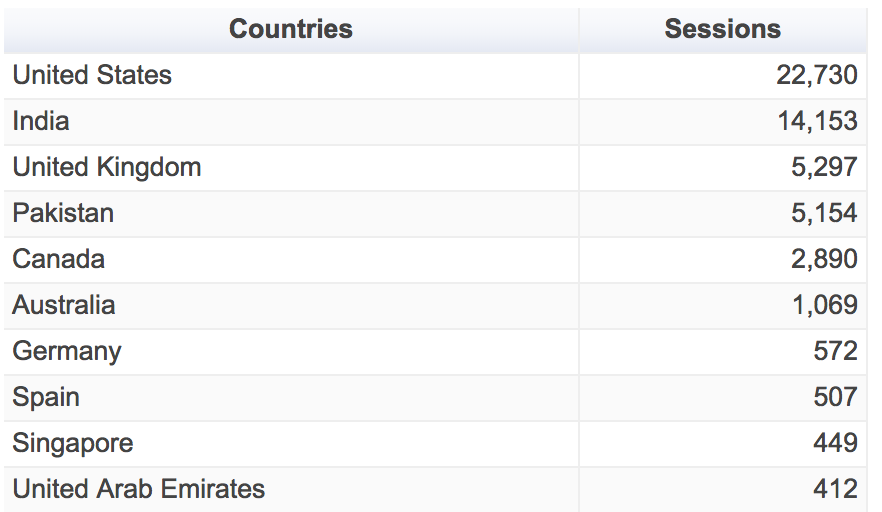
 

How did I handle casual racism in Los Angeles? Awkwardly

I am trying to avoid the “P-word” in BP but my wife assures me that after the Shahid Afridi controversy that if BP were to simply be about that “topic” we’d get a million viewers a day (I was telling her the readership views). I’ll probably crack from the moratorium but in the meantime let’s read on the sublime Romesh Ranganathan (his sense of humour is just wicked).

Before I first arrived in the US, I had been bombarded with advice from my friends about the nightmarish experiences that anyone brown faces at immigration, and warned that I should steel myself for a thorough interrogation and a cavity search. This turned out not to be the case, as I was welcomed by the officer at immigration and wished well on my new journey. He then started discussing astrology with me, which I couldn’t give a shiny shit about, but obviously had to feign interest to avoid immediate deportation.

It was only a couple of weeks later that my attitudes towards racism were once again brought under scrutiny. My family and I were at a restaurant having dinner with an all-white family (I mention this because it’s relevant to the story, not just because I want to show off that I have white friends) when an older woman approached our table.

“I have been watching you all evening, and I have to say how wonderful I think you are.” Nobody at the table had any idea what she was talking about, but, I have to admit, a small part of me hoped I might have been recognised so that I could demonstrate to my wife that I did in fact have some profile over here and this move to the US wasn’t a complete waste of time. My dreams were immediately shattered, however, when she announced to most of the restaurant: “This is what America is all about. Families eating together regardless of colour! This makes me so happy. And I’m saying this as a Republican!”

I sat in astonishment as my wife and friend discussed how nice that was and what a positive experience we had just had. I firmly disagreed. I made the point that we were just sitting having dinner and that we should be able to do that without it being commented on or misinterpreted as some sort of social statement. My wife and friend, however, felt that this woman might have felt like she had made some progress in her attitudes and that her approaching us to share that was something to be celebrated.

On both of these occasions, I felt that my response to what was happening was insufficient and that perhaps I have a responsibility to tackle these beliefs to help combat discrimination. But, mostly, I just want to have a quiet Mexican meal with my token white mate.

Is Political Philosophy the key difference between west and the rest even now?


One of the reasons by which west has perhaps emerged successful is through political philosophy, philosophy is a method of discourse that seeks to corner the opponent into providing coherent answers that are not rooted in identity based reasoning. Western world has gone through incredible transformation over last 5 centuries and one of the key component of that transformation has been the political philosophy that emerged in parallel and its place in guiding their worldview.

Which is why one might observe and study the arguments and discourse of people in other countries in public and in parliament . One must check for the proliferation of enlightenment values in these societies . If it is tribal in nature with no understanding or value given to plain reasoning not rooted in identity or no active pressure by various levels of society, from civic rights groups to media to academics to politics & business to this effect, then one might conclude that they deeply value tribal identity as a means to be preserved without it being called into question(free speech), these societies are going to continue to be trapped in the said discourse without any recognition precisely as the political /tribal interests of various participants across different sections of society are rooted in identity .Civic groups, media, academics in those societies for all their pretensions of being liberal or secular are infact engaging in this tribal discourse.  Without enlightenment values, can these societies transform?.  I would have to say no. This brings us to the fact that progress measured merely in terms of benefits or poverty or maternal mortality etc can still accompany  illiberal politics. Any difference measured in these societies will be imagined only through identity and solutions will also be driven with regards to identity.

Philosophy must be therefore made a necessary part of education, specially made for law,media,politics and science .  This is so, because with freedom one can gain further freedom and make social progress on all measures, but society without freedom , even if it advances in some or all other social scores cannot be certain to preserve or gain further freedom .  I see lot of comparison being made between Islamist states or states with Islam given primacy and India or china/communist states and India. This is unfair comparison altogether, making progress while preserving freedom is harder than otherwise.

Was there an “Aryan Invasion?”

I’ve been fairly busy recently with work but I read a very good comment right now about semantics.

An Indo-European migration is a very different term to an “Aryan invasion”; the latter seems simply to be a Euro-colonialist divide & rule tactic.

I confess I don’t know much on the matter but I don’t see how the recent genetics somehow justifies anything more than a population movement.

Until there is more evidence of an “Aryan invasion”; I don’t see why such hurtful terms need to be bandied about (it only accentuates unnecessary divisions, which do have modern-Day political consequences).

We should be wary of external narratives foisted on a vulnerable Subcontinent; South Asians have a worrying propensity for ideology that has already cost so much in terms lives, prosperity & prestige..

The quiz show contestant

The above click is “going viral.” One of the things that crosses my mind: would a guy who looks like this ever get a shot in Bollywood, or more generally Indian, film industry as a leading man? Is skin color an issue for men as well as women? The only leading men I know off the top of my head are relatively fair to medium, as opposed to dark (I can think of three or four, hardly any, I don’t follow Indian media).

South Asian genetics, the penultimate chapter

A long post at my other blog, The Maturation Of The South Asian Genetic Landscape, a reflection on the important preprint The Genomic Formation of South and Central Asia. Shorter:

  1. The original inhabitants of the Indian subcontinent who descent from the “out of Africa” migration separated very quickly, ~50,000 years ago, from other eastern populations (East Asians, Andaman Islanders, Papuans, etc.). These are the “Ancient Ancestral South Indians” (AASI).
  2. Agriculturalists from what is today Iran seem to have entered and mixed with the AASI in the Indus Valley earlier than 5,000 years ago, and possibly as early as 9,000 years ago. The only samples they have are from extra-Indian sites, in Central Asia and eastern Iran, as outlier individuals. They call these “Indus_Periphery” (I call then InPe).
  3. The “Ancestral South Indians” (ASI) were created from a mixing of InPe with AASI still extant in much of South Asia ~4,000 years ago.
  4. Between ~4,000 and ~3,200 years ago populations from the steppe arrive, carrying admixture from Iranian farmers, as well as people from the steppe (Andronovo-Sintashta?). They mix with the ASI population, though a few groups, such as the Kalash, mix directly with InPe, and create unmixed “Ancestral North Indian” (ANI).
  5. Subsequent mixing between ASI and ANI populations in various fractions accounts for most of the variation in South Asia.
  6. Some groups are enriched for “steppe” as opposed to the Iranian agriculturalist that first came with InPe. In particular, Brahmins. The hypothesis then is differential ancestry of Indo-Aryan heritage persists to this day.
  7. The Munda of northeast India have a somewhat different origin, mixing Southeast Asian ancestry with ASI and further AASI. The fact that unmixed AASI were present in South Asia indicates that the Munda arrived before the full mixture was complete. Though Austro-Asiatic expansion into northern Vietnam dates to ~4,000 BC, so I think it can’t be that early.

Things I now think are unlikely:

  • Indo-Aryan interpenetration with non-Indo-Aryans in the IVC before 4,000 years ago (I was somewhat agnostic on this). The date for migration now seem very close to the “Classical Model” of arrival around 1500 BC.
  • The AASI is very diverged from the Onge, who form a clade with mainland Southeast Asian Negritos. I now think it is likely that the AASI were primal, and not migrants from Southeast Asia.

It would be nice if the results were published from the Rakhigarhi site, which dates to 4,600 years ago. But it seems less and less necessary. Perhaps at some point we’ll get enough samples from Pakistan to generate a reasonable model….

Neoliberalism

Thomas Friedman is one of the world’s greatest champions of neoliberalism. Neoliberalism works great when most people have high levels of physical health, mental health (called Chitta Shuddhi in Sanskrit) and intelligence (called Buddhi in Sanskrit).  In my opinion human beings can acquire these things through their own effort. [Many neuroscientists disagree with me that “environment” can appreciably increase measured IQ.]

Listening to Thomas Friedman makes clear how much new technologies such as AI benefit those with physical, mental health and intelligence. In my view countries with less post modernist syndrome (which colonizes the mind with inferiority complex, a lack of self confidence, and a lack of freedom of thought, intuition and feeling) especially benefit from globalized neoliberalism and technological innovation. Implicitly this benefits Asians. Very soon China will have more billionaires than America; India too will follow in less than a generation. How will post modernists react?

Continue reading Neoliberalism

Administrative note on this weblog

I don’t know most of the people who contribute to this weblog anymore. So I don’t know how to contact you. Can you please update your profile with an image icon so that it’s easy to see who is who?

Thanks.

Brown Pundits