Review: The Storm Before the Storm

A relatively short (265 pages), fast paced and lively account of the Roman Republic from 146 BC (the fall of Carthage and Corinth) to 78 BC (the death of Sulla), covering the period in which the Republic saw major social upheaval, conflict and civil war and in which many of the constitutional checks and balances of the Republic fell by the wayside, setting the stage for the final overthrow of the Republic by Julius Ceasar and his grand nephew, Augustus Ceasar. Mike Duncan is known for his Roman history podcasts and in this book he makes the case that the decline of the mos maiorum (the “mores”) of the Roman Republic in this period of crisis was the crucial factor that led to the final fall a few decades later. WHY the mos maiorum fell apart is a big question, and it is not really answered in this book (a book that really tries to answer that question would probably be much denser and longer than this book) , but is beautifully described, and that is enough to earn 4 stars.
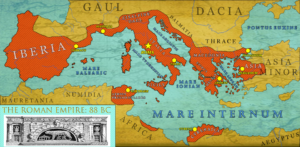

This period of Roman history and its main characters are not as prominent in popular memory as the final crisis of the Republic. Almost every educated person has heard of Julius Ceasar, the ides of March, Antony and Cleopatra, and Augustus, but relatively few people are familiar with characters such as the Gracchus brothers, Gaius Marius and Sulla, which is a tragedy, because their stories are as fascinating (if not more fascinating) than anything that happened in the final crisis of the Republic. if you are not a Roman history nerd and are not already familiar with these compelling characters, then this is a great introduction to the era and its most famous personalities. Colleen McCollough’s historical fiction (the “Masters of Rome” series) is far more detailed and richer in texture because in historical fiction she can fill in details where the historical record is silent (she is very careful to stay faithful to the historical record as far as it is known), but if you just want the story that is in the history books, this is a great place to start. Its all in here, the increasing immiseration of the peasant proprietors who were the base of the ancient Republic; the corruption that came with increasing wealth; the fight to extend citizenship to all Italians; the rise (and violent fall) of the Gracchi, aristocrats who championed the cause of the downtrodden; the incredible (and incredibly long) career of Gaius Marius, the “new man” (novus homo) who rose from outsider to outstanding general, savior of Rome and 7 time consul but just could not bear to retire; and last but not the least, the life of Lucius Cornelius Sulla, impoverished aristocrat, brilliant general, harsh conqueror and even harsher dictator, who tried to reform and re-animate the ancient Republic and actually managed to retire at the height of his power, but whose reforms failed to prevent (and whose personal example probably aggravated) the final crisis of the Republic. As you read, you cannot help wondering why 20 famous movies and TV serials have not been made about these people. Marius’s escape from Rome alone is worth at least one great movie, with more hair-raising chases, captures, escapes, betrayals and last minute twists of fortune than any fictitious adventure movie could possibly squeeze into one character’s life.
Overall, a great read, well worth a look.
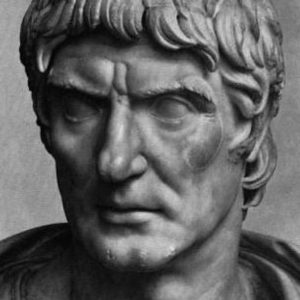
Lucius Cornelius Sulla
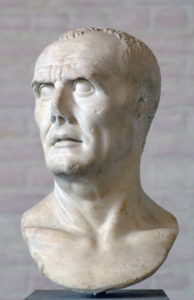
Gaius Marius

Where do humans come from?

We know very little about the past

All groups studied, from British and Bengali people to Peruvians and Puerto Ricans, had a dense cluster that closely matched the Altai Neanderthals. Some populations also had a cluster that matched the Altai Denisovans, which was particularly pronounced in East Asians.

The surprise was a third cluster — not like the Neanderthal DNA and only partially resembling the Altai Denisovans. This, the authors concluded, was a second and separate pulse of Denisovan genes into the DNA blender.

“The geography is quite suggestive,” Browning said. The authors hypothesize that, as ancestral humans migrated eastward, they came across two different Denisovan populations. One pulse, to the north, shows up in people from China, Japan and Vietnam.

Comment of the Day – the State of Sri Lanka

Alot of Brown Pundits focuses on the Hindustani question, which ultimately manifests as the IndoPak rivalry. I thought I would highlight sbarrkum’s thoughts:

Hmm, I assume none of commenters have been to Sri Lanka.

Seem to get the impression SL is part of greater India by the readers.

First and foremost we do not have upper caste varnas. The highest caste is Farmer/Govigama/Vellala. 50% of the society and within which old feudal class.
Almost on existent now among the Sinhalese. More prevalent among the Tamils.

Its a polyglot country where all and sundry have been visiting or invading over 2000+ years. 500 years under colonization, starting with Portuguese.

Of course everyone in this country is “Pure” Sinhalese or Tamil. Not much different from Americans. You are just supposed to become a Sinhalese (I am mutt, mainly Tamil/Kalinga)

Even with all that admixture, we are the darkest (in general) in South Asia and Asia. The Brahmin commenters run Sri Lankans/Sinhalese down as the low caste Dalits who emigrated from India with Aryan pretensions.

That said we dont seem to be doing too bad, even after a 30 year civil war. Compare and contrast the stats, Life Expectancy, Literacy. GDP/capita is no measure of the egalitarian country. The US has so much higher GDP/capita but misery and poverty of the inner cities has no comparison to rural poverty in SL.

ZachNote: I notice Sri Lankan Tamils in the West have alot of swag. They are into gangster culture and what not; completely different to their TN counterparts.

I copied the below data from Wikipedia; Sri Lanka, India & Bangladesh acquit themselves fairly well. Pakistan’s showing is absolutely disgraceful; shame on the Pakistani leadership.  Also Pakistan’s behavior in Afghanistan has dragged down that country to the shits as well; I understand Afghanistan was a proxy in the 80’s but supporting the Taliban after that, well that was an absolute effing disgrace!

A rough calc shows South Asia to be a 3 trillion dollar economy for appropriately 1.8 billion people. That’s an absolute disgrace by comparison since East Asia is an 18 trillion dollar economy with a slightly less population (the US is a 20 trillion dollar economy with a sixth of the population). It may just be that the festering sore of Indo-Pak relations may have a greater human and economic cost than one-offs like the American Civil War, the Great Leap Forward and Cultural Revolution.

Country
[172][172][173][174]
Capital
[174][175][176]
Area
(km2)
[177]
Population
(2017)[178]
Density
(per km2)
Nominal GDP
(2017)[179]
GDP per capita(2017)[180] HDI(2016)[181]
 Sri Lanka Colombo 65,610 20,905,335 318.6 $84.02 billion $3,930 0.766
 Maldives Malé 298 375,867 1,261.3 $3.58 billion $9,950 0.701
 India New Delhi 3,287,263 1,342,512,706 408.4 $2.450 trillion $1,850 0.624
 Bhutan Thimphu 38,394 792,877 20.6 $2.31 billion $2,870 0.607
 Bangladesh Dhaka 147,570 164,827,718 1,116.6 $248.85 billion $1,520 0.579
   Nepal Kathmandu 147,181 29,187,037 198.3 $23.32 billion $799 0.558
 Pakistan Islamabad 881,913 207,774,520 223.1 $304.4 billion $1,629 0.550
 Afghanistan Kabul 652,864 34,169,169 53.3 $20.57 billion $559 0.479

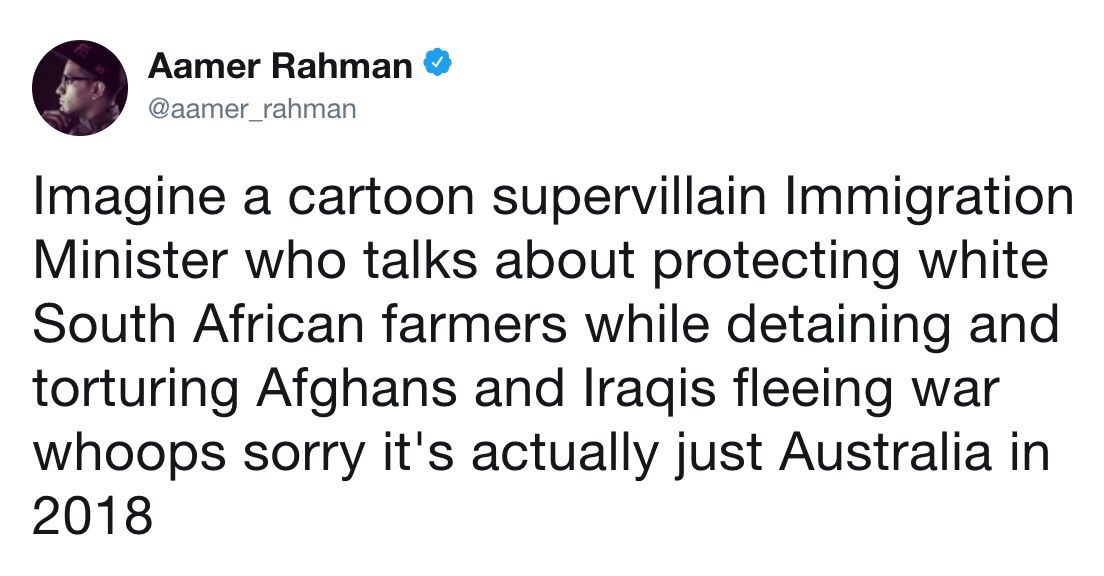
Do Muslim refugees have a right to Australia?

I don’t see what’s so wrong with Australia protecting her borders. The Ummah has a moral responsibility for Muslim refugees; why should the West have to take on this burden.

White South African Farmers have a right to escape to Australia. Pakistan & Iran can host Afghans & Iraqis; why do they need to travel all the way to Oz & Europe with their alien values?

If Australia was a neighbouring country to Afghanistan I can understand the need for refugee. This is why I’m quite sanguine about Latin American immigration to the US (it’s the same geographic region). Of course each country has a right to police its borders as it sees fit.

I’m all about Mughlai decadent culture but the West should not be raped any longer (as a corollary it should not rape either; what it did in Syria & the Arab Spring was unforgivable).

Is it time for Asian Americans and Latino Americans to ask to be considered “white”?

This article might seem provincial and mostly irrelevant to non Americans and maybe it is. But for Asian Americans and Latino Americans this is an increasingly important subject.

Indians and Indian Americans love the Clintons . . . including conservative Indians, and Republican Indians; but a line from Hillary Clinton’s speech in Mumbai has an eerie uncanny feel to it:

“You know you didn’t like black people getting rights, you don’t like women, you know, getting jobs, you don’t want to, you know, see Indian Americans succeeding more than you are.”

It is no secret that Asian Americans massively outperform caucasion Americans based on every available socio-economic statistic; including divorce rate, out of wedlock births, academic performance, mean and median income, mean and median wealth, rate of committing criminal offenses, incarceration rates, unemployment rates during recessions (unemployment rates during economic booms are similar), entrepreneurship.

These well known facts represents the greatest fear Asian Americans have. How to prevent a major anti Asian American xenophobic racist jealous backlash similar to what Jews are currently experiencing?

Has the time come for Asian Americans, Arab Americans, Muslim Americans and Latino Americans to ask to be considered “white” for all legal, affirmative action, business and secular purposes? Of course all academic, US census, DOJ tabulation of granular statistics for legitimate purposes should continue as is; and every American has the right to practice any global culture and faith they choose.

Continue reading Is it time for Asian Americans and Latino Americans to ask to be considered “white”?

Comment of the day

This comment by girmit touches on the interethnic distribution of wealth. Of course a lot of the East is now following the West in adopting a more traditional class system determined predominantly by wealth.

“appreciate the detailed response. I can’t dispute that overall schema if we take a broad view of things. Most certainly, we’ve even seen historically the consolidation of ethnicities as service castes to strong polities. And yes, over a long enough period i don’t think its inconceivable that the most heterogenous stratified population could coalesce into an ethnic group. Sort of how in england the Saxon and Norman cultures are no longer ethnicities but are only subtly perceptible by surname and regional concentration and church denomination, they may still residually correlate to social class in a way. So something like this could happen in India I suppose, but I imagine the gestation time to be incredibly long, so long that it may not outpace the coalescing of a global human ethnicity.

Another thought about highly functional institutions is that they may be incredibly well performing but incapable of distributing opportunity evenly across the population. The Indian armed forces are an example of a national institution that is highly prestigious across all regions, but cannot possibly accommodate the majority of qualified candidates. So it can be respected and resented at the same time. Defence jobs are great careers for rural youth and the economic impact on high recruitment regions is exceptional. But this was also important pretext to the bhindranwale movement, where punjabi sikhs felt affront at legacy recruitment quotas being scaled back (or reverse discrimination, don’t know the whole picture) and it resulted in enough rural youth unemployment to be fertile ground for extremism.

Another challenge for india is major industries running like ethnic cartels. Even if we concede that these business communities have a certain genius for efficiency, and are in the current moment the most able stewards, it is a lost opportunity to another group. In many ways , the creation of Pakistan allowed the Punjabi muslim agrarian castes to move up the value chain into commodity dealing and other enterprises, one would assume that in an unpartitioned Punjab, khatris and Agarwals may have dominated those trade networks. So the appeal of separatism often goes beyond ethnic narcissism and can be sublimated economic strategy. If Punjab weren’t such a massive beneficiary of central grain procurement, it might have had less to lose by going its own way.”

ZachNote: I remember when I first lived in Uganda I was taken aback by how important tribal links were and in some cases superseded wealth; rich Ugandans would socialise very freely with their poorer counterparts, on the strength of tribal affiliation (this is of course diminishing over time thanks to Westernisation). This phenomenon was very different to Britain and Pakistan, where class has such a dominating role and guides one’s social life.

It’s also arguable whether to be fully civilised one must have a very differentiated class system, which supersedes all other ties like religion or race or caste. In Britain there are many aristocratic families with Jewish ties or descent (a few come immediately to mind like the Chlomondleys, the Marquess of Reading, the Whalley-Cohens, the Lascelles family), which means that anti-Semitism wasn’t really a bar to the elite over the last century, if not more..

Mindy Kaling – the South East Asian

I follow Black Twitter (well Black Instagram) very closely and I’m taking a keen interest in the Wrinkle in Time controversy. However I couldn’t resist:

“Shouldn’t everyone have a seat at the table? That’s all we are saying here,” DuVernay said at a press conference. “Mindy is South-East Asian, Deric McCabe, a little Filipino-American boy. African-American, biracial, black, Caucasian, let everyone be there, Latino. It’s about time.”

Not to quibble but Mindy is half Tamil & half Bengali (her actual name is Vera Mindy Chokalingam). I really admire how she’s Westernised her name without losing her roots (contracting Chokalingam was quite clever).

I have been to Calcutta and I regularly go to Chennai (my wife was born in Madras). There is definitely a tropical feel to Chennai and Calcutta is a very romantic city with a beautiful but unkempt colonial heritage. They are of course firmly in South Asia but I’m not expecting the talented Ava to know the particularities of Asian geography (in the West we are all Wakandans).

I tweeted earlier today that in Hollywood one is either White or Wakandan. The People of Colour debate has been effectively championed by African Americans who define the diversity debate. It is Ava’s magnanimity that when casting her film she also includes Asians of all sorts. I hope Wrinkle in Time smashes expectations. I hazily remember reading the book many moons ago in the summer of ’92/93 as an eight year old. It was a random gift from my friend’s mother and I remember being struck by it’s dark tones. Of course many decades later I read Wrinkle in the Skin, which was an even darker tome on post-apocalyptic earthquakes (which is a surprisingly gripping genre).

Persian Princess of Pakistan; Benazir Bhutto

Since Benazir and I are both half-Persians I always found her life to be interesting (I could never get enough of her quip that she knew enough Persian to understand the family gossip). I was randomly googling her when I came across this startling excerpt. I don’t know much about this incident?

You surely know that one of the most psychologically formative experiences for the young Benazir was growing up in a house where her father (Zulfikar) gave his Persian mistress pride of place in the home. Benazir would come to breakfast with her father and mistress at the table while her mother ate from a tray quietly and alone in her bedroom in another wing of the house. When one tries to understand how Benazir came to have her husband kill her brother, it helps to know what a strange childhood she had. Salman Rushdie’s thinly-veiled roman a clef about the Bhuttos and Zia, Shame, captures some of this atmosphere quite well.

Apparently Nusrat left back to Iran for 6months but wasn’t allowed to take the children with her (Islamic law on divorce & custody being as enlightening as it was) but to be fair I’ve always found Zulfikar to be a somewhat disdainful and problematic character. I had heard in his last years that he had a Bengali mistress (nicknamed Black Beauty) who now lived with her female lover in Karachi but I have no idea what to believe.
It’s remarkable the extent to which Benazir looked like her mother. In the picture below I could have sworn this was was Benazir, not Nusrat, who was with the Shah and his elegant wife Farah Diba.
Born on March 23, 1929, Nusrat had lived a life of comfort after marrying Mr Bhutto as his second wife in 1951. In this file photo, Begum Bhutto is seen along with their imperial majesties, the Shahanshah Arymehr and Shahbano of Iran, Prime Minister Zulifikar Ali Bhutto and President Fazal Illahi Chaudhry. ? Dawn File Photo

A few remarkable facts about Benazir were: Continue reading Persian Princess of Pakistan; Benazir Bhutto

Why language families matter (in an Iranian context)

I’m typing out this post while in the nearby table 4 young students are recreating the Cambridge Bangladesh society (apparently it’s been moribund for a few years while the Indian & Pak Socs are simply flourishing). I find the irony to be delicious; I can’t escape Brownitude in even the Waspiest of places. I’m overhearing their conversation and it sort of weakly ties into my post about how intellectuals in the West can have such a lingering and profound influence on politics in the East.. Continue reading Why language families matter (in an Iranian context)

Review: Empire, by Niall Ferguson

If you are reasonably woke and you manage to read the last chapter, you cannot possibly give this book more than one star. On the other hand, even if you are fully woke, you can easily give this book 4 stars as long as you are able to ignore Niall Ferguson’s pro-imperial coda. The reason is straightforward; this is actually a pretty decent (and except for the end, quite balanced) history of the British empire. It is not a very long book, so it cannot cover all episodes, but most of the highlights (good AND bad) are here. No attempt is made to gloss over the genocides and cruelties, though a little bit of spin here and there is to be expected (and can be excused). I have read many books about the empire and this period of history, but this short book is as good a summary as any (at least up to the 20th century, the 20th century part is not necessarily wrong in outline, but we know so much about events in India that it is hard to ignore the lack of detail, or the airy dismissal or dissing of some of our favorite details).

Continue reading Review: Empire, by Niall Ferguson

Brown Pundits