The right amount of Love

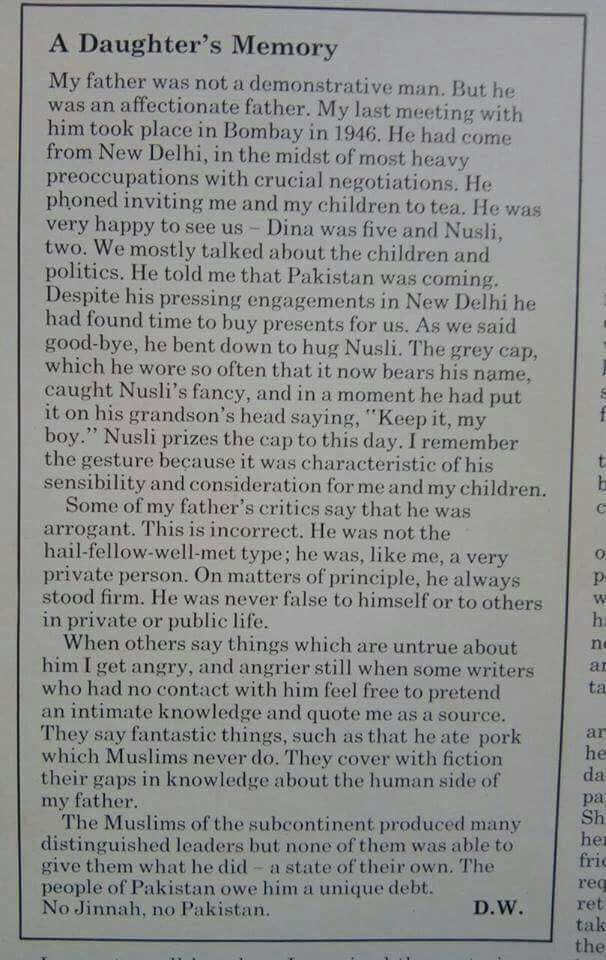
There was an interesting passage in this screed against Quaid-e-Azam:

A man who cannot extend unconditional love to his children, who casts them out for following their hearts, is a cold and callous human being, and not a leader worth following.

I’m not condoning what the Quaid did with regards to Dina Wadia but even so I don’t think material attachments, as a rule, should override ideological underpinnings. Disowning one’s child for marrying outside one’s religion is foolish but there are reasons as to why one would want to disown one’s child.

As an aside South Asia (especially Pakistan) seems moribund in its obsessiveness with the past and after the jump I’ve posted a passage, which my wife sent me, about Mindfulness in the present. Her contention is that the Old World in general looks backward rather than forwards to a gleaming future hence why the best Research Institutes in the world are West Coast USA.

Continue reading The right amount of Love

How the Other Half Dies..

An old video that somebody just sent me. I don’t think the situation of the Hazaras has improved much since then. About the rest of Pakistan, well, terrorism is down, crime is up and down, some things are better.. what do you think?

Hazara boy shares his thoughts about Pakistan..


Review: The Holocaust, A New History

Historian Laurence Rees has spent a lifetime studying the Holocaust, and it shows in this book. This is a very readable (and horrifying) retelling that begins in post-WWI Germany and details all the steps in the somewhat haphazard but ultimately effective process that led to the most horrifying mass murder in history.

The holocaust was not the largest genocide in history in terms of death toll (estimates and definitions vary, so it hard to say with certainty) but Rees makes the case (and I think it is a very reasonable case) that many aspects of this particular genocide are uniquely evil and terrifying and these aspects justify its unique position in the history of human mass murder (and this includes comparison with such immense and horrendous crimes as the Arab and European trade in African slaves).  Anyhow, readers can (and surely, will) make up their own mind about the relative horror of this particular crime, but if they read this book, they will at least learn the full extent of it.

Rees starts with the currents of antisemitism that circulated in 1920 Germany (many of these were pan-European, some were even of Anglo-American origin) and the process by which Hitler rose to power. The book makes it clear that while anti-semitism was commonplace in Christendom, most Germans were not thinking of systematic genocide; but some violent, sociopathic and evil people were dreaming of it, and they gradually coalesced around Hitler and got the chance to put their demonic ideas into practice, using all the terrifying resources of a powerful modern state. Continue reading Review: The Holocaust, A New History

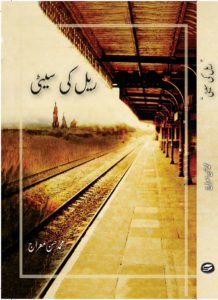
Review: Rail Ki Seeti (an elegy for partition)

Mohammed Hasan Miraj is a Pakistani writer who served in the army, was stationed at Siachen glacier and then worked in ISPR (Interservices Public Relations) where he made at least one movie and then retired as a major and went to the London School of Economics to earn a degree in communications. While working for ISPR, he wrote several very nice articles in Dawn newspaper, almost all of them little travel pieces about various places in Pakistan; these articles are rich with history and folklore and display an erudite, liberal, tolerant and sagely tragic spirit; they are also obsessed with the romance of train travel.
This apparently lifelong fascination with travel, history and trains has now been poured into his first Urdu book, a small gem called “Rail ki Seeti” (the train whistle). Continue reading Review: Rail Ki Seeti (an elegy for partition)

Sikhism & Iran’s Symbol

Image may contain: text
No automatic alt text available.
I saw this in an Iran forum and was immediately intrigued but it turns out to be simply a coincidence. However it’s a nice segue to this article on the Sikhs of Iran, Iran’s Sikhs get a better deal than many other minorities.
The strong relations between India & Iran is no joke; I remember on my second trip to Tehran last year the queues to the Indian embassy for visas were literally bursting. Sadly (or not) the relationship between Pakistan & Iran seems to be a very one-way affair, Pakistani’s are more enamored and the Indo-Pak Shi’ite pilgrims in Iran don’t make the best impressions of themselves with their excessive fawning (or so I’ve heard).

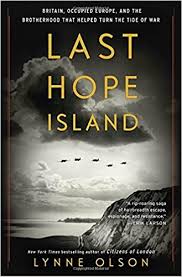
Book Review: Last Hope Island

The history of the Second World War continues to offer up new and fascinating details as archives are opened and dying old men occasionally decide to tell the truth before they die (the latter opportunity is now almost gone, the first is still a work in progress). Lynne Olson does a good job here of bringing to light an aspect of that titanic struggle that deserves its own book length treatment: the European exiles who found shelter in Great Britain (the “Last Hope Island” of the title) and the role they played in the war.

These exiles did not always come to England because England had stood by them; The Czechs had been sold out; the Poles, while unlikely to survive in any case, received little or no real help against the Nazis; the Norwegian campaign and Britain’s blunders and betrayals in that saga are already relatively well known (Churchill, responsible for some of the biggest blunders, was lucky to survive them and become PM; that he did survive them also proved fortunate for those who opposed Nazism, since blunders and all, he was still crucial to the survival of Britain and even the eventual liberation of Western Europe). Benelux and the French fell mostly to their own weaknesses, but Britain’s interventions were not without their share of blunders, minor betrayals and other embarrassments. This book reveals all these details, and shows how much of what did survive owed to individual initiatives, chance, and the vicissitudes of fate, and not to the brilliant performance of the British establishment. Though to be fair, the lesson here is not that Britain had a bumbling establishment, but rather how much stupidity and muddle-headedness attends any great war, especially before the kinks are worked out.
The role of the Poles in particular is worth highlighting (and tragic, now that we know what happened to that much-abused nation in the years that followed); it is already relatively well known that Polish pilots played an outsize role in the crucial Battle of Britain, but I did not realize how much resistance they faced before being allowed to play that role; what is less well appreciated, even today, is how critical their role was in the decoding of Enigma, far and away the greatest intelligence coup of the war. The role of the French in Enigma is also highlighted, as is the absolutely critical role they played in jump-starting the Western nuclear program. Continue reading Book Review: Last Hope Island

CPEC

Before I share the notes on CPEC I thought I would share the Achievements of the Punjab Govt.

I attended a round table discussion on CPEC (I believe it stands for China Pakistan Economic Corridor).

A few salient points I gathered from the talk:

(1) there seem to be two routes for CPEC; one via West Punjab, Sindh and the other via KPK/Baluchistan.

(2) the Brits historically conceived as India ending West of the Indus and the start of Central Asia. British strategic planning in what was to become West Pakistan (West of the Indus) was essentially security related; to prevent incursions from the North West. Hence the discordance of railways in inner India and the lack of connectivity in Outer India (West of Indus). British approaches to West Pakistan would later formulate colonial approach to much of Africa (mitigation & mining as opposed to management; as the academic used the shorthand “diamond & slaves approach).

(3.) CPEC is a “black box” at the moment; very little information available on it at the moment. Criticism is also very muted and in fact there are reports of Pakistan societies in the UK being coerced to “shut up” by governmental authorities.

(4.) I raised the point that CPEC could never really be an economic endeavour but is a masquerade for PAK foreign policy. Lahore-Delhi and/or Bombay/Khi Links would generate tremendous eco-cultural several orders of magnitude to CPEC.

I’ll add more points as they come to mind..

New low in civil-military relations in Pakistan

From Dr Hamid Hussain

A brief summary of my response to many questions from non-Pakistanis (but keen observers of the scene) not familiar with background about recent friction in Pakistan. Pakistanis are much more informed about the issue.

“Neither to laugh; nor cry
Just to understand”. Spinoza

Past is Prologue – New Ebb in Civil-Military Relations of Pakistan
Hamid Hussain

“It is difficult to envisage some thirty or forty generals and a smaller number of admirals and air force commanders appointed solely by Providence to be the sole judges of what the nation needs”. The Times, April 6, 1961

In 2017, Pakistan is going through another cycle of severely strained civil-military relations. A certain level of friction in civil military relations is norm in many countries. This is especially true in the case of countries where military has maintained its dominance in national decision-making process. Opinions are so polarized that making a rational argument has become an arduous task. Anyone pointing to deficiencies of civilian leadership and improvement of governance is labelled as sweeping the floor for the military while anyone cautioning military leadership to pause and reflect is labeled as lackey of corrupt politicians and unpatriotic. Continue reading New low in civil-military relations in Pakistan

Brown Pundits