Hamid Hussain Reviews Cloughley’s Book about the Pakistan Army

A History of the Pakistan Army: Wars and Insurrections by Brian Cloughley

Dear All,

Some questions came my way about Brian Cloughley’s good book about Pakistan army. I put them in an unconventional book review. Regards, Hamid.

Book Review by Hamid Hussain

A History of Pakistan Army: Wars and Insurrections by Brian Cloughley, Fourth Edition. Karachi: Oxford University Press, 2014, pp. 588

Brian Cloughley’s A History of Pakistan Army is the fourth edition of a book, which was originally written in 1999. Fourth edition adds many new chapters especially tenures of General Pervez Mussharraf and General Ashfaq Pervez Kayani. Author is one of few foreigners with long association with some senior Pakistani officers going back to early 1980s. This gives the author an advantage to draw on his personal associations.

Book is a comprehensive review of history of Pakistan army starting from 1947 when country gained independence. It documents journey of Pakistan army over six decades.

On page 29 author commenting about Ayub’s actions after becoming C-in-C states that “He examined the Military Secretary’s records of every senior officer and, if in doubt about someone’s competence, he sacked them”. This needs clarification and understanding of the context. The issue was not much about competence but about reliability. In March 1951, only about two months after General Muhammad Ayub Khan took over command of Pakistan army, a conspiracy was unearthed by the local police where a group of army officers were planning to overthrow the civilian government. The leader was then Chief of General Staff (CGS) Major General Muhammad Akbar Khan. Many officers involved in the conspiracy were left leaning and avowed leftist and famous poet Faiz Ahmad Faiz was also involved peripherally. After the arrest of main culprits, Ayub used this opportunity to ease out all officers with leftist leanings. For Ayub, the issue was reliability of officers and proper orientation rather than competence. Many officers promoted by Ayub to senior ranks will never pass a competency test in any decent army.

Author complements Ayub for ‘considerable activity in all sorts of spheres’ and that constitution committee finished its work in just over a year. A little background will help readers understand the machinations behind these maneuvers to keep dominance of western wing. There were seven members of constitution committee; four from West Pakistan and three from East Pakistan. Even Ayub’s own handpicked cabinet members from East Pakistan; Muhammad Ibraheem, Abul Qasim Khan and Habib ur Rahman demanded greater autonomy during discussions on Constitution and warned of grave dangers of a highly centralized government. Several 4:3 votes during these deliberations clearly indicated a genuine different thought process and different perspective among ministers from the two wings. Ayub was clever enough to keep three Bengali members on board as he needed to show that Bengalis were at the table but in fact handicapped by being minority in the committee. After the promulgation of the constitution, he dropped all three Bengali ministers from the cabinet which clearly shows his motives.

On page 78 in remarks about Major General A. O. Mitha, author points to “withdrawal of a well earned decoration’ of the officer and suggests that Bhutto was responsible for the withdrawal. It is quite clear that then C-in-C Lieutenant General Gul Hassan recommended to the President for withdrawal of the award and even Mitha blames Gul Hassan and not Bhutto. As far as award of Hilal-e-Jurat is concerned, there are two aspects of the issue. One is whether Mitha deserved the decoration and second is the technical aspect whether proper procedure was followed. Mitha was close friend of then President and C-in-C General Agha Muhammad Yahya Khan and was serving as Quarter Master General (QMG) in 1971. Yahya sent him to East Pakistan just prior to ‘Operation Searchlight’ in March 1971. Mitha arrived on March 24 and appointed Deputy Corps Commander to Lieutenant General Tikka Khan and put in charge of the operation. This was done verbally and no official notification was issued. Mitha travelled all over East Pakistan and gave direct orders to fighting formations for operations against Bengali rebels. Mitha was in East Pakistan from March 24 to April 11, 1971 when Pakistani forces disarmed Bengali troops and fought with rebellious soldiers. After pacification, he visited East Pakistan again about two months later. Chief of Staff (COS) General Abdul Hamid initiated the citation for the award of Hilal-e-Jurat to Mitha for his role in crucial operations in March 1971 and General Yahya Khan approved it. It is strange that Mitha was upset about the withdrawal of the award as he thought that he deserved it for his crucial role in the operations. However, in his memoirs he mentions that he was retired unjustly and gives the argument that as QMG his responsibility was only to supply what was in stock and had nothing else to do with either the planning or execution of war. In his view others were responsible for the debacle.

Now the tricky issue of whether Mitha deserved the award. His role was essentially advisory and although he was not in direct command of troops, in fact he travelled all over East Pakistan and gave direct orders as well as supervised operations including infantry, artillery and Special Services Group (SSG) troops. In view of general confusion all along the chain of command, lack of clear direction from top brass and management crisis at mid-levels, Mitha’s actions were important to take the initiative back and restore the writ of the state. Looking from this angle, in my view, he probably deserved the decoration. On pure technical and administrative grounds, Mitha was not in direct command of troops and his role was essentially advisory. In addition, citation was not initiated by his direct superior Lieutenant General Tikka Khan but COS. Mitha and then CGS Lieutenant General Gul Hassan didn’t like each other and when later became C-in-C, he recommended to President to withdraw the award on technical grounds. Bhutto who was busy putting generals in the dock was happy to approve it.

On page 88, author while describing some actions of 1965 war states that “Major Aziz Bhatti thoroughly deserved the award of Nishan-i-Haider (the highest gallantry award)”. There is no question that many soldiers including Bhatti fought bravely to defend their country and deserve all praise. However, highest gallantry award is usually awarded for actions beyond the call of duty and bravery in face of enemy action. Major Raja Aziz Bhatti was company commander of Alpha Company of 17th Punjab Regiment. On September 10, Bhatti was in a three story house in Barki village along with an artillery observer Captain Mahmood Anwar Shaikh of 24th Medium Regiment commanded by Lieutenant Colonel Sial to coordinate artillery fire to stop Indian advance. He survived the action of September 10 when Barki village was captured by Indian troops. On September 11, Indian troops advanced towards the east bank of Ichhogil canal. Shaikh was replaced by a Junior Commissioned Officer (JCO) Subedar Sher Dil but he was not effective therefore Bhatti took over the important task of directing artillery fire on advancing Indian troops. Bhatti was supporting the Pakistani counter attack led by Major Habib Khan of 12th Punjab Regiment (Habib along with seven of his comrades was killed in this action). Indian artillery (7th Artillery Brigade as well as 5th and 66th Field Regiment and 82nd Light Regiment) was also very active in the theatre. Bhatti was killed by an artillery shell while manning own side. His commanding officer Lieutenant Colonel (later Brigadier) Ibrahim Qureshi had to re-write his citation three times to qualify for the highest award. Some officers are candid about the deficiencies in the system of gallantry awards in off the record conversations. Only one officer Major General ® Tajammal Hussain Malik went on record and mentioned in his memoirs that after investigations by a committee set up by General Head Quarter (GHQ) it was determined that sixty to seventy percent of gallantry awards in 1965 war were bogus. In Indian and Pakistani armies controversies about gallantry awards caused significant resentment among soldiers. In Indian army, a fine cavalry officer who gallantly fought in 1965 war was a bitter man his whole life because he was not awarded a gallantry award. He claimed that if he had won the gallantry award, he would have been an army chief. He retired at Brigadier rank and later in life took his own life.

On page 294, author points to disagreement between Prime Minister Muhammad Khan Junejo and General Zia ul Haq about promotion of two officers; Pir Dad Khan and Shamim Alam Khan referring to both of them as ‘admirable officers’. I’m sure they are wonderful chaps but promotion is based on professional competence. Major General Pir Dad Khan was commander of Force Command Northern Area (FCNA) in April 1984 when Indians occupied Siachin glacier. FCNA comes under the command of Rawalpindi based X Corps and Lieutenant General Jahandad Khan was Corps Commander from March 1980 to March 1984. I knew late General Jahan Dad Khan for several years and discussed this subject with him. I used to joke with him that he should thank Indians for taking Siachin excursion just two weeks after his handing over the charge. Pakistan was well aware of possible Indian move and this was discussed at the highest level. Pir Dad thought that due to extremely difficult terrain Indian move was not very likely. General Zia ul Haq was of the view that even if troops were involved in the area due to difficult terrain only a brigade sized force on Indian side and about battalion sized Pakistani force will be involved. Everyone missed the tough logistical question. Jahan Dad claimed that he envisaged this and informed the high command that army’s helicopter force will be needed. In addition, he advised that Military Intelligence should keep its ears and eyes open in the area and monitor Indian troop movement to give warning in time to Pakistani forces.

Pakistan’s plan was to move troops to strategic points in late April or May. Pir Dad was probably correct in his assessment about the terrain but he was proven wrong by Indians and area was lost under his command. It is not only Mr. Junejo who thought that officer didn’t deserve to be promoted but majority of Pakistani officers hold the same view. General Zia ul Haq rewarded him by promotion to Lieutenant General rank and appointed him Corps Commander.

On page 301, author while describing Benazir Bhutto’s relations with army writes that ‘on 24 May Benazir Bhutto dismissed the Director General Inter Services Intelligence, Lieutenant General Hamid Gul’. This is not correct. Benazir complained to Chief of Army Staff (COAS) General Mirza Aslam Beg about Hamid Gul and asked him to take action against him. It was not due to any differences over policy but due to the fact that Gul was directly involved in cobbling together the opposition parties against Benazir in elections and involved in intrigues against her government (Mr. Gul has admitted to this fact after his retirement). Gul was not doing it on his own initiative but carrying army high command’s decision, therefore it was no surprise that instead of taking disciplinary action, Gul was given the prestigious assignment of command of Multan based II Corps. Late Major General Naseerullah Khan Babar was a close confidant of Benazir and he was the point man as far as army was concerned. I knew General Babar for long period of time and had several very long sessions with him and he shared many intrigues of that time period with me.

On page 344 when describing General Pervez Mussharraf’s appointment as COAS, author states that he ‘brought in or moved some of his own team’ and in this regard gives the example of appointment of Lieutenant General Muhammad Akram as QMG and then concludes that ‘the chain was not controversial’. This conclusion is flawed on several grounds and a brief description will clarify the point. Immediately after the announcement of his appointment, Mussharraf settled down in Armour Mess (General Jahangir Karamat was still in Army House) and Lieutenant General Khwaja Ziauddin then serving as Adjutant General (AG) joined him. Mussharraf embarked on major changes and brought the new team of his own confidants to key positions of command of Rawalpindi, Multan, Lahore and Karachi Corps and CGS, Military Secretary (MS) and Director General Military Intelligence (DGMI) posts.

Akram was Corps Commander of Lahore-based IV Corps and has been at that post for a little over a year. When Musshrraf was Corps Commander of Mangla based I Corps, he used to come to Lahore for relaxation. Every Corps has its own intelligence and it keeps an eye on happenings in its jurisdiction. Akram gently pointed to Mussharraf to be careful as he was in the run for the position of COAS and Mussharraf was offended by this. Musshhrraf’s first action as COAS was to remove Akram from the command and posted him as QMG (QMG and Chief of Logistics Staff positions are usually used by COAS to park a senior officer on the side for a while if he can’t be removed immediately). Rawalpindi based X Corps Commander Lieutenant General Salim Haider was moved to Mangla as Mussharraf had an earlier tiff with him on a petty protocol issue. Salim was replaced at Rawalpindi by Mussharraf’s old buddy Lieutenant General Mahmud Ahmad (then serving as Commandant of National Defence College). Lieutenant General Muzzaffar Usmani was brought from Bahawalpur Corps to important Karachi Corps. Lieutenant General Muhammad Yusuf Khan was brought as Multan Corps Commander while Lieutenant General Khalid Maqbool was brought as Lahore Corps Commander. In addition, Major General Ihsan ul Haq was appointed DGMI.

All these newly appointed officers were trusted allies of Mussharraf and the trajectory of their future career clearly points to this fact. Mahmud and Ihsan served as DGISI and later Ihsan was given fourth star and appointed Chairman Joint Chiefs of Staff Committee (CJCSC). Yusuf later served as CGS and then promoted to four star rank and appointed Vice Chief of Army of Staff (VCOAS). Khalid was later appointed Governor of Punjab in 2001 and became the longest serving governor of the province until 2008 when Mussharraf saw his own sunset. More important is the fact that when in October 1999 Ziauddin was appointed COAS, one of the first orders of Ziauddin which never took effect due to coup was to bring Salim Haider back as Rawalpindi Corps Commander and appoint Akram as CGS.

There are some errors in the book which can be corrected in next edition. On page 26 author describes the assessment of Nicholas Barrington of British High Commission and British Military Attaché written in 1966 about Ayub Khan. Author has mixed Ayub’s profile with another officer. The description of ‘an aristocrat from Patudi family and highly intelligent and rather an intellectual and he is also Anglicised’ by Barrington and ‘rather shy nature and one cannot see him inspiring his officers by the force of his personality though he might inspire admiration for his integrity and intellect’ and reference to polo by British Military Attaché is description of Lieutenant General Sahabzada Yaqub Khan and not Field Marshal Ayub Khan. Ayub was from humble rural background and his father was Risaldar Mir Dad Khan of Hodson Horse. Terms like Anglicised and intellectual do not apply to Ayub and it was Ayub’s powerful personality rather than his intellect which inspired others. Ayub could ride but was not a polo player and in early 1950s during Peshawar vale hunt was thrown off his horse. British High Commissioner Sir Gilbert Laithwaite had described Ayub’s profile but about a decade earlier in 1958 in these words, “He was according to our records, a failure as a Commanding Officer (Lieutenant- Colonel) on active service and had to be relieved”. This should also clarify author’s description of Ayub on page 48 “gallant in combat”. On page 77 when mentioning Sahabzada Yaqub Khan, author states that Yaqub was awarded Military Cross for gallantry in North Africa. This is incorrect and Yaqub didn’t earn any gallantry award in Second World War. He spent most of the war as prisoner of war first as involuntary guest of Italians and later Germans. He used this time to learn Italian and German languages. Yahya was in the same theatre during that time period and successfully escaped from captivity. He is alleged to have made the remark that Yaqub declined to join them in escape stating that he was learning the Italian and German languages.

The chapter on operations in FATA gives only one point of view as author relied heavily on diaries provided by then Corps Commander of Peshawar Lieutenant General Ali Muhammad Jan Orakzai. Orakzai was Corps Commander of Peshawar based XI Corps from October 2001 to March 2004. Author edited Orakzai’s diaries for later publication and reliance on one single source narrowed the scope of analysis of a very complex situation. Personal friendship can also limit one’s ability to critically analyze and I suspect that this happened in this case. Some of Orakzai’s observations narrated by author are so incredulous that it is hard to believe that the man put in charge of the most important Corps held such views. On page 390 it is mentioned about South Waziristan that ‘No foreign fighters have been seen by independent witnesses’. Based on my own work on operations in FATA and interviews with different sources (operational as well as intelligence), I found almost consensus that tenure of Orakzai was to put it mildly paved the way of the future disaster. Mussharraf relied on Orakzai for advice about FATA thinking that being a member of a tribe was an advantage. This concept is flawed on several levels. Most educated tribesmen whose families left native lands grew up in cities and gradually lost contact with their ancestral lands. If someone has no interest then he may know few family stories about his own clan or tribe but this does not make him an authority on a different tribe. On another level, he can be less effective as other tribes will not see him as representative of the government but simply member of a tribe which could be rival for local resources (this happened when a Pakistani officer who happened to be member of Wazir tribe was a senior ISI operative in the region. He was an officer of Pakistan army representing government but to a Mahsud he was simply another Wazir and no matter how impartial he would be seen as member of the rival tribe).

According to some intelligence officers who operated in the region in that time period, Orakzai as well as then Inspector general Frontier Corp (IGFC) Major General Taj Muhammad Khattak were in complete denial and oblivious to the rapidly shifting ground right under their feet. ISI provided them details of movement of foreign fighters in FATA but their response was that there are no foreign fighters in our area of command and blaming them for generating false reports. Militants were gaining strength by the day and eliminating traditional tribal elders while other elders ran away to the safety of the cities. Orakzai like everybody and his cousin was talking about development of FATA and advocating making roads and spending money ignoring the basic fact that militants were rapidly expanding their authority, sidelining and eliminating traditional tribal leaders with government authority evaporating by the days and weeks not in years. In this context talking about building roads without first establishing the authority of the government meant that he was actually improving the logistics of militant infrastructure. This is proven by the facts that emerged later when army cleared some areas. Militants had established an elaborate underground infrastructure with extensive training facilities, industrial sized car and motorcycle bomb factories and tons of explosives neatly stacked in warehouses was found. This massive infrastructure was not put in place by ghosts but over several years right under the nose of XI Corps. In addition, in their great plans, senior brass was totally oblivious to the deep suspicion of the local population as locals were not blind and aware of double dealing of the army. Mussharraf brought Orakzai for briefing at the White House presenting him as an authority on tribal affairs. Americans had their own sources of information from inside Pakistan and were not much impressed. In 2004, when he handed over the command to his successor, militants were in full control of South Waziristan and Pakistan had lost large swaths of tribal territory. To be fair to Orakzai, he was carrying out the policy agreed by the senior brass. Now, General Mussharraf has admitted that at that time Pakistan allowed Afghan Taliban to park in Pakistani territory.

There are few things which are not important for ordinary reader but from a military history point of view need clarification. In the notes on page 49 author describing allotment of cavalry regiments in 1947 states that “The Guides Cavalry bound logically for Pakistan”. Guides Cavalry had two non-Muslim (Dogra & Sikh) and one Muslim (Pathan) squadron and initially it was allotted to India. On the other hand Scind Horse with two Muslim (Muslim Rajput & Pathan) and one non-Muslim (Sikh) squadron was allotted to Pakistan. Every regiment is proud of its regimental center but Guides center at Mardan was not an ordinary center but a shrine where legends of Raj served and stories told and re-told. It was unimaginable to think about Guides without Mardan. British officers convinced senior authorities and decision was reversed where Guides Cavalry was allotted to Pakistan and Scind Horse to India. This complicated the already confusing break up of regiments and battalions.

Author has expanded his earlier work by adding new chapters. Book is a good read for anyone interested in Pakistan army. It takes reader on a journey that spans sixty year history of Pakistan army.

Hamid Hussain
June 27, 2015
No Water from Mosque for Christians

btw, the Sikh Guru invocation is a thing now. Apparently the meme has spread in the Christian community..
I have also noticed that in conversations if you compare Christians in Pakistan to Blacks in the old South, it makes the message clearer to modern liberals. Try it..

Omar Ali

Link to news story here.

Thirsty Christian Accused of Blasphemy for Drinking Water from Mosque

  • Saturday, October 10, 2015
  • by Wilson Chowdhry


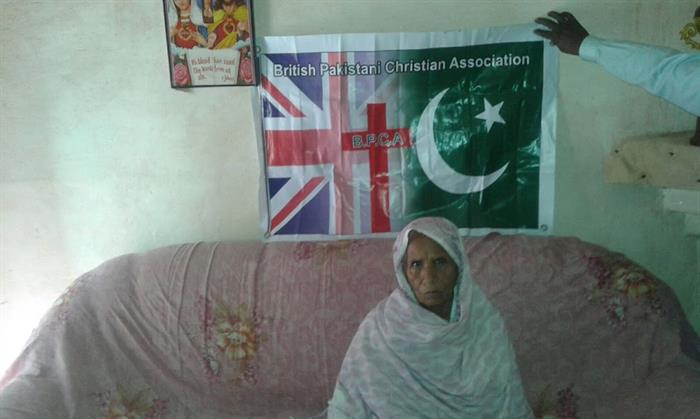
Bashiran Bibi forced to live alone since her son Aftab Gill was accused of blasphemy

A Christian family accused of blasphemy narrowly escaped an extra-judicial killing after a Muslim lynch mob assembled to murder them.
Aftab Gill, 40, lived in Railway Colony in Wazirabad, Distt Gujranwala, and worked as a master tailor. He has five children, three sons and two daughters. Their house is near a local mosque and, like many other local people, they regularly drew water from the water tap outside the mosque as no other clean water mechanism is available in the community. The water was paid for as per the Mosque policy.
The Mosque tap where water can be bought.
On 14th August 2015, a young Muslim man named Zain Shah (18 years) from the neighbouring village told Aftab Gill’s sons, Akash (12 years) and Adnan (5 years) to convert to Islam, but they refused. On the same day, whilst Aftab was taking water from the water tap at the local mosque, the same man shouted at Aftab and said:
“You Christians are not allowed to take water from the mosque. If you want to drink our water you must embrace Islam and pray regularly inside the mosque. Otherwise evil infidels defile our water taps.”

A few days later Zain Shah arrived with other Muslim men and again demanded the sons to convert to Islam. They slapped Gill’s eldest son Akash who refused to convert and at that point Aftab replied to the men, saying:
“You failed to convert Baba Guru Nanak (Founder of Sikh faith) so why pursue converting my children who follow the true and living God”.
At this Zain and his friends started to beat the father and his sons, and while local police saw the altercation and intervened, they refused to lodge an FIR against the Muslim aggravators. Two hours later Zain and his brother visited their home accompanied by a mob of about 200 men ready to lynch the family. Thankfully a local called the police who dispersed the crowd before any violence occurred.

Later that day a few elders from the Christian community asked police officials to accompany them with Aftab so they could meet with the local cleric to resolve the issue. Despite the general perception that local Muslim clerics deliver hate speeches in the mosque, this local chief priest (Molvi) was refreshingly not of the same mind set. He assured the terrified Christian family that he would not allow the situation to escalate, but advised that Aftab needed to leave the village for the sake of his own and his family’s future, believing this also would reduce tension in the community. Since then Aftab and his family have moved away from the area, leaving Aftab’s distraught mother Bashiran Bibi living alone in the former family home. She said:
“Life for Christians in Pakistan is now worse than ever: we are attacked daily and treated worse than rats. Muslims do not want us as their neighbours because they believe we are evil and have satanic diseases. My son and his family came close to death and we were all terrified when the mob came to our house. I prayed to God for His protection and by His grace we have survived, but now my children are far away from me and I am very lonely: my tears are constant.”

There was no First Investigation Report (FIR) registered at the local police station as the issue was resolved amicably outside the criminal procedure.

There are a few other Christian families living in the same area and we are concerned for their safety. The tensions in the community have somewhat dissipated but could erupt again at any time as no separate safe drinking water facility exists for the Christians, requiring them to also use the Mosque tap. The BPCA would like to install a clean water pump in the area for this hard-pressed community and simply need to raise £750 for the installation. We hope to install it in the local church whereby it can become a beacon of hope for our suffering minority.

Shamim Masih said:

“Living near any mosque for a Christian family in a Muslim dominated country like Pakistan could be dangerous at any time. I had a very similar experience when I was living in Rawalpindi and we had a rented house near a mosque. Normally during hot summers, water levels dropped and we faced a shortage of water. People used to collect water from the nearby mosque, paying them a small fee. I was forced to do the same and we happily paid our contribution until one day the cleric came to know that we are from the Christian faith. Immediately the local cleric stopped us from taking water from the mosque which caused us great difficulty.”

He added:

“Later when we moved house we faced further discrimination. We saw a house for rent and agreed terms with the owner, but when I shared I was Christian with the landlord he refused us his house as he will not let it to a Christian. The majority of Muslims living in rural areas of the country think that Christians are inferior and unholy people. I remember the story of poor sister Asia Bibi who dared to drink water from the same cup as her Muslim co-worker, which led to a religious debate and her being arrested for blasphemy. Now she is suffering a life sentence in prison that may ultimately lead to her early demise.”
The British Pakistani Christian Association would like to help Aftab Gill’s family by supporting them through the stressful and painful reality of being forced to leave their home due to persecution. We would like to help them with six months rent which totals £600 and by providing food for 6 months, which is £240. We hope that through the generosity of our donors we can illustrate the love of God to this hurting family.
Please prayerfully consider helping Aftab Gill and his family. Donations can be sent using these bank details:

Payee: BPCA
Sort Code: 20-44-22
Account number: 43163318
Bank: Barclays

Ref: Love for Aftab Gill

For international donations please use these details:
IBAN: GB62 BARC 20442243163318
SWIFTBIC: BARCGB22

Alternatively you can use the PayPal facility on the top right hand corner of our blog, our PayPal email address is info@britishpakistanichristians.org.

Cheques should be made payable to the BPCA to our address: 57 Green Lane, Ilford, Essex, IG1 1XG.

BRITISH PAKISTANI CHRISTIAN ASSOCIATION is a trading name for BRITISH PAKISTANI CHRISTIANS LTD which is a charity entered onto the Register of Charities with the Registered Charity Number 1163363


Thank you.

With your support we hope to change the lives of millions of Pakistani Christians.

Front door of the local mosque.
Aftab Gill’s uncle Riaz Masih, a local cobbler
Bashiran Bibi

Is Jeremy Corbyn a Tory pawn to annihilate the Labour Party forever?

When I put my part deux (or is it trois) of JC insulting the Queen, it soon turned into his comments about Osama Bin Laden’s assassination being a “tragedy.”

The reason why Jeremy Corbyn is going to lose, and lose badly, while David Cameron busily plans the coronation his best friend George Osborn for a 20year Tory reign, well.

  1. Winning elections is actually very easy. There are two votes that really matter, middle class middle England and working class urban England. Both are white not very diverse, not racist but don’t like immigrants, not classist but don’t like posh people. Both are of course very fond of the richest immigrants out there, the Royal Family. 
  2. If you run on an anti-immigrant (light touch no one wants to be a Nazi about it) and anti-rich people (again light touch no one in these two electoral banks support welfare street or heavy taxes, it all about a fair chance) then you’ve got a chance.
  3. Jeremy Corbyn is the candidate that is almost perfectly designed by the Metropolitan Left. His appeal to Middle England is probably non existent.
Winning an election is easy; pick a 100 marginal seats, find what the swing voters care about and campaign like crazy there. Corbyn has been making so many own goals recently that he’s looking control of his initially very well-crafted slogan, “the politics of austerity.”
The SNP annihilated Labour because it cleverly disassociated the link between voting for SNP and voting for Independence (a failed cause, much like Catalonia).
The Labour party will soon shrink to it’s original base, Tory-Haters.

A Letter from Former ISI DG Javed Qazi (and comments from Dr Hussain)

What follows is Dr Hamid Hussain’s comments regarding General Javed Ashraf Qazi’s long letter about the role of the army in creating the current Jihadi mess. Hamid sahib’s comments are in red.
The original is on Major Amin’s website.

Dear Sir;

Thanks for forwarding Lt. General Javed Ashraf Qazi’s bird’s eye view of ‘witch’s brew’ that is perfected over three decades of fermentation. My two cent worth in respected officer’s main text in red.  In private conversations, I’m more candid with officers who had/have front row seat to the ‘horror show’ and obviously that limits what I can say in an open forum.  I’m just finishing excellent biography of Auckinleck by John Connell and most quotes are from that book.

For the un-initiated, few housekeeping rules;

–      As expected, respected officer can only talk about certain aspects and his professional oath prohibits him from discussing other aspects of his job.  He is a patriotic Pakistani and army officer so it is natural that he will give that perspective defending certain policies which is his right.
–      Every nation has its narrative and we may agree or disagree with that narrative.  I have the chance of interacting with non-Pakistanis therefore I’ll interject that view to give some perspective. I found a great similarity in opinion of Pakistanis regarding Americans and Afghans view about Pakistanis.
–      Every narrative blames the ‘other’.  Fact is that this is too big a shit hole to be the job of one actor.  Everybody (locals, regional and international) has generously contributed towards this. Similarly, no one player holds the key to nirvana but a collective effort will be needed to clean it up.
–      In general, everybody agrees with Pakistan’s genuine security concerns regarding Afghanistan and that includes me. However, disagreement is about careful and cautious handling of an explosive situation to safeguard one’s interests versus repeatedly thrusting hand in the snake pit and coming openly in favor of one or other party in a civil war thus multiplying one’s adversaries exponentially.
–      Discussion is limited to practical aspects and not any ideological or moral ground as ‘Saur’ revolution of Afghanistan was as legitimate or illegitimate as General Zia’s coup in Pakistan.
–      Every perspective is limited and mine is no exception.  My opinion is based on my own limited work and subject to correction, critique etc.

“Wisdom after the event is the privilege and the peril of the historian”.  John Connell

Warm Regards,

Hamid

In case you haven’t seen. Would be interested in any comments you may have.

From: Javed Ashraf Qazi
Date: Fri, Sep 4, 2015 at 11:11 AM
Subject: Debate: Army Vs. Civilians
I do not remember if I clarified it earlier but I shall do it once again so that at least you should be clear in your mind and do not mix up various groups and terminologies. What I am going to tell you is the absolute truth.
I am in a position to do so since I was as DGMI in indirect contact with Mujahideen in 1990-91 and was the DGISI in 1993-95 when the Taliban appeared and captured Afghanistan less Panjshir valley.(It is correct statement by the respected officer but only to a certain extent.  Head of an organization is an informed person but he also has significant limitations.  Modern intelligence agencies are large bureaucracies with personality, organizational and turf battles. This is especially true for intelligence organizations.  I’ll give some explanation about MI and ISI but this applies in general to any other organization.  In almost 90 percent of cases, head of MI and ISI has no previous experience with intelligence and in general never served with the organization which he is leading.  This means that it takes a while before he is briefed about wide ranging areas in which his organization is involved.  As he is dependent on his subordinates for information therefore in general he is given more optimistic or neutral pictures.  It is highly unlikely that his subordinates will give him any honest opinion about botched operations. On another plane, if his subordinates disagree with the policy of the high command they have some room from maneuverability.  This applied to individual handlers (usually Colonel rank officers) in the field dealing with Afghan commanders.  I may provide some more details on this subject in my forthcoming obituary of Colonel ® Shuja Khanzada as he was involved in one such game.  In summary, if handler disagrees with the policy, he can slow or stop the flow of information going upwards and continue to give his own line to the ‘proxies’ as later don’t have any other channel upwards. Another important factor to remember is ‘compartmentalization’. In every organization, all eggs are never put in one basket.  When General Zia was uncomfortable with increasing power of then DGISI General Akhtar Abdur Rahman, he gave some tasks to MI.  Similarly inside the organization, different departments don’t know the details of working of another department in the same building.  This is norm and nothing unusual.  This is exacerbated when there is mistrust among senior officers or friction.  Case in point, when juniors came to know that DGISI Lt. General Ziauddin had lost the confidence of army Chief, his subordinates (then Major General Ghulam Ahmad and Jamshed Gulzar Kayani) passed information directly to Chief bypassing their own boss and in due time rewarded with promotions and coveted appointments to reward their loyalty.)
Mujahideen were first organized as a resistance group by Gen Babar on the orders of Mr Bhutto. (this is correct.  I have done quite an extensive piece on this early time period before Zia’s coup based on interviews with first hand witnesses including several hours long sessions with late Major General Naseerullah Khan Babar). These were mostly students from Kabul and other cities. The Russians had not yet marched in but there was hostility against Pakistan. When the Russians marched into Afghanistan, gen Zia decided to organize a resistance movement against them and keep them away from our borders. ISI was given this task and the groups called Mujahideen came into existence. Later The U.S., Saudis and others joined in when they saw the mujahideen as an effective resistance. Yes the ISI organized, trained and armed these Mujahideen groups and successfully kept the Russians engaged until they were forced to withdraw. The Army itself was not involved except some officers like Col Imam who were serving in ISI. The prominent leaders of the time were Hikmatyar, Haqqani, Ahmed Shah Masud, Gilani, Yunus Khalis etc.

After the Russian withdrawal these groups got into a power struggle. Hikmatyar had been elected (I’ll not be that charitable to call this process as election.  In fact, around $5 million provided by Saudi Arabia resulted in this arrangement of a fractious lot) as Prime Minister and Rabbani as the President. Masud who was the Defence Minister captured Kabul and did not allow Hikmatyar to enter Kabul. (and Hikmatyar earned the distinction of being the Prime Minister who decided to bomb his own capital rather than go there and take charge.  Even atheist Soviets were considerate enough to avoid destruction of mosques but the ‘pious lot’ where every resistance party had the word ‘Islam’ inserted in its name turned Kabul into rubble destroying countless mosques.  Pakistanis don’t know the animosity between Masud and Hikmatyar.  In fact they hated each other more than their hatred for Soviets. This goes back to days when both were ‘milk faced boys’. In 1973, when Pakistan’s efforts were in infancy to bring Afghans to Pakistan for training, both chaps were undermining each other. There were casualties and at one time Babar got furious and summoned Hikmatyar and threatened him that if he didn’t stop then may be one day his corpse will be floating in Kunar River.  It is very important to understand internal Afghan dynamics as in my view Pakistanis were seriously handicapped in judging Afghan character. They thought they can brush everything under the carpet of Jihad.  No wonder that one day ISI handlers called their Afghan clients as great warriors of Islam and next day called them ‘jokers’. Some really lost the path and ended up ‘reverse indoctrinated’.) A civil war ensued with lot of killing and total anarchy in Afghanistan. (Just like Pakistanis blame Americans for most of their ills, an overwhelmingly majority of Afghans blame Pakistan squarely for all the bloodshed stating that how can Pakistan wash its hands when it trained, armed and launched these folks even when they were turning Kabul into rubbles long after the last Soviet had left Afghanistan. Pakistanis can disagree with this notion.)
It was now 1993 and I was appointed DGISI. I took a decision to disengage ISI from Afghanistan since we did not want to take sides. U.S. And others had pulled out and no help was available. I called back all ISI reps back except liaison officers in the Embassy and Consulates. I was heavily criticized by Hameed Gul for doing so. (this was the right decision taken by General Abdul Waheed Kakar and efficiently carried by Qazi.  However, many Pakistanis including some ISI officers called it an American move to cleanse ISI stables; in my view a wrong impression.  It was in Pakistan’s interest although Washington used the stick of threatening to label Pakistan ‘sponsor of terrorism’ to get everybody’s attention.)
In 1994, the ex mujahideen and a group of students from Madrassas rose in revolt against the Mujahideen commanders. People of Afghanistan welcomed them. The leader was Mulla Umar who was head of Madrassas where it all started. They did not encounter any resistance and the troops of Mujahideen commanders fed up with atrocities surrenders and came over to them. They became known as Taliban because the bulk came from Madrassas. We did not create them or armed them since a lot of them were ex fighters and there were plenty of weapons in Afghanistan. (This is the dilemma when a country gets too much involved in another country. They can claim that when a fighter changes his cap badge, it absolves them of all responsibility but those on the other end will keep blaming them based on old associations.  Same is true even today.  If Pakistan brings Taliban on the table everybody says look they are Pakistan’s proxies and if Taliban go on their own way ignoring Pakistan’s advice, no one believes. Afghan clients can be very slippery. For every Afghan eating from Pakistan’s hand, there are ten Afghans who are eating from someone else’s hand.)
Our first contact with Taliban was after they had rescued our convoy to Uzbekistan being held by a commander. They had by this time taken Kandahar and Herat and were marching on Kabul. They neither asked for military help nor we gave them any. They sent a delegation to me requesting that we remain neutral in this struggle. Kabul surrendered without a fight just as all other cities did and they did restore peace in Afghanistan. We recognized them as the de facto Govt in Afghanistan (Afghans have a simple question that how come that Pakistani generals who enjoy their gin and soda and send their daughters to convent of Jesus and Mary to get educated want the most retrogressive gentlemen of Afghanistan to rule them.  If a Talib is good for Afghanistan then why he is bad for Pakistan? This dilemma is the root cause of confusion.) and they did not allow India to do any hostile activities against us. We had only liaison officers in Kabul, Kandahar, Herat and Mazar Sharif. Col Imam was one of them located in Kandhar. These Taliban after 9/11 and the U.S. Assault had to leave Kabul and became the resistance in Afghanistan. A lot of them came to Pakistan and took refuge in our refugee camps or the tribal area. Haqqani who is such a thorn in American side came to N Waziristan. Subsequently he managed to establish his writ in three southern provinces of Afghanistan.(Correct to a certain extent but it also begs the question as who established writ in Pakistan’s tribal territories and how?) His fighters were now in Afghanistan but their families stayed on in Waziristan until Operation Zarb e Azab of Pak Army against TTP. Haqqani and his group have never attacked any place in Pakistan. They also did not launch their operations against Kabul from Pakistan since they control Paktia and Khost in Afghanistan. Their families however were  in N Waziristan but we did not attack their camp (this is correct and Pakistan saw in its own interest that Mr. Haqqani is not bothering them therefore if he is beheading Afghan soldiers or bombing the shit out of civilians in Afghanistan, they don’t care.  If we accept Pakistan’s point of view then how about Afghan’s point of view.  Afghans can claim that Mr. Fazlullah is not bothering them and it is not their business what he does in Pakistan. Each party can make others life miserable if they choose.  However, both countries need to come out of their present mind set and understand each other’s limitations.) despite pressure from Americans who would not send their own troops to fight them in Khost but instead wanted us to attack their base camp/ families.
After the U.S. Came in lot of foreign fighters specially Uzbeks who had taken refuge in Afghanistan now came to our tribal areas. They bought or rented property and teamed up with criminals to push the Malik’s out of tribal belt. Some inmates of Guantanamo Prison like Abdullah Mehsud were let out and came back to form a group called Tehrik-e-Taliban Pakistan. It has nothing to do with Taliban of Afghanistan. (This needs correction.  Muhammad Alam aka Abdullah Mahsud had been fighting in Afghan Taliban ranks since 1996.  In fact, he lost one leg in 1996 in a fight against Northern Alliance.  In 2001, he was in Taliban ranks and fighting in northern Afghanistan and surrendered to Dostum. After a vacation at Guantanamo Bay where U.S. tax payers paid for his prosthetic leg, he came back to the theatre.  He was active in Af-Pak theatre until finally his luck ran out and Pakistanis dispatched him to his maker in Zhob.)   Sectarian killers and other criminals like ransom seekers and car thieves etc. all joined and they started their atrocities on the people of Pakistan. The Army or the ISI had nothing to do with their rise. (Sectarian killers rotate through various organizations for survival as described above.  Everyone knows about the ideology of Lashkar-e-Taiba; a group primarily trained for operations in Kashmir. They are pretty candid about what they think about Shia and other Sunni groups i.e. Barelvis. Their leaders may not openly advocate violence against ‘deviants’ but they prepare a very fertile ground and others are free to pick from this nursery.  While their leader Mr. Hafiz Saeed can be given a ‘golden handshake’ and a lucrative ‘severance package’ as state feels it is the right policy but what about the rank and file?  A large number is not physically involved against the state but everyone knows where their sympathies are.  Those who disagree with their own leadership have already found greener pastures in other organizations.  This is no secret that Pakistan’s sectarian killers were at camps in Afghanistan during Taliban time and none other than then DGISI Ziauddin and interior minister Lt. General Moinuddin Haider went to Afghanistan pleading with Taliban to do something about them.  More important point to ponder is that a youth of 17 & 18 who attained the power of having the authority of life and death and basking in glory.  Now we expect that he will just go back to his tea stall and taking the abuse from ordinary folks.  I think de-radicalization programs started by the army are maturing and in the long run will be helpful in containing the fires.)  They are the worst liabilities and no one ever considered this lot as assets. Some religious parties and zealots including some ex ISI officers tried to support them in the name of Islam but met the fate as that of Col Imam. These criminals are now on the run and this TTP remains the greatest threat to our security. Haqqani has remained a friend and is now totally in Afghanistan. We need to remain out of any conflict between the Afghan groups and keep friendly relations with all. (This is the sane course but temptations are hard to control.  In addition, too much blood has passed under the bridge and it will take a long time for everybody to forget what happened.)
Irrespective of what lies have been told and some books by our Pakistani authors this is the truth. They had to sell their books and invented fake stories behind the rise of Taliban with the help by ISI. This is the real truth which you may or may not believe but at least you have been told.  (This may be true, but what about ISI officers who proudly claim that they are legitimate or illegitimate fathers of Taliban and on every forum defend them?)
The groups who murdered Pakistanis were never created or nurtured by the Army or the ISI. This TTP is a bunch of criminals masquerading as Taliban. ( I disagree with the respected officer in strongest terms.  I think it was great ancient Chinese strategist Tao Te Ching who said that “No disaster is greater than slighting the enemy; for slighting the enemy borders on the loss of one’s treasures”.  My own work in this area and interaction with a number of officers with front row seat to the show gives me pause.  If we accept respected officer’s view that these are simply thugs then how we explain that they gave Pakistan army run for their money.  No doubt, they are a dangerous and blood thirsty enemy responsible for so much grief for Pakistan but let’s pause for a minute.  I’ll not go into more details but only highlight few things. Look at the events from 2003- 10; TTP organization: rise among leadership based on performance, earning respect and loyalty from following, training, motivation, use of skills (using workers with experience of mining in Baluchistan to create extensive underground infrastructure in Swat and other tribal areas), thorough planning, operational excellence, audacity, hitting center of gravity i.e. Pakistan army installations repeatedly with success, slick propaganda and sending the general public morale in nose dive.  Sir this is not the performance of a bunch of criminals but a determined foe.  There is a method in his madness.  A thorough understanding of adversary is must to meet the challenge.  This is the true test of professionalism. Reminds me a sentence which Auk wrote to his Corps Commander about adversary in Western desert ‘I have no doubt that they will be vigorous, clever and dangerous’. Alas there was no Auk at GHQ who could see clearly and prepare accordingly.  Too many years wasted before the right course finally adopted.)

                             They are totally different and have no relationship with Afghan Taliban. The only assets created by Pakistan were the Mujahideen who were used to push the Soviets out of Afghanistan. We did not create the Taliban which was an indigenous movement. Why is it so difficult to believe the truth? (This is a good example of simplicity of thought ignoring varying loyalties and blurring of boundaries.  Respected officer is correct in pointing the difference between rise of Taliban in Afghanistan and Taliban in Pakistan but totally oblivious to the fact how this thought process permeates across boundaries.  It also ignores how various groups use connections to their advantage. He wants to wish away the facts which are not disputed.  Few examples can refresh everybody’s memory.  Thousands of Pakistani religious seminary students led by clerics who had connections with Afghan clerics fought on front lines long before American B-52s showed up on skies.  When U.S. came to town thousands more went to Afghanistan to fight.  Those who are fighting sectarian wars have rotated through organizations active in Afghanistan, Kashmir etc.  Even today, when pressure comes on these organizations they move to a group not under attack.  Even proselytizing and non-political Tableeghi Jammat’s vast infrastructure is being used as ‘rat lines’.)  Why must you believe the anti-army lobby trying to throw all blame at army’s doorstep since it makes them heroes in the eyes of so called liberals sitting in U.S. (We have heard this before many times where army feels only it has the monopoly over patriotism. I don’t know many civilians but at least those well informed Pakistanis that I have the pleasure to know have also buried their loved ones and I find their view much more informed about some crucial issues.  They have a different view but they are no less patriotic.) I am sending you a complete rundown on all these groups and the misuse of terminologies to demonize the army and the ISI by your friends in U.S.
Your facts are totally incorrect. I have posted a detailed fact sheet on all these groups. You should believe me since I am in the full picture and was on the spot as against you depending on what others have written. TTP except the word Taliban has nothing to do with Taliban who are all Afghans. Haqqani is very much a part of Taliban but has nothing to do with TTP except that before the Army operation both coexisted in N Waziristan in their respective area. (A chap is abducted in Afghanistan and ends up in Waziristan, when TTP groups develop differences, then Haqqani’s emissaries come in to broker peace, when Commissioner of Malakand goes for negotiations, sometimes he leads the prayer while at other time Mullah Fazlullah, Corps Commander of Peshawar, Lt-Gen Safdar Hussain first garlands Nek Muhammad and then calls Nek’s successorBaitullah Mehsud “a soldier of peace,” a senior army officer telling a group of journalists “We have no big issues with the militants in FATA. We have only some misunderstandings with Baitullah Mehsud and Fazlullah. These misunderstandings could be removed through dialogue” and calling these two chaps patriots.  Entire Pakistan mourning the untimely death of late Hakimullah Mahsud and none other than interior minister wailing publicly and lamenting the death of a great peace maker. Is this all fairy tale or I’m delusional. Now things are clear but the time period under discussion was full of confusion, strategic myopia and incompetence at various levels. Pakistan lost a lot in this muddle. I have the pleasure and honor of knowing a large number of Pakistani officers; a good number first rate officers.  Many performed admirably no matter what their rank and when done professionally also delivered and completed their assigned task.  However, I’m a very strong critic when it comes to competence and professionalism and in private conversations I advocated as early as 2003-04 to start the business of sacking the ‘dead wood’ on the ship. I think it was Auk who said “It may not be in accordance with ‘usual practice’, but this is an ‘unusual’ war, and it will have an ‘unusual’ end if we do not get a move on and sweep aside cobwebs and precedents and ‘usual practices” and this was the cross road for Pakistan in 2003-4.  I think it was a fine Pakistani officer who said about the task at hand in those early days.  “I have come to the conclusion that we have to do it Sir and if we have to do it then better do it today than tomorrow”.)
TTP is Pakistan oriented wanting to capture the state. They are also barbaric killers more like the ISIS. (Should we believe that these chaps were raised and trained in Timbuktu and took chartered flights in C-130s to land in Waziristan, declare Emirate and gave Pakistani state an eviction notice which was accepted without a protest. Off course, army is not solely responsible for the royal mess but one cannot simply wash hands calling it the will of God. These demons are real and need to be exorcised.) If the operation by the army had not destroyed their bases in Waziristan, there would have been thousands more of our country men in graves. These killers were never an asset for anyone but themselves or our religious parties who tried to defend them. Surprise was Imran Khan who for a long time failed to differentiate and kept calling TTP as our people. (This is all history and good indulgence.  It is with purpose of understanding and not some silly exercise of blames or claims and counter claims.  Wars are not fought according to some manual and marking a checklist.  It is all uncertainty, fleeting moments of chance and test of will.  Now that the right decisions have been made, it is important to make sure that the momentum continues. The price of complacency will be more blood and tears.)

“Fools admire, but men of sense approve”.                  Alexander Pope

Joseph Conrad, the Modern World, Yemen; Random Thoughts

This post was triggered by an an excellent piece about the great Joseph Conrad in Prospect magazine. (Though I do think “anticipating terrorism” is too narrow a title, he was anticipating much more). I am posting a couple of excerpts, a piece about Yemen and my copied and pasted remarks from Facebook. Followed by a few random quotes that just came to mind in connection with this. It is an impressionistic post, please don’t connect too many dots 🙂

Conrad gets bad press in some narcissistic pigmy circles these days (who doesn’t?) but he is truly one of the greats. “Under Western Eyes”, for example, should be assigned reading for anyone starting their study of the Russian revolution and much that followed.

From the Clive James piece:

“..They are, in fact, idealists: and idealism is a cast of mind that Conrad questions even more than he questions radicalism. The logical end of radicalism, in his view, is terrorism; but idealism is the mental aberration that allows terrorism to be brought about. Conrad’s originality was to see that a new tyranny could be generated by people who thought that their rebellion against the old tyranny was rational. Thus his writings seem prescient about what was to happen in the Soviet Union. 


…As the collision between bliss and destruction gets closer, the reader will spend at least a hundred pages praying that Heyst has a gun hidden away somewhere. The first big slaughterhouse battles of the First World War had already been fought while Conrad was publishing the novel, but there is not a hint of pacifism. Conrad knew that unarmed goodwill is useless against armed malice. It was to be a lesson that the coming century would teach over and over, and so on into the present century: peace is not a principle, it is only a desirable state of affairs, and can’t be obtained without a capacity for violence at least equal to the violence of the threat. Conrad didn’t want to reach this conclusion any more than we do, but his artistic instincts were proof against the slightest tinge of mystical spiritual solace, and so should ours be. Our age of massacres has also been an age of the intellectual charlatan, when people claiming to interpret events can barely be relied upon to give a straightforward account of what actually happened. Conrad was the writer who reached political adulthood before any of the other writers of his time, and when they did, they reached only to his knee.


…Conrad should have made his heroes as intelligent as himself, the better to illustrate his thematic concern with how the historic forces that crush the naive will do the same to the wise, if they do not prepare to fight back. Finally, he tends to reinforce our wishful thought that cultivation—gained, for example, from reading the novels of Conrad—might be enough to ward off barbarism. But barbarism doesn’t care if we are cultivated or not.

Then I saw (via Ali Minai)  a tangentially related piece in the daily Beast, about Yemen. Worth a read.

“..And, most tragic, is the loss of life and the irreversible disruption of the lives of Yemeni people who display a deep love of family and extend their warmth and generosity to visitors. I feel diminished that this remarkable country can no longer be discovered by others and that violence is destroying its historic beauty and threatening its extraordinary people.”

My comment on this was typically obsessed with my personal obsessions, but I do think there is a point in there somewhere: There is no escaping the modern world. The technology gap means no premodern society can ever hope to survive unmolested unless they are thousands of miles from anything anyone modern may want. So the real trick is find a way to survive in the modern world (of states and armies and schools) without losing everything you hold dear. This seems difficult, but not impossible. But it seems to be specially hard in the Muslim world because we have our own “almost modern” “primitive-culture-destroying” myth and it makes things just the tiniest bit extra-hard. The shsit could have hit a smallish fan in Yemen just because different groups wanted to fight over it…nothing new about that. And not impossible to survive. But the state ideal does not seem to have enough legitimacy to really settle down (and make the necessary compromises and deals with more advanced countries) in the core Muslim world at this time. It will be a long night in Yemen.

“Heaven and earth are not merciful. To them, men are as straw dogs, destined for sacrifice.”– Lao Tzu

Could man be drunk for ever
  With liquor, love, or fights,
Lief should I rouse at morning
  And lief lie down at nights.

But men at whiles are sober
  And think by fits and starts,
And if they think, they fasten
  Their hands upon their hearts.

(AE Houseman)

It takes the Navy three years to build a ship. It will take three hundred years to build a new tradition. The evacuation will continue.. (Admiral Cunningham ordering the Royal Navy to continue the evacuation of Crete in the face of heavy German air attacks)

“With two thousand years of examples behind us, we have no excuses when fighting for not fighting well.” T. E. Lawrence

Once war has been undertaken, no peace is made by pretending there is no war.
—- Duryodhana (and look what happened to him)

He is a fool that practises truth without knowing the difference between truth and falsehood.
— Krishna to Arjuna


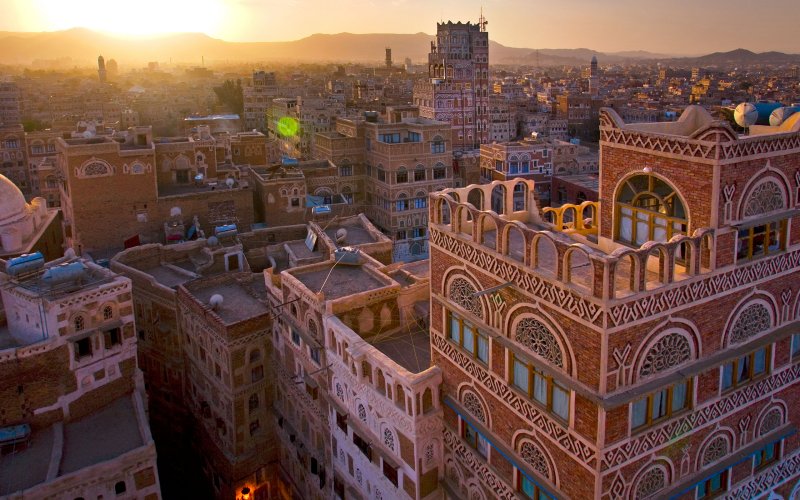
The unique architecture of the Unesco World Heritage City of Sanaa at sunset Yemen

Image result for jordan pilot fire

Indian Studies; Reversing the Metropolitan Gaze

A long essay by Brooklyn philosopher Samir Chopra on the Hindutvadi school (not necessarily their term, or his) of Rajiv Malhotra and  Balagangadhara and friends.
Excerpt:

As the historian Satadru Sen pointed out to me in conversation, there are two broad points that run counter to the kind of gaze reversal Balagangadhara and Malhotra attempt.  First, their attempt founders on some ineluctable facts. Orientalist gazes reflect uncomfortable historical realities of power; the East is scrutinised by this gaze because the West, to put it bluntly, conquered it. The philosophical and theoretical apparatus of its gaze was that of a civilization that had asserted its will over another. No such conquest underwrites this attempt to examine the West through an Indian lens, especially when Indian scholars themselves by and large do not rely on Indian philosophical or theoretical analyses to study the world or their own societies. Indeed, there is at this point in time, no unconquered, un-Orientalised Orient to deploy against the West. The fact of conquest does not grant the West the right to objectify. But still, whatever came before its encounter with the East has been transformed at a very fundamental level by this fact. So again, there is now no authentically Indian or indigenous lens that can be brought to bear on the West.  The contexts within which our discourses take place are those largely constituted by the Western intellectual tradition; Balagangadhara’s and Malhotra’s philosophical idioms—couched in English—belong to it. The contemporary exercise of reversing the gaze—in particular, in the manner sought by Balagangadhara and Malhotra—seems like a thought experiment destined to fail.


Second, the “Indian culture,” “Hinduism,” and “dharmic traditions” referred to by Balagangadhara and Malhotra are left mysteriously unspecified. We might wonder how inclusive these terms are. Those who assume the existence of these broad and abstract categories can all too easily marginalise others who might not share their unspoken definitions of them. The group Balagangadhara claims to be speaking for—the “majority of Indians”, the “men and women” who “protest” the “violence” done to them by academic studies of “Hinduism”—enjoys hegemonic status. Those who suffer under that hegemony— women, adivasis, Dalits—might put forward very different understandings of what they would consider acts of “violence” directed against them, and might not, for instance, mind the inducements of conversion.

Here is a challenge for “Indian studies” as advocated by  Balagangadhara and Malhotra: to not take refuge in imagined glories of systems understood in the abstract, independent of their actual historical application and manifestations, or indulge in implausible apologia for manifestly real social ills. Rather it must reckon with the history of this nation, one in which English has emerged as a language in which Balagangadhara and Malhotra seek to communicate and one whose study requires a more inclusive view than they seem to exercise. – See more at: http://www.3quarksdaily.com/3quarksdaily/2015/09/sn-balagangadhara-and-rajiv-malhotra-on-reversing-the-gaze.html#sthash.q1aSAVr4.dpuf

I had some off-the-cuff comments on the 3QD site and am copying them here (with minimal editing) in the hope of getting feedback.
I know Malhotra fans are going to be somewhat upset, but by now those who are also my friends will realize this is not meant to be an attack..

Malhotra (and company?) seem to be operating (most of the time) at the level of political polemicists, driven by their commitments in present day politics (particularly identity politics, in which they have chosen their ground as Hindu nationalists or Indian nationalists, or both?). Their scholarship seems no more objective (to me) than that of various left wing “politics-first” scholars who use the jargon of postcolonial studies or Marxism (post-Marxism?), or of the various Islamist scholars whose priorities are set by their chosen identity (real or imagined..or both?) and their contemporary political stance.
All of these groups may not be equal. To an amateur outside observer (aka me) the Indian-HIndutva armamentarium seems a bit thin. Not zero. But thin, compared to the vast quantities of scholarship (good, bad or mixed) upon which any progressive scholar can build. Or even when compared to what is already mainstreamed within the metropolitan gaze for Islamists. Hindutvadis have further to climb (and less asabiya to start with? After all, most Hindus in mainstream metropolitan academia are not Hindutvadis; there are many more Gayatri Spivaks or mainstream liberal scholars, no?).

An acquaintance (Pakistani) who is an Islamist and a historian (U Chicago) once dismissed some vaguely Indophile claim I happened to make with the dismissive retort: “Oh Please! Let us not delude ourselves about the relative civilizational heft of these contenders. My party (Islam) may be down, but we are not at Hindu-level in the world civilizational conflict game. Let’s not bring the minor league teams into this”.

I rejected his stance then (and still do) based on whatever notion of Western-Scientific-Global-Human-Punjabi-Indian-Islamic identity and ideals with which I imagine myself trying to figure things out, but a lot of Hindutva’s relative weakness is explicable in such terms: they are just not embedded deep enough in the dominant traditions of the modern world. Still, by itself this is hardly a permanent disqualification. A billion people, a long history, a cultural heritage that is not yet completely lost; maybe even “Indianism” may not be a completely impossible fantasy (though I personally think any form that becomes strong enough to play at world level will have to become more inclusive within India, and more friendly to science, to Western knowledge and to serious historiography)?

At some level, I expect almost all of us (readers of 3QD, liberal Desis) see ourselves as being above this level of identity politics and it’s “crude clash of civilizations worldview”. And I hope we are right. But comparing apples to apples, the crudity of some of their myths, ambitions and paradigms is not an infinite distance from the sophistication of Marxian or even Niall-Fergusian worldviews.

Then again, as Samir points out, one group did manage a huge conquest relatively recently. And had a disproportionate role in creating the modern world. At some point, we have to reckon with the facts on the ground.

PS: from twitter:
Ali: One can speak of angels and be taken seriously, but talk of 6-armed deities won’t fly.


 Not fair, of course, but history still lives in a Judaeo-Christian discourse.


In that sense, their frustration is understandable, as was Said’s.But frustration alone isn’t scholarship.

Omar: But one feels for them. Where Said is honored, they r treated as idiots..


PS2: The following passage from Samir’s article is worth a second look:

Those who suffer under that hegemony— women, adivasis, Dalits—might put forward very different understandings of what they would consider acts of “violence” directed against them, and might not, for instance, mind the inducements of conversion.

While completely unremarkable to anyone who works in the Western tradition (including poco-pomo scholars who like to imagine they inhabit an anti-western universe hovering above the Metropolitan tools and toadies of the world), it is also a good example of what Malhotra and his fans would consider “Western brainwashing in action” (with some justification?).

Why is it that Indian society and Indian history cannot be approached without focusing on the “hegemony of the upper-castes” (sometimes simplified to Brahmanism) and the “oppression of women, adivasis and Dalits”? This trope is so popular that it is hard to imagine it could be otherwise, but isn’t this the most Metropolitan of Metropolitan gazes at India? The story of India includes (for sure) caste-differentiation, the subordinate status of women and the oppression of Dalits (since I know almost nothing about those now labeled adivasis, I will leave that topic to those who know better), but something similar is true of practically ANY premodern society. Yet when we talk of Japanese art or Chinese literature we don’t always have to bring up how  women were treated, or how Japanese peasants were treated or how outcaste Japanese existed (very precariously) on the outskirts of those beautiful Japanese cities; but it does seem that no comment about Indian history or culture can be written without an obligatory nod to caste-oppression or the status of women. (I understand that there are Hindutvadis who would like to continue certain oppressions here and now, but again note that their “cultural peculiarities” do not get the same “understanding” (if not approval) as those of, say, the Islamists).
Why might this be a problem? Well, first of all, it may not be the whole story.  And secondly, it may not even be entirely true. It is a construction, a structure we impose on the great mass of Indian history and culture. And Western writers wrote this book on Indian culture and Indian history in the last 200 years, and they created many of the categories, and they continue to do so... even Indians writing about India (especially, but not only, in English) are never free of this metropolitan viewpoint and these metropolitan priorities; even (and perhaps especially) when they write as left-wing critics of Western domination.

Of course, Malhotra and company tend to see this as conspiracy (the left-liberal Indian is a “pet” or “hired hand” of the machinery of Western domination), while I think even people like Pankaj Mishra and Arundhati Roy are completely sincere and in fact, in their own minds, are fighting against the West and its domination of discourse. They just don’t see their own (very) Western gaze.
Which is the point.

PS3: I am making absolutely no claim of somehow having escaped this “Western gaze” problem. I personally don’t see it as that much of a problem. But the frustration of the Hindutvadis comes from the fact that those who do see such things as a problem are not giving them the same license that they are willing to give to other “others” in global culture.  🙂
Something like that.

PS4: Rajiv Malhotra posted a reply on his yahoo group. It is posted below (btw, if his aim is to get the conversation started, then this article from Samir counts as a major breakthrough. While somewhat critical, it is not the usual brush-off that Rajiv Malhotra gets from the Western-Desi academia)
Malhotra wrote. BEGIN QUOTE:

Samir Chopra says Nussbaum responded to me, but merely cites her allegations
with no backup. To say I am no good without concrete examples, etc. is
hardly a “response”.

He says my idea of non-translatables has the problem that we would be unable to communicate ideas across cultures. But he does not consider my proposal
that we embed these Sanskrit non-translatables into the English language, and
gradually help people understand them without using English substitutes.
The same has been done with words imported from German, French – and
even Sanskrit words like yoga. These are called loan words in
linguistics. So why the fuss?

He feels that all too often I rely on a narrow history of the west. This
is true and must be true of any attempt to engage the west, and I
repeatedly point out that my intent is not to essentialize and rather to
see distinct loci for discussion purposes. It is also true of the history of India commonly taught. When they say “Islamic/Mughal period” what about major non-Islamic empires and rulers in many parts of the country? Similarly for the so-called British period. The layering of Indian history into chronologies is an article of academic dogma seldom challenged; but the facts of history are far more complex. There is virtually nothing you can say about India without counter-examples. Take caste, sati, dowry for example – one cannot consider these uniform across either time or geography. So a good project for the author would be to take over what I tried doing since the 1990s – to write point by point rebuttals of USA textbooks, college reading materials as well as research papers on such subjects, pointing out the “narrowness” of their approach. The hard reality is that people refer to referents like China, EU, USA, etc. in a similar manner as approximations that serve a given purpose but that cannot be essentialized too much. So when I contrast the history-centrism of Abrahamic faiths with dharmic reliance on embodied knowing of living exemplars, I make an important and original observation. This can enrich the discourse. Thats its purpose. And as a matter of fact, I have succeeded in introducing many such points of distinction into the discourse. Several theologians from the Abrahamic traditions have themselves found such observations remarkable. The author is using too much of the text-book postmodern critique of any reference to anything.

I have been a permanent resident of the USA since 1971 (long before the
majority of US citizens were born); hence I certainly understand its cultural diversity intimately, having engaged in numerous NGOs, civic groups, professional, etc areas. These scholars from India tend to be in campus cocoons blissfully ignorant of society outside what they read from each other.

He claims I consider western thought inferior. I do not. However, I find its struggle to move from modernity to post-modernity suffering. On the one hand it borrows and digests a great deal from India in this movement. On the other hand there is a sanitization/domestication of Indic materials in this process that removes important elements.

What I find inferior are the Indians mimicking the west and blindly
importing it, and I critique Indians’ inferiority complexes. Neither here nor there, they control too much discourse. Thats my target. Americans are merely the product of their European backgrounds followed by the scars of occupying the land of the (genocided) native americans and of using black slavery.

I agree with him that what we need is neither left or right but revival of
traditional Indian spirit of free inquiry. Here he would do well to fight the blockades erected by Indian sepoys in service of mainly western imported theories and cartel agendas.

The main point Samir Chopra misses completely about my work is that its chief goal (and success) is to create a voice that wants to reverse the gaze to begin with. What specifically such voices (in the plural) will do cannot be anticipated, but such voices must emerge. The post-colonial Indian voice has failed because it was too much embedded inside the very fortress it claimed to topple. (In this respect I find Balagangadhara to have had very limited impact as he has tried to oppose from within the system and must obey its rules.) Post-colonialism, funded by the likes of Ford Foundation and others like them, has been a project to channel and domesticate such resistance.
So it matters not what I say, as long as its consequence is to create:
first a suspicion against the received wisdom on India from the academic
establishment; then experiments (of which mine is only one) to rejoinder; then attempts to construct alternative narratives. This is just the beginning of a very long term process. It has to start somewhere.

END QUOTE


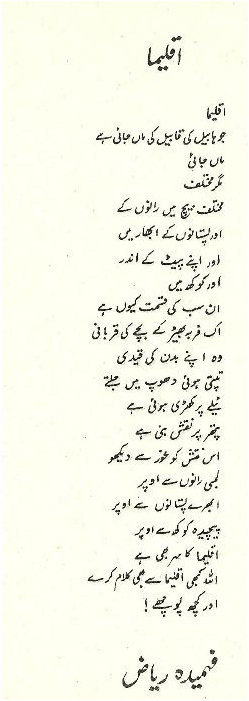
Aqlima. Daughter of Adam

A translation (by Ruchira Paul) of Pakistani Feminist poet Fahmida Riaz’s poem Aqlima (daughter of Adam and Eve)

Audio in the poet’s own voice. (mislabeled as another poem).


Aklima
jo Habil aur Kabil ki maa jaani hai
maa jaani,
magar muqtalif
muqtalif beech raano ke
aur pistanon ki ubhaar mein
aur apne pait ke andar
aur kokh mein
is sab ki kismet kyun hai
ek farba bher ke bachche ki qurbani
woh apne badan ki qaidi
taptee hui dhoop mein jalte
teele par khadi hui hai
patthar par naksh banee hai
us naksh ko ghaur se dekho
lambee raano se upar
ubharte pistanon se upar
paicheeda kokh se upar
Aklima ka sar bhi hai
Allah kabhi Aklima se qalam karain
aur kuchh puchhain.

(Translation)
Aqlima..
Born of the same mother as Abel and Cain
Born of the same mother but different
Different between her thighs
Different in the swell of her breasts
Different inside her stomach
And her womb too
Why is the fate of her body
Like that of a well fed sacrificial lamb
She, a prisoner of that body
See her standing in the scorching sun on a smoldering hill
Casting a shadow that burns itself into the stones
Look at that shadow closely
Above the long thighs
Above the swelling breasts
Above the coils in her womb
Aklima also has a head
Let Allah have a conversation with Aklima
And ask her a few questions.
(Aklima was the lesser known offspring of Adam and Eve, the sister or Cain and Abel)

Colonel Imam As I Knew Him

A note about colonel Imam, sent by Dr Hamid Hussain. The writer is not identified (but is a Pakistan army officer). The lines in red are comments from Dr Hamid Hussain.

COL IMAM AS I KNEW
I had known
Sultan Amir later on Col Imam since mid-1966. I had been commissioned
about 6 months earlier than him. However, my unit Guides Infantry FF (formerly
Queen Victoria’s own) came to Lahore as a result of pull back of forces due to
Tashkent Accord in 1966 about the time he was commissioned in the 3rd
Pathans (FF).
Both young
and energetic got plunged into the lives of young officers of that time which
was divided in training and sports events, assaulting Xing water obstacles
exercises, even evenings were devoted to regimental dinner and guest nights
leaving very little time for fun and frolic. Only on Sundays one could indulge
‘non-training events’. Most of us covered our sleeplessness of the previous six
days of the week.
In December
1970 both of us found ourselves competing for selection into the elite SSG
(Special Services Group). I must have just crawled through but Sultan Amir
passed through the three days of gruelling selection tests with flying colours.
Only 24 officers were selected from the large number of officers who had
volunteered for the SSG.
The basic
Commando Course started in early 1971. It was here we discovered the real
Sultan Amir. Originally designed by the US Special Forces instructors, it was
considered as one of the toughest courses in Pakistan if not other modern armies.
He would carry the heaviest load to farthest distance not asking for relief or
respite till one of us felt that we are not being fair to him. He was the most
helpful among all of us to carry anyone’s belongings tired enough not to carry
his own weight, weapons, ammunition or anything else. After 25-30 miles, night
marches over the most rugged terrain when we would just slump down he would run
around to see our hideout, gather fire wood, cook food and see to the security
drills of the hideout etc.
It was here that his real
leadership qualities came out.
A few days
before we were to graduate from the course, he was with us in setting a record
of crossing the Mangla Lake at its widest, approximately swimming 6 miles both
ways in 2 hours & 45 minutes. This record remains unbeaten till today. He
along with Brig Akram later Commander SSG came out with the highest grade in
that course.
He was
posted to the elite Tipu Company and I went over to 2 Commando Brigade (SSG).
During the Dec 1971 war he had infiltrated behind the Indian troops in the
Desert Sector and laid a blocking position. Unfortunately the Pakistani ground
offensive just petered out. It goes to his credit that lost, hungry and
forsaken he was able to safely extricate along with his troops. By the end of
1973 he had undergone the US Special Forces Course at Fort Bragg along with
Psychological Operations Corse. His visit to the US was to bring about a marked
change in him; appreciating their training methodology while criticising the
materialistic way of life that he saw there. Meanwhile, as the OC Parachute
Training School he had also become a jump master with golden ensign (over 100
jumps).
We went up
our career ladders, commanding our parent battalions and landed back together
in 1976. I was the Commanding Officer (officiating) and he as the Second in
Command. We went through hectic training, exercise, operations, etc. together.
During this period we were involved in training of the Mujahedeen on a small
scale courtesy General Naseerullah Khan Babar who was the architect of the
forward policy and had advised Mr Zulfiqar Ali Bhutto to be proactive along the
Durand Line and payback in the same coin for what the Afghans were doing in
NWFP in particular. Promoted to the rank of Lt Col
he commanded his Paltan and landed in the Afghan cell of the ISI in early 80’s
and was to become a larger than life legend. His stay there was to also change
his earlier outlook towards life as well as profession. ( a number of officers went through
a transition later dubbed as ‘reverse indoctrination”)
It was
here that he adopted the nom de guerre of Col
Imam which became a world famous identity.

Imam went after his job with single minded devotion. Firstly, training
the Afghan Mujahedeen and later leading them into operations against the Soviet
troops. Without, de-negating the efforts of the Mujahedeen it was not possible
to coordinate any operation without the immense efforts of this handful of
officers and men. The animosity among Afghan groups was so great that Ahmad
Shah Masoud and Hikmatyar killed more of each other’s cadres than the Russians.
(The Taif incident is a
classic example of this when Afghans could not even agree who would be their
spokesperson at the conference and irate Saudis put the entire Afghan
delegation in Taif prison to knock some sense).
Imam had a low opinion about the operational
capability of the Russian forces except the Spetnaz. He had a healthy regard
for them and thought that they were among the best Special Forces in the world.
He was one
of ISI operators who stayed the longest, went the deepest and earned total
respect of the Mujahedeen for his operational handling, tact and coordination.
This was also the most dangerous period with Soviet gunships ruling the air
(superiority). However Charlie Wilson’s effort bore fruits and the induction of
Stinger anti-aircraft missiles severely challenged the Soviet air superiority.
Very few people know or understand that most difficult period. Were it not for
the timely induction of these SAMs Dr Najibullah might have been still around.
At the same time he was not without his distractors while handling over the
Afghan desk to me my predecessor Gen Afzal Janjua remarked that one of the
biggest worry he had was the personal security of Imam.
He was apprehensive that Gulbadin Hikmatyar (GB) may eliminate him for his
friendship with Akhunzada Nasim (the
biggest drug smuggler of Afghanistan)
the leader of the
Mujahedeen in Helmand Province but vehemently anti GB. During my stay as the
Head of the Afghan desk I too had to ensure that they do not come into each
other’s clashing zones.
The Peshawar
Accord of 1992 owed itself to hectic work of pushing the Mujahedeen leaders
round the clock to come out with a solution. Prince Turki Al Faisal Head of
Saudi intelligence was also there to pressurize the Afghan leaders (In my own opinion in line with
Afghan’s history money played a much larger role than everything else. Turki’s
Chief of Staff Ahmad Badeeb brought the cash in brief cases.  No one knows
the exact amount but some estimate that it may have been around $5 million)

. However it was handful of people in which Imam
was also brought in to utilize his influence, charm or arms twisting abilities
to force the Afghan leaders to come out with an accord. Although not to the full
satisfaction of Iranian diplomats waiting in line to exercise their own
influence on future of Afghanistan. The working to bring out an accord was by
itself one of the major achievements of ISI. Till the last moments there were
hiccups and a possibility of its being sabotaged.
The
Mujahedeen Government led by Hazrat Mujadadi was installed in April 1992. Most
of our work in operations had finished. I asked for a posting out Imam stayed there till his retirement.
Afghanistan remained in a state of civil war even after the installation of the
Mujahedeen Government. It was the period of the warlords, Turan Ismael in
Herat, Gul Agha in Kandahar, Rashid Dostum Uzbek at Mazar I Sharif and the
Ahmed Shah Massoud  in Punjsher Valley and other Tajik areas. The Central
Government was confined to parts of Kabul only.
The Foreign
Service officers were not interested or keen in serving in a turbulent
Afghanistan particularly after the assault on Pak Embassy and drubbing of our
diplomats in Kabul. (was
this the incident in which Defence Attaché Brigadier Ashraf Afridi was
injured?)
Col imam came in handy and was appointed as
Pakistan’s Counsel General at Herat. Having very good personal relations with
Turan Ismael and his brother, he went after his job with gusto. There is no
record of Imam having strayed beyond his
official responsibility and interfering in the internal affairs of Afghanistan
however his personal friendship with so many of them does not rule out his
influence over them. As a Counsel General  Imam
strengthened these friendships further. He was also target of kidnapping and
assassination more than once. Probably his distractors wanted to shoot two
birds with one shot i.e. embarrass Pakistan besides eliminating him.
Pakistan
Government during this period was conceiving its own plan for opening up
Central Asian Republics through over land routes through Afghanistan. His
location at Herat and Kandahar was ideally suited for facilitating this
purpose. The Interior Minister Gen Baber was particularly very keen though some
saner elements had advised against this adventure. Unfortunately the very first
convoy led by Imam got mired in the intra
Afghan feuds and was made hostage. The timely arrival of the Taliban saved Imam and the convoy from annihilation. The
arrival of the Taliban in 1996 onwards was a home grown affair in Afghanistan
though laid at the doors of the Pakistani establishment Imam’s personal knowledge was most useful in
establishing contact and ultimately recognizing Taliban, Although little
prematurely and without the input of the foreign office.  
Till the
last he remained an admirer of the Taliban and prided in having been Mullah
Omar’s instructor. (After
2001, he was invited for a talk at NDC.  The title was Fall of
Taliban.  When he rose to speak, he started by saying that the title of
the talk was wrong.  Taliban was not an entity but an ideology, hence it
will live on. The same opinion was echoed by another officer who had worked for
a long time with southern Afghan groups when he told me few months after
September 2001 about possible outcome of the coming conflict.)

We had heated discussions on the subject particularly after the destruction of
the largest Buddha’s statue at Bamyan. However it was difficult to convince Imam. He did enjoy the good company and basked in
the limelight he was getting as a mentor of Taliban. His impressive, tall and
handsome looks with a white turban did knock off some pretty journalists. He
also had a knack of impressing people with his candid and frank opinion particularly
on the future of American occupation in Afghanistan. He felt that more innocent
Afghans had been killed as collateral damage than the Russians did. The time
and the psyche of Afghans foretold that the time and space was on the side of
the locals.
Lastly what ultimately happened to Col
Imam is the most difficult question to be
answered by anyone else to him. His last public appearance was the marriage of
my daughter on 5th of March 2010. A few days later he was apparently
kidnapped by the Punjabi Taliban known as Asian Tigers on a visit to Waziristan
along with Khaled Khawaja and Asjad Qureshi a British Pakistani journalist. Imam had earlier told me that during President Karzai’s
last call on President Musharraf Karzai had complained that rouge elements of
ISI under Col Imam
were training the Afghan Taliban. Imam was
called upon by his old Directorate where he told them that if he was training
them then they would surely know it because nothing remains hidden from the
plethora of Intelligence agencies for long. It is felt that he was lured into
coming by one of the foreign funded Taliban groups with the aim of finding out
what was ISI or Imam’s  linkages with
the Afghan Taliban. When nothing came out he had to be eliminated otherwise the
game would be up. The story of arrest of Raymond Davis and Imam’s purported execution by the Pakistani
Taliban soon after seem to interwoven and interlinked somewhere. It also gives
credence to the perception in Pakistan’s establishment of Pakistani Taliban
being a tool in the new great game in the pay of distant paymasters. It will
remain a mystery till his remains are found, DNA tested and given a proper
Islamic burial. (Every
nation and group has its own narrative as well as priorities and that is
fine.  However, Pakistan does not have the sole right to fish in the
troubled waters.  Everybody and his cousin also want to enjoy this playful
hobby. The risks and benefits of playing in the snake pit need to be thoroughly
analyzed before embarking on these dangerous journeys.  In my opinion,
‘what the others can do’ is almost always missing from decisions made by
‘knights of the long table’.  One doesn’t have to agree but need to take into
consideration what others think or may do.  I recall only months after the
November 2001, when new Afghan ruling band of Kabul warned that if this time
around neighbours specifically referring to Pakistan & Iran don’t behave
then they will make sure that this time around, the fire will not be limited to
Afghanistan but also burn their homes. When reminded of conventional military
power of Pakistan, the smiling Afghan rascal replied that ‘when was the last
time that we used any army?’  We simply have to tell the bugger that
whatever you snatch in your foray is yours and that incentive alone will be
enough.  Now with this ingredient in the chalet, you add a little bit of a
poisonous ideology and the one who drinks from it can be a bit difficult to
handle. As far as I know these warning were given for years but no one cared
and the Afghan decision to pay back in the same coin came very late.  I
don’t have access to any special information, but based on my limited
knowledge, at least until 2008-09, there was no significant official Afghan
support to either Pakistani Taliban or Baluch militants. Mr. Bugti before he
moved to the hills where he was later killed sent message to Kabul asking for a
safe passage. Kabul and Washington vetoed it telling him to mend fences with General
Mussharraf.  From Afghan’s point of view if Taliban version of
Sharia under the benevolent guidance of
now late Mullah Omar is good for Afghan people then what is wrong with the
Taliban
Sharia under the divinely inspired Mullah
Fazlulluah for the people of Swat? Everyone no matter how big or small can play
the dirty game that can hurt the adversary to a certain extent, however, people
of the region deserve better. There are no innocents and every state has
indulged in the dark art.  Restraint should not be seen as a favour to the
adversary but in best self interest. The only sane advice that applies to every
player Pakistan, Afghanistan, India, Iran, U.S., Russia, Israel etc. is
understanding the limits of power especially covert action. I like former CIA
director Richard Helms words,
“Covert action is like a damn good drug.  It works,
but if you take too much of it, it will kill you”.
  (quoted in Bob
Woodward’s 
Veil:
The Secret Wars of CIA.)
“A friend is someone who tells you
the truth.  Not someone who believes in you”.  Late King Abdullah bin
Abdul Aziz.

Romila Thapar. Something is missing..

A good, wide-ranging interview with Romila Thapar   (original link is broken, I am not sure what it was, but this video is around the same time (and i posted another one below this post)

I have no argument with a lot of her history writing or the ideal of the neutral, skeptical, inquiring historian.., as far as it goes. But with Romila ji, something is missing; her own vision of what is India and WHY it is India. After all, we could (and did) have multiple polities in this subcontinent and now have at least 2 that explicitly reject their Indian identity and want to be known as either an entirely new people (“pakistanis”) or as Bengali Muslims who prefer their own country. The rest of the subcontinent remains India. For a historian it must be of interest WHY Pakistan is not Indian, but India is. And for India to be, it has to have an identity. What is that identity? In other words, secular democracy is fine and all, but all secular democracies on the planet today have an identity that is not entirely arbitrary. So India cannot expect to somehow do fine as “Indians who happen to be indian bcz that is how the British left them”… there has to be something more than that.

Now it is frequently said (mostly by her enemies?) that her basic framework is Marxism. But as far as I know, she does not explicitly claim this. Is it? and if she does not like to claim it, why not? And even if it is, there are so many subcults within Marxism by now, we may need to know more specifics.. But anyway, let us assume it is some sort of Marxism, then we shoud note that Marxist Chinese and Marxist Russians ended up with very strong (and expansive) nationalist visions of Russia and China. What is her vision of India? and what is that identity based on (what is “India” in her mind? in her worldview?). Maybe she should lay it out more instead of relying on the understanding and sympathy of others who hold equally vaguely Marxist views?

It is not that she has no clue. I am sure she has many, but she does seem to take its existence for granted. Maybe she thinks it doesnt need to be contested, it is so obvious and clear. But I think she should still put her vision out there. Let us judge how solid it is. Maybe it IS very solid. Maybe it will turn out to be rather thin. Or standing on ground that is more “colonial” than her fans would like to admit? My point is that she seem to assume the liberal secular democratic state exists without its own legitimating narrative or common culture. That seems un-good 🙂

And what about the economy? India did not do well economically under the “generation” Romila ji admires. Some of us think this was due to pseudosocialist interventions;  And that her wider circle of supporters and fellow travelers picked the “wrong” economics? does she still think those are the right economics? Maybe she does, but I find that most leftists don’t argue very deeply and firmly about that these days, preferring the easier and more superficial BS about postcolonialism and intersectionality or whatever. This too needs some work..and some discussion.

Anyway, my thought is that she could be right about ALL the factual details of this raja, that monument, that battle…and still have said little that is deep/insightful about how all that evolved into modern India and where it may/will/should evolve next.. That all those kingdoms and Rajahs will not fit into the neat categories and stories of various nationalist or religious parties is hardly a great discovery. In India it is sometimes claimed that Hindutvadis are the main mythmakers about the past, but in reality there are as many mythmakers as there are parties contending. I think she should lay her version out in more detail.

PS: I would prefer a secular democratic liberal Indian state. But even such a state needs a legitimating narrative, , Look at any powerful state: there is a central culture that is in charge and confident of its place (this last thing may not apply fully to all sections of Western academia but still applies far more than “the sky is falling” critics sometimes claim.. though how that may eventually shift is an interesting question) i.e. it presupposes a dominant common culture. Or so I think. Maybe I am wrong. But we may need to debate this more explicitly than she ever does..I am just not sure she has enough to say about the development of that ideal, and the challenges that stand in its way today, in India, in any deep sense. As you may expect, the hindutvvadis have complaints.. 

Decline in Violence Worldwide; For Now?

Steven Pinker has an article in the Guardian about the continuing decline in violence within humanity as a whole.
save image

Last para:
“Though I’m relieved that making myself a hostage to fortune eight years ago has not turned out badly, (at least so far), needless to say my greater relief is for the state of humanity. Despite the headlines, and with circumscribed exceptions, the world has continued its retreat from violence. We need invoke no mysterious arc of justice or end of history to explain it. As modernity widens our circle of cooperation, we come to recognise the futility of violence and apply our collective ingenuity to reducing it. Though a few narcissistic despots and atavistic zealots stand athwart this current, history does not appear to be on their side.”

• Steven Pinker’s graphs can be seen in full here

I happened to have the following exchange on FB about this article

 Omar Ali: I don’t doubt his data, but as Ali keeps telling us, this trend may not last. I am still optimistic, but as is obvious from Syria etc (and from reading Fukuyama), the modern state is a critical factor in this trend. What if state failures accelerate? and at some point, what if those single disasters coalesce into world war? That would do it for Pinker (and for us)…Maybe more for us than for Pinker. SJWs and postmarxist bullshitters notwithstanding, the core of Western states (and East Asia/China) may still hold…..People in intact states may see a continuation of this trend, even as the shit hits the fan from Morocco to Malaysia. Now THAT may be a more likely outcome than total reversal of this trend. In that case the death toll would depend on whether India has hit the fan or escaped (which pretty much means Pakistan would also have escaped…since if we hit all the way, the splashes of gore would probably get India to slip anyway). Unless India hits the fan, the worldwide toll from a Morrocco to Malaysia hit would still be low (I am assuming Indonesia will find a dictator and escape the trend)…Cheery thoughts. 🙂

Abbas: We are in for interesting times, as the Chinese say… 🙂

Ali: I think it is more likely than not that we have lived through a brief liberal interlude in history and the world is about to return to its natural state of universal conflict between neotribal nationalisms. How’s that for cheerful thoughts?

Abbas: Keep working on making the singularity real, my friend. The fate of humanity hangs in the balance. (To be read out loud in the movie-trailer guy’s voice.)

Omar: Ali, It would be foolish to take any of your guesses (about anything) too lightly, but I remain an optimist (of sorts). I think Europe, China and the Americas may not rejoin the world-war trend even if the waters rise and things get worse. They may see some modestly nasty things, but not a return to universal conflict. They will probably kill a lot of people outside their own countries (and sort of, kind of, fight each other in the middle east and Africa, mostly via proxies), but not descend into total war with each other. Why? I dunno. I just think our brains are somehow wired to prefer the pessimistic view, so our nth-order “considered view” should be deliberately biased towards optimism. Something like that. That’s not a very solid basis for optimism, I admit. 🙂

by the way: I think the US has caused state failure in Iraq and contributed to it in Syria (and now has a supporting role in the attempted state failure in Yemen; in Yemen I think the Saudis are the prime movers of the idiocy. There is no reason to accept the Eurocentric Metropolitan Racist view that only White people have agency. The Subaltern may speak 🙂 )
Why has the US caused these state failures? I dont think it was deliberate. But I do think it shows you that it is not just the SJWs/Postmarxist academics who don’t appreciate how important the state is; even the decision makers of the most powerful state in the world don’t seem to get it. Or rather, they don’t seem to have sufficient grasp of where the asabiya or legitimacy of a state comes from: it comes from genuine fellow feeling, or it comes from colonial structures that happened to be this way and within which the necessary fellow feeling builds over time. EITHER can work. Both together are even better. But remove both, and the shit will hit the fan…
Which is also why groups like the Kurds can fight better than any fake army put together by US advisers alone. US advisers PLUS genuine national feeling (Afghanistan, if the US had not allowed us to mess it up) can work though 🙂

What do you think? 


PS: another comment on that FB  thread:
Aditya: What a dose of negativity and gloom this morning! And I don’t much like Pinker myself. 


Those who have money riding on it are really bullish on Africa. I have some firsthand visibility into a region from Manila to Delhi to Cairo and I can’t see really many causes for gloom myself. A bit Edgy White-Liberal? Perhaps, but these are good times for the region. Also a good time to remind ourselves that IF south India were hived off, the remaining portion of north India lags Bangladesh’s and Pakistan’s development indicators. There’s a new tech incubator in Pakistan, there are big data think tanks in Sri Lanka and massive cross regional investments brewing. The rational force against world war won’t be the nation state but the increasingly dense network of capitalist self interest.

Brown Pundits