It seems us Pakis are instinctively Unionist (which makes sense – God save the Queen).
Multiculturalism with Chinese Characteristics
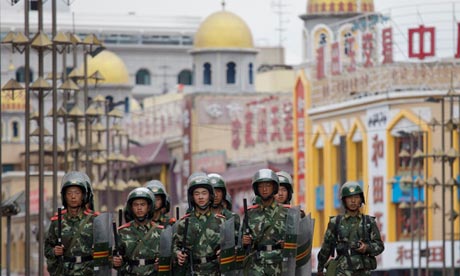
Multiculturalism with Chinese characteristics…China’s war on terror becomes a war on conservative Islam.
Not that I am anti-Chinese. I am also a fan of China. Actually I am a fan of everyone. Why not? In our Indian culture we never got too worked up about faraway places anyway, which I think is eminently sensible. and with the current civlizational crisis in the Islamicate world, much worse may happen in less Chinese countries.
But while I can sort of let it go, I dont think the Paknationalist dream of a Chinese-Islamic partnership with Pakistan as China’s Muslim enforcer will get away unscathed. I assume they will try to put all of this in the catergory of “American propaganda”, but some of it does seem to be true. That could become an issue.
“Chinaâs campaign against separatism and terrorism in its mainly Muslim west has now become an all-out war on conservative Islam, residents here say.
btw, those thinking I am joking about the paknationalist dream have not met Pakistani Nationalists of the senior army officer type… See Zaid Hamid for details (paid generously for his efforts by the ISI, as reported by his own ex-accountant). Its a load of crap, but that doesnt mean it doesnt have believers….
Shanghaiist reports on Project Beauty: the chinese effort to make Uighur women show their face

Miss Tourism Queen Xinjiang, Finals
CCTV reports on Miss Tourism Xinjiang.

Xinjiang cultural troupe in Pakistan

China Post reports on Beard informants.

Brand Brown Muslim
struggling Bangladeshi immigrants….Putting himself through Oxford, Cambridge, Munich and Yale, he has been a mathematician, investment banker and international
human rights lawyer……..one is often tempted to speculate about
which of the two characters derives from Rahman himself…..Is it the brilliant, Bangladeshi Zafar?….Or could
it be the aristocratic Pakistani investment banker
with no name?….
….
In a way (and we accept this with great reluctance) the founding fathers of Pakistan had it right. There is a lot to be said for the creation of a “Medina in South Asia” as the authentic voice of sub-continental Sunni muslims. We have strong reasons to believe that once the memories of the dead and afflicted have faded, the sub-surface links between erstwhile East and West Pakistan will re-assert themselves.
…..
….
It is a shame that the (West) Pakistanis did not really recognize the Bangali muslims as their peers and equals. The gaps are now slowly mending (even as the gap with India and Indians is rising). With the help of imaginative leadership (aided by generous Gulf dollars) a broad coalition of Sunni muslim countries across South Asia (and perhaps even beyond) is possible.
If such a federation comes to life, a huge vote of thanks will be due to …who else…the imperialist United Kingdom (and the West as an extension). The Brown Muslims of London and New York who feel alienated by Western ways and discriminated by Western elites will be the prime movers in any reconciliation, rapprochement and if it comes to that even the hard work of federation building.
Already Bangla-Pak alliances are popular in the West…and why not? The BMs are defined (and constrained) by what they are and what they are not…not Indians (but browns), not Arabs (but muslims), not Westerners (but living in the West).
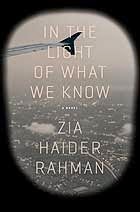
While inter-marriage will help, the heavy lifting must be done by powerful, sublime literature that help underline the commonalities between Bangladeshis and Pakistanis and subtly (and not so subtly) highlight the differences with other people. Thus we have “In the Light of What We Know” by Zia Haider Rahman a cultural (and spiritual) sibling of “The Reluctant Fundamentalist” by Mohsin Hamid and one which adds to the growing (and unique) voice of Brown Muslims. May such a thousand flowers bloom.
….
The really interesting thing (for us) is the reaction of Indian Muslims. First off, the non-Sunnis (Shias, Ismailis, Bohras, Ahmadis…) may turn away from emphatic declarations of Sunni faith and due to the lived experience of non-sunni muslims in those countries. Muslims from South India (who are quite prosperous, mostly) may form a distinct cohort which resists assimilation with other Brown Muslims (similar to how Tamil Shudras will always reside outside and in opposition to the Hindu-Hindi majority).
The two most “vulnerable” groups are the Muslims of Eastern India (primarily Bengal and Asom) and those of the Hindi belt (primarily Uttar Pradesh and Bihar). As the Hindu-Hindi state grows in strength it is likely that the sense of alienation amongst muslims will keep growing. The eastern muslims are probably the most deprived of the lot (as per the Sachar committee report). The northern muslims are probably the most victimized – Azamgarh in UP is routinely termed in the news media as Atank-garh (terrorist town).
At the end of the day partition is as much a state of the land as it is a state of the mind. It will be a very good thing if the Hindu-Hindi state is able to overcome the caste divide that has poisoned our society for thousands of years. But it will be a very bad thing if the result is that the Muslims are defined as the common enemy (just like they are in the west).
India cannot realistically hope to expel all muslims to Bangla-Pak. Even in that narrow sense there is no choice then but to co-exist.
This is no doubt an asymmetric situation (and Hindutva-vadis are naturally upset) but ultimately the secular way is the moral way. Nations who stand on immorality will never attain their fullest potential. Alternatively, to adopt Amartya Sen’s terminology, the contributions from the missing millions of minorities would have been a source of pride and joy…and ultimately strength of any nation.
…………
Imagine a book in which a gossipy story about former Pakistan
president Pervez Musharraf peeing in a women’s washroom and drunkenly
pursuing the Norwegian ambassador’s wife co-exists with a chance meeting
with Hamid Karzai, “at that time a rather shady figure involved in the
oil business”.
…
Or where a riff on Princeton mathematician Kurt Godel’s
Incompleteness Theorem is followed by an explanation of German physicist
Johann Poggendorff ‘s Illusion. Or which tells you that kings in Saudi
Arabia are buried in unmarked graves in keeping with austere Wahhabism
and the question that Charles II asked members of the Royal Society.
…
Now
don’t imagine, read Zia Haider Rahman’s extraordinary book, In the
Light of What We Know. The banker-turned-human rights lawyer tells the
story, over 500 pages, of a conversation that spans the lifetimes of its
two protagonists: Zafar and the nameless narrator.
…
The two men
meet at university at Oxford and over the course of several years
develop a friendship that survives heartbreak, nervous breakdown and
cataclysmic world events, the war in Afghanistan and the collapse of the
American banking system. It takes them from long walks in Manhattan
which sometimes end up in Ellis Island, to ambles in London from the
British Museum through the elegant Georgian squares of Bloomsbury.
…
There
are more dramatic leaps of time and place: Zafar travels to rural
Bangladesh, where his family originally came from before his father
found work as a waiter in London; to Oxford, where he fights his own
embarrassment about his parents’ status in life; to Kabul, where a proud
nation is enslaved by the West in what the latter believes is a
civilising mission; to a sunlit but sterile kitchen in a New York home,
not necessarily in that order.
….
The narrator, in the midst of being
accused of financial irregularities, takes time out to listen to a
friend he feels he left behind, partly propelled by guilt and partly by
the collapse of the certainties of his own life. It is a contrast in
privileges: The narrator’s own posh, have-it-all Pakistani family
compared to Zafar’s impoverished Bangladeshi parents unable to overcome
the atrocities of the 1971 war.
…
It is
no surprise that Rahman’s book is earning rave reviews, gathering much
acclaim as it sweeps readers off their feet with its scope and
sensibility. The writer, who lives in London, and whose life seems a
tempting reflection of that of his narrator, has created an
extraordinary adventure. It is far away from the colonial narrative of
Afghanistan, which makes it a committed political novel if ever there
was one.
…
At its heart, it is a post 9/11 novel. which is why one
finds occasionally echoes of Mohsin Hamid’s The Reluctant
Fundamentalist.
…
It is a novel of rare beauty and power that has electrified the
literary establishment. It begins in London, about the time of the
financial crisis of 2008. The narrator, a young Pakistani
matÂhematician-turÂned-investment banker, opens the door one morning to
see a bedraggled, half-Âfamiliar figure outside. It takes a momÂent for
him to recognise Zafar, the Bangladeshi math prodigy and his one-time
mentor who had disappeared mysteriously years ago. The narrator takes
Zafar in and instals him in his guest room, and Zafarâs strange,
disturbing story emerges, throÂugh conversations and diary pages, its
eveÂnts cross-cutting between Oxford, LonÂÂdon, New York, Kabul and
Islamabad.
In the Light of What We Know is a work of post-9/11 fiction, a
territory that has been well covered by writers like Mohsin Hamid and
Nadeem Aslam (not to mention Don De Lillo and Martin Amis), but Zia
Haider Rahman presents his version of it with a seething new anger. It
is a story that mixes the political and the personalâfriendship and
betrayal, class and alienation, the collapse of financial markets, as
well as of nations.
…
Reading the book, one senses resonances of JosÂeph
Conrad, V.S. Naipaul, Graham GreÂene, John Le Carre, but most of all,
perhaps, W.G. Sebald, whose novels, like this one, are a hypnotic
mixture of travel, memory, fact, quasi-fact and fiction.
It is a hugely
ambitious work, which could so easily have gone wrong, but Rahmanâs
towering imagination, combined with his elegant, almost mathematically
precise prose, help him pull it off with envÂiable ease. The novel ends
with a painful twist and a reference to Godelâs Incompleteness Theorem,
which seems to be at the heart of it all: in every system there are
propositions that are true, but cannot be proved to be true. And then,
one final, wry Sebaldian touch: a blurred black-and-white photograph of
two men, appÂarently Einstein and Godel, taken from behind, as they take
one of their long walks through a Princeton evening. Thus, in a sense,
we come back to where the author started out, 555 pages earlier.
….
Rahman, the authorâs profile tell us, was born into a family of
struggling Bangladeshi immigrants (his father was a bus conductor).
Putting himself through Oxford, Cambridge, Munich and Yale, he has
successively been a mathematician, investment banker and international
human rights lawyer. This book clearly owes its authenticity to his own
personal story. Reading it, one is often tempted to speculate about
which of the two characters derives from Rahman himself. Is it,
obviously, the brilliant, born-into-poveÂrty Bangladeshi Zafar? Or could
it, not-so-obviously, be the aristocratic Pakistani investment banker
with no name?
As the novel unfolds, one alternately thinks this way and
that, until one realises that they are probably both Rahman, in
different avatars, as he pours his self into the narrative. (In that
blurred black-and-white photograph of Einstein and Godel on their walk
through Princeton, after all, you canât tell which is which).
……..
indiatoday/in-the-light-of-what-we-know-by-zia-haider-rahman
….
regards
Lehman Sisters (India)
In A/P we have a total of eight Indians out of twenty five. If there is a quibble, there are too many bankers (in the left-liberal world bankers are considered evil) starting with Gail Kelly (Australia, Westpac) at #1.
Then again feminists have forcefully argued that the global recession of 2008 could have been avoided if only there were a band of Lehman Sisters at the steering wheel instead of the mad, bad brother-hood. Taken in that spirit there is much to cheer about the Indian lady-brigade- the Sisters are in charge of half of the assets of the country. It is good to see a world-beating number that you can feel good about. Go team!!!!
In the top ten we have the fav four of Chanda Kochhar (2) of ICICI Bank, Arundhati Bhattacharya (4) of State Bank of India, Nishi Vasudeva (5) of Hindustan Petroleum, and Shikha Sharma (10) of Axis Bank.
…..
The remaining four are Kiran Mazumdar Shaw (19) of Biocon, Chitra Ramkrishna (22) of National Stock Exchange, Naina Lal Kidwai (23) of Honkong and Shanghai Bank and Mallika Srinivasan (25) of Tractors and Farm Equipment (TAFE).
Unlike the men-list (which we imagine is mostly populated by West Indians), there is only one Marwari (Kochhar) and one Gujarati (Mazumdar).
trend in banking that has gone unnoticed â the steady increase in the
number of women joining the banking sector. Sample this: At Punjab National Bank,
40-45% of new recruits are women. At Allahabad Bank, that share is 25%,
while HDFC Bank says that 40% of its trainees are women. In fact, some
of the women executives who took up banking jobs in recent years say
that in certain batches their numbers go well past the 50% mark.
….
As many as eight Indian women, led by ICICI Bank chief Chanda Kochhar,
have made it to the Fortune list of 25 most powerful women “shaping the
new world order” in the Asia-Pacific region.
…
Kochhar, ranked highest among Indian women, has been ranked second
across the region, while three others — SBI’s Arundhati Bhattacharya
(4th), HPCL’s Nishi Vasudeva (5th) and Axis Bank’s Shikha Sharma (10th)
— have also made it to the top-10.
….
The list is topped by Australian banking major Westpac’s chief Gail Kelly.
…
Other Indians on the top-25 list include Biocon chief Kiran
Mazumdar-Shaw (19th), National Stock Exchange CEO Chitra Ramkrishna
(22nd), HSBC’s Naina Lal Kidwai (23rd) and TAFE Chairman and CEO Mallika
Srinivasan (25th).
…
Releasing the latest rankings, the Fortune magazine said that women
around the world are continuing to win the top jobs, so much so that
more than a third of the women on this Asia-Pacific list are making
their debut in the coveted list, including two from India.
The two Indian new entrants are Bhattacharya and Vasudeva.
…
“More and more businesswomen are taking tougher jobs and helming bigger
firms. More than a third of the women on our Asia-Pacific list are
making their MPW (most powerful women) debut,” Fortune said.
…
Among Indians, Bhattacharya is ranked second after Kochhar and is the
first woman to hold the three-year post at SBI, who oversees a
208-year-old institution with USD 400 billion in assets and 218,000
employees dispersed among 16,000 bank branches across India.
…
On the other hand, Vasudeva, 58, became the first woman to head an
Indian oil company and is “and one of only four women to helm a Global
Fortune 500 firm in the Asia-Pacific region”.
…
NSE’s Ramakrishna is the only woman on the list heading a stock exchange.
….
Meanwhile, PepsiCo’s India-born CEO Indra Nooyi has been ranked third
among world’s most powerful business woman by Fortune in its worldwide
list. Nooyi is only Indian-origin woman on this year’s global list,
which has been topped by IBM Chairman and CEO Ginni Rometty and General
Motors CEO Mary Barra.
….
Link (2): timesofindia.com/Women-bankers-Making-capital
Link (3): crisil.com/corporate/Most-Powerful-Women
…
regards
Playing the loony tunes (non-stop)
thoughtful and well-researched it was…..whenever he was on air, I used to tell my
parents proudly…thatâs my professor on TV….I canât believe that a scholar like him has been shot dead…..It’s like losing a father….
…
We are assuming (perhaps wrongly) that since Prof Auj was guest of honour at the Iranian Embassy, he must be a Shia. Ceratinly he can be accused of being a non-conformist.
…….
distinction, was known for his unorthodox views and was fighting a legal
case against the originator of a widely circulated text message that
called him an apostate.….The
professor had issued controversial fatwas (religious decrees) â
pronouncing for example that a Muslim woman could marry a non-Muslim
man, and that women need not remove lipstick or nail polish before
saying their prayers. Such views can cause serious offence to some
conservative Muslims in Pakistan….
……
…
This much is true, as Omar has pointed out repeatedly, weapons like the blasphemy law which are shiny and useful will not be put away so easily. It will require a mass movement and a big-hearted man (who can rise above all partisanship).
….
A
Muslim scholar named Muhammad Shakil Auj who had received death threats
over “blasphemy” allegations was shot to death Thursday
in Karachi, Pakistan. Auj was the dean of Islamic studies at the
University of Karachi, and some of the blasphemy allegations against him
reportedly originated with his colleagues.
Unidentified gunmen on a motorbike attacked the vehicle he
was riding in on his way to a reception at his honor at the Iranian
Consulate. Dr. Auj was shot in the head and neck and died immediately,
officials said. A female student in the back of the car was shot in the
arm and was treated at a hospital. A week earlier, a visiting religious scholar at the same
Islamic studies department, Maulana Masood Baig, was also shot dead by
unknown attackers.
Auj
had told police that four colleagues at the University of Karachi
had accused him of blasphemyâincluding one colleague who’d previously
held Auj’s position as dean. The four were arrested but are free on
bail, and they are “being questioned” about Auj’s murder, the Times
reports. A seminary in Karachi had also called for Auj’s death.
…
Thursday morning started with very tragic news. One of my beloved teachers who had taught us in university was shot dead for some unknown reason.
Dr
Shakeel Auj was Dean, Faculty of Islamic Studies, University of Karachi
since 2012. He completed his PhD in Islamic Studies from University of
Karachi in 2000 with a PhD dissertation of âComparative Study of Eight
Selected Urdu Translations of Holy Quran.â
Apart from PhD in Islamic Studies, he also possessed an LL.B and a
Master Degree in Journalism. With all his books, research papers,
articles and an unending list of prizes and honors, he was an institution of his own.
Dr
Shakeel was my lecturer for Islamic Studies during my Bachelors back in
2006. After I graduated, I hardly got a chance to meet him again, and I
still regret it. Dr Auj was an unconventional Islamic scholar
who used to believe that Islam was an easy religion to practice, and it
was the people who had made it difficult.
We used to have
detailed, open discussions on various topics in the class, and he was
always very inviting to his studentâs opinions despite having tons more
knowledge and understanding.
I still remember his analysis on the
meaning of âAl Rehmaanâ and âAl Raheemâ, the two names for Allah; how
thoughtful and well-researched it was! Doctor sahab also had a
strong media appearance and whenever he was on air, I used to tell my
parents proudly that thatâs my professor on TV.
I canât believe that a scholar like him has been shot dead in such a
horrendous way. It’s like losing a father; someone who spent his whole
life serving others without a complaint and played a pivotal role in
teaching, grooming, mentoring, guiding and making us into better
individuals today.
……….
Link (1): slate.com/karachi_islamic_studies_scholar_killed_for_blasphemy
Link (2): dawn.com/of-guilt-and-goodbye-too-late-to-thank-my-professor
Link (3): thehindu.com/pak-liberal-academic-shot-dead
….
regards
“Indian Muslims live for India….die for India”
…….
…
Above all we need to put a stop to the polarization for votes aka match-fixing (all parties do it), it is an un-reliable recipe for success (even if it was not such a despicable one to begin with). Everything considered, Toilets before Temples seems to be the best slogan for a secular nation full of young people which looks to the future and stops worrying (but still caring) about the past.
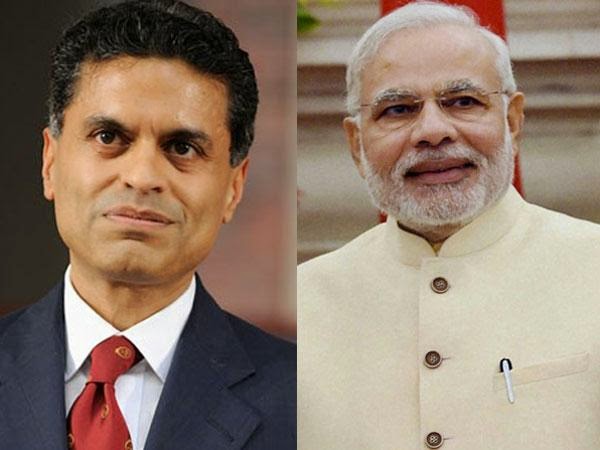
Top-line Verdict: Fareed Zakaria is mostly impressed by Narendrabhai Damordas Modi and has a few reservations. FZ describes NDM as “among the sharpest” he has met and that FZ “underestimated
him.” Also this: “He is very smart, intelligent and focused. He is very driven and
has a long term agenda. He wants to be a statesman at the world stage.
He is a man who looks to the future and not into the past,” the CNN
journalist said.
……
This seems to be the key observation:
……
is clever to not get embroiled in controversies by projecting himself as
a nationalist figure, something his party and its affiliates aspire
for. This observation, Zakaria said, was based on his talks with the
Indian prime minister.
The journalist, however, thought Modi was under-performing in fields of
reforms that India needs urgently and apprehended that not a bold Modi
but a not-bold-enough Modi could make India suffer.
…..
After your election people have begun asking again a question
that has been asked many times for the last two decades, which is, will
India be the next China? Will India be able to grow at 8 to 9 percent a
year consistently, and transform itself and thus transform the world?
See, India doesnât need to become anything else. India must become
only India. This is a country that once upon a time was called the
golden bird. Weâve fallen from where we were before. But now we have the
chance to rise again. If you see the details of the last five or ten
centuries, you will see that India and China have grown at similar
paces. Their contributions to global GDP have risen in parallel, and
fallen in parallel. Today’s era once again belongs to Asia. India and
China are both growing rapidly, together.
But people would still I think wonder can India achieve the
kind of 8 and 9 percent growth rates that China has done consistently
for 30 years, and India has only done for a short period.
Itâs my absolute belief that Indians have unlimited talent. I have no
doubt about our capabilities. I have a lot of faith in the
entrepreneurial nature of our 1.25 billion people. There is a lot of
capability. And I have a clear road map to channel it.
Ayman al-Zawahiri the head of al Qaeda has issued a video and
an appeal trying to create an al Qaeda in India. In South Asia, he
says, but the message was really directed towards India. And he says he
wants to free Muslims from the oppression they face in Gujarat, in
Kashmir. Do you think, do you worry that something like this could
succeed?
My understanding is that they are doing injustice towards the Muslims
of our country. If anyone thinks Indian Muslims will dance to their
tune, they are delusional. Indian Muslims will live for India. They will
die for India. They will not want anything bad for India.
Why do you think it is that there is this remarkable
phenomenon that you have a 170 million Muslims, and there seem to be
almost no or very few members of Al-Qaeda, even though al Qaeda is in
Afghanistan, and of course the many in Pakistan. What is it that has
made this community not as susceptible?
Firstly, Iâm not the authority for doing a psychological and
religious analysis on thisâŠBut the question is whether or not humanity
should be defended in the world? Whether or not believers in humanity
should unite? This is a crisis against humanity, not a crisis against
one country or one race. So we have to frame this as a fight between
humanity and inhumanity. Nothing else.
There are many people in the United States, and some in
India, who wish that the United States and India were much closer allies
â the worldâs oldest democracy, the worldâs biggest democracy. But
somehow that has never happened, and there have always been these
frictions and difficulties. Do you think itâs possible for the United
States and India to develop a genuinely strategic alliance?
I have a one word answer: Yes. And with great confidence I say yes.
Let me explain. There are many similarities between India and America.
If you look at the last few centuries, two things come to light. America
has absorbed people from around the worldâŠand there is an Indian in
every part of the world. This characterizes both the societies. Indians
and Americans have coexistence in their natural temperament.
Now, yes, for sure, there have been ups and downs in our relationship in the last century. But from the end of the 20th century to the first decade of the 21st century,
there has been a big change. Our ties have deepened. India and the
United States of America are bound together, by history and by culture.
These ties will deepen further.
So far in your contacts with the Obama administration â you
have had several cabinet ministers come here â do you feel that there is
a genuine desire from Washington to try to upgrade the relationship
with India substantially?
Relations between India and America should not be seen within the
limits of just Delhi and Washington. Itâs a much larger sphere. The good
thing is that the mood of both Delhi and Washington is in harmony with this understanding. Both sides have played a role in this.
….
Link: cnn.com/prime-minister-narendra-modi-speaks-to-fareed-zakaria
….
regards
Sail the 7 seas (on iceberg rafts)
history of ostriches, emus and rheas does not match the break-up of the
continents….scientists believe that their common ancestor could fly…..New
World monkeys rafted
to South America on a clump of earth…..these three groups
represent 73 percent of the land mammals living there…..
…
It was Darwin who first suggested that wolves arrived on the Falklands Islands by floating on icebergs. For making such an extraordinary speculation the greatest biologist ever was criticized in the strongest terms. Now there is fascinating evidence of snakes swimming 120 miles across the open ocean (and many others). Forget the boring old stories of human colonization, this is the exciting new story of animal colonization of the the planet we all call home.
……………
….
We are reminded here of Jurassic Park (the novel) where female dinosaurs had escaped from their habitat and had found a way to breed. Nature – it was famously said – will always find a way. And nature has found a way for creatures as immobile as snails to migrate from one continent to another by clinging on to the feet of birds.
…
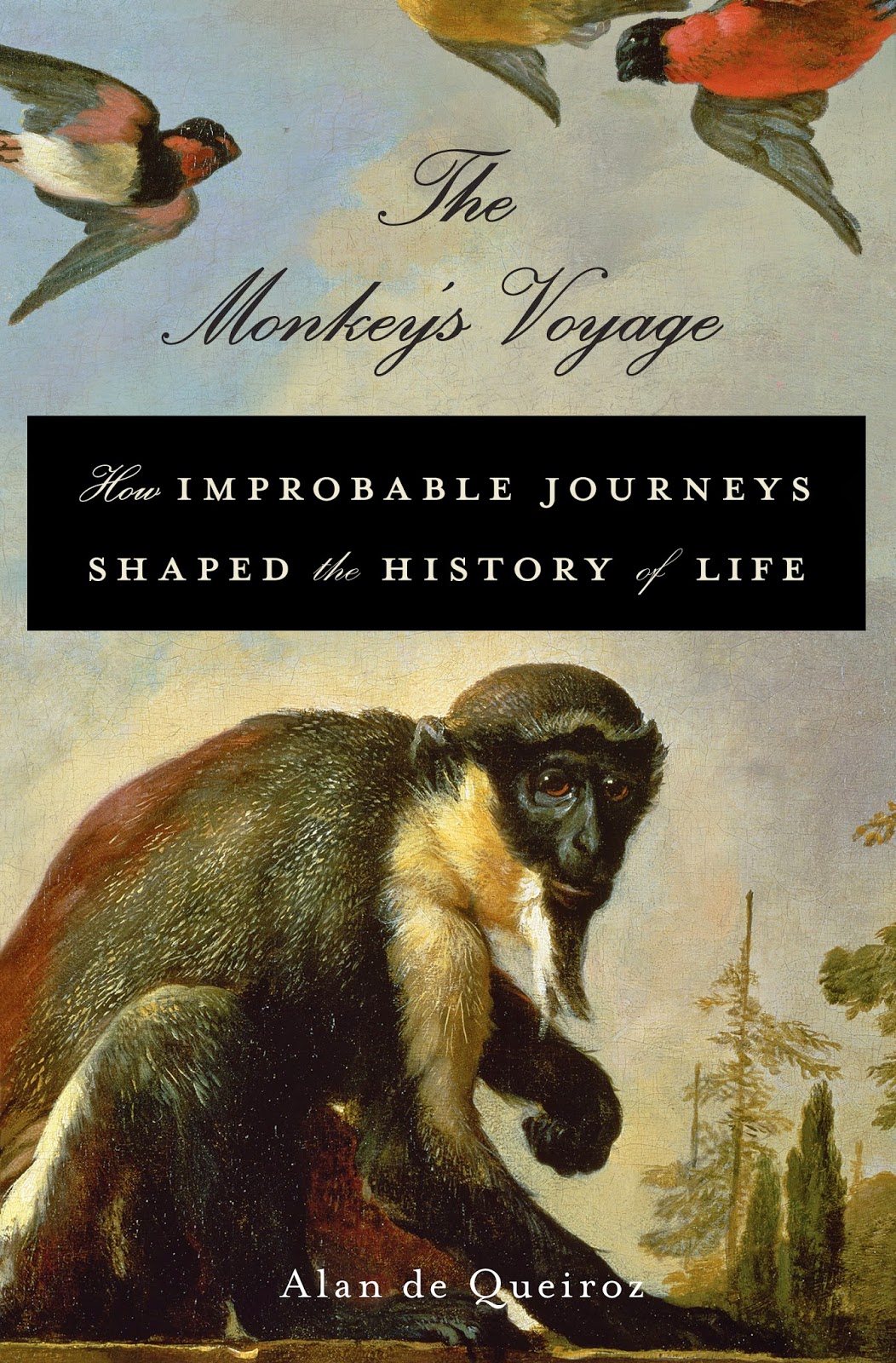
In June 2000, Alan de Queiroz became curious about an enormous,
ragged-looking garter snake that lived on the tip of Baja California.
Like many other biologists of his generation, de Quieroz had been taught
that species traveled the Earth to new habitats on slowly drifting
continents.
…
This snake had relatives on the other side of the Sea of
CortĂ©z on Mexicoâs mainland, and de Queiroz assumed that this population
ended up on Baja 4 to 8 million years ago, when the peninsula split
from the mainland.
…
But using a new method based on genetic
sequencing to estimate when the two populations split, he found that it
had occurred in the past few hundred thousand years. In other words, one
or more pioneering garter snakes had probably floated across 120 miles
of open ocean.
…
As de Queiroz prepared to write up the surprising
results of his snake study, he discovered that the reptile was not an
outlier. Biologists were finding that even after continents drifted
apart, plants and animals somehow hopped between them.
…
âObviously, the
continents had moved â nobody was claiming that the theory of plate
tectonics was wrong â and obviously, they had carried species with
them,â he writes, âbut somehow, these facts did not explain nearly as
much about the modern living world as we had thought.â Chance ocean
crossings did.
…
In his engaging new book, âThe Monkeyâs Voyage,â
de Queiroz makes the case that the vibrant and distinctive biological
communities we see today were created by organisms rafting across oceans
and soaring through the atmosphere. âThe large number of these
colonizations tells us that, in the long history of this living world,
the miraculous has become the expected,â he writes.
To understand how contentious this notion is, de Queiroz takes us back
to the 1950s and â60s, when a wealth of new information emerged about
continental drift. Geologists had long recognized that the coasts of
South America and Africa fit together like puzzle pieces and had
theorized that they were once a single landmass.
But now measurements
from the ocean floor revealed several ridges, including one in the
middle of the Atlantic Ocean, where the sea floor was spreading before
the scientistsâ eyes. These discoveries provided a clear mechanism for
how the continents creep along. Geologists determined that,
approximately 180 million years ago, there was an ancient uber-continent
called Gondwana, which sat on the equator and was composed of what are
now South America, Africa, Antarctica, India and Australia.
Gondwana was also a revelation for evolutionary biologists. Its
break-up, they surmised, was probably etched in the history of life. For
instance, ostriches, emus and rheas, closely related birds found in
Africa, Australia and South America, became a textbook example of this
continental drift theory. Another famous example were southern beech
trees, which are found in South America, Australia and other smaller
pieces of Gondwana.
This theory was attractive because it was elegant and sensible, but,
as de Queiroz colorfully describes, its proponents became a little too
dogmatic about it. Léon Croizat, a self-trained botanist of French
heritage who lived in Venezuela, coined the phrase âEarth and life
evolve togetherâ and believed that continental drift explained
everything about plant and animal distributions. To him, the idea that
plants or animals crossed oceans on their own was outrageous and
unscientific.
…
He characterized Darwin as âcongenitally not a thinker,â
in part because of Darwinâs suggestion that wolves may have reached the
Falkland Islands on icebergs. Croizat came in for criticism himself. An
eminent American paleontologist called him âa member of the lunatic
fringe.â
…
Indeed, there had always been evidence that, over the
long history of life on Earth, plants and animals made remarkable
journeys. Consider, for example, that young spiders are carried on the
wind by their silky threads and land on the decks of ships far from the
coastline. Freshwater snails cling to the feet of migrating birds. And
fishermen on the Caribbean island of Anguilla once watched a natural
raft of logs get washed onto shore with 15 green iguanas on it, a
species that had not previously existed there.
…
Proof of how
important these journeys are in evolutionary history finally arrived in
the late 1990s with genetic-dating studies, such as the one de Quieroz
conducted on his garter snakes. We now know that the evolutionary
history of ostriches, emus and rheas does not match the break-up of the
continents. Some scientists believe that their common ancestor could fly
and that they became flightless only after settling on their respective
continents. Among the other creatures de Queiroz considers are New
World monkeys and two other groups of mammals, which apparently rafted
to South America on a clump of earth. Today, these three groups
represent 73 percent of the land mammals living there.
…
….
regards
“My dad is from Jullundur”
relieved to have at least one Indian person in the receiving line…..Prime Minister looks at me, and says oh you are Indian, I said
yes…the President nodding approvingly….Prime Minister
Singh asks: Where are your
parents from? I said…Punjab. my dad is from Jullundur…..The Prime Minister said, “Oh, his father and I are from the same place….”
…
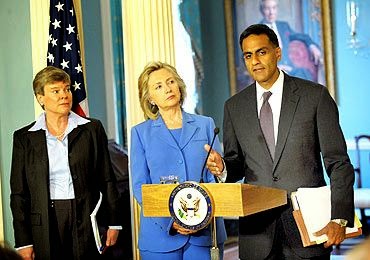
The Viceroy-elect to India has been declared after long months of intense deliberation: Richard Rahul Verma is a very close associate of the next-in-line-to-the-throne.
…
In our opinion this is quite a master-stroke by our overlords. While “yellow” China and Japan are promising filthy cash, here is truly a bonding of souls, “white” and “brown.” If proof was ever needed on this point, we point to Exhibit #1: US Congressman Curt “Bollywood lover” Clawson (Florida-19) who got confused by brown skinned officials representing the United States of America.
….
But think about the nature of Clawsonâs goof. Sitting across a
congressional hearing room from Nisha Biswal, an official at the State
Department, and Arun Kumar, who works at the Department of Commerce,
Clawson addressed the two Indian-Americans
as if they were representatives of the government of India. Which is to
say: He had trouble recognizing that two Americans who trace their
ancestry to the developing world are really American.
…..
Nisha Desai Biswal (immigrant from Gujarat, married to an Odiya) is the Assistant Secretary of State for South and Central Asian Affairs, and now we have an Indian-American ambassador to India as well. The cup of joy will surely overflow if/when the future Madam President selects Dr Amerish Babulal “Ami” Bera (Gujarati immigrant, Congressman representing CA-7, Sacramento County- East, California) as Vice President. That will be the day….
The only problem will be if/when a fire-breather like Preet Bharara is
given a “sensitive” posting….indeed this would be a scenario with
maximum scope of amusement.
We are not sure whether to be proud (first time an xx-American has been appointed to an xx country) or parochial – why not a Bong or Mallu ambassador, why do Punjus…and Gujjus always get to be first?
Then again we are given to understand that appointments to important government posts (also university faculty positions) in the USA require checking for prior communist associations. As we know, one cannot be too careful these days.
…..
Richard
Verma remembers the time when he was a little kid, seeing his mom in
her sari waiting for a bus to go to work in sub-zero centigrade
temperatures in blowing and drifting snow.His father had emigrated from
Punjab, arriving in New York City in 1963 with $24 in his pocket, and
his mother and siblings had followed a few years later.
“The times were
hard. We had no money. The kids could be mean in school to this new
immigrant family. But they persevered,” he recalls. “They showed us what
it meant to be strong, what it means to stay together, and confront
challenges as a family, and they taught us to be proud of our roots.”
…
On Thursday, the proud son of Indian immigrants who personify Indian
enterprise and academic excellence â his parents were the first ones in
the family to be educated; his father went on to earn a PhD â was
nominated by US President Obama to be the US ambassador to India. He
will be the first Indian-American to take the job if (or when) he is
confirmed by the Senate; indeed, he will be the first Indian-American to
get an ambassadorial appointment to a major country, not counting the
sinecure (to Belize) Obama’s bestowed on his collegemate Vinai
Thummalapally.
Richard Rahul Verma is from a different stock
from the entrepreneurial Thummalapally, who now has a key job in the
Department of Commerce; the Indian-American of Punjabi stock is himself
no slouch when it comes to academic and professional accomplishment.
While there is an element of surprise in his nomination given his south
Asia background and India roots, his formidable resume (including an
ongoing PhD program at Georgetown University) and the Washington roadmap
he has traversed for two decades make him a shoo-in for the New Delhi
job, despite reservations in some quarters about whether an
Indian-American is best suited for the post.
Verma is a
consummate Washington insider who has worked in both the legislature and
the executive; in fact, his last post bridged the two â he was the
Assistant Secretary of State for legislative affairs during Hillary
Clinton’s stewardship of Foggy Bottom â and that job came to him by
virtue of his years as a chief foreign policy aide to Senate leader
Harry Reid. Before that, between clerkships and stints at law firms, he
worked with the legendary Pennsylvania lawmaker Jack Murtha, learning
the ropes on the Hill.
In fact, in a farewell to Verma when he left the US state department
job in 2012, Clinton recalled in a very personal way how much Verma
guarded her back and how much he meant to her. “My mother lives with us
in our house here in Washington, and I was saying goodbye to her this
morning and she said, ‘What’s wrong, you don’t look very good.’ And I
said, ‘Well, I know, I am not just in a very good mood today.’ And she
says, ‘Well, you know, there’s so much going on in the world, all over
the country, and the economy.’ But I said, ‘No, it’s not it; it’s Rich
Verma (leaving).'” Clinton related.
Of course, Obama would know â also
personally. Verma assisted him in debate prep during his 2008
Presidential campaign, and like the President and his wife, Verma and
his wife Pinky are also legal eagles, a power couple with law degrees
from American University and UPenn respectively. When he arrives in New
Delhi later this year or early next year, Verma will bring with him not
just legalese, having worked on a ton of legislation and international
treaties (including some New Delhi is not particularly fond of), but
also a smattering of Hindi, which he is said to have kept up with.
Doubtless, much more than that will be needed to elevate the US-India
partnership. But despite his relatively modest vintage (he’s only 45 and
of Asst. Secretary rank; previous US ambassadors have been heavyweight
political appointees like David Mulford and Tim Roemer; or foreign
service veterans such as Frank Wisner and Tom Pickering), Verma will
bring to the table impressive range of work, from national security
legislation to international treaties on non-proliferation, to bilateral
agreements, including the US-India Civilian Nuclear deal, which he
oversaw from the Senate side.
But most of his, he will bring an
India connection, the likes of which is unprecedented, as is evident
from this story he relates: In the fall of 2009, Verma was invited to
the White House arrival ceremony of Prime Minister Manmohan Singh. When
he told his father about this, his dad was very excited “because in my
dad’s words, ‘we are from the same place’ in India.” With my dad, says
Verma, no matter what Indian person we meet anywhere in the world,
shopkeeper, waiter, restaurant owner, doctor…it doesn’t matter, he
always say you are from the same town, went to the same school, from the
same village. “I said Dad, there are 1 billion Indian people, it is
mathematically impossible that all of you can be from the same
place….he said well, I’m telling you, you should tell the PM. Thanks,
dad, but I’m not doing that….”
“When the day comes, and I am
getting my turn in line, and there is the President, and he says this is
Rich he works at the State Dept (you could tell the President was
relieved to have at least one Indian person in the receiving line…).
The Prime Minister looks at me, and says oh you are Indian, I said
yes…the President nodding approvingly. What do you do? Prime Minister
Singh asks: Oh I work at the State Dept Great, he said. Where are your
parents from? I said, Northern India, Punjab. He asked where … and I
said my dad is from Jullundur. The Prime Minister turned to the
President and said, “Oh, his father and I are from the same place….”
……
Link (1): timesofindia Richard-Verma-new-US-envoy-to-India
Link (2): theatlantic.com/a-florida-representatives-indian-american-gaffe-is-revealing
….
regards
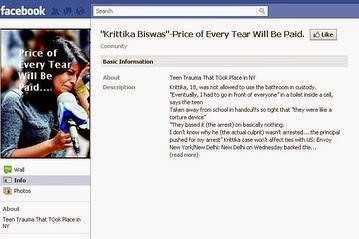
“Price of every tear will be paid”
and India has been “vindicated” with the court order….settlement acknowledged that Biswas was an “honor student” at the time of her “false arrest”….
….
First off, we are very happy that Krittika Biswas has been pronounced innocent and has received civil damages that will go towards restoring her faith in the justice system. However the background story is a bit dark and it should serve as a cautionary example to others.
……
As a stereotype this is at least half true, Indian students in the USA (and elsewhere) will be focused on grades and are expected to do well in studies, while Americans will look at high-school and college as more of a (enriching) life experience.
Indians are unlikely to be familiar with US harassment laws and zero-tolerance codes and the fact that the criminal justice system will not hesitate to take action against elites (unlike in India where things can be hushed up).
As a daughter of a diplomat Krittika Biswas is not a typical case. She benefited from strong support from the Indian diplomatic establishment and (we presume) did not lack in financial backing. This will not be true for middle class Indian kids in search of “US degree” who may be wholly destroyed by their own thoughtless actions or malicious behavior forthcoming from fellow (american) students.
We understand the need for emotional closure (and lawyer-ly hyperbole) but we are uncomfortable about all the drum beating about violated honor being restored of Ms Biswas, Indian Foreign Service and India (it is a bit like how Dr Aafia Siddiqui is described by patriots as a daughter of Pakistan….also unfairly targeted by the Americans). It was a false case against a civilian who was not representing India officially, and the “crime” was probably upgraded due to zero-tolerance principles adopted by US schools.
The (most important) question remains, why was the student who actually committed the crime not charged? Without any other exculpatory information it does lend credence to the charge that the indictment (and arrest) was driven by “ethnicity” and/or a “tragic rush to accuse.”
…..
Incidentally it is only in rare cases that a white male american student will suffer such extreme prejudice from the police and courts. The most memorable recent example is the Duke lacrosse case which was initiated in 2006 and whose aftermath can be felt even seven years later in 2013-2014 (!!!) when the falsely accused students settled their lawsuits against Duke University and the city of Durham and a rogue policeman who used to disproportionately target Duke students committed suicide. Even in that instance it so happens that the false accuser was never brought to justice for her horrific actions.
……….
In March 2006, Crystal Gail Mangum, falsely accused three white students, members of the Duke Blue Devils men’s lacrosse team, of raping her at a party held at the house of two of the team’s captains in Durham, North Carolina on March 13, 2006……On April 11, 2007, North Carolina Attorney General Roy Cooper
dropped all charges and declared the three players innocent. Cooper
stated that the charged players â Reade Seligmann, Collin Finnerty, and
David Evans â were victims of a “tragic rush to accuse.”
On May 16, 2014, the three accused lacrosse players and the City of
Durham settled their long-running lawsuit. Under terms of the
settlement, Seligmann, Finnerty and Evans received no monetary
compensation, instead they requested that the city give a $50,000 grant
to the N.C. Innocence Inquiry Commission…..On February 21, 2008, the families of 38 of the lacrosse team’s 47 members who were not accused filed a 225-page lawsuit
against Duke University. The lawsuit against Duke University was settled out of court in 2013.
Both the University and the players declined to comment on the details
of the settlement….In early July 2014 Sgt. Mark Gottlieb committed suicide in Dekalb County, Georgia where he had worked as a paramedic…..
…….
In a
significant legal victory for the daughter of an Indian diplomat, the
city of New York has agreed to pay her USD 225,000 to settle a lawsuit
she brought against it after she was jailed for a day and suspended from
school on suspicion of sending obscene emails to her teacher.
Krittika Biswas has in turn agreed to dismiss all the claims against the
city, Board of Education and the officials of the New York Police
Department who had arrested and detained her in 2011.
US
District Judge John Koeltl in the Southern District of New York said in
his order that the City of New York agrees to pay Biswas USD 225,000 in
“full satisfaction of all claims” and in consideration for the payment
Biswas “agrees to dismissal of all the claims” against the defendants.
He said that the parties in the case “desire to resolve the issues”
raised in the litigation “without further proceedings and without
admitting any fault or liability.”
Biswas’s lawyer Ravi Batra
said in a statement to PTI that the “honour” of Biswas, Indian diplomats
and India has been has been “vindicated” with the court order. The settlement acknowledged that Biswas was an “honor student” at the time of her “false arrest.”
He said Biswas joins him in “thanking” the Indian- American community,
former ambassadors Prabhu Dayal and Meera Shanker and her former
classmates and teachers whose “emotional and moral support” helped her
in her legal fight.
Biswas had filed the lawsuit seeking USD
1.5 million in damages for her wrongful imprisonment and suspension from
school. She was detained and arrested in February 2011 on the grounds
that she had sent “offensive and sexually threatening” emails to her
teachers in Queens’s John Browne High School.
Biswas is now in
India. The defendants had moved to “dismiss” the entire lawsuit but an
appeals court had last month refused to throw out the lawsuit saying the
arguments by them were “without merit.”
Biswas’s lawsuit had
detailed the circumstances that led to her being handcuffed and
imprisoned forcibly approximately 28 hours “for nothing.”
Biswas was “forced to be processed through the criminal justice system,
and spent over 24 hours in jail without being allowed to meet her
parents or visited by senior Indian diplomats. All of this occurred,
despite her actual innocence as this was a case of mistaken identity.”
It states that she was discriminated against and falsely accused of sending offensive e-mails because of her ethnicity.
An investigation after her arrest had found that another student had
sent the emails but that student was not arrested or criminally charged,
which Batra said is “proof of foul discriminatory disparate treatment”
of Biswas “despite her actual innocence.”
Citing the India-US
relations, particularly in the wake of the upcoming visit of Prime
Minister Narendra Modi, Batra said he advised Biswas and her family that
a “just resolution” of the case would be an appropriate move to
“enhance the bilateral relationship.”
…..
Link: indiatimes.com/New-York-city-to-pay-225000-to-Indian-girl-to-settle-lawsuit
….
regards
Naw beats Aye
The two nation theory which is best summarized as “our heroes are their villains” has no doubt been hugely successful….in compounding misery of all the communities involved.. The wrongs of the past should have been dealt with a truth and reconciliation commission (just like in South Africa).
The irony is that separation did not reduce the rancor one iota: Pakistan-India and Israel-Palestine have fought four (official) bitter wars, things are not too much better in Northern Ireland.
But when it comes to Britain herself, the answer was made clear today. Partition is never a solution to the problems, it also makes all of us poor as people. The cultural lines are never clearly drawn and purity is over-rated. Speaking of India specifically, the answer to a prosperous future is to encourage more secularism (and mixed marriages aka love jihad) not to create more ghettos and breed intolerance.
The bad blood that has been created over this partition fight will not (easily) go back into the bottle. The polls are clear on this point: the English now resent the Scots just as much as the Scots look down upon the English. The dividing lines will be sharper once a vote is announced for a Brexit from the European Union. Alex Salmond and Nigel Farage are smart ambitious politicians, they are unlikely to take no for an answer.
All that said we are happy for the Brits. Yes, it is certainly better together.
……
Scottish voters have rejected independence, deciding to remain part
of the United Kingdom after a historic referendum that shook the country
to its core.The decision prevented a rupture of a 307-year
union with England, bringing a huge sigh of relief to the British
political establishment. Scots voted 55 per cent to 45 per cent against independence in a vote that saw an unprecedented turnout.
…..
A
majority of voters did not embrace Scottish First Minister Alex
Salmond’s impassioned plea to launch a new state, choosing instead the
security offered by remaining in the United Kingdom.
Salmond
conceded defeat, saying âwe know it is a majority for the No campaignâ
and called on Scots to accept the results of the vote. He said the voted âhas been triumph for the democratic process.â
âIf
that is the result for the referendum then clearly I am deeply
disappointed,â Scottish National Party (SNP) deputy leader Nicola
Sturgeon told the broadcaster. Votes cast for and against
Scotland’s independence in a historic referendum were running virtually
neck and neck, but leading âNoâ campaigners had suggested that victory
was in sight.
Scottish
Secretary Alistair Carmichael, a âNoâ supporter, told AFP: âIt’s early
days but it’s looking fairly good.â Michael Gove, Conservative former
minister and confidant of Prime Minister David Cameron, told Sky News
that âfingers crossedâ, the union appeared safe. âThe result looks
disappointing,â admitted Patrick Harvie, a member of the Scottish
parliament for the Green Party and âYesâ campaigner.
Crowds
gathered for all-night parties in Glasgow and Edinburgh, draped in the
blue-and-white Saltire flags of Scotland and setting off flares. âWe
are going to stay out till the result,â said Dylan McDonald, 17, one of
Scotland’s 16- and 17-year-olds who have been able to vote in a
referendum for the first time after the qualifying age was lowered.
The
historic decision gripped many Scots who previously took little
interest in politics, igniting passions and raising the prospect of deep
changes to the governance of the union no matter the result. Cameron
promised greater powers for Scotland’s parliament in a last-minute bid
to convince voters to stay in the union, prompting politicians in his
Conservative party to call for the same treatment for England.
He
will speak on the future of the United Kingdom as soon as the referendum
outcome is issued, and if independence is rejected he is expected to
announce plans to change the division of power in the highly-centralised
union.
Some ballot boxes were brought by helicopter and others by boat from
remote islands to be counted after polls closed, with the final result
predicted to arrive in the early hours of Friday.
The closure of the airport on the Isle of Lewis due to fog meant ballot boxes would have to travel by slower fishing boat.
At
the counting centre in Scotland’s oil city Aberdeen, boxes of postal
votes were tipped out onto tables at the stroke of 10:00 pm when polls
closed, and officials immediately began sorting the ballots.
Election
officials in Glasgow said they had contacted police over a handful of
allegations that people had turned up to vote only to find their names
already crossed off the ballot sheet.
The question for voters at
Scotland’s more than 5,000 polling stations was âShould Scotland be an
independent country?â and they are asked to mark either âYesâ or âNoâ.
International
media descended on the Edinburgh venue where the city’s ballots will be
totted up to witness a count that could have repercussions from Spain
to Canada.
The SNP has said it hopes for full independence by 2016
if it wins, and a range of separatist movements sent representatives to
Scotland to learn from the election.
âScots, please, vote yes,
for yourselves, but also for us,â Daniel Turp from the Parti Quebecois
said at a press conference in Edinburgh where 29 European separatist
movements also signed a declaration calling for self-determination.
Leaders of France and Spain warned that separatism risked undermining Europe in the run-up to the vote.
A palace spokesman told Sky news Queen Elizabeth II was following events from her family home Balmoral Castle in rural Scotland. She is âkept abreast of information… from her team of advisers in London and Edinburgh,â the spokesman said.
Many people in the rest of the United Kingdom are concerned about the
prospect of Scottish independence, which would sever a deep bond and
cut the UK’s surface area by a third.
âAt last the threat we have
over Scotland’s future may be lifted if people vote the right way,â said
pensioner Alistair Eastern, 60. âWe just have to hope that it turns out
with the right result and Scotland isn’t ripped out of the United
Kingdom by the nationalists.”
….
Link: dawn.com/scots-reject-independence-in-historic-vote
….
regards