In addition to a fairly exhausting travel schedule I’ve been consuming a fair few iBooks.
Soft genocide?
….as the international court
for Rwanda put it, it was the âcrime of crimesâ …..When it came to the Khmer Rouge, this development was only
complicated by the peculiar political usage of âgenocideâ in Cambodia…..In 1999, the UN Group of Experts announced…not take a position onâwhether the Khmer Rouge committed
genocide with respect to part of the Khmer national group.â ……
….
…..
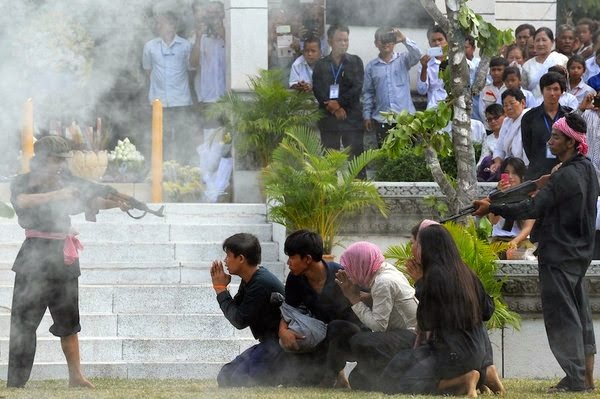
Cambodians are enthusiastic about play-acting to honor the memory of the victims of Pol-pot and company. We can sympathize as we sense that there will be a fuller sense of closure that way.
As far as justice is concerned…unfortunately all we have (again) is a lot of play-acting and word-playing and a bit of fore-playing (but much more expensive to enact at $220 mil…all those lawyer fees….).
We love international law. Majority community killing their own is not considered genocide. However, majority community killing minorities is appropriate for the g-tag.
Thus Chicoms killing 45 mil Hans is not considered suitable for the worst of the worst tag. Neither is the 30mil killed by Stalin and company. Not even the 3 mil Khmers killed by Pol Pot qualifies as genocide.
As a saving grace the 20k Vietnamese and 90k Cambodian muslims (Cham) killed by the Khmer Rougue may finally see some justice. Regardless of definitions, evil men need to be taken down by other (righteous) men on earth, not any supernatural agency.
Incidentally something which aroused our curiosity is the Cambodian word for genocide: prolai pouch-sas. We are no linguists but “prolai” in Sanskrit (used in Bengali as well) denotes a state of crisis (at the end of times level). Perhaps a person who knows will step forward and clarify?
………………
August 7 was supposed to be judgment day for the last two leaders of
the Khmer Rouge regime.
Thirty-five years after the end of Pol Potâs
calamitous agrarian revolution, a United Nations-backed court in Phnom
Penh found the movementâs chief ideologue Nuon Chea and the former
president Khieu Samphan guilty of crimes against humanity and sentenced
them to life in prison.
On the lawn in front of the courtroom on the outskirts of Phnom Penh,
the mood was self-congratulatory. Deputy Prime Minister Sok An called
the judgment âa milestoneâ for the court and for Cambodia, which rebuilt
itself âfrom scratch after liberation from the genocidal regime, the
regime of horror.â David Scheffer, the UN Secretary-Generalâs special
expert to the court, said,
âToday, the winds of international justice
swept through the rice fields of Cambodia, through its cities, its
villages, its forests.â
Finally, some were saying, the Khmer Rougeâs top echelon was being
held accountable for a utopian folly that killed as many as two million
people. For what the US Congress once described as âone of the clearest
examples of genocide in recent history.â For what various American
officials â Hillary Clinton, Steven Rapp, Samantha Power â have also
called a genocide.
Except that neither Nuon Chea nor Khieu Samphan was convicted of
genocide on August 7. And the tribunal will never even consider that
charge in connection with the vast majority of the Khmer Rougeâs
victims, the Khmer people, who make up 90 percent of the Cambodian
population today.
When the Extraordinary Chambers in the Courts of
Cambodia, as this tribunal is formally called, does address genocide in a
second phase of the leadersâ trial, it will do so only in relation to
two Cambodian minorities: the Vietnamese and the Cham, a Muslim group.
This is an awkward development. Some 20,000 Vietnamese and 90,000
Cham are believed to have died under Pol Pot â compared to well over 1.3
million Khmer, according to the most conservative estimates.
One Khmer
woman, who lives in exile and travelled to Phnom Penh for the August 7
verdict, said that the courtâs decision not to consider a genocide
charge on behalf of the Khmer left her feeling like victims were being
denied their âright to the precise term for what was done to usâ â it
was as though âhistory had not been understood.â For Ung Billon, another
Khmer who is the president of a victimsâ association in France called
Les Victimes du Génocide des Khmers Rouges and who also came for the
verdict, it was âan insult.â
And so even Cambodians who were relieved by the guilty verdicts and
especially the life sentences, like these two women, were left feeling
baffled, even betrayed, by the courtâs handling of the genocide charge.
This is only natural. âGenocideâ has been the term of choice in Cambodia
to describe Pol Potâs regime for nearly four decades. It is the
characterization favored in schoolbooks and the local news, by
bureaucrats and lawyers.
In this respect at least, the ECCC is frustrating the very people to
whom it was supposed to bring resolution, recognition, and
reconciliation. Not only does the courtâs narrow, technical definition
of genocide clash with the widespread popular understanding of the
crime, it also risks pitting different Cambodian communities against one
another.
There is, in fact, a simple explanation for why most of the Khmer
Rougeâs crimes, though widely thought to be a paradigmatic example of
genocide, both inside and outside Cambodia, are not actually that: the
1948 Genocide Convention, which codified the concept into international
law, deliberately ruled out its application to political pogroms and
class war â the signal crimes of Stalin, Mao, and Pol Pot.
That treaty defines genocide as killings, among other acts, committed
with the âintent to destroy, in whole or in part, a national, ethnical,
racial or religious group, as such.â This idea built on the word
âgenocideâ itself, a neologism combining genos (Greek for race or tribe) and cide
(Latin for killing), which the Polish lawyer Raphael Lemkin proposed in
1944, well into the Holocaust, to denote the deliberate âdestruction of
a nation or of an ethnic group.â
But the language adopted in the
convention was also a compromise reflecting the power dynamics of the
day. The Soviet Union, for example, opposed including âpoliticalâ in the
list of protected groups in the definition, presumably because it was
wary of getting into trouble for purging its opponents back home.
The Khmer expression for genocide, prolai pouch-sas, seems
to have first appeared when Cambodia ratified the Genocide Convention in
1950. But then it hardly was used, even within the learned elite; it
appears neither in the 1956 Cambodian penal code nor in the 1966
reference dictionary of Khmer compiled by the scholarly monk Chuon Nath.
And when the term became common in Cambodia, at least in official and
formal written language, soon after the Vietnamese toppled the Khmer
Rouge, it took on a meaning different from Lemkinâs original.
The Vietnamese communists, previously the Khmer Rougeâs patrons,
marched into Cambodia in late 1978, after vicious incursions by Pol
Potâs forces into Vietnam and amid mounting evidence that his regime was
self-destructing. The Khmer Rouge went underground, and in short order
the Vietnamese tried some of the movementâs leaders in absentia, holding
what they called âthe trial of the genocide crime of the Pol Pot-Ieng
Sary clique.â (Ieng Sary was the Khmer Rougeâs foreign minister then â-
and a defendant at the ECCC until he died last year.)
They turned the S-21 detention and torture center in Phnom Penh into a
showroom of horrors, with advice from curators in Eastern Europe. A
large sign calling the former prison the âGenocide Museumâ was placed at
its entrance and inmatesâ clothes were displayed in mounds, an
iconographic touch inspired by Nazi concentration camps.
All this made good political sense. The Vietnamese needed to justify
their occupation of Cambodia, and they needed to do so while
distinguishing the virtues of their communist ideology from the
perversions of Pol Potâs vision. What better way than to cast the Khmer
Rouge regime as an aberrant form of communism and accuse it of genocide,
the Nazisâ defining crime?
Propaganda became even more necessary as the Vietnameseâs lightning
liberation turned into a lengthy occupation; their continued presence
risked rekindling many Cambodiansâ ancestral anxiety about Vietnamese
expansionism â an anxiety so deeply engrained it had long been the
fodder of terrifying childrenâs fairytales. Schools were supplied with
new textbooks short on pedagogy and long on hyperbole. âThe Pol Pot-Ieng
Sary clique killed more than 3 million people and completely destroyed
everything in Cambodia,â read one book intended for the second grade.
âWe are absolutely furious and strongly struggle against these
atrocities.â January 7, the day in 1979 that Vietnamese troops seized
Phnom Penh from the Khmer Rouge, became celebrated as Victory over
Genocide Day.
However heavy-handed, the effort caught on. Prolai pouch-sas
roughly means to eliminate the lineage of a people or a nation, and
that definition echoed many Cambodiansâ personal experiences under the
Khmer Rouge, according to Muny Sothara, a psychiatrist at the
Transcultural Psychosocial Organization, an NGO in Phnom Penh that
provides mental-health services, who has worked since 2007 with Khmer
Rouge victims involved in the trials. Pol Potâs minions had seemed
intent on weeding out their enemies by âpulling them out roots and all,â
as one creepy Khmer Rouge saying went. The movement often targeted a
suspectâs entire family, group of colleagues, or community.
And so it was that almost as soon as the Khmer phrase for âgenocideâ
came to mean anything to Cambodians, it meant something both broader and
more precise than the destruction of a nation, ethnicity, race, or
religion âas suchâ: it meant the Khmer Rougeâs attempt to exterminate
Cambodians, mostly Khmer â their own group. (Kong Sothanarith, a
forty-something news editor at Voice of America, told me recently, âItâs
when I went into journalism that I realized the word meant almost
exactly the opposite of what I had been taught.â) And the term took. The
horror of the Khmer Rouge âgenocideâ was a rare matter on which
Vietnamese occupiers and Cambodian occupied could agree.
On April 30, 1994 -â while a bona fide genocide was raging
in Rwanda â the US Congress passed the Cambodian Genocide Justice Act,
which created the Office of Cambodian Genocide Investigations in the US
State Department, which in turn created the Cambodian Genocide Program
at Yale.
The idea was to document the Khmer Rougeâs crimes and at some
point prosecute them.
Very soon after that, the UN Security Council set up two tribunals to
judge abuses committed when Yugoslavia and Rwanda imploded â the first
international criminal courts since Nuremberg and the Tokyo trials.
The
notion of genocide finally had its day in court. (It had not be properly
adjudicated before, not even at the âgenocideâ tribunal that had tried
Pol Pot and Ieng Sary in 1979, which had used a legal standard of its
own making.) Meanwhile, in France, Germany, Spain, and Ethiopia,
legislators and judges were expanding the concept, sometimes
specifically to cover the destruction of political groups. Some legal
scholars were also trying to apply it to Cambodia: Pol Potâs regime had
committed a genocide against the so-called ânew people,â those urbanites
who were the prime enemies in its class war; its general onslaught
against Cambodians, a national group, could be called an
âauto-genocide.â
That the concept of genocide was stretched this way is a measure of
the cachet and clout it had acquired by then. After all, there was no
legal gap that needed filling: the Khmer Rougeâs crimes readily fell
under other categories, like crimes against humanity (a widespread and
systematic attack against civilians) or war crimes (severe mistreatment
of certain combatants and civilians during a conflict). And most jurists
would agree that international law establishes no formal hierarchy
among mass crimes.
But by the 1990s, genocide had a âsuper stigma,â
according to Patricia Wald, a US Court of Appeals judge who served at
the Yugoslavia tribunal. Or, as one chamber at the international court
for Rwanda put it, it was the âcrime of crimes.â
When it came to the Khmer Rouge, this development was only
complicated by the peculiar political usage of âgenocideâ in Cambodia.
In 1999, the UN Group of Experts that had been asked to figure out how
best to try Pol Potâs lieutenants â Pol Pot himself had died the year
before â announced that it would not take a position on the âcomplex
interpretive issuesâ surrounding âwhether the Khmer Rouge committed
genocide with respect to part of the Khmer national group.â
And so when
the ECCC came into being in 2006, genocide was included in its mandate
(along with crimes against humanity, war crimes, and violations of the
Cambodian penal code). And under the courtâs civil law procedure, it
would be up to two investigating judges to lead a factual inquiry and
determine how to characterize any crimes they uncovered â a
technical-seeming task fraught with high-stakes symbolism.
The Khmer Rouge leaders were arrested in 2007, and at first were
charged only with crimes against humanity and war crimes. (There were
four leaders at the time, but since then Ieng Sary has died and his
wife, the Khmer Rouge minister for social affairs Ieng Thirith, has been
declared unfit to stand trial because of dementia.) Genocide charges
were brought two years later, and only in reference to the Vietnamese
and the Cham.
Marcel Lemonde, who was the international investigating
judge back then, recently explained to me his officeâs thinking on the
issue. He said that âtroubling factsâ unearthed during the investigation
suggested that the Khmer Rouge âmay have intended to destroy the Cham
as Cham rather than as political opponents, and to destroy the
Vietnamese as Vietnamese rather than because the regime was at war with
Vietnam.â Not so with the Khmer population. âTo establish that a
genocide occurred, a group needs to have been identified,â he explained,
âand that group cannot be the quasi entirety of the population â
otherwise the notion no longer makes sense.â
Still, it had been a difficult call. Lemonde and his Cambodian
counterpart, You Bunleng, feared that pursuing a genocide charge
exclusively on behalf of two small minorities would offend many
survivors and victimsâ families. But Lemonde said that he and You
Bunleng, who was especially uncomfortable, decided they could not avoid
the issue by dismissing the genocide charge altogether at that stage.
Better to give it a full airing at trial and let the prosecution,
victimsâ representatives, and the defense debate its merits and its
limits. Genocide, the ECCCâs marquee crime, had become a liability.
When the trial judges decided to segment the gigantic indictment into
smaller parts and stagger them, they postponed the genocide issue to a
later stage. (The recent verdict concerns only abuses pertaining to
various forced population transfers and the execution of officials from
the military government that the Khmer Rouge deposed in April 1975; the
next phase of the trial, which is expected to start later this year,
will include genocide, as well as crimes at certain work cooperatives
and security centers, internal purges, and forced marriage.)
Nuon Cheaâs
lawyers challenged that decision. In an appeal last year citing âthe
sheer gravityâ of the genocide charge and its âspecial and privileged
roleâ as âan encapsulation of the Khmer Rouge period in the public
mind,â they asked that it be included in the first part of the trial.
Whether they really saw an opportunity to win an acquittal or simply
wanted to kick up some dirt, you know something is amiss when a
defendant is clamoring to be prosecuted, and ASAP, for genocide.
The trial judges certainly face an awkward predicament, one more
awkward still than the investigating judges did. They are damned if they
rule there was no genocide against the Cham or the Vietnamese (meaning,
there was no genocide at all). And they are damned if they rule there
was a genocide (meaning, against some group other than the Khmer
majority). Whatever they do, this internationally sanctioned court â
which has cost some $220 million so far â will frustrate most Cambodian
victimsâ sense of what happened to them.
Nor is it clear that the two minorities stand to gain much from the
special treatment. An eighty-four-year-old imam I met in 2011 in a small
Cham village in Kompong Chhnang, a few hours north of Phnom Penh,
complained that the Khmer Rouge had prohibited him from praying and
forced him to eat pork. Yet he also said, âWhen it came to the beatings
and the killings, no one suffered more than anyone else.â
This view is
common, says So Farina, a researcher at the Documentation Center of
Cambodia, or DC-CAM, who has interviewed several thousand Cham over the
past decade. Most Vietnamese, for their part, have no desire to stand
out, especially against Khmer Cambodians, according to Long Danny,
another DC-CAM researcher. Many are poor, some are stateless, and most
would rather keep a low profile: anti-Vietnamese sentiment still runs
very deep in Cambodia.
The perils of these paradoxes havenât surfaced yet because the ECCC
operates at a remove from daily life, and outside the court the same old
talk of that other, generic kind of genocide still prevails.
Educational and outreach efforts to parse the termâs legal and casual
uses have been modest and mixed. DC-CAM, which was originally set up by
Yaleâs Cambodian Genocide Program to collect evidence of Khmer Rouge
crimes, is credited with putting together in 2007 the first history book
to describe the regime in any detail.
The book largely forgoes the use
of âgenocide,â preferring to focus on facts, but the accompanying
teacherâs manual uses the word liberally. And through its âGenocide
Educationâ program, DC-CAM has been distributing posters with
anti-âgenocideâ slogans to schools throughout the country. Even Muny
Sothara, the counselor from TPO, and some victimsâ lawyers have favored
maintaining their clients in a state of constructive confusion.
How much longer can such obfuscating work? Thouch Féniés Phandarasar,
a Khmer refugee living in France who testified at the trial last year
and flew back to Phnom Penh for the judgment earlier this month, told me
she hadnât realized how the court was handling the genocide charges
until the week before the verdict, when she was briefed on the second
phase of the trial. And then she was âoutraged,â she said.
For her,
âgenocideâ connotes extermination in a way that âcrimes against
humanityâ cannot, and so âif the tribunal refrains from using the term,
it must do so for everyone, rather than use it just for the Vietnamese
and the Cham.â Ung Billon, the head of the victimsâ association in
France, told me, âThis was a genocide between two political ethnicities:
The communists killed us because we werenât communists. So to be told
that Khmer victims arenât included in the genocide is unacceptable for
me.â
One could argue that the long-awaited trial of the âKhmer Rouge
genocide,â that oxymoron, will help clarify both the nature of communism
and the notion of genocide by confronting the essentially political
character of most of the Khmer Rougeâs crimes with the politically
expedient origins of the legal definition of genocide. But it is a
lesson that comes at a cost for the people the court was supposed to
help, the victims, especially those who are most involved in its work.
Many Cambodians, like other people who survive mass crimes, seem
haunted by that question with no answer: âWhy?â But a moment after first
asking it they often repeat it with this characteristic twist: âWhy did
the Khmer Rouge try to exterminate Cambodians?â If only the Khmer Rouge
had tried to exterminate an ethnic or national group other than their
own â if only their central purpose had been to commit a genocide â- then it might all make a bit more sense.
…..
Link: http://www.nybooks.com/blogs/nyrblog/2014/aug/25/khmer-rouge-genocide-wasnt/
….
regards

We have a deal!!!
would control strategic policy areas, such as relations with the United
States, Afghanistan and India…promise of freedom for former president (retd) General Pervez Musharraf
and that Sharif’s government had secretly agreed to let Musharraf go
abroad after a symbolic indictment over treason……
……
When Prime Minister Nawaz Sharif said we are here to stay he was actually trying to convey a message.
Poor Imran Khan, Sharif senior has reportedly managed to strike a deal with the Army after all. Actually that is not quite correct, the Army has used Khan to soften up the Sharif brothers. Ayesha Siddiqui calls this a “soft coup” and that Nawaz will remain a Prime Minister in Name Only (PiMNO, our words). The chance of PTI riding the protest horse to the throne now appears remote.
…….
Prime Minister Nawaz Sharif is close to making a deal with the
Pakistan Army, in the backdrop of the political events that are
unfolding in the federal capital, The Wall Street Journal reported.
The
report suggests that as per the proposed agreement, the armed forces
would control strategic policy areas, such as relations with the United
States, Afghanistan and India.
…….
The military has extracted a
promise of freedom for former president (retd) General Pervez Musharraf
and that Sharif’s government had secretly agreed to let Musharraf go
abroad after a symbolic indictment over treason, which took place in
March.
The Wall Street Journal says the government went back on
the deal as a result of which trust had eroded between the military and
Sharif.
Government aides said the military has seized on Sharif’s
weakened status during the political crisis and are now seeking
guarantees from the prime minister that he will follow through on the
agreement, the report suggests.
It also says that for the rest of his term, Sharif will be a ceremonial prime minister.
“If
Nawaz Sharif survives, for the rest of his term, he will be a
ceremonial prime ministerâthe world will not take him seriously,” said
Ayesha Siddiqa, an analyst based in Islamabad. “A soft coup has already
taken place. The question is whether it will harden,” the report says.
Government aides said in the report that the administration was also
willing to let the prime minister’s brother, Shahbaz Sharif, step down
as chief minister of Punjab.
Thousands of protesters led by cleric
Tahir-ul-Qadri and Pakistan Tehreek-i-Insaf Chairman Imran Khan have
camped outside the parliament building in Islamabad to demand the
resignation of Prime Minister Nawaz Sharif. The two-week showdown
at the heart of the capital has rattled the country and shaken Sharif’s
government just 15 months into a five-year mandate.
Imran Khan
has remained defiant and refused to end his sit-in protest, saying he
was seeking âindependence or deathâ and would not rest until both Sharif
brothers quit.
Khan has alleged massive cheating in the May 2013 poll, though international observers said the vote was largely free and fair.
…….
Link: nawaz-close-to-reaching-deal-with-army
…..
regards
COPS. Oh America!
Another one. A producer of the show COPS is shot by….a trigger happy cop.
The rate at which cops kill unarmed people (mostly black people, but occasionally others as well, as in this case) is too damn high. In fact, the rate at which Black people get killed by cops is higher than the rate at which they were lynched by the klan in most years….. I avoid a lot of news stories because i have become irritable in my old age and for peace of mind I avoid news that tends to trigger elite left-lib bs, but even the paranoid can have real enemies and in this case the leftlibs have the right target…out of control copishness is an awful problem in this country. If someone could somehow dial that down and stop the war on drugs, this would be a great country. I wish I knew how to do it within my lifetime. On the other hand, I remain a man of faith….i think we will eventually get there. WHEN will we get there? that is the issue…probably not soon enough.
Of course its not just cops. The fetishization of guns and the desire to shoot them extends well beyond militarized trigger-happy cops.
If I was a hard hearted cynic, I might say this instructor had it coming, but imagine the burden this poor 9 year old girl will carry for the rest of her life. Her parents may be idiots for taking her to a gun range to shoot automatic weapons, but she is still a child and deserves sympathy…
Look at what police officer Sunil Dutta has to say about this topic...and weep.
btw, as some of the above links show, the libertarian magazine Reason has long had the right idea about the war on drugs, the prison mafia and militarized overbearing copishness in the land of the free…
Letter to India: what soldiers wrote in the first world war
A very interesting piece in caravan
http://caravanmagazine.in/vantage/what-indian-soldiers-first-world-war-wrote-home-about
To commemorate the centenary of Indiaâs service in the First World War,
the British historian David Omissi collected the letters of Indian soldiers away
from home in Indian Voices of the Great War, published this year by
Penguin. These eloquent letters offer a poignant glimpse into the lives of these
Indian soldiers, whom history forgot.
Examples:
A wounded Sikh to his
father
[Gurmukhi]
Brighton Hospital
18th January 1915
Tell my mother not to go wandering madly because her son, my brother, is
dead. To be born and to die is Godâs order. Some day we must die, sooner or
later, and if I die here, who will remember me? It is a fine thing to die far
from home. A saint said this, and, as he was a good man, it must be true.
Ram Prasad (Brahmin) to Manik Chand (c/o Sikander Ali, Bamba Debi
Bazar, Marwari Water Tank, Bombay)
[Hindi]
Kitchenerâs
Indian Hospital, Brighton
2nd September 1915
And send me fourteen or fifteen tolas of charas, and
understand that you must send it so that no one may know. First fill a round tin
box full of pickles and then in the middle of that put a smaller round box
carefully closed, so that no trace of the pickles can enter. And send a letter
to me four days before you send the parcel off. [Letter withheld]
…
The “Great” is no more in Great Britain
anniversary of burning the White Houseâ….embassy quickly retracted: âApologies for earlier Tweet. We meant to mark an event in
history & celebrate our friendship today âŠ. Today UK-US
celebrate #specialrelationshipâ…..
…
…..
Whichever way the September 18th vote goes for Scottish independence, one thing is for sure:
after 112272 days (starting 01 May, 1707), Scotland will no longer count as a willing partner in
the Union. Truth be told, this breakdown started during the Thatcher
years triggered by the hated poll tax. However from what we read in the
papers and based on accounts by friends, even most of Northern England (Yorkshire and even the Midlands)
is in a different planet compared to London and the South-East England.
There is essentially a sense that London- a truly global city and home of the super-affluent – does not care much about the poor cousins “oop north” and imposes out of touch policies and unwanted migration on the rest of the country.
Thus while the upstart (and popular) parties are polar opposites – Scottish National Party (SNP) is left-liberal and the UK Independence Party (UKIP) is libertarian-paleocon – they are in agreement that London is bad for the country and harmful for the future. In the words of the wag, there is no better-together (pro-union campaign slogan), only bitter together.
…
How should we feel about all this as Indians? We note that the article gives credit to the British for giving Indians the gift of democracy. There are other folks who would say that India would not even exist as a nation but for the British. Thing is, if you choose to take credit for the good things, you need to own up to the bad things as well (the Victorian holocausts, the Bengal famine,…).
Also something which is almost never emphasized, it was the British-Indian army that helped maintain order in the far reaches of the empire and which also played a significant role in the World Wars and countless other wars. If Britain gave birth to a new India, the British empire was sustained through Indian blood, sweat and treasure. Not for nothing, India was known as the crown jewel of the empire. The moment Britain lost India, the empire gig was up.
…..
During the 19th and early 20th centuries, Britain had dominion over so
many portions of the Earth it was said, famously, that âthe sun never
set on the British Empire.â Since the end of World War II, however, that
sun has been steadily dipping toward the horizon. Today, sundown is
truly at hand.
…
On Sept. 18, the voters of Scotland will go to the polls to
determine whether their nation will declare independence from the United
Kingdom after 307 years of union with England. Polls over the last 18
months reported by the website What Scotland Thinks
show a gradually rising tide for independence even though advocates of
remaining in the U.K. still lead in the surveys. But many Scots have
said they are undecidedâand thus they hold a key to the decision.
…..
The
Economist magazine has suggested
that Scots voting with their heads will choose to stay with England,
while those voting with their hearts will opt for independence, but âit
is the nationalists who have fire in their bellies.â
….
The
undecided Scots also hold the key to the final dissolution of one of the
greatest empires in history. The British Empire brought profound
changes to the worldâbut in the decades since its rapid decline after
World War II it has become a kind of a historical joke, sometimes in
poor taste.
….
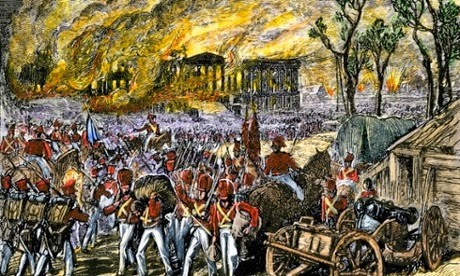
This week the British embassy in Washington decided, for
reasons only known to itself, to hark back to Blightyâs glory days and
tweet a picture of a sparkler-bedecked cake âcommemorating the 200th
anniversary of burning the White Houseâ during the War of 1812.
..
After
newspapers got wind of the tweet, the embassy quickly retracted it,
tweeting: âApologies for earlier Tweet. We meant to mark an event in
history & celebrate our strong friendship today âŠ. Today UK-US
celebrate #specialrelationship & work together shoulder to shoulder
across the globe.â
….
But even that assessment is somewhat self-delusional. Since the
beginning of the Cold War, America has done the lionâs share of the
shouldering. Britain, the colonizer of America, has become in some ways
the colony (or lapdog, as some self-deprecating British wags put it).
And now itâs about to get even smaller.
….
The downsizing process
has been long and hard. At its most extensive, the British Empire
comprised 57 colonies, dominions, territories or protectorates from
Australia, Canada and India to Fiji, Western Samoa and Tonga. From
London, the British ruled about 20 percent of worldâs population and
governed nearly 25 percent of the worldâs land mass, according to
calculations by British researcher Stephen Luscombe.
….
The spread of
British influence, including the English language, gave birth to the
United States, the worldâs only superpower; the worldâs largest
democracy in India; and, perhaps inadvertently, disseminated British
concepts of freedom, democracy and common law around the globe. On the
negative side, Britain once corrupted an entire nation, China, with
opium purely to extract drug revenues, and its haughty, racist dominance
of subjected peoples left generations of rage in its wake in many
countries (not least of which are some of those closest to home, like
Ireland).
….
Today that empire has been reduced to 14 scattered
islands such as the British Virgin Islands in the Caribbean and Pitcairn
Island in the South Pacific. The Commonwealth of Nations founded before
World War II and revived after the war comprises 54 former British
territories but is little more than a monument to the empire. Now the
wave of dissolution is lapping up against the shores of the British
Isles themselves.
an empire, though some former provinces still experience âcolonial
cringeâ at the sound of upper-crust British English. Londonâs imperial
might began to crumble during World War II after Japanese armies marched
to gates of India and the shores of Australia, breaking the back of
Western colonialism before Japan was defeated in 1945. A nationalistic
surge ended the colonial era, beginning with the withdrawal from India
and Pakistan in 1947.
….
Some would say the empire officially came
to an end in February of that year whenâutterly drained by the two world
warsâthe British cabled Washington that they no longer had the money or
troops to defend Greece or Turkey as the Soviet Union threatened to
extend its influence in the early Cold War. …
âThe British are finished,â
Dean Acheson, soon to be Harry Trumanâs secretary of state, was said to
have remarked when he read the cable. The United States quickly
displaced the United Kingdom as the main stabilizing power in the West.
….
The
decline of British power hasnât come without a fight. In 1942, Winston
Churchill was famously quoted saying: âWe mean to hold our own. I have
not become the kingâs first minister in order to preside over the
liquidation of the British Empire.â
….
But his successors have been
liquidating ever since. Over several decades, Britain withdrew from East
of Suez and from their possessions in Africa; Hong Kong, the city-state
that reverted to China in 1997, was among the last to go. There has
been one exception: In 1982, in a desperate effort to hold onto the
miniscule Falkland Islands in the South Atlantic, the U.K. fought a
brief war with Argentinaâwhich it won as a kind of imperial consolation
prize.
………
Link: politico.com/the-sad-end-of-the-british-empire
…..
regards
“We are here to stay”
visited him (Imran Khan) in the hospital and he congratulated me….he will
play the role of a constructive opposition…Imran invited me to Bani
Gala…..assured me he is with the government in all steps taken in good
faith” …..
….
After a long, long wait….hopeful (wise) words for Pakistan (from Pakistan). We want to see a decisive leader, not a fire-breather, neither a passive observer.
…..
Amid mounting pressure
from protesters to quit as Pakistan’s Prime Minister, a defiant Nawaz Sharif on
Wednesday refused to resign saying the country has survived “difficult
times” and the current political crisis too shall pass.
“We have survived difficult times. In the 2008 elections, our hands were
tied. But we campaigned and participated, we did not cry about rigging â and it
would have been a legitimate cry,” he said in his first major speech since
the crisis erupted two weeks ago.
“Because at that time there was a dictator that controlled the government.
He held those elections…But we said if PPP has got more seats than us then we
will accept that right of the PPP” he said in his address to the National
Assembly.
Political stalemate has continued for the last two weeks with Imran Khan-led
Pakistan Tehreek-i-Insaf (PTI) and cleric Tahir-ul-Qadri’s Pakistan Awami
Tehreek (PAT) refusing to budge from their demand of the Prime Minister’s
resignation over allegations of rigging in last year’s general election and
killing of 14 PAT supporters in Lahore on June 17.
Sharif expressed hope that this phase will pass and Pakistan will be steered
towards prosperity.
The Prime Minister in his address indicated in no uncertain terms that his
government and the present Parliament are here to stay, Dawn News reported.
“We are not going to be diverted by these things. The journey for the
supremacy of Constitution and law in Pakistan will continue with full
determination and God willing there will not be any interruption in it,”
he said.
Sharif said today would be remembered in the nation’s history as a great day
for democracy.
“This great display of strength will always be remembered. It makes me
happy to think that this is the voice of the 200 million people of the
country,” the premier said. Sharif said his PML-N for five years worked with the Pakistan People’s Party
government and supported it to complete its term.
“I visited him (Imran Khan) in the hospital when he was injured and he
congratulated me on winning the polls and said he will play the role of a
constructive opposition,” Sharif told the House. “Imran’s claims were published in the papers as well,” he said,
adding that PTI had reservations but accepted the results of the elections. “Later, when Imran invited me to Bani Gala, I went and we had a pleasant
discussion. He assured me he is with the government in all steps taken in good
faith,” Sharif said.
The crisis escalated in the last week with thousands of supporters of Khan and
Qadri camping outside the Parliament, demanding the Prime Minister’s
resignation.
Sharif said “if today, we correct ourselves for the way forward, that will
be positive for Pakistan.”
He pointed out that a committee had already been constituted for electoral
reforms and all political forces should sit together and give their opinions.
“This is the triumph of a vision…which is not about
individuals…governments come and go, prime ministers come and go but focusing
on the principle of democracy and Constitution is a victory of the system, of
democracy,” he said.
“I haven’t seen a similar example in the country’s history,” Sharif
told the House, adding that the fact that nine of out ten parties voted for the
resolution supporting democracy was a historic moment for Pakistan.
He also referred to the government’s developmental ventures in his address.
“Our energies should be directed towards Pakistan’s development instead of
what we have witnessed in the recent days,” Sharif said.
Meanwhile, the Supreme Court on Wednesday ordered PTI and PAT protesters to
clear the Constitution Avenue which also includes a road in front of the apex
court and the Parliament by Thursday.
A five-judge larger bench of the Supreme Court, headed by Chief Justice
Nasir-ul-Mulk, was hearing a set of identical petitions filed by bar
associations across the country against the PAT and PTI’s sit-ins on
Islamabad’s Constitution Avenue.
According to petitioners, protesters were breaching the rights of the common
citizen which ensure freedom of movement and right of assembly.
After making several observations, the court ordered PAT and PTI protesters to
clear the way in front of the Parliament by Thursday.
The protesters have been sitting in front of the Parliament House and the
Supreme Court building since August 19, making the road impassable for government
employees.
The order came as the clock ticked on a 48-hour ultimatum given by Qadri on
Monday for the Prime Minister to step down.
Back channel efforts to broker a settlement between the government and
protesters were on.
…..
Link: Pakistan-survived-difficult-times-this-too-shall-pass-Nawaz-Sharif
….
regards
Where are all the good men?
Rotherham…..Good people will feel shame….. Lots instead will blame the victims…..girls
from disadvantaged backgrounds…..lured with cheap gifts and
false affection….children seen as trash, by rapists as well as the authorities, including the police.…..
….
It seems all our societies are struggling to deal with angry young men. Earlier there used to be epidemics, wars, and famines that helped in “mowing the lawn,” to reduce the burden of young men who have nothing to live their lives for, nothing to look for in the future. Simultaneously, women are now coming out of the shadows and they are also less willing to tolerate nonsense. Hence the men are facing a crisis situation: you may still take out your frustrations at work by beating up the lady at home, but society (not just the law) is much less forgiving these days.
We have never thought much about the love jihad narrative, but the role of society in trampling the wishes of men over women must not be under-estimated. Why should men (all communities) today get social sanction for multiple marriages?
Even worse, why should men be allowed to get away with abusing women for decades as the men in charge look the other way? Why did the courageous few fathers who attempted to rescue their daughters get arrested instead? Why did the victims themselves get arrested for drinking problems? Why did it take four reports over ten years for the police to acknowledge serious problems? Why was there no community outreach to the women (whites as well as minorities)?
.
Given powerful evidence of industrial scale sexual abuse, why are there still no public naming and shaming of the responsible officials? Why does it have to be women such as Prof Alexis Jay and Yasmin Alibhai Brown (see below) to stand up for other (all) women?
…………
There have been a few heroes such as Andrew Norfolk of the Times who blew the whistle on the piss-poor performance of the Rotherham police and the child services. We wish there were more folks like him.
Society needs more good men who will lead the youngsters to a path filled with hope, instead of anger. Perhaps an institute for developing male leaders in the new age? Less of the old, my way or the highway boss, more of the enlightened leader-servant. Else we will be on a fast-track to a broken society….as the men fall down, they will also drag the women along with them.
……………………..
…..report on child sexual
abuse in Rotherham, South Yorkshire, between 1997 and 2013: About 1,400 children
were sexually exploited in Rotherham over a 16-year period, although no
one knows the true scale of exploitation over the years. In more than a
third of these cases the youngsters were already known to child protection agencies.
…
White experts and officers have for too long been reluctant to
confront serious offences committed by black and Asian people. Such
extreme tolerance is the result of specious morality, that credo that
says investigating such crimes would encourage racism or enrage
community activists and leaders, or, worse, make the professionals
appear racist.
So, instead of saving children who were being gang raped,
drugged, assaulted, threatened and terrorised, they chose to protect
rapists, abusers, traffickers and drug dealers. And themselves.
I can imagine what the talk will be among Asians in
Rotherham today. Good people of course will feel shame. Lots, however,
will not, and instead will blame the system or the victims â young girls
from disadvantaged backgrounds who were lured with cheap gifts and
false affection. Such children are seen as trash, low life, by their
rapists as well as the authorities, including the police.
The
perpetrators are not paedophiles in the normal sense of the word. Racial
and cultural odium as much as ugly lust and power drives them to abuse.
Most of them are also irreversibly misogynist. It is a lethal mix, this
sexist psychopathy.
I partly blame their families and
communities. Too many Asian mothers spoil their boys, undervalue their
girls, and demean their daughters-in-law. Within some British Asian
circles, the West is considered degenerate and immoral. So itâs OK to
take their girls and ruin them further. Some of the most fierce rows I
have ever had have been with Asian women who hold these disgusting
views.
I ask them to think what they would feel if gangs of white
men took out their girls, gave them presents, took them places, and then
seduced, beat and passed them around. The men might say they were
rescuing the girls from oppression, showing them a good time, saving
them from a life of forced marriage and all that.
Yes,
racists will have further ammunition after this report. Blame those who
did what they did, not those who are brave and just enough to expose
them. I will always fight for the rights of minorities. But I will not
defend the indefensible.
…….
Link (1): theguardian.com/rotherham-abuse-report-finds-1400-children-were-victims
Link (2): independent.co.uk/rotherham-child-abuse-scandal-apologists-misogyny-and-double-standards
Link (3): rotherham-sexual-abuse-children
…….
regards
How the smallest reflects grand ideas
Pakistan as a spoil of war
So the PTI, an urban Punjab party, marched from the heart of the Punjab, Lahore, to the north of the Punjab, Islamabad, to demand power from PML-N, a rural-industrial Punjab party while the Punjabi dominated Army looks on. Where does Pakistan actually come into this highly entertaining Punjabi spectacle?