My fiancée was in the mood to watch Bollywood and I happily obliged. Even though my brothers are married to desis, both sister in laws are born abroad. Only mine is an Indian (with her mother’s relatives spread over Gujarat and her dather’s in the South & abroad; the great Sindhi-NRI diaspora at work).
Kipat Barzel
element in the operation of Iron Dome: Some crews are better than
others, and training and experience count…..American missile-defense crews get little live-fire training…..U.S. military should rethink the way it trains its missile-defense
troops…..
A valuable overview of missile defense.
To the horror of peace activists everywhere (torture never works!!, missile defense never works!!!) the Iron Dome works. However this is a cautionary tale. The Israeli Defense Force (IDF) says that it needs 13-15 Iron Domes for full coverage, only nine are operational. Expense is probably not an issue, we will put on our best “Jews own the world” hat and assume that there will be a fair good number of billionaires willing to pony up for an Iron Dome with their name inscribed on it.
But it may also be the case that Israel does not take the threats too seriously and is using Hamas as a punching bag. Hamas no doubt deserves every bit of the bitter medicine but the problem is that the leaders (and even troops) are hiding in deep tunnels, while the civilians are bearing the brunt of this brutal war.
So….. if Israel has perfected missile defense, Hamas has also perfected missile offense. While Israel has attacked Gaza with tanks, Hamas has a few nifty (30m deep!!!) tunnels which are being used to launch surprise attacks inside Israel. Both sides gain from the ability to keep the water boiling at the right temperature (following what a famous Pakistani general had once said).
Worldwide muslims are living under varying degree of occupations by non-muslim powers in Kashmir, Xinjiang, Palestine and Chechnya (there are less prominent ones as well). Of course many more muslims are living under the domination of muslim dictators and tyrants. It gives us no pleasure to say that the first set seem to be better off than the second one. It is a false choice really, all muslims should be free to pray and fast (and not pray and fast as well) and get on with their lives.
………………………
Between the fall of the Jewish Commonwealth to the Romans in the first
century A.D. and the founding of Israel in 1948, Jews were remarkably
easy to kill. Not anymore.
…
Today, thanks to an innovative missile-defense system called Iron Dome (in Hebrew Kipat Barzel),
it’s harder than ever. Yet when it was first proposed, many Israeli
defense experts (and one way or another most Israelis consider
themselves defense experts) were reluctant to support the idea of a
defensive response to rocket attacks from Gaza and Lebanon.
….
Throughout the history of warfare there has been conflict between
those who believe in the strength of a defensive posture and those who
put their faith in the attack. Aside from the proponents of the nuclear
doctrine known as Mutual Assured Destruction, no one has ever seriously
claimed that an exclusively offensive or defensive strategy is viable.
Some military organizations have traditionally put more emphasis on
defense and others on offense.
….
Israel, because of its small size, has always preferred to fight
offensively. If there is going to be a war, let it happen on the other
guy’s territory. This made sense in the 1950s and ’60s. In 1973,
however, the IDF’s lightly fortified positions in the Golan Heights and
on the east bank of the Suez Canal were overwhelmed in the initial Arab
surprise attack.
….
This led to the delusion that the Bar Lev line in Sinai was somehow
an Israeli version of France’s disastrous Maginot Line at the beginning
of World War II. In fact, it was a set of positions built during the War
of Attrition (1968–70) to protect Israeli soldiers from Egyptian
artillery fire, and hadn’t been intended as a line of defense capable of
repelling a full-blown attack. The costly success of the IDF’s
offensive across the canal and the drive on Damascus in the north
convinced Israel’s military leaders that their attack-centered doctrine
was the correct one; it just needed better tanks.
….
In spite of this doctrine’s failure to work as planned during the
Lebanon war that began in 1982, Israel’s leaders remained committed to
an offensive-minded strategy. However, they knew that their enemies were
beginning to equip themselves with long-range missiles. Indeed, Egypt
had used a few early-model Scuds during the Yom Kippur War.
….
Thus, when the Reagan administration offered Israel the chance to
take part in the Strategic Defense Initiative (SDI) missile-defense
program in 1983, a small faction inside the IDF leaped at the chance.
….
Gradually Israeli leaders came to recognize that missile defense was
just as important as other forms of air power. Thanks in part to U.S.
funding, the Arrow missile-defense system was built and deployed along
with a limited number of Patriot-missile batteries. Israelis had long
been used to having bomb shelters in their homes and neighborhoods, and
they came to accept missile defenses as just another form of homeland
protection.
….
During the 1991 Gulf War, Saddam Hussein’s forces fired 42 modified
Scuds at Israel. The ensuing controversy over the effectiveness of the
Israeli and U.S. Patriot units that were hastily activated and deployed
in response taught both America and Israel some valuable lessons.
….
For
one, education and preparation count. The Israeli Patriot crews were
barely halfway through their training when the crisis broke out. Neither
Israel nor the U.S. Army had enough experience with these weapons to
understand how to effectively integrate them into a large-scale
defensive scheme. ….
The U.S. Patriot units did not arrive in Israel until
the war was already underway, and their improvised deployment has
generally been regarded as a failure.
….
Another problem was that space-based sensors on America’s Defense
Support Program early-warning satellites, which provided critical alerts
every time the Iraqis launched a Scud, were not directly hooked into
Israel’s air-defense system.
….
The satellites were designed to give early
warning of a Soviet nuclear strike, and their ability to detect Iraqi
missile launches was an unplanned side benefit. The Israelis learned the
hard way that they would need a complex, sophisticated, and extremely
fast-acting sensor system if they were to make missile defense work.
….
When the Second Gulf War broke out in 2003, Israel had deployed the
early version of its Arrow defense missile. It also had integrated
improved Patriot batteries and had developed an advanced
command-and-control organization to provide it with a multi-layered
national missile-defense system.
…
Yet when Hezbollah fired thousands of rockets at northern Israel
during the 2006 Second Lebanon War, existing missile defenses did little
or nothing to stop this attack. For some unknown reason, Israel was
unwilling or unable to obtain the American Centurion short-range
missile-defense system (based on the U.S. Navy’s Phalanx anti-missile
gun). Additionally, the proposed Nautilus chemical-laser system was seen
by experts as both too expensive and too easily overwhelmed, since it
could only fire seven or eight shots before it needed to be refueled.
….
Meanwhile, the Israeli defense firm Rafael was developing the concept
that would lead to Iron Dome. It would be based on Israel’s
longstanding expertise in radars and especially on the AESA (Active
Electronically Scanned Array) type radar. This technology uses dozens of
small transmit–receive modules to scan for targets. It does not need
any sort of mechanical sweeping apparatus, and its power output can be
easily adjusted to concentrate on any given part of the sky.
….
Israel had
first developed such radars as replacements for the older systems that
equipped its F-15s and F-16s.
…
Iron Dome uses a Multi Mode Radar (MMR) to detect and track enemy
rockets. If the rockets are going to land in an uninhabited zone, the
system does nothing; if the projectile is going to hit a neighborhood or
an area that has been designated as “protected” it will launch one or
sometimes two “Tamir” interceptor missiles in order to destroy the
incoming weapon.
….
Its rate of success, which the IDF claims is in the 85 to 90 percent
range has been challenged by, among others, Theodore Postol of MIT, a
longstanding, hardcore opponent of U.S. missile defense. …
The details of
the system’s effectiveness are closely held, but in its performance
against the improved “Grad” and other rockets that Hamas has been using,
the results speak for themselves.
….
The system is by no means perfect. When a rocket is hit, it does not
disintegrate into nothingness. Debris from both the missile and the
rocket fall to Earth and this debris can sometimes do damage, but this
is minimal compared to the damage a live warhead would do.
…..
Back in 2012 I wrote a piece
for the Gatestone Institute making the argument that the economics of
Iron Dome are not as bad for Israel as some people claim. Since then,
the price of the Tamir interceptor missiles has probably gone down
thanks to improved manufacturing techniques and the larger quantity of
weapons being built.
…..
Three points about the system are significant for Americans. First,
while the U.S. has been financing a great deal of Iron Dome’s
development and manufacturing, our military seems reluctant to take
advantage of the weapon’s availability. Second, the system is
continuously being improved; as with every military system there is a
constant need to update the hardware and software, and, thanks to Hamas,
the Israelis have a great deal of live-fire data on which to base their
upgrades.
…..
The third, not always evident, point is that there is a human
element in the operation of Iron Dome: Some crews are better than
others, and training and experience count. The technology by itself can
only go so far. American missile-defense crews get little, if any,
live-fire training. Simulators have their limits. In light of this, the
U.S. military should rethink the way it trains its missile-defense
troops.
…..
According to recent reports, Israel now has at least nine Iron Dome
units in operation. The IDF has said in the past that they need a total
of 13 to 15 units to cover the whole country. As production for Israel
winds down, the U.S. would be wise to consider buying a few units of its
own for use in South Korea and in places like Bagram Air Force Base in
Afghanistan. After all, the Taliban often use rockets similar to those
used by Hamas. We should expect that future enemies will use similar
weapons against similar targets. If an Iron Dome were to prevent the
destruction of a single U.S. C-17 transport plane, it would pay for
itself several times over.
…..
The U.S. is already scheduled to begin producing components for Iron
Dome, and there is no reason why it could not manufacture an
increasingly large part of the system. Rockets such as the Grad have
been an important part of the arsenal of insurgents in low-intensity
conflict, and are also an important weapon in more conventional warfare.
As time goes on, Iron Dome or weapons systems like it will be
integrated into the arsenals of all the major powers.
…..
Link: http://www.nationalreview.com/node/382931/
……
regards
Iraq, an old post

Archie the anarchist
following a complaint to Singapore’s Media Development Authority which
found it was not in line with social norms …..
OK Singapore is a weird place, it allows (we hope) internet porn while blocking Playboy (the interviews, people are missing out on the interviews!!!!)
But why ban Archie? Because….. presumably, just like Iran, Singapore does not have any gays. Not only that, just hearing about gays will pollute the minds of youngsters and they will turn int gays. What a nightmare.
When people talk about the positive influence of religion (which we do not deny) they should also acknowledge the immense harm that it does on both believers and non-believers alike.
…….
Singapore has banned a volume of the “Archie” comic book that featured a
same-sex marriage, adding fuel to a censorship row that erupted over a
children’s story about two male penguins hatching an egg.
“Archie: The Married Life Book Three” was taken off book shop shelves
following a complaint to Singapore’s Media Development Authority which
found it was not in line with social norms and breached their content
guidelines.
…
News of the ban, which was imposed earlier this year but came to light
late on Wednesday, comes a week after Singapore’s National Library Board
said it was to destroy three children’s books seen as being
pro-homosexual, including penguin story “And Tango Makes Three”.
…
That prompted about 400 people to turn out on Sunday for a “read in” of
the books in the national library’s atrium, while on Wednesday, three
authors resigned as judges from Singapore’s main literature prize in
protest against the move.
Singapore has tight rules on censorship, banning Playboy magazine and
blocking dozens of websites in what it has described as “a symbolic
statement of the types of content which the community is opposed to”.
However, whether homosexual content falls into that category is a thorny
issue. A growing groundswell of support for gay rights is being met
with noisy protests from religious groups, keen to maintain the status
quo of sex between two men being illegal.
Last month, a record crowd turned out for a gay-rights rally called
“Pink Dot” while several Christian and Muslim groups protested against
it by wearing white.
Minister for Communications and Information Yaacob Ibrahim has said he
supports the library’s stand, although unusually not all members of the
governing People’s Action Party (PAP) share that view.
“I do not believe homosexuality falls in the category of issues which
should be excluded,” said Hri Kumar Nair, a PAP member of Parliament in a
Facebook post titled Pulp Friction.
“But I think most neutrals would agree that children should read books with controversial themes supervised,” he added.
For Archie, the volume’s removal from book shelves in Singapore comes as
the redheaded American teenager is due to exit the comic world
altogether.
Next week, an issue will be released in the United States that shows him dying as he takes a bullet protecting a gay friend.
…..
Link: http://www.firstpost.com
…..
regards
Arundhati Roy = Nathuram Godse
book is extremely important for Dalits and it not right to add
footnotes to the book. We feel Arundhati Roy has diluted Ambedkar’s
writing and there is every chance that the book might be misinterpreted……Roy has always been a Maoist sympathiser and has never been vocal on
Dalit atrocities. So with that understanding, how can she write a
foreword for the book?” ….
Roy and Godse are dwellers of distant planets so one has to be careful while drawing equations. She is THE leading global thinker while he was just a deluded terrorist. But it should be highlighted that Roy is a fan of Comrade Charu Majumdar (see below), a terrorist of equal or much higher caliber than Godse.
What unites Roy, Godse and Majumdar is deep-seated Gandhi-hatred, and to mock non-violence as a way to solve (big) societal problems. Perhaps it is because deep down we are all defined by our caste. Roy, Godse and Majumdar are all Brahmins who despise the upstart Vaishya/Baniya (Gandhi).
………..
….After acknowledging that Mazumdar’s “abrasive rhetoric fetishses violence,
blood and martyrdom, and often employs a language so coarse as to be
almost genocidal”, Roy finds that despite all this blood lust Charu “was a
visionary in much of what he wrote and said. The party he founded (and
its many splinter groups) has kept the dream of revolution real and
present in India. Imagine a society without that dream. For that alone
we cannot judge him too harshly. Especially not while we swaddle
ourselves with Gandhi’s pious humbug about the superiority of ‘the
non-violent way’ …
………..
As far as blood lust is concerned, while Majumdar argued in favor of “making shoes for the poor with the skin of rick people” (Bengali- dhonir chamray goriber juto), Godse wanted a Muslim mukt Bharat (muslim free India).
Now Roy has made many Dalit activists extremely unhappy (see below). They want her to shut up about Gandhi and also shut up about Ambedkar. This is primarily because Roy (as dalit activists see her) is a forward caste celebrity trying to cash in on Ambedkar. They are not interested in her certificates because of her lack of a (caste) certificate. Throwing stones at Gandhi is not going to change that equation.
We learn that the book launch (for The Annihilation of Caste in Hyderabad by AR) was cancelled because of opposition from Dalits? We would expect S Anand (publisher) to scream out when there is attack on free speech on HIS own book. Before he and other left-liberals shout wolf again they will need to tell us why one form of censorship is bad, while others are benign.
……..
You would think, therefore, that Dalit intellectuals would only be happy
that Arundhati Roy is engaging with that text, that leading English
language magazines are telling the world about it, that we need to read
Ambedkar, and explaining why.
Strangely, some Dalit radicals and
intellectuals have a problem with Arundhati Roy reading, learning from
and expounding about Ambedkar. On March 9, Roy was to be in Hyderabad to
launch the book. But the event was cancelled because the publisher
feared protests from Dalit radicals who have been upset about the book. The Hindu quoted some of them:
“The
book is extremely important for Dalits and it not right to add
footnotes to the book. We feel Arundhati Roy has diluted Ambedkar’s
writing and there is every chance that the book might be misinterpreted.
Roy has always been a Maoist sympathiser and has never been vocal on
Dalit atrocities. So with that understanding, how can she write a
foreword for the book?” asked J. Srinivas, state co-convenor for the
Dalit Shakti programme, and a post-doctoral fellow at the University of
Hyderabad.
Renowned author and lawyer Bojja Tarakam, who
will be the guest at the event, also plans to raise objections
regarding the content. “Most of the preface is about Gandhi, rather than
Ambedkar. What is the need to write so much about him?” Mr. Tarakam
said. However, he opposed any kind of curbs on the release of the book
and felt it should be released in order to facilitate healthy discussion
on the subject.
In other words, Dalit intellectuals think
it is their right, by virtue of their caste, to decide whether a Maoist
sympathiser can write on Ambedkar; whether one can write on the Ambedkar
debate with Gandhi; or whether one is allowed to write more words in
criticism of Gandhi than in praise of Ambedkar. Annihilation of Caste was written for the upper castes, meant to be addressed to them.
……
Arundhati Roy, the Booker-prize-winning author who likes to shock us
periodically with her outlandish statements, is now in the business of
rubbishing Gandhi. She is sailing in the same boat as Babasaheb Ambedkar
– and Nathuram Godse, one might add. For Roy, Gandhi is Caste Bigot,
not Mahatma.
….
Godse put bullets into the Mahatma because he was allegedly too
pro-Muslim and anti-Hindu; Roy wants to erase the name of Gandhi from
every institution that currently carries it because, she says, Gandhi
was an out-and-out casteist.
….
According to this Times of India report,
Roy, speaking in the memory of the late Dalit leader Mahatma Ayyankali
at Kerala University, said universities named after Gandhi should be
renamed. Her reference was probably to Mahatma Gandhi University, a
leading educational institution in God’s Own Country.
….
The newspaper quotes Roy as excoriating Gandhi for an essay he wrote in
1936 titled The Ideal Bhangi to prove that Gandhi was casteist and
patronising towards Dalits. Today nobody would use the word “bhangi”
without inviting the charge of gross political incorrectness, but Gandhi
lived in politically incorrect times. Much of Ambedkar’s writings on
caste and religion too would not pass muster in today’s identity-charged
political discourse.
Arundhati Roy also despises Gandhi for his idealism.
There is some validity to the caste charge levelled against Gandhi. He
was a social conservative keen to reform caste, not annihilate it.
Ambedkar was irritated by Gandhi’s claim that caste was not central to
Hinduism but a sin committed by caste Hindus for which they must atone.
Many Dalits also see Gandhi’s decision to call “untouchables” Harijans
as condescending and obnoxious.
Gail Omvedt, another writer influenced by Marxist thinking, explains Gandhi’s approach thus:
“Gandhi was not simply a devoted Hindu, but also a fervent believer in
his idealised version of ‘varnashrama dharma.’ He felt that what he
considered to be the benign aspects of caste – its encouragement of a
certain kind of solidarity – could be maintained while removing
hierarchy and the extreme evil of un-touchability. This was in fact the
essence of his reformism.” Ambedkar saw caste as the very basis of evil,
which needed to be excised completely from the body politic.
Godse, a Brahmin, had views on caste that Gandhi would not have disapproved of. In his trial statement,
he says that he “worked actively for the eradication of untouchability
and the caste system based on birth alone. I openly joined anti-caste
movements and maintained that all Hindus are of equal status as to
rights, social and religious, and should be considered high or low on
merit alone and not through the accident of birth in a particular caste
or profession….I used publicly to take part in organised anti-caste
dinners which thousands of Hindus, Brahmins, Vaishyas, Kshatriyas,
Chamars and B—–s participated. We broke the caste rules and dined in
the company of each other.”
The interesting point is Godse hated Gandhi for his “appeasement” of
Muslims while Arundhati Roy criticises Gandhi for his alleged casteism.
Godse wanted Gandhi excised from this world, Roy wants Gandhi excised
from public memory for espousing the evil of caste.
Despite present-day antagonisms between Ambedkarites and Gandhians, it
is doubtful if Ambedkar himself, unlike Roy, would want Gandhi
forgotten, though he would certainly want him removed from a pedestal.
But if so far Roy’s views are analogous to Ambedkar’s, she seems to
despise Gandhi as much for his impractical idealism. In contrast, she
can forgive the murderous ideas of Naxal theoretician Charu Mazumdar for
being a visionary. This is what she wrote some years ago about her
travels in Naxal-land titled, “Gandhi, but with guns.”
After acknowledging that Mazumdar’s “abrasive rhetoric fetishses violence,
blood and martyrdom, and often employs a language so coarse as to be
almost genocidal”, Roy finds that despite all this blood lust Charu “was a
visionary in much of what he wrote and said. The party he founded (and
its many splinter groups) has kept the dream of revolution real and
present in India.”
“Imagine a society without that dream. For that alone
we cannot judge him too harshly. Especially not while we swaddle
ourselves with Gandhi’s pious humbug about the superiority of ‘the
non-violent way’ and his notion of Trusteeship: ‘The rich man will be
left in possession of his wealth, of which he will use what he
reasonably requires for his personal needs and will act as a trustee for
the remainder to be used for the good of society.’”
Put another way, Charu’s murderous idealism was fine, but not Gandhi’s.
Roy’s views, in fact, are in sync with what Godse himself had to say
about Gandhi, who said: “He (Gandhi) was, paradoxical as it may appear, a
violent pacifist who brought untold calamities on the country in the
name of truth and non-violence.”
Just as Roy ridicules Gandhi’s idealism about trusteeship, Godse mocks
Gandhi’s ideas of non-violence thus: “His activities for public
awakening were phenomenal in their intensity and were reinforced by the
slogan of truth and non-violence, which he paraded ostentatiously before
the country. No sensible or enlightened person could object to these
slogans.”
“In fact there is nothing new or original in them. They are
implicit in every constitutional public movement. But it is nothing but a
dream if you imagine the bulk of mankind is, or can ever become,
capable of scrupulous adherence to these lofty principles in its normal
life…In fact, honour, duty and love of one’s own kith and kin and
country might often compel us to disregard non-violence and to use
force. I could never conceive that an armed resistance to an aggression
is unjust.”
Roy eulogises Charu for his revolutionary ideals, even if achieved
through violence. But Gandhi’s idealism pursued without violence is
“humbug.”
It would appear that if Godse had only been a murderous Marxist, Roy would have approved of his act.
……
Link(1): http://www.firstpost.com
……
regards
No escape from Buk-M (range: 82,000 ft)
every country that bought anti-aircraft weapons from Russia”…..after the collapse of the Soviet Union, Russia sold these weapons
systems “to anybody who wanted them” …. missiles on the BUKs…range 82,000 feet…..
Unless you have a rocket that takes you to outer space and back you will face trouble evading a Buk missile…..
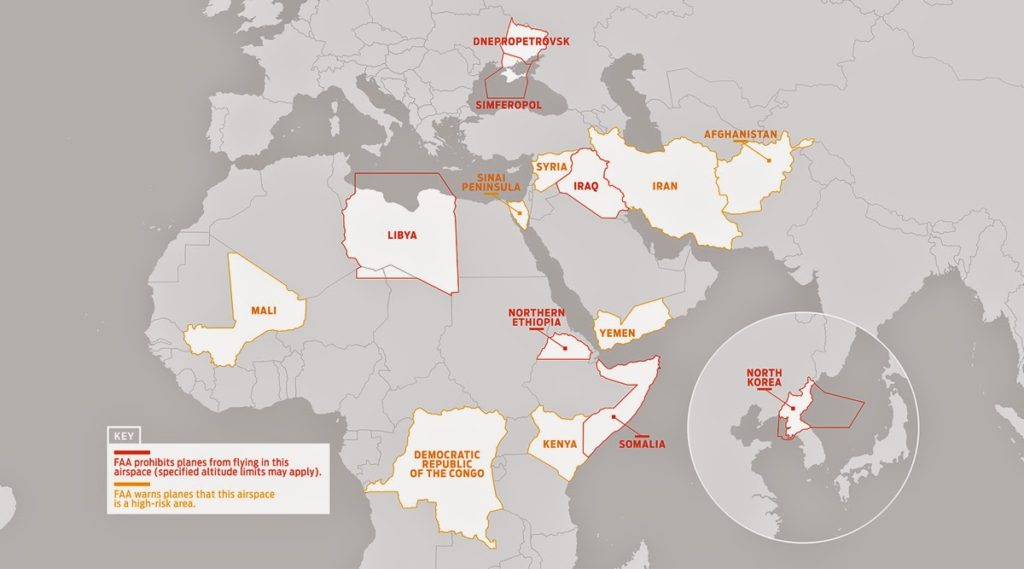
Red Zones:
Dnepropetrovsk—Planes Not Allowed to Fly at any Altitude
Iraq—Planes Not Allowed to Fly Below 20,000 feet with Exception of Immediate Arrivals and Departures from Erbil International Airport
North Korea—Planes Not Allowed to Fly at any Altitude
Northern Ethiopia—Planes Not Allowed to Fly at any Altitude
Libya—Planes Not Allowed to Fly at any Altitude
Simferopol—Planes Not Allowed to Fly at any Altitude
Yellow Zones:
Afghanistan—Operators Warned Against Attack From Small-Arms Fire and Man-Portable Air Defense Systems (MANPADs)
Democratic Republic of the Congo—Operators Warned Against Flying Below 15,000 Feet
Iran: Operators Warned That Iran and the United States do not Maintain Consular Relations
Mali—Operators Warned Against Flying at or Below 24,000 Feet
Kenya—Operators Warned Against Attack from Man-Portable Air Defense Systems (MANPADs)
Sinai—Operators Warned Against Flying at or Below 24,000 Feet.
Syria—Operators Warned Against Flying at any Altitude
Yemen—Operators Warned Against Flying at or Below 24,000 Feet
….
After 9/11 travel became a pain in the neck. We had to discard nail clippers, we drank baby formula milk (yes, really). Then there are people who cannot fly because their name is on a list.
Now with proliferated missiles reaching a range of 82,000 ft, you will always worry about terrorists scattered around the globe who may attack you at any moment. Yet, people will continue to fly (and die).
…….
Permit us a small whine on the side(dish). When we look at the map above (and the discussion, see below) we see no mention of the restricted air-space that China has imposed over China sea (the idea is that flight information has to be relayed in advance, else it may be shot down).
Also, the entire Kashmir (both India-administered and Pakistan-administered ) is shown as disputed territory (which is fine and dandy by us). But when it comes to China, we have Xinjiang, Tibet, and Aksai Chin- nary a dotted line on the map!!!!
On second thoughts, perhaps US Federal Aviation Administration maps are now being printed in China.
…………………
The Malaysia Airlines flight shot down Thursday in eastern Ukraine, likely by a BUK missile launcher
operated by pro-Russian separatist rebels, raises an obvious question
among American travelers: How often do passenger airplanes fly over
conflict areas where there are anti-aircraft systems?
The answer is frightening.
To
make civilian air travel safe and avoid yesterday’s catastrophe in
Ukraine, the Federal Aviation Administration maintains a list of Notices to Airman (NOTAMs)
that place restrictions on commercial flights operated by U.S.
carriers in potentially hazardous airspace. Airspace may be considered
hazardous if it is over an active volcano, near a weapons testing site,
or over an active conflict zone.
But until Thursday night, after the 298 people aboard MH17 were killed, there was not a NOTAM in effect for eastern Ukraine.
Jeffrey Price, an aviation security analyst,
said that the incident is nearly without precedent: “People just
weren’t expecting a military-grade radar from a surface-to-air missile
to be launched at a commercial flight.”
And yet, passenger jets
regularly fly over areas with active surface-to-air missiles. While the
FAA sets the rules for U.S. jetliners, the United Nations-affiliated
International Civil Aviation Organization is responsible for regulating
international airspace.
“At all times, MH17 was in airspace approved by the ICAO,” Malaysia Airlines said in a statement,
adding, “The route over Ukrainian airspace where the incident occurred
is commonly used for Europe to Asia flights. A flight from a different
carrier was on the same route at the time of the MH17 incident, as were a
number of other flights from other carriers in the days and weeks
before.”
In April, the FAA issued a NOTAM restricting American
carriers from traveling at any altitude over the Simferopol region of
Crimea, about 350 miles from eastern Ukraine. Thursday night, in
response to the downed Malaysia Airlines flight, they expanded the
warning to include the Dnepropetrovsk flight region covering the
contested area. In addition to new FAA restrictions, both U.S.-based and
international airlines have voluntarily rerouted
many their flights around eastern Ukraine and Crimea; some flight
activity continues to trickle across western parts of the country.
Several of the restrictions in the map above only apply to flights below a certain altitude—usually
under 24,000 feet. This varies according to the situation on the
ground. In the Democratic Republic of Congo, for example, where rebels
possess less advanced rocket technology, the minimum operating altitude
is 15,000 feet, whereas planes flying over ISIS-controlled regions of Iraq must remain above 20,000 feet.
But less than two weeks ago, the Ukrainian government declared
it unsafe to fly over eastern Ukraine at an altitude below 32,000 feet,
because of the presence of anti-aircraft weapons. MH17 was at a cruising altitude of 33,000 feet when it was shot down.
Jacques Astre,
a pilot and FAA inspector for more than 30 years, flew over the same
airspace on Sunday on a business trip to New Delhi. “To be honest with
you, I was feeling insecure because I knew what was going on down
there,” Astre said in a phone call from the Indian capital. “There was
no guarantee that such weaponry wouldn’t go above 32,000 feet. There’s
no shield that would protect you at 32,000 feet.”
While the FAA
now prohibits flights at any altitude over eastern Ukraine, yesterday’s
crash calls into question the utility of FAA warnings in other conflict
zones where planes are restricted from flying at cruising altitudes
below 24,000 feet.
According to Dmitry Gorenburg, a Russian
military analyst at CNA Corporation, BUK systems “are in just about
every country that bought anti-aircraft weapons from Russia.” He added
that after the collapse of the Soviet Union, Russia sold these weapons
systems “to anybody who wanted them,” with the exception of countries
under sanctions from the international community.
The missiles on the BUKs have a range of up 82,000 feet, well within reach of commercial jets flying within FAA regulations.
Former aircraft engineer Peter Marosszeky told the New York Times
that “airlines have not typically worried until now about
surface-to-air missiles reaching planes at cruising altitude, because
only a very large missile with a lot fuel could ascend such a distance.”
While these weapons systems are known to have proliferated among state
actors, it is extremely rare for a rebel group to acquire the technology
and capability to shoot down a plane at cruising altitude.
The
fact that it is so rare for non-state actors to possess this kind of
weaponry explains why the FAA’s flight-restriction altitudes over
conflict zones are often set below both cruising altitude (32,000-40,000
feet) and the range reached by anti-aircraft missiles (up to 82,000
feet). When asked how they determine a safe altitude, the FAA declined
to comment.
Keith Mackey, a former pilot and current aviation safety consultant,
says the FAA could do more. “They don’t give you enough information so
that you could actually do anything positive to react to threats. Most
of the time [the NOTAMs] are a cover-your-butts deal, so that they can
say they warned you.”
Mackey said that like all bureaucracies, the FAA is not known for its efficiency. For example, they have yet to lift restrictions
over northern Ethiopia, even though the civil war there ended in 1991.
The fact that restrictions were not imposed over eastern Ukraine until
after the Malaysia Airlines disaster may be indicative of a larger
agency-wide problem.
“There’s gonna be an awakening for sure,”
noted Astre. “I think you’re gonna see airlines be more wary and civil
aviation authorities reacting more immediately then they were before.”
…….
……
regards
Anthropogenic heat-wave in Kashmir (451F)
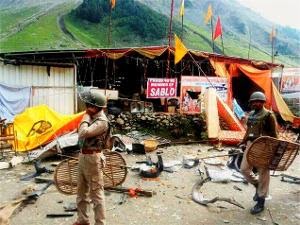
suspended….50 people were injured in police action….110 tents and community
kitchens were gutted in fire and 70 LPG cylinders exploded….police fired
teargas shells and lathi-charged locals…
….
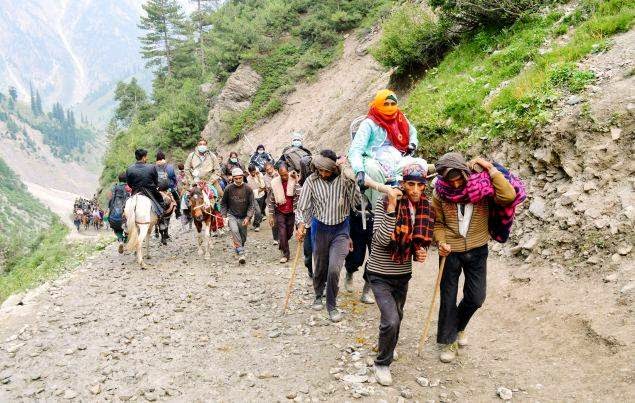
Every year it is the same stupid movie, thousands of devotees marching up to Amarnath through hostile territory (you hate us and we hate you back) and all it takes is a small spark to morph into a giant fireball.
Kashmir differs from Gaza strip in that the local administration (and even militants) is made more pliant by Indian bribes. Also Indian tolerance for dead troops is probably higher than that of Israel. This is as opposed to the Uighurs who are being subjected to ethnic swamping and cultural genocide.
It may be short-sighted (and wishful thinking) on our behalf but Kashmir at this point looks more stable than Xinjiang. If any future peace treaty leads to withdrawal of army then that may be the best possible compromise to be had amongst the main stake-holders (except the Pandits who will never see their native land again).
At the end of the day cold war is just as bad as hot war. India of all countries should have the courage to solve difficult problems through non-violence. In the worst case scenario it has to learn how to let go with grace. India should build a strong, high wall along the Chenab river and look East to South-East Asia.
The advantage of this strategy will be that North-East will finally see the development it deserves. There are many many valleys in Arunachal Pradesh, just as beautiful as Kashmir and much more serene.
………………….
The
Amarnath Yatra was suspended on Friday after at least 50 people were
injured in police action and clashes between two groups following
alleged stabbing of a Kashmiri businessman near Baltal base camp.
Around
110 tents and bhandara or community kitchens were gutted in fire and 70
LPG cylinders exploded. Police also arrested four people including two
CRPF men for the violence.
Officials said the pilgrimage to
Amarnath cave shrine in south Kashmir Himalayas continued along the
Pahalgam route and was only suspended via Baltal in Ganderbal district.
The suspension is temporary, officials said. Police said 20 people were
hurt when police fired teargas shells and lathicharged locals protesting
against the attack on Anwar Khan, who supplies tents to pilgrims in
Baltal.
News agencies said the quarrel turned violent after the
CRPF tried to intervene and at least two jawans were arrested based on
allegations against them of setting some tents on fire.
Khan
was injured and taken to a Srinagar hospital after owners of a kitchen,
Rahul and Rohit, allegedly stabbed him over a dispute. Police sources
said IG (Kashmir) Abdul Gani Mir rushed to the scene to monitor the
situation.
The
CRPF constables arrested were Pawan and Sushil, along with the two
langar owners for the attack after hundreds of people took to the
streets to protest the stabbing as the news of the attack spread.
“A law and order situation arose because of some minor squabble between
some people in Baltal Yatra camp. The situation has been brought under
control. Some civilians and policemen got injured in the incident,”
said a police spokesman. He added some tents and a few langars caught
fire, which was brought under control. A source said 110 tents and
langars were burnt down.
……
……
regards
The Bangladesh Paradox
countries have had good growth but little poverty reduction. Bangladesh….had disproportionate poverty
reduction for its amount of growth.
The data is well known but the mysteries remain. A comprehensive look-in by master-class blogger and economist Jyoti Rahman. JR asks some important questions and sets up an impressive research agenda that is sure to benefit the laggards in South Asia – India (minus south), Pakistan, and Nepal.
JR has a story which sounds plausible but needs more data/analysis: Well, how about a stylised, and very speculative, story along this
line — while RMG has meant women entering the formal workforce, migrant
worker boom has sent a lot of risk-taking men overseas; aided by the
NGOs and microcredit, households have smoothed consumption and invested
in human capital of their children; but they have not invested in
physical capital, avoided entrepreneurial activities, and have not
pushed for a more investment-friendly polity.
……..
The Bangladesh Paradox:
The belief that growth brings development with it—the
“Washington consensus”—is often criticized on the basis that some
countries have had good growth but little poverty reduction. Bangladesh
embodies the inverse of that: it has had disproportionate poverty
reduction for its amount of growth.
That quote is from a November 2012 Economist article.
That article, and accompanying editorial, had a go at explaining the paradox. Joseph Allchin had a crack more recently at the NY Times.
The suspects are usual: garments, remittance, NGOs.
The first thing to explore is whether Bangladesh is compared with an
appropriate benchmark? Is it that Bangladesh has done better with its
growth and income, or is it India (or Pakistan) that is the exception?
The Economist notes that Bangladesh has a few features that India or Pakistan lacks:
Because of its poverty, it has long been a recipient
of vast amounts of aid. With around 150m people crammed into a silted
delta frequently swept by cyclones and devastating floods, it is the
most densely populated country on Earth outside city states. Hardly any
part is isolated by distance, tradition or ethnicity, making it easier
for anti-poverty programmes to reach everyone. Unusually, it has a
culture that is distinct from its religion: although most Bangladeshis
are Muslims, their culture and language are shared with the non-Muslim
Indian state of West Bengal. Religious opposition to social change has
been mild.
Has Bangladesh received more aid per capita than other poor
countries? How does Bangladesh’s growth-development trajectory compare
with other densely populated monsoon deltas — say, countries along the
Mekong? Or perhaps, Bangladesh should not be compared with India and
Pakistan as a whole, but with the four Pakistani provinces and 32 Indian
states?
Does a paradox remain if the comparators change? Does Bangladesh
still perform better in terms of development / living standard given its
growth / level of income? A proper research agenda would answer these
questions first.
Suppose the answer is yes, that the Paradox still remains, its resolution will rest on a two-part investigation.
The first part would explore the GDP story in detail. That Bangladesh
does better given its GDP does not make GDP irrelevant. Quite the
contrary. Bangladesh was wretchedly poor place until the 1980s. It’s not
a coincidence that things started getting better as the economy started
accelerating. We would want to know what about the GDP growth process
that may have contributed to the development in a relatively favourable
manner.
What do we know about the growth story of the past few decades?
From a strictly growth accounting perspective, we know that while
favourable demographic transition and female workforce participation
have helped, it is multifactor productivity that explains the GDP
acceleration. From a sectoral perspective, we know that agriculture’s
share of the economy has shrunk, that of manufacturing has risen, and
services have become more productive. And we know the particular
industry that has led the charge — readymade garments.
So far, this seems like a straightforward export-led manufacturing
driven growth story a la our neighbours to the east and north.
Yet, it’s not so clear cut when we look at the expenditure side of
GDP. Unlike the Asian fast industrialisers, Bangladesh has not
experienced an investment boom. In fact, low private investment relative
to GDP may be the single most important problem facing the country’s economy.
Of course, why investment hasn’t grown is a question that needs
further exploration — and the answers will have obvious policy
implications. But is there something to the consumption pattern as well?
Particularly, have remittance and microcredit affected consumption
above and beyond what would be implied by wages growth coming from
industrialisation?
In addition to the macro trend, do industrialisation, remittance and
microcredit interact in a way that have microeconomic — that is,
household and firm level — impact favouring consumption over investment
even after accounting for various market and government failures that
inhibit investment?
What am I getting at here?
Well, how about a stylised, and very speculative, story along this
line — while RMG has meant women entering the formal workforce, migrant
worker boom has sent a lot of risk-taking men overseas; aided by the
NGOs and microcredit, households have smoothed consumption and invested
in human capital of their children; but they have not invested in
physical capital, avoided entrepreneurial activities, and have not
pushed for a more investment-friendly polity.
We would want to explore this story further. We would also want to
explore the income side of GDP, and tie it into a political economy
analysis.
The remittance boom, for example, should see the labour share of the
economy rise. Of course, the question is, what happens to the money that
is remitted back? It’s reasonable to assume that unskilled labourers
are from the poorer parts of the society. So, in the first instance, any
remittance back to the villages is a good thing in that it reduces the
direst type of poverty — that is it stops things like famine or
malnutrition. But what happens after that? My tentative hunch is that a
lot of remittance has been saved but not invested in a productive way,
rather they ended up fuelling land/stock prices —this is an area that
needs to be explored in detail.
What about the RMG boom?
Theoretically, proceeds of the manufacturing boom should accrue to
both labour and capital. Has that happened? Has the process of
distribution been dynamic or static? Here, by dynamic I mean whether the
industries are going up the value chain —from the cheapest tee-shirts
to more expensive designer brands to leather and other fancier fashion
items to toys to cheap electronics to expensive electronics to stuff
that requires more skilled labour. If the process has been dynamic, then
we should expect less tension between labour and capital, because both
wages and profits rise over time.
In addition to the detailed exploration of the growth process, the
research agenda will need to focus on the factors that explain the
development above and beyond what might be expected from the growth
itself.
As a starting point, let’s take the four factors listed by the
Economist: government spending and policies on social programmes that
assisted family planning and empowered women; the green revolution;
remittance; and NGOs.
Let’s think about these factors in a systematic way.
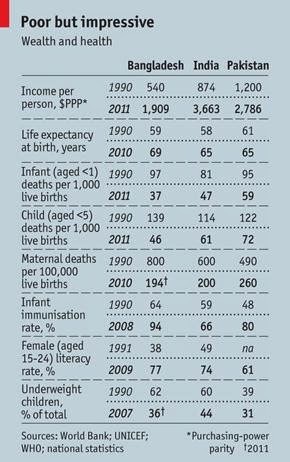
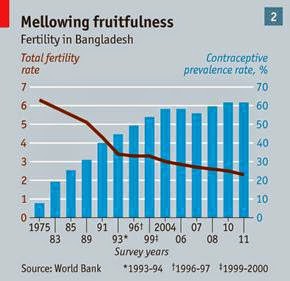
The chart on the left from the Economist illustrates the
female empowering social transformation. But how important has the
government, and NGO, interventions been relative to the advent of the
RMG sector. As far as girls’ education is concerned, Mushfiq Mobarak of
Yale finds the garments made the difference (this
is a subject of a detailed post). We would like to see the relative
impacts of industrialisation, direct government policies, and NGO
activities analysed across various metrics.
The green revolution is a relatively straight forward story, as is its impact,
and remittance we have discussed above. In addition, we would want to
know how, if at all, the impact of these factors have changed (and is
likely to change) in a more rapidly urbanising Bangladesh.
Finally, we would want to analyse the economics and political economy
of the NGOs —what the Economist calls the ‘magic ingredient’.
Large NGOs such as BRAC are as much business conglomerates as philanthropies. In fact, the Economist compared BRAC to Korean chaebols.
Is that a reasonable comparison? Do we understand the microeconomics of
NGOs? Does our view of Bangladesh Paradox change at all if we viewed
these NGOs as little different from Korean or Japanese business houses
at comparable stages of development? And what about the impact of the
NGOs on public finance, and indeed the state’s capacity to build
institutions in general?
Needless to say, this is a pretty ambitious research agenda. But it’s
hardly impossible. Is there anyone out there to tackle this?
…..
Link: http://jrahman.wordpress.com/2013/12/02/decoding-the-bangladesh-paradox-a-research-agenda/
……
regards
Please protect pink people (pronto)!!!
Now that BJP-NDA is in power and they have absolute majority the time for prevarications are over. There is no opportunity to hide behind coalition partners (as the Congress often did, especially with the Women in Parliament Reservations Bill). We understand that people who have voted in favor of BJP (not including ourselves) were in part motivated by the fact that it will take bold decisions for the long-term benefit of society (even if they prove to be unpopular in the short run).
The good news is that the Health Minister Shri Harsh Vardhan (who is an actual medical doctor) has announced that the human rights of gays must be protected. Now his party needs to translate his words into action and pass a gay rights bill in the parliament.
……..
Health Minister Harsh Vardhan today batted for “human rights” of gays
and said it was the government’s job to protect their rights.
“Everybody, including gays, has human rights. It is the job of the
government to protect their rights,” he said on the sidelines of an
event.
He, however, declined to make further comments when asked to explain his
position as his party, BJP, had supported the Supreme Court judgment
which had upheld the validity of Section 377 of IPC, criminalising sex
among homosexuals.
BJP, which was in opposition when the Supreme Court judgement came last
year, had said it was for the government to decide the next course of
action over the matter, and the party would take a position depending on
the official move.
The SC is at present hearing a curative petition on the matter.
Senior BJP leaders have spoken in different voices over the issue and
then party President and present Home Minister Rajnath Singh had termed
gay sex “unnatural.”
Another senior leader and present Finance Minister Arun Jaitley had
taken a more liberal position, saying he tended to agree more with the
Delhi High Court order decriminalising gay sex, which was later
overturned by the apex court.
……
Link: http://www.outlookindia.com/news/printitem.aspx?850245
…..
regards
“Mosul is now empty of Christians”
conditions before 0900 GMT…..”Christian
families are on their way to Dohuk and Arbil” in Kurdistan….. “For the first time in the history of Iraq, Mosul is now empty of Christians.”
….
Mosul, Iraq. Officially certified to be Christian free as of today.
Incidentally, the same thing happened two decades ago in Kashmir. The message blaring from the mosques was stark: all minorities leave NOW (leave your women behind).
…………
Thousands
of Christians abandoned their homes and belongings to flee the Iraqi
city of Mosul on Friday following an ultimatum by jihadists who overran
the region last month and proclaimed a caliphate.
As
militants attempted to break government defences in strategic areas and
edge closer to Baghdad, Christians joined hundreds of thousands of
Shiite and other refugees into Kurdistan.
Their flight to the
safety of the neighbouring autonomous region coincided with the expected
homecoming of Iraq’s Kurdish president, Jalal Talabani, after 18 months
of treatment in Germany.
The Islamic State group running Mosul
had already demanded that those Christians still in the city convert,
pay a special tax or leave but messages blaring on mosques’ loudspeakers
appeared to spark an exodus.
An earlier statement by Mosul’s
new rulers had said there would be “nothing for them but the sword” if
Christians did not abide by those conditions before noon (0900 GMT) on
Saturday.
“Christian families are on their way to Dohuk and
Arbil” in Kurdistan, Chaldean patriarch Louis Sako, who heads Iraq’s
largest Christian community, told AFP. “For the first time in the history of Iraq, Mosul is now empty of Christians.”
Most Christians in the northwestern Nineveh province fled in terror
after jihadist-led militants enforcing an extreme version of sharia — or
Islamic law — launched an offensive on June 9.
But many of the
poorest families returned when the fighting stopped and IS started
administering the city. Sako put the number of Christians who were still
in Mosul on Thursday at 25,000.
The mass displacement was the
latest in six weeks of turmoil which the have forced more than 600,000
people from their homes, left thousands dead and brought Iraq to the
brink of collapse.
Talabani’s return to his native Kurdistan on
Saturday was likely to spark celebrations among supporters from his
Patriotic Union of Kurdistan party.
He is widely celebrated as a
skilled negotiator, who enjoys good relations with both the United
States and Iran and has repeatedly mediated between Iraq’s fractious
politicians in recent years.
But some observers warned that
there was little the avuncular 80-year-old head of state could do to
ease spiralling ethno-sectarian violence and rhetoric and roll back the
Islamic State’s expansion.
“I really do think this is a
post-Talabani era. I’ve stuck my neck out there, but I haven’t heard any
Iraqis talking about him in any way being president,” said Toby Dodge,
director of the London School of Economics’ Middle East centre.
Federal forces collapsed, in some cases abandoning uniforms and weapons
in their retreat, when fighters under the command of IS leader Abu Bakr
al-Baghdadi launched their assault.
The army has since
regrouped, received intelligence, hardware and manpower from Washington,
Moscow and Shiite militias, but nonetheless struggled to regain lost
territory.
Security analysts have said Baghdad remains too big a
target but the militants have in recent days repeatedly attacked
targets that would expose the capital if captured.
On Thursday
night, a jihadist commando stormed the Speicher air base north of
ex-president Saddam Hussein’s hometown of Tikrit, sparking a fierce
battle. “Last night, gunmen infiltrated the base. There were
snipers and suicide bombers among them, they managed to reach the
runway,” an intelligence officer who survived the attack told AFP.
He said the pilots managed to fly all but one of the base’s aircraft to
safety but a statement posted on jihadist Internet sites said many were
destroyed.
Many, including within his own Shia alliance that
comfortably won April elections, now see Prime Minister Nuri al-Maliki’s
departure as essential to national reconciliation efforts.
In a
Friday sermon delivered by one of his spokesmen in Karbala, the
Iranian-born Grand Ayatollah Ali al-Sistani — Iraq’s most revered Shia
cleric — appeared to lean in the same direction. “The new
government should have broad national acceptance and be capable of
solving the crisis in the country and correcting the mistakes of the
past,” he said.
Parliamentary blocs have until Sunday to submit
nominees for the post of president, whose election is the next step in
what has been a protracted and acrimonious process to renew Iraq’s
leadership.
Despite his unexpected return, there is little
expectation that Talabani, who has been president since 2005, will seek
another term.
…….
……
regards