Rahul’ abject failure means that Priyanka is Indira Incarnate.
Congratulations to India
It’s been a clear victory for Modi (or rather PM Modi).
Modi is King, BJP crushes Congress
The dynasty (just like every other Indian dynasty) has collapsed under its own weight.
The crown prince is metaphorically banished to the jungle and should come back after 14 years (if ever) and rule with the consent of his people. Never ever assume the privileges of power if you are not responsible enough to wield power in a dutiful manner.
The real interesting thing is the performance of the regional parties, each of whom had claimed the king-makers position which has been the most sought after role in all post-1984 coalitions.
For UPA-I it was the Left with a few dozen seats (till the Nuclear accord with the USA), for UPA-II this role was assumed by the Trinamul Congress of Mamata Banerjee (AITC).
In this election the key power-brokers were identified as AIADMK (Jayalalitha Jayaram), Biju Janata Dal (Naveen Patnaik), YSRC (Jagan Mohan Reddy), Bahujan Samaj Party (Mayawati), Samajwadi Party (Akhilesh Yadav), Rashtriya Janata Dal (Lalu Yadav) and AITC (Mamata B). The most significant nation-wide impact was expected from the Aam Aadmi Party (Arvind Kejriwal).
Of the above, Jayalalitha (leading in 37/39 seats), Jagan (9), Naveen (18), and Mamata (34/42) have performed very strongly. SP (5) and BSP (0) were crushed in UP by the BJP, while RJD (4) was similarly crushed in Bihar. AAP is leading in only 4 seats. Telengana Rashtriya Samity (TRS) is expected to do very well in …..well Telengana (leading in 11 seats). The Left is totally crushed in Kerala and in Bengal (only 8 seats)– hopefully it will teach them to be a bit more humble while peddling outdated ideologies.
……..
| VERDICT 2014 | |||||||||||||||||||||||||||||||||||||||||||||||||||||||||||||||||||||||||||||||||||||||||||||||||||||||||||||||||||||||||||||||||||||||||||||||||||||||||||||||||||||||||||||||||||||||||||||||||||||||||||||||||||||||||||||||||||||||||||||||||||||||||||||||||||||||||||||||||||||||||||||||||||||||||||||||||||||||||||||
|
|||||||||||||||||||||||||||||||||||||||||||||||||||||||||||||||||||||||||||||||||||||||||||||||||||||||||||||||||||||||||||||||||||||||||||||||||||||||||||||||||||||||||||||||||||||||||||||||||||||||||||||||||||||||||||||||||||||||||||||||||||||||||||||||||||||||||||||||||||||||||||||||||||||||||||||||||||||||||||||
| 2014 Seats above are results + leads | |||||||||||||||||||||||||||||||||||||||||||||||||||||||||||||||||||||||||||||||||||||||||||||||||||||||||||||||||||||||||||||||||||||||||||||||||||||||||||||||||||||||||||||||||||||||||||||||||||||||||||||||||||||||||||||||||||||||||||||||||||||||||||||||||||||||||||||||||||||||||||||||||||||||||||||||||||||||||||||
……..
Link: http://www.outlookindia.com/
……..
regards
Kick-off (8am Delhi, 330am London, 1030pm New York)
How does the Election Commission, that national treasure of India work its magic? The reporters from Dawn interview ex-Chief SY Quraishi.
…………….
commission in India does not only have all the powers that it needs to
organise this biggest electoral exercise in the world, it is willing and
ready to use it as well. The size of electorate in India is a colossal
810 million, ten times the one in Pakistan and multiplying it with the
geographical, linguistic and other diversity factors, the sheer
mechanics of the exercise become mind boggling.
Yet, the commission
comes out victorious from this labyrinth as the participants generally
do not contest its impartiality or capacity. The commission has faced
some criticism in the present hotly contested elections but that has
largely focused on it being not quick in responding to calls for action.
From
Pakistanâs point of view where the commission is mistrusted and always
deeply embroiled in controversies, the more surprising is the fact that
the commissions in both countries enjoy roughly the same constitutional
powers. There are however some differences as well.
âThe courts
canât intervene in our working in any manner. The constitution
guarantees this non-interference that many subsequent court rulings have
further reinforced. That gives us the required agility,â said S.Y.
Quraishi, the former Chief Election Commissioner of India in an
interview with Dawn in New Delhi.
âThen we assume total control
over bureaucracy, cutting its links with the political governments
completely. We purge the entire state machinery of political bias by
ordering transfers and postings following our own assessments of each
individual functionary or in response to complaints,â says Mr Quraishi.
He adds: âThe commission invites every party individually in every area
and each of them gives us their lists of suspected, biased
functionaries. We act after summary inquires.â
âWe also insulate
the officials appointed to perform election duties from their political
masters. No minister or chief minister is allowed to call them for a
meeting. We suspend them even if we come to know that the chief minister
has talked to them on phone,â says the former commissioner who belonged
to Indian Civil Service.
The
commission in India does not require army to perform any election duty
and in fact keeps it âmiles away from the processâ. It instead lists
police, paramilitary and other armed forces for assistance and once they
are assigned they come under the commissionâs âcommandâ.
Quraishi
is all for the Electronic Voting Machines (EVMs) and rubbishes the
criticism on this âilliterate-friendlyâ machine that has replaced paper
ballots in India. The machine was first introduced in one state on
experimental basis as early as 1984 but it was provided the requisite
legal cover only in 1998. It was then put to use in all the state
assembly elections before being used for the entire Lok Sabha elections
in 2004 for the first time.
He believes that EVMs not only save the
commission from the hassle of printing paper ballots, it also makes the
contentious counting process as easy as one, two, three. âAnother
matchless advantage is obliteration of votes rejected for being marked
erroneously,â says Quraishi. (According to a FAFEN report the number of
rejected votes in 2013 elections in Pakistan exceeded the margin of
victory on 35 of the 266 contested seats.) The commission in India is
also experimenting with introduction of biometric system for voter
identification.
âThe money powerâ however is the biggest and
burgeoning challenge that the commission is faced with. It not only
places a legal bar on the candidates to not spend beyond the prescribed
limit, it makes them open separate bank accounts dedicated to their
campaign expenses. âThen our flying squads videograph the campaign
activities and maintain a shadow account of each candidate,â says
Quraishi. âThe candidates have to submit their expense accounts three
times during the 14-day campaign and they are not allowed to report the
cost of a cup of tea that they offered to their supporters at rupees two
if its market rate is rupees seven.â The commission carries a list of
the market prices of all the items that a candidate can possibly use in
his/her campaign and has powers of disqualifying them on wrong
reporting.
…………..
Link: http://www.dawn.com/news/1106141/why-is-the-election-commission-effective-in-india
…………….
regards
South Asians more lactose friendly than Middle Easterners?
Bangladesh ferry sinks: 200 feared dead
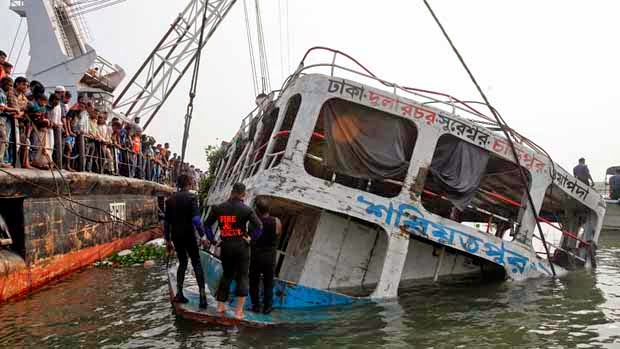
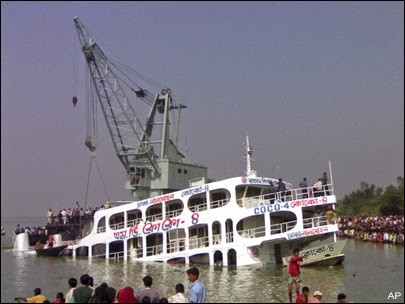
Just like that so many innocent souls sent to their death due to (criminal) overcrowding of boats, as has happened many many times before (the disaster below is from 2009). Some people (South Asians especially) never seem to be able to learn from their mistakes (but they will remember their pet hatreds over centuries).
….
A Bangladeshi ferry with around 200 passengers on board
capsized in a river near the capital Dhaka on Thursday, with police
reporting that at least six bodies had been recovered with a rescue
vessel still on the way to the site.
The M.V. Miraj-4
ferry capsized in stormy weather in the Meghna river at Rasulpur in
Munshiganj district, 27 kilometres from Dhaka. The accident occurred at
around 3:30 pm (0930 GMT). The ferry had been going to Shariatpur from
Dhaka.
âWe are heading to the spot with rescue team,â said Saiful
Hassan Badal, Deputy Commissioner of Munshiganj district told Reuters.
He said the navy and coast guard were sending rescue teams and a ship
had been sent from Dhaka.
So far six bodies had been recovered, including that of a child, according to Oliur Rahman, a police officer at the scene.
……………
The death toll from the capsizing of a ferry over the weekend in
southern Bangladesh rose Monday to 77 after rescuers recovered an
additional 19 bodies.
Rescuers plucked 15 bloated bodies Monday
from River Tetulia, where the overcrowded triple-deck ferry capsized
late Friday, police official Mohammad Bayezid said. An additional four
bodies were found overnight in the river, he said.
Bayezid said
the bloated bodies were found as far away as three miles (five
kilometers) from the site of the accident. Rescuers used speedboats to
go farther downstream because some bodies may have been washed away
during high tide.
Authorities said the search for dozens of people still listed as missing was suspended for the night Monday.
“Our
divers have gone inside the submerged part of the ferry and found no
more bodies there today,” said Shahabuddin Ahmed, a fire brigade
official supervising the rescue work. “On Sunday we found bodies mostly
inside the submerged ferry. And on Monday, all the bodies were found
floating in the river.”
The M.V. Coco was packed with hundreds of
travelers leaving Dhaka to head home for the Islamic festival of Eid
al-Adha when it tilted and went down after reportedly hitting a river
shoal.
It started to take on water as it arrived at Nazirhat town
in the coastal district of Bhola, about 60 miles (100 kilometers) south
of the capital.
Authorities said there were no passenger lists,
so it was unclear how many people were aboard the vessel, but Dhaka’s
private ETV television station said it could have been carrying more
than 1,500 people. The boat was approved to carry 1,000 people.
…..
Link (1): http://www.dawn.com/news/1106503/bangladesh-ferry-capsizes-with-200-passengers-aboard
Link(2): http://www.komonews.com/news/national/78135097.html
………
regards
Another 2 states observation
First off I liked the idea of a dichotomy between the merchantile Arabian Sea ethnicities vs. The introspective Bay of Bengal ones. It’s something interesting to explore for sure.
Why 2 States works.
I went to see 2 States last night and my friend & I were the only ones in the cinema (surprisingly for the large desi population in Kampala Bollywood doesn’t have long runs).
Economy high priority (not hindu nationalism)
We imagine Modi’s goal would be to broaden the playing field not through compromise (as the Economist wisely suggests) but by having a vote consolidation plan for West Bengal and Kerala. If he can manage to get up to 20% in either state, the BJP will achieve the status of the Muslim League (IUML) – a pocket of votes and seats that nobody can ignore.
………………………
But even the most pessimistic (for the BJP) forecast suggests the
party led by Mr Modi will be the biggest and will get more seats and
votes than at any previous election in India. It has made inroads among
voters in areas (such as Kerala or West Bengal) where it had no
impression before. An estimated record turnout of 66.4% of voters also
buoys the BJP, adding to the strength of its likely mandate. It looks
inconceivable that any other party, whether Congress or some combination
of regional outfits, could form a government.
Thus the BJP, with Mr
Modi in charge, is preparing to rule.
To get control of the
lower house of parliament, and thus to form a government, Mr Modi needs
272 seats. Higher estimates by the pollsters suggest he could pass that
figure with only the support of the closest allies of the BJP, without
reaching out to coalition partners such as Jayaram Jayalalitha in Tamil
Nadu. Yet even if these turn out to be accurate he may prefer to build a
broader coalition, for two reasons.
First, to rule effectively Mr Modi
needs to project power beyond the lower house of parliament. Legislative
changes require consent of the upper house, where he has no majority.
And any prime minister must find ways to co-ordinate work of the central
government with powerful state governments. A wider coalition could
help in both areas.
Second, Mr Modi presumably dreams that his party can
be in office for more than one five-year term. That requires limiting
the clout of the (soon to be) opposition Congress party. The more
coalition allies that the BJP can attract today, the more isolated
Congress will be. Yet if Mr Modi is to manage a broad coalition, he will
have to change style from the rather aggressive figure on the campaign
trail who traded insults with opponents, sneering at rivals. As a chief
minister he could rule his state, Gujarat, with no consideration for
power-sharing; now he should adopt such skills quickly.
What
will come first for Mr Modi? The transition in India can be fast, with
Mr Modi likely to be installed within a week or so of the official
results (and a replacement chief minister for Gujarat named too). He is a
man who exudes impatience, and whose campaign has often emphasised the
need for efficient, decisive government able to implement policies with
speed. Indiaâs stockmarkets are rallying, investors expect measures to
be taken quickly to encourage investment, economic growth, job creation,
better infrastructure and a broad return of confidence in India.
At the same time, Mr Modi will have to find
the voice of a statesman who represents all of India, not only the
victors. He rose first in the Hindu nationalist movement, the Rashtriya
Swayamsevak Sangh (RSS), which leant heavy organisational support in
this election to its protégé. It would be natural if it, and other such
bodies, now hope that Mr Modi will promote their values (broadly
equating being an Indian with being a Hindu). Mr Modi should disappoint
them. Many in India, including Muslims, Christians and more secular
Hindus, expect Mr Modi to make clear that his priority is not Hindu
nationalism but economic recovery. The clearer he can be about that, the
better.
…………
Link: http://www.economist.com/blogs/banyan/2014/05/indias-election-exit-polls
………
regards
Blasphemy and its discontents..
some random news items.
A “liberal” doctor said something to a pharma rep (he probably said “I dont want to prescribe your overpriced medication to patients who don’t need it“) and the pharma rep told his buddies that the local GP is a liberal and is not properly respectful of religion. His buddies happened to be graduates of the vast network of Islamic Purification Factories one can find all over Pakistan. Mom (Pakistan’s far-sighted armed forces) and Dad (Saudi Arabia and the USA, in that order) got together to make this baby in the 1980s, but as in humans, the germ cells within mom were born a generation earlier. Lovingly cradled in the Islamic Republic and brought to maturity in anticipation of the arrival of Daddy’s little swimmers. Anyway, the local graduates were quick to grasp the necessary implications of having a “liberal” doctor in Jalalpur Jattan. They went and shot him dead.
Junaid, a “liberal” student from the remote borderlands of Punjab went to America on a Fulbright scholarship and came back to teach at Multan University (yes, I know, Bloody Fool, so close to a Green card and he returns to teach!). His “conservative colleagues” were unhappy. So they asked the local chapter of the Islamic Chatra Shibbir to put a stop to this menace. A pamphlet was circulated, saying that Junaid was a blasphemer who wrote blasphemous things about the wives of the Holy Prophet on Facebook under the pseudonym “Mullah Munafiq”. The police sprang into action and arrested the man from a 100 miles away. They prepared an indictment without bothering to involve the cybercrimes wing or otherwise find evidence connecting Junaid to Mulla Munafiq. No evidence? No problem. He is still in prison, 14 months later.
Junaid’s family had a hard time finding a lawyer for him, until the local representative of the Human Rights Commission of Pakistan took the case. He was threatened in court by fellow lawyers for daring to do so. He reported the threats to the police. A few weeks later, he was shot dead. Junaid no longer has a lawyer and faces a mandatory death penalty. Mulla Munafiq is still happily posting on FB 14 MONTHS after Junaid was arrested and put in high security prison. The ways of the infidels are indeed mysterious.

Faisal, a generous, loving, hard-working doctor had served his community for 25 years. He happened to be a Shia and made no bones about it. This was not a problem in the old, impure Pakistan, but by now a “Muavia colony” has grown up near his home (how fast they grow up!).
Muavia colony. As they say in Urdu “naam hi kafi hai” (“the name says it all”). Someone from Muavia colony sent him (and his brother and his cousin) threats, warning them to stop polluting the clean air of Hasan Abdal with their “Rafidhi” religion. They stayed in town, providing medical care to thousands. So Dr Babar Ali was shot dead on his way home from work in March 2014. And 2 months later, so was Dr Faisal Manzur. The police remain clueless.

A group of lawyers protested against police high-handedness. The police officer involved is named Umar Daraz. He was verbally abused during the protest. His name happens to be the name of the second caliph of Islam (and of a few million other people). 60 lawyers have been charged with blasphemy.
A poor Christian woman working in the fields drank water from a “Muslim” cup. The local Muslim women (“superior” to the Chrisitan lady in terms of status) complained and they had an argument. A couple of days later she was charged with blasphemy. She was duly sentenced to death in 2010. She is still on death row. Hearing about this, the Governor of Punjab said he thought this was a bit much and she should be set free.

His own guard gunned him down. Hundreds of lawyers volunteered to defend the killer. Thousands rallied in front of the killer’s house to support the noble family and to praise their glorious son. A judge sentenced him to death and then ran away from the country because of death threats. A mosque has just been named in honor of the killer. Local Barelvis (so-called “Liberal Sufi Muslims” in the discourse of Western and Westernized Desis) are delighted that one of their own has restored their honor by killing the governor.

Subhanallah. Everything is going according to plan.
Only an armed force can stop these armed purifiers of Pakistan. But the army has other priorities (linked less to Islamic purification and more to permanent and over-riding “strategic” aims like the conquest of Afghanistan and the eventual defeat of India; but its all connected anyway). Liberals will either have to convert the army to their cause or move to the US to try and invent counter-propaganda for use after the apocalypse.
Theoretically, there is another option: the liberals, Shias, Pakhtoon Nationalists, Baloch Nationalists, Sindhi Nationalists, Ahmedis, Hindus, Free Thinkers, malcontents, etc. could, separately or together, invite another army to enforce order. For various reasons, I think this is not possible at this stage. But after the apocalypse, all bets are off...
For background on the blasphemy law, see here.
I am posting this excellent column from Gul Bukhari in full. It sheds some light on some aspects of state collusion in this saga.
But there is something wrong with even the nomenclature we use to describe what is happening, or to express what we want the state to do. A silent onlooker implies someone simply detached from proceedings, neither helping nor harming. Thus when we accuse the state of being a silent onlooker, we are implicitly asking it stop âonlookingâ and do something, to take some action.
Implicit to the term failure is an unsuccessful attempt at success, and therefore blaming the state for having failed means we are imputing an attempt by the state to put things right in which it failed. Similarly, when we criticize the state for apparent paralysis where blasphemy related killings are concerned, we are assuming a will or desire to do something, something good that is, but a bodily or physical inability to do so.
This language clearly indicates that we are not clear about what is going on, or what needs to change. The state is not a silent onlooker. No, the state is an active participant in blasphemy killings. It is not paralyzed at all, but actively complicit in the accusations and arrests. The state has not failed; it has been enabling incarceration of innocents, and aiding unfair trials of accused.
Though a cursory look at most blasphemy cases in Pakistan will demonstrate the same principles at work, just one horrifying example of Mr. Rehman and his client Mr. Junaid Hafeez should suffice here.
Firstly, it is the state that provides the open and alluring prospects for spurious and malafide accusations of blasphemy to be entertained seriously by the courts in shape of the blasphemy laws. The state made the laws, and the state remains responsible for not amending or repealing laws, especially at the time the 18th amendment was introduced to clean up the constitution of Pakistan during the previous governmentâs tenure. Thanks to the state, the blasphemy laws of the country continue to take the lives of innocents with increasing frequency in this country. It is ironic, every time anyone is lynched or murdered, everyone looks to the state to bring perpetrators to justice. It is almost laughable.
After an accusation has been made, the next state instrument, itâs law enforcement agencies, swing in with their role: the most ridiculous and nonsensical FIRs are registered without a shred of investigation, evidence or even exact description of the crime. Alleged acts or words of blasphemy are not even described. Yet, such FIRs are deemed sufficient to proceed against anyone accused of having committed a crime punishable with death.
In the case of Mr. Junaid Hafeez, he was accused of being the administrator of a Facebook page that is run by a pseudonym, and allegedly contains disrespectful commentary on the prophetâs wives. Reportedly, the police did not even check whether the IP address the Facebook page is being managed from, belongs to Mr. Hafeez or not. And reportedly, while Mr. Hafeez remains behind bars presumably without access to the internet, the Facebook page continues to be operated and updated. It might be useful to mull over whether thus far in this absurd saga, it is the state at work or the accusers of Mr. Hafeez.
Next, the state is obliged to ensure a fair and free trial of all accused, even of those it has facilitated in landing in this envious position. As in Mr. Hafeezâs case, neither are most lawyers willing to take on blasphemy cases, nor judges of junior courts will to stick their necks out to return fair or just verdicts. Once again, it is because the state will not provide them with the security that they deserve. Nor will the state prosecute those that threaten or perpetrate violence on lawyers and judges in these cases. Only after several months of trying to convince different lawyers, was Mr. Hafeezâs family able to engage Mr. Rashid Rehman as defense counsel. And only personal courage and strength of his convictions caused Mr. Rehman to take up the case, not any protection offered by the state.
Indeed, Mr. Rehman was threatened repeatedly, including during one of the hearings and in the presence of the presiding judge. Indeed, Mr. Rehman asked the judge to take notice. Indeed, Mr. Rehman asked for security. But the representatives of the state had discharged their duties: the police had registered the FIR and arrested the accused. The magistrate had remanded the accused. The judge sat on the bench listening to the case and the threats. Neither were aggressors apprehended, nor protection provided to Mr. Rehman.
Whilst the petitionerâs lawyer and other lawyers from the Multan bar are on record having threatened to kill Mr. Rehman, with several of these personsâ statements together with their photographs having been recorded in newsprint, the FIR registered for the murder of Mr. Rehman is against the usual âunidentified personsâ. On the other hand, a Facebook page is run by a pseudonym, alleged insulting remarks unspecified, yet the FIR is registered against one Mr. Junaid Hafeez.
At every step, the state provided and facilitated the incarceration of the one and murder of the other. Neither was the state âsilently onlookingâ, nor paralyzed, nor failed. It succeeded very well.